London Value Investor Conference 2015 - Part 2 - Q&A with Neil Woodford

Q&A with Neil Woodford, at the LVIC, 20 May 2015
They saved the best until last at LVIC this year, with Neil Woodford ("NW") , the star fund manager doing a Q&A session with the day's host, David Shapiro, which ran for about an hour from 5:30 to 6:30pm. I took detailed notes, so below is close to verbatim. I hope this is useful & interesting, for people who were not able to attend the event in person.
Woodford spent 25 years at Invesco Perpetual, taking it from a small boutique fund manager, to a big company. In 2014 he set up on his own firm, Woodford Inv Mgt, and has been highly successful raising funds, with a fresh approach including lower fees, and complete transparency (fund holdings are published in full).
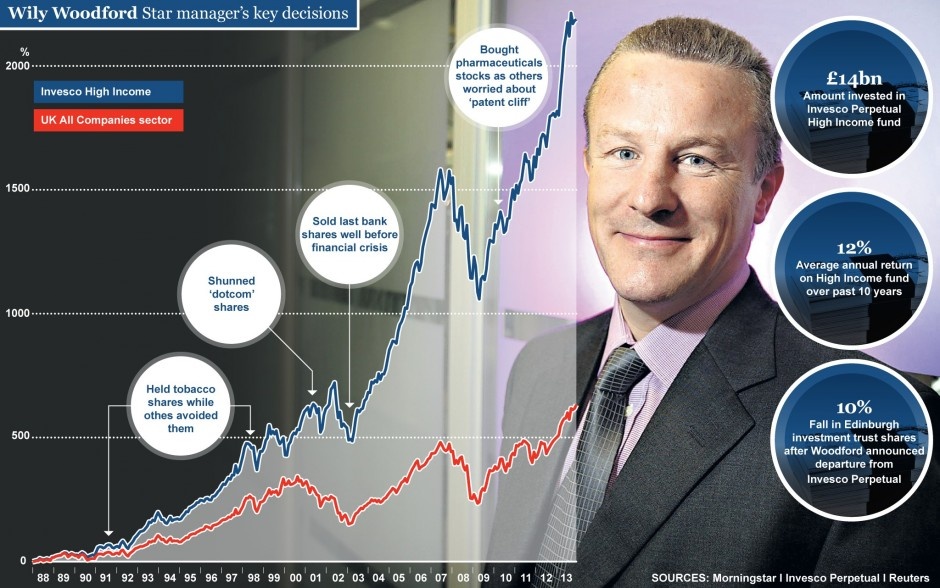
(image courtesy of telegraph.co.uk)
Unfortunately David Shapiro ("DS") got a little carried away with his introduction, and it went on, and on, and on, with audience members and Woodford himself starting to look a little nonplussed! We're here to listen to Woodford, not you! I could hear myself think. Eventually Shapiro stopped talking, and Woodford paused for a moment, then quipped, "You want me to wade in?!"
Woodford said that he'd had a couple of jobs in fund management prior to Invesco, in the 1980s, but "wanted to run money myself, not by committee - that doesn't deliver what the clients want". "I wanted to be held accountable, and be recognised".
DS: What changed (at Perpetual)? (i.e. why was he happier at Invesco & stayed there 25 years)?
NW: The early 90's Budgets opened up the market for funds - tax changes. We started with just £14m in the Invesco High Income Fund in 1988. When I left it was £13bn! That wasn't all capital growth though! {chuckles from audience}. I learned a huge amount - you never stop learning.
DS: Did you enjoy things less once Invesco had become a big company?
NW: Yes. Fund management works best as a cottage industry. I mean active fund management anyway. A small, team-based infrastructure is best. Over time, the scale of Invesco Perpetual became displeasing.
DS: Did the asset base get too large at Invesco for decent returns?
NW: No. A large asset base is NOT an impediment to good absolute returns.
DS: Did you challenge the high fee structure over the last 25 years, when you were at Perpetual?
NW: As a fund manager working for someone else, you can't control these things. The great thing about setting up my own fund mgt company is that I can structure it to best suit the clients - low costs - no legacy issues - open and transparent.
Not having layers of compliance stopping us from communicating with clients how we want to.
DS: Talking of which, do you feel you left problems behind when you left Perpetual? They were hit with an £18.6m fine after you left! Did someone mess up on your watch?
NW: {looking somewhat taken aback. Paused} Ummm... {awkward laughter} The FCA's report is a good read! It explains what went wrong. I don't want to go into the process, at a public forum like this.
DS: Would you do anything differently?
NW: The problems were about reporting. We hadn't communicated what was happening in the portfolio. What I learned is that we need to be industry-leading in our compliance. So we don't use derivatives now. We have strong compliance. I feel safe and comfortable now.
DS: You do things differently. Not just bottom up, you get the big sector calls right too. How?
NW: I did a degree in economics, but I left Uni knowing nothing about economics! Just a lot of complex mathematical stuff, which I hated! I learned how economies work from fund management.
All businesses are affected by macro factors - be it growth, taxation, forex, trade, etc. These macro factors are all important in helping me form a view on medium & long term prospects. I have no idea on the short term. You then marry your macro analysis with the stock specifics.
Bottom up stock analysis is only looking at half the picture. You have to combine it with a macro view.
DS: Are you still bearish on the UK economy? Did you miss the big upward move in the housebuilding sector as a result of your macro views?
NW: Everyone has sins of omission. You can't catch every move. I set out to deliver absolute returns, and I try to build a portfolio that does the job.
It's impossible to pursue the perfect portfolio - but you'll never achieve it.
DS: What is the extra ingredient that you bring to things?
NW: I don't worry about what other people do. Portfolio construction is not science, or even pseudo-science. A lot of people hide behind science. It's more heart than judgement. You're trying to assess the FUTURE. You can't be scientific about that!
However, the past is a really helpful guide to your view of the future.
Valuation is key. You've got to buy at the right price.
Companies, management, the economy - these can all change.
If you do the work, you can make an informed judgement.
We base our expectations on the median outcome for a company - i.e. not the bull case or the bear case.
DS: How do you value early stage companies for your new £800m fund?
NW: On the same basis as more mature companies, but we flex the assumptions. You can value pre-revenue companies. But first you have to be sure that the technology will actually work. Then you can project forwards.
There's more uncertainty with early stage companies. So we flex the uncertainties, we build a model, then risk adjust it. So we might use a 20-25% discount rate, halve the size of the addressable market, etc.
We get very, very close to businesses we invest in. I've learned skills over the years, to make the process better.
DS: Are you competing with Private Equity?
NW: No. PE usually fund established businesses. We're not doing that.
Innovation in the UK has been terrible at being commercialised. Probably ARM is the only UK company that's scaled up. Yet we (the UK) lead the world in Universities, Nobel prizes, science & innovation, but we're absolutely rubbish at commercialising this science. This is very much due to the absence of early stage, patient capital.
Therefore the opportunity for our new fund, is that we can invest in unbelievably good technology, at very low prices.
DS: Is an open-ended fund structure better, or closed-ended?
NW: We do both. I've done open-ended for 10 years. The Regulator allows 10% in illiquid investments, in open ended funds. I've gone up to 4-7% ish. Closed ended is the best structure.
DS: You withstood the tech boom in 1998 to 2000, which must have been difficult. With Tesco, you sold Warren Buffett a pup! How do you withstand a bad patch?
NW: You have to accept periods of under-performance. If you can't weather them, then get out of the kitchen! The pressure mounts. You need investment anchors - discipline and an approach which stands the test of time. Trust your discipline. That got me through the tech bubble, when everyone else seemed to have embraced it.
That was an incredibly difficult time for me. Tony Dye (aka Dr Doom, a fund manager who warned in the late 1990s that stocks were over-valued and due a correction - article here) did lose his job. At the time, the Lex column got it right - they said he may be right, but it's too late to save his job.
If you don't have discipline, then you capitulate at the worst possible time. That was an incredibly draining time for me, but I've gained strength from it.
Turning to Tesco (which Woodford sold his fund's shares to Warren Buffett, before the big drop), I didn't realise the full extent of what was going wrong. It had already become a drag on our performance. I became less confident in how Tesco was deploying fresh capital - they were doing things I thought of as "flag planters". I saw poor returns on incremental capex.
However, we didn't foresee the rise of the discounters (Aldi, Lidl).
After listening to a 30 min conference call with the CEO, I thought to myself, Tesco's problems are structural, not cyclical. So we sold £700m Tesco shares in a week! I can move quickly when I need to, despite being a long-term, patient investor. We didn't know at the time that Warren Buffett was the buyer.
At this point David Shapiro joked that the difficult questions were over now, and he would throw Neil over to the audience for questions. I will number these, as the identity of all the questioners is not known to me.
Q1: Does the UK trade deficit worry you?
NW: I do worry about UK structural headwinds, yes. Recent growth in the UK economy has not come from exports or financial services. The quality of UK growth is very poor. It's the worst trade balance in 30 years.
In the recent General Election, we heard lots of propaganda about the economy. But in my view the growth targets, and deficit reduction targets, are unrealistic. We're repeating the mistakes of the past.
I'm hopeful for the UK's medium and long term prospects, if we can nurture and scale technology companies, but that's some way off. I worry about what's driving UK growth.
Q2: Why is Verseon (LON:VSN) listing on AIM, when it's an American company, and how can you have confidence in it? (this is a recent IPO in which Woodford has taken a 10.5% holding)
NW: We think it fits our criteria to grow, and be disruptive. We make a judgement based on experience. The company has been going for 10 years already, so it's further through the technology risk stage than people perhaps realise - it's already jumped hurdles. We're very excited about it.
Why AIM? Management are scarred from a previous experience listing on NASDAQ, with a previous venture. The listing requirements are less on AIM, and the intention is to quickly move to a full listing.
Q3. One of your holdings, Utilitywise (LON:UTW) has had questions raised about its accounts. What is your view?
NW: There was one research note in particular which questioned their accounts. Quindell and HelpHire were cited as warnings in that research note, by this analyst.
We've done extensive due diligence on Utilitywise, and are completely satisfied with their accountancy, cashflows, and the future outlook.
We're extremely relaxed. The valuation is ludicrous. We think the analysis was inaccurate - not malicious, but just poor. We've used recent weakness to buy a lot more.
Q3 (follow up): who checks these things?
NW: Saku (Sasha) and Paul (Lamacraft) focus on early stage businesses, whereas Stephen (Lamacraft) and I look at FTSE 350 stuff, and international. Utilitywise falls between the two, so we've all looked at it together, and we've met the company.
We work very closely as a team. Three guys work for me, have delegated responsibility to a team of researchers. I pull the trigger.
Q4: Fees - what is reasonable?
NW: The financial services industry has been guilty of over-charging in the past.
What offends me the most, are high fees for closet index trackers. What is the solution to that? Should it be outlawed by regulators? No. The answer is more transparency. Investors will vote with their feet (as they have with Tesco!). That process is underway, but is slower than expected.
People are happy with our fees at Woodford Inv Mgt, but it's not the main reason they choose us. The whole industry needs to change - it embarrasses and offends me.
We out-sourced all of our back office, and IT. So we've variabalised (good word!) our fixed costs - and we pass on the savings to our clients.
People have a right to know what we're doing with their money!
Dull, and late reports to clients are just not good enough!
We publicise our portfolio on a monthly basis. Not everyone internally was in favour of this!
We also use social media to communicate with clients.
Q5: What do you look for in management, at early stage companies?
NW: Early stage skills may not be the right skills for commercialisation of the technology. We work with management to get them to understand this. The best entrepreneurs understand that their skills will only take the business so far.
Founders can be control freaks! Sometimes you have to wait for them to run out of money, to implement the changes that are needed.
We are in genuine partnership with founders. Our job is to remove the headache of inadequate capital for them.
That concluded the Q&A session, so David Shapiro thanked Neil Woodford, and we retired for drinks & networking.
My opinion - Woodford really is a class act, and someone I will definitely be following more closely, now I've heard from the horses mouth what his approach is. I've bolded above the parts that were key points for me, so no reason to repeat that.
I hope you found this report useful & interesting.
Regards, Paul.
Disclaimer
This is not financial advice. Our content is intended to be used and must be used for information and education purposes only. Please read our disclaimer and terms and conditions to understand our obligations.

23 comments
Definitely an interesting read. Thanks Paul!
If I can just wade in on this. Everyone likes a pat on the back, we're all human. So, even though it's silly, I absolutely love it when people give my articles a thumbs up - especially when it's a weekend article that I've written in my leisure time, unpaid, because I think people will find it interesting & useful.
Conversely, it is a bit dispiriting when you spend a few hours writing an article, and only about 1% of people click on the thumbs up button. You do think to yourself, why did I bloody bother, if people can't be bothered to say thank you for your effort, via a simple mouse click. I don't expect it for every article, but for the really good ones, it's a nice pat on the back & is appreciated a lot, however childish or pathetic that might sound.
I'm sure other writers feel the same. A pat on the back when deserved, is always a nice thing.
Regards, Paul.
P.S. As this article has had probably my highest ever thumbs up score, I'm going to write another one now!! However, I should add that the organisers of LVIC have asked me not to write verbatim articles, as it causes problems with contracts of speakers - everyone assumed I must have recorded the Woodford session, but I didn't - I'm just a very fast note-taker, and have a good memory, so when reading my notes back, can hear & see the speaker in my head, and reproduce the whole thing almost verbatim. I'll be a little more circumspect with the next article, paraphrasing, and drawing out key points, rather than creating an exact replica!
Who knew?
I've never taken any notice of those voting things. I don't get the point. Paul can see how many hits his posts get from the logs & site reporting tools. So you're supposed to vote everything to prove to others you've read it!
I guess it helps the unthinking follow the crowd :-)
I think of it from the point of view of a poster. It's good to feel that ppl appreciate the effort that goes into publishing a good article. Especially when most posters are non professional .
paul
did any of the speakers mention any current favourites in European/US large caps?
Cheers for writing this up Paul - what are your thoughts on Utilitywise (LON:UTW) at the moment? I seem to remember that you were quite bearish.
Regards,
Sully.
Ed, I once demonstrated to a large blue-chip client that they could get more response from a small classified ad than the full page ads they were running. The customer group they were aiming for didn't look at corporate full page ads, but studied the particular classified section closely. One of those rare glorious contracts where you dramatically reduce the client's spend and dramatically increase their business.
On my laptop screen that large box is not visible at the end of the article, and invisible to my perception once I have made a decision to scroll down and read comments.
Just my 2p
Jon
Thanks Paul for taking notes and the feedback; very useful. Woodford certainly has a large following which prevented me from investing in his Perpetual fund which I thought got far too large to move above a snails pace, however he seems sanquine about size and his new fund is also rapidly increasing due to his past performance. Getting in early on the current fund ; boosted by the high demand, has at least provided a buffer to absorb some of any future mkt falls. I have very few funds but have done well by investing in managers with integrity, as per Terry Smith. For me they provide a proportion of investments about which I need to spend less time and can concentrate on my selections.
His openness regarding his individual investments , on the one hand provides some comfort if I already hold them BUT on the other I believe he is 'selling his own book' to crank the price!
Thanks for taking the time to post this Paul and the effort in formatting it for easy digestion!
Thanks very much Paul - very informative.
"So we've variabalised (good word!) our fixed costs". Yes, a good word and one, I suspect, that we will be hearing more of. That is the essence of what, for example, Software as a Service (SaaS) businesses are doing.
Thanks Paul for taking the time to keep us all well informed, much appreciated. Charles
Also the number of reads is not representative of the numbers of readers, it is the number of times it's been viewed. That is if you re-read it, or read added comments the read count is incremented. You could probably divide the number by 10 to get the number of readers.
That said it's true to say there is a lack of thumbs up but I would suggest that the degree of interaction on the threads is more indicative of reader interest.
Thanks for the write ups Paul.
Regards
Phil
I agree with the UI comment. It would be rational to repeat this line
Saturday, May 23 2015 by Paul Scott 6 comments 2,243 reads 47 |
at the end of articles.
Jon
BTW. This post has been read 1,600 times (as of now) but only 24 readers have bothered to thumbs up it! (There are no thumbs down). I clearly don't understand psychology - why do readers not make the minimal effort to thank blog authors via thumbs up?
I'd blame the UI, the thumbs are shown at the top and scrolled away when you finish a long article which is when it would be a good time to vote. Also does the reader count only logged in users or also non-voting visitors (and robots)?
Cig - reader count doesn't include bots. It's both logged in and logged out reads.
FYI - there's a huge thumb rater after the article - which looks like this:
Perhaps it should be moved further up. We are redesigning the boards (as well as the rest of the site)... so all this feedback is highly welcomed.
I've actually been tracking the 'voting' rate recently. Currently across all articles each month of all the logged in members that read articles and comments, 9% vote. The people that vote tend to be the same voters from week to week. It could well be that many just don't know how to vote, or don't think it's important to vote. Hard to tell.
We are sure there are design changes we can make which can encourage not only the rate of voting, but also the amount of commenting. All ideas welcome.
Ah! That is weird, I had not noticed these buttons. Maybe it's because it's below the link to Paul's blog (on Paul's posts) which is in banner-ad format, that people tend to blank out? Makes you wonder how many other elephants go unnoticed (e.g. in balance sheets)... funny brain.
Hi Ed
My pennyworth:
1. Stupidly I hadn't really noticed the large yes no buttons.
2. I think this because I read almost exclusively on my iPad and when I see the close of the post I swipe up to quickly get to the comments and the buttons go by in a flash.
3. Can you clarify whether cig is right. Surely the reads is the number of unique visitors rather than views? If not it should be shouldn't it? I often read an article once and then re-read it many times later.
4. I have used the thumbs up/down symbols but these work very poorly on my iPad so I often give up!
Paul thanks for a great article. I have given it a thumbs up.
Thanks for taking the time to pass it on - much appreciated
Thanks Paul, very informative and much appreciated.
thanks Paul, nice information
Nice one Paul. Sounds like a very interesting interview and conference (even if you only got there for lunch!).
Thanks for taking the time to write up your notes.
Damian