Market Musings 010423: Q1’s Frequently Asked Questions

Market Musings 010423:
Q1’s Frequently Asked Questions
Six of the questions I have been asked the most of late…
Summary:
Is the banking crisis over yet?
Is a US recession nailed on to this year?
Can inflation really return to 3% or under by the end of this year in Europe and in the US?
Are you still positive on Stocks today despite all the concerns?
Is it time to return to investing in property?
What benefits from stress in the banking sector?
Podcast this week:
The silver linings to the banks’ stress cloud
March : all about the Banks
How stock markets are surprisingly resilient despite banking stress
What are the silver linings to the banking stress cloud?
A Fed pause can be good for stocks over 6-12 months
Look again at equities
Frequently asked questions
I present below 6 questions that I have been asked several times of late, together with my answers...
1. Is the banking crisis over yet?
No, this is rather unlikely. The stresses in the US regional banking sector remain evident.
There is still deposit flight as deposits leave low yielding deposit accounts at smaller banks and either go to larger banks for safety reasons or go to money market funds. These funds yield up to 4.7%, which is over 4% higher than the average bank deposit rate today. So, there clearly remains stress in the US banking system as a result of this deposit flight.
Accelerating deposit outflows from US banks

Source: St Louis Fed
The second area of concern is commercial real estate i.e. offices, warehouses, shopping centres and so on. The US regional banking sector has been a very large lender, in particular to this commercial real estate segment.
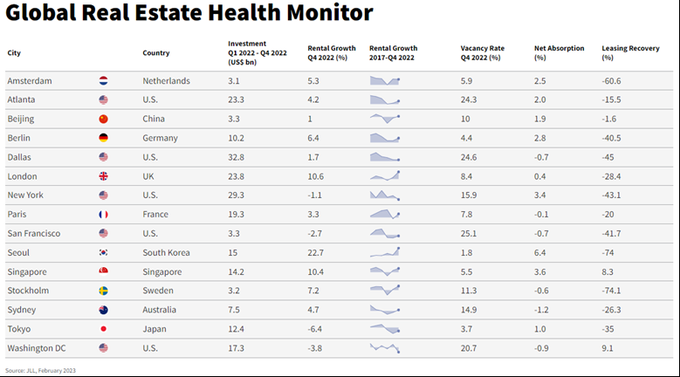
Vacancy rates post COVID remain relatively high in particular for offices in many US cities.
C. 25% office vacancy rates in Atlanta, Dallas, San Francisco and Washington DC
Source: JLL
So there is a risk of a wave of defaults on debt that has been lent to these commercial real estate funds. Office vacancy rates remain elevated in big cities where the return to work trend has not been that strong, such as San Francisco, Dallas and Washington DC.
If we look at the performance of bank stocks or bank bonds, by looking at, for instance, the KBE US Bank ETF or the XLF US financials ETF, we can see that there has been a fragile stability, but not really much of a rebound.
Only a very modest rebound in US banks thus far

Source: tradingview.com
So I think investors realise that the stress is not over. The collapse in banks’ share prices has not continued, but there has not been a real rebound as of yet.
In Europe we can look for instance to the iTraxx Europe Financials CDS indices, which are a way of tracking the cost of insurance to protect financial bonds against default. These have come down a little bit, but they need to come down a lot further in the wake of the Credit Suisse forced merger. Equally well, the AT1 CoCo bonds that were hard hit when Credit Suisse effectively defaulted on them when the merger with UBS was announced, have rebounded a little bit but again remain far far away from where they were before the start of the banking stress. So I think we can say that there is some emerging stability in the banking system for now but it is somewhat fragile.
European AT1 (CoCo) financial bonds are still a long way from February levels

Source: tradingview.com
2. Is a US recession nailed on to this year?
One of the key conclusions from this banking stress is that credit conditions are going to tighten yet further, as a result of the pressure on regional banks. They will have lower deposits and as a result, they will be forced to tighten lending standards further and give out fewer loans.
Generally when credit conditions tighten, this means less credit is issued, and less credit being issued means less growth. So it usually is a clear signal of at the very least a very sharp slowdown in growth, if not outright recession.
US credit conditions were already tightening even before the SVB failure

Source: US Federal Reserve
Our base case remains a modest recession in the US in the second half of this year, then returning to sub trend growth in 2024.
These tighter credit conditions are one reason; the second reason is the delayed impact of the full rate hike cycle by the Fed. Normally, it can take 12 to 18 months for the full impact of a rate hike to be felt in the economy. So over the next few months we are still going to feel an increasing impact from the rate hikes that were already done up to a year ago. And that will slow the economy from now to the end of the year.
It is difficult to imagine at the moment when you look at current economic data as US economic data is tracking for Q1 at around 3% annualised growth rates are actually pretty strong.
But this is unlikely to be maintained through the second quarter, and even more unlikely to be maintained into the second half of the year. We still expect a sharp slowdown in growth which incidentally should lead to a sharp slowdown in inflation as well, but a sharp slowdown in growth leading to negative growth in the second half of the year.
If we look to Europe, a recession is still not certain, but there are some warning signs in terms of the slump in the volume of retail sales, for instance in Germany. It seems that consumers are spending less as a result of the high inflation rates, particularly caused by energy prices.
The good news for Europe is that the energy crisis is subsiding. The full impact of falling wholesale energy prices has not been passed on to consumers yet, but should be passed on to consumers over let's say the next six months. So there will be some form of relieving of pressure on consumers from energy prices in the next six months in Europe, which again should help maintain consumption.
We should also remember that excess savings in house for households remains extraordinarily high in Europe. In addition, the level of employment in continental Europe remains pretty much at an all time high. So again, that's good news and with increases in wages and salaries as well. This should help underpin consumption and could potentially therefore avoid a recession in Europe. But there will be a sharp slowdown in growth, no doubt.
3. Can inflation really return to 3% or under by the end of this year in Europe and in the US?
Yes, we certainly think so.
While it is true that current inflation rates remain far too high for comfort, certainly for central banks in the US and in Europe.
But, remember that there are a number of disinflationary forces at work, which will play out over the next six months.
Energy prices have slumped in Europe from the Ukraine conflict highs, down over 85% in terms of both natural gas and electricity wholesale prices, which should eventually be reflected, as I said, in household prices.
This will provide relief both for companies and for households in the European economy over the remainder of this year.
In the US, we see a similar pattern in energy prices - not so much in gasoline but more in natural gas prices, which are at multi-year lows in the US.
European, US natural gas prices slump from post-invasion highs

Source: tradingview.com
So again, over the second quarter US households should obtain quite a lot of relief from lower energy prices, calming down the rate of inflation.
Secondly, food prices should start to calm down - at the moment, they seem to be running very high. Certainly if you look at your local supermarket you can feel the impact of much higher food prices.
However, if we look at the FAO index of world food prices, these have been falling for quite some months now.
FAO world food prices continue to fall, led by vegetable oil and cereals


Source: FAO
And this eventually should be reflected in food inflation in the high street. So again, this represents a second source of potential relief for household budgets.
Thirdly, we can talk about the price of goods. Good prices, including the price of transportation of these goods, for instance from Asia, have fallen sharply.
So we expect this disinflationary effect from the price of goods, particularly goods that are imported from abroad should come down sharply as well over the next few months.
Then we can talk about housing rents. Well, housing prices are definitely falling all across Europe and indeed, quite sharply in the US as you would expect, given the much higher mortgage rates that are now being offered. But rents are also coming down. So the housing component of CPI, which is a very big element of US inflation, should be coming down quite sharply over the remainder of this year.
The last question to see for inflation therefore remains, services and wages because wages are the biggest proportion of services.
This, it has to be admitted, remains sticky. But we would still expect the indirect effect of lower energy prices to feed into services and thus bring services inflation down.
We also expect wage inflation to calm as companies, particularly in the US, start to lay off more people not only in the tech and financial sectors but elsewhere. This should then bring the jobs market a little bit more back into balance and reduce the intense wage pressures that we have been seeing up until recently.
So overall, yes, we expect CPI in the US and Europe to fall really quite sharply over the next few months and return closer to 3% by the end of this year.
4. Are you still positive on Stocks today despite all the concerns?
Yes, we believe that stocks globally are climbing so a so-called “wall of worry”.
This is typical - there is always something to worry about. At the moment clearly it is firstly the war in Ukraine, which is ongoing, and secondly, the banking stresses in the US spilling over also into Europe.
It is remarkable to note then, that the Euro STOXX 50 index has returned to its recent highs, despite the big drop in banks. The same can be said also for the French CAC 40 index.
Euro STOXX 50 index defies banking slump to return to recent high

Source: tradingview.com
Similarly, if we look to the US, we can be encouraged by the recent upwards momentum both in the NASDAQ 100 index and also in theS&P 500 itself. Both seem to be moving higher in a series of higher lows and higher highs which suggests an uptrend is forming. Again, this has occurred in spite of the stresses in the banking sector.
Tech-heavy Nasdaq 100 shows surprisingly strong upwards momentum

Source: tradingview.com
We believe that the fall in long term interest rates supports stock valuations. Then the question becomes: how is the momentum of earnings going to turn out over the next few quarters? Because that should be the determining factor for the stock markets.
In Europe, the momentum has been strong - quarterly results up to now have actually surprised to the upside in general from a number of sectors, including of course, financials, energy, industrials, as well as consumer consumer goods such as food and beverage, all have given generally positive earnings surprises up to now in Europe.
In the US the picture is a little bit more mixed, but recently, earnings estimates have been actually starting to trend higher once again. This is surprising given that we're expecting a sharp economic slowdown over the next six months. There is pressure on profit margins in the US but nevertheless, earnings estimates seem to be rising. So analysts seem to be suggesting that things are not as bad as they had thought a few months ago
5. Is it time to return to investing in property?
This is a yes and no answer, unfortunately. The yes relates to listed properties such as REITs, which are listed on stock markets in the US and Europe. REIT share prices have already corrected a very long way. And so in the near future may present some value for investors particularly as they in many cases offer much higher dividend yields today.
US and European listed Real Estate has already suffered since start-2022

Source: tradingview.com
The no relates to the vast bulk of property which is unlisted. Unlisted real estate prices are only readjusting slowly, and I think that they will take several quarters more to fully adjust.
We are still at a point where we see a battle between buyers and sellers. Buyers are happy to buy but much lower prices, while sellers are unwilling to drop their prices much.
This sort of standoff between buyers and sellers typically takes 6 to 12 months to resolve. So it is probably too early to look for opportunities in the unlisted property market, p[articularly commercial property. I think we would need to wait another six to 12 months to really start to find those opportunities.
In the meantime, look to the listed REIT sector as a place where prices have already been “marked-to-market” extremely rapidly and perhaps where they do represent something closer to reality.
6. What benefits from stress in the banking sector?
The clear beneficiary from the current banking stresses are precious metals, principally gold. Gold acts as a safe haven. It acts as a refuge also from those who are worried about lower interest rates and about those who worry about the weakness of their own currencies.
For instance, gold tends to be inversely correlated to long term bond yields. So lower bond yields usually means higher gold.
The same is true with the US dollar - when the US dollar weakens, the gold price (of course in dollars) rises over time.
So we have three key drivers here. A safe haven demand, a weaker dollar and lower long term bond yields all of which are favourable for gold. It is also favourable for gold’s little brother silver.
Note that as of the end of March, gold has hit its highest ever monthly close at nearly $2,000/ ounce. I think that this positive momentum is likely to be maintained. And we have been for some time suggesting precious metals and gold as useful diversifying assets for investors, which is becoming ever more true today at a time when these banking stresses could continue. The effect of banking stress on the economy will also become apparent between now and the end of the year, pushing the US economy into recession.
Gold has just set a new all-time monthly closing high at nearly $2000/oz

Source: tradingview.com
So our conclusion is to continue to like gold, and to continue to remain invested. For a leveraged effect, look at silver which is only half of its all-time highs back set back in 2011, whereas gold is at its new all time high on a monthly closing basis.
One could also look at precious metals miners, which also are far far far below the high set back in 2011. So these miners have lagged the movement in the gold price up to now. But we think there could be a catch-up effect both for silver and for precious metal miners over the next few months.
Let’s hope for further advances in the week ahead,
Edmund
Disclaimer
This is not financial advice. Our content is intended to be used and must be used for information and education purposes only. Please read our disclaimer and terms and conditions to understand our obligations.
24 comments
Gold and silver should always be part of a diversified portfolio. But today they also offer a lot of upside potential as well, fill your boots!
The small gold/silver miners have yet to catch up with spot gold. For example I see that Hummingbird Resources (LON:HUM) is starting to move, up 22% today. Serabi Gold (LON:SRB) starting to move too, Centamin (LON:CEY) is still cheap paying a solid dividend....
on ' money market funds. These funds yield up to 4.7%, which is over 4% higher than the average bank deposit rate today'
I hear a lot lately about 'money market funds' - can anyone suggest a couple of examples of what these might be?
Money market funds are an investment product that focuses on short-term
securities. These securities are deemed very low-risk – and typically
include a blend of government-issued bonds like US Treasuries and UK
Gilts, alongside high-grade corporate bonds. The purpose of investing in
a money market fund is not to generate long-term investment or growth.
Have a look at this in the UK for an example of a low risk cash-like money market fund:
https://www.vanguardinvestor.c...
They benchmark to the SONIA interest rate, which is very close to the Bank of England base rate - 4.25% presently.
Stupid question, but do we have money market funds in the UK yielding 4.7%?
More like 4.2% I think, close to the BoE Base rate
Thank you Edmund. I don't know where you feel the rental market is coming down. That certainly is not the case in the UK residential, and especially not in the SE where shortage of availability is driving prices up and up and potential renters to distraction., This doesn't seem likely to end soon.
I hope you don't own any old buildings in the EU:
I hope you don't own any old buildings in the EU
No. But I own Kingspan, Volution, Daikin, Eneraqua, Trane Technologies and a selection of industrials, like Schneider Electric and Addtech, whose ranges include energy efficient construction products.
Our goverduhment is ahead of the virtue race with the Minimum Energy Efficiency Standards (MEES). Still we can always work from home and the hulks become temporary hotels.
Haha don't get me started on MEES / Carbon Reduction Targets.
Our government is essentially betting on technologies that don't work well or haven't been invented yet. See here for example.
Meanwhile our largest oil and gas producer is cutting UK investment due to the new windfall taxes. Shell and Total are making similar noises relating to the UK. So that means less energy independence for the UK over time.
There are tectonic changes occurring right now but we aren't seeing them get a mention on the BBC "news". For example, Kenya has agreed to buy their oil from Saudi directly in their domestic currency (Kenyan shilling), thus bypassing the USD completely. Brazil just announced the same thing, they are ditching the USD for trade. Then you've got Mexico, Saudi, Iran and so on lining up to join BRICS.
“There are decades where nothing happens; and there are weeks where decades happen” – V. Lenin.
Don't forget the Chinese deal with TotalEnergies SE (LON:TTE) for LNG!
.
The UK residential market, especially in London and the South East, is experiencing strange dynamics in large part due to the change of treatment of buy-to-let investment properties for tax purposes... This, plus the huge hike in borrowing costs of late has led to a lot of shrinkage in available-to-let properties, similar to the case in Dublin for instance.
But this is not true to the same degree elsewhere in the world...
Edmund, Your articles are always very well written, and also very well backed up by the data which you provide. For many of us here, including me, it is well worth reading. But there is a nagging doubt in mind, which is that, from what I can see, your attitude is always positive. Maybe that is because the data since you started to write for Stockopedia has always been positive. But I wonder whether or not some negative information is being overlooked.
Quite possibly!
But to be fair, I am not always positive.
For instance, in my "day job" we were actually Neutral on Equities from February to November last year...
But I think the point is that there is usually some opportunity somewhere, whether in stocks, bonds, commodities or elsewhere...
Ed
Looking at royalty companies who have exposure to the spot price but without the operational risk of getting it out of the ground and processing it, and for governments to tax it.
For gold Franco-Nevada (NYQ:FNV) and silver Wheaton Precious Metals (LON:WPM).
Copper is found with gold so have an additional long term demand tailwind.
There are some good free blogs to get a few insights into the industry. A few paid for like David Morgan's The Morgan Report. and digital magazine 'Mining' to explore. Dominic Frisby also in the sector (and cryptos - but then he is a comedian).
Yes I am a big fan of royalty companies,
for exposure to precious metals prices without the risk of rising expenses hurting profits...
Franco-Nevada (TSE:FNV) and Wheaton Precious Metals (TSE:WPM) are the highest quality precious metal royalty companies.
For base metals, potash and other key resources, Altius Minerals (TSE:ALS) is leader. Altius is the only company that I know of that still gets a Rick Rule ranking of 3 (Franco and Wheaten both ranked at 4).
For the Oil & Gas royalty companies there are quite a few to chose from. I recently (via Resource Insider) invested in a private Oil & Gas Royalty company. I'd highly recommend Resource Insider to anyone serious about the resource space, it is $5,000 per year to join (*and you have to be an accredited investor to partake in any private offerings).
Thanks for Resource Insider. Investopedia has good information on accredited investors and private placements, I just need to become a High Net Worth Induvidual :)
You are very welcome.
Thank you Edmund for this comprehensive macro analysis, it's great for me as a small investor to read your articles, which help inform my investment decisions, and in particular helps determine how bull or bear my stance, and thereby the timing of my actions. Best wishes for the week ahead.
Thanks Ed...more food for thought. The Economist has article in this week's edition on commercial property - and although sector poor doesn't think it will be as bad as private property sector crash in 2007-09 due to 1) commercial lending at max of 75% of value and 2) Commercial property value half of residential property 3) Local politicians don't want to see decaying inner cities so will provide assistance....Capital (LON:CAPD) a good gold play if you prefer picks & shovels to pure gold miners
I also like Capital (LON:CAPD) but their Investments element is like a yo-yo in terms of valuations of these largely non quoted companies. If you look closely at the annual presentation - which I think is first class by the way - you will see the management's justification and the long term value of these to the business. Unfortunately, too many people are short termist right now, and this last year's valuation was a big negative versus the previous year's big positive. That has a significant impact on the SP unfortunately.