Market Musings 01/05/21: Don’t Panic! You CAN stay invested in Equities

Don’t Panic! You CAN stay invested in Equities
Summary:
- Podcast: Seeking Sustainable Sustenance in France
- Don’t Panic! You CAN stay invested in Equities (even over summer)
- Seasonality favours Health care, Food & Beverages, Technology now
New Podcast: Seeking Sustainable Sustenance in France
Charlotte and Edmund discuss trends in healthy eating in France.
Seeking Sustainable Sustenance in France
- Why is this trend growing?
- How does France fare in plant-based food compared with other countries?
- How is France adapting to new consumer needs?
- How can people invest in these emerging food trends?
- Is there a future for insect-eating?
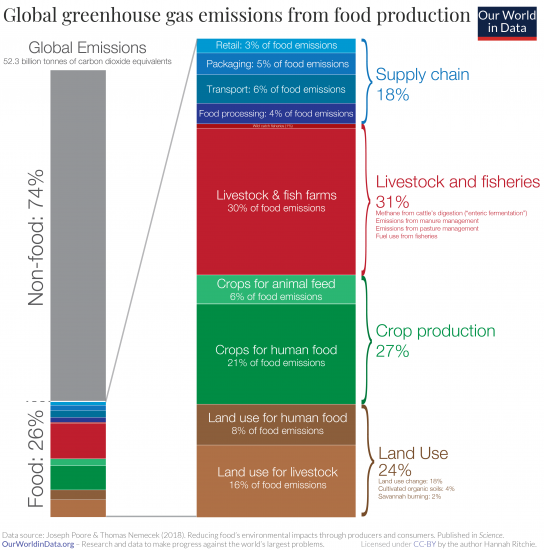
26% of Greenhouse gas emissions come from Food Production!
Don’t Panic! You CAN stay invested in Equities
Yes, it is the beginning of May, so keen stock market historians will be crying out: “Sell in May and Go Away” (until the end of September).
This year there are lots of reasons for even calm rational investors to listen to this advice:
- The global stock market has risen 84% in USD terms since the March 2020 market low, and 27% since the beginning of November last year. There is naturally a huge temptation to bank these extraordinary gains…
- Stock market valuations are on the high side, particularly in the US (end-2022 P/E of 22.3x for the S&P 500 index). We know that high valuations today generally lead to lower future long-term returns.
- Retail investor stock market sentiment is on the high side, reflecting widespread optimism (perhaps over-optimism?).
- Fund flows to stock funds and ETFs have been huge these past few months, with US investors putting USD167 billion into stock funds and ETFs since the end of January 2021.
- Negative seasonality: Stock market returns have historically been far worse over the summer (May-September inclusive) than over October-April. So seasonality is negative for equity markets from now until October.
BUT
There are lots of reasons for not rushing to sell your stock market exposure just yet…
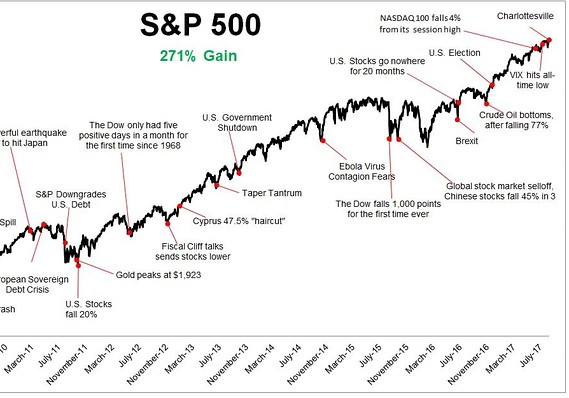
1. Climbing the stock market “wall of worry”: there are ALWAYS reasons to worry about the state of the global economy, geopolitical risks, risks to companies from competition or changing end-markets, exogenous shocks like COVID-19 and so on. But more often than not, stock markets continue to motor higher regardless...
S&P 500 has gained impressively despite a myriad of concerns/events
2. Momentum begets momentum: i.e. What goes up, tends to continue to go up - this “time series momentum” is the basic principle behind trend-following strategies, which have been successful historically.
According to AQR, “We find that the past 12-month excess return of each instrument is a positive predictor of its future return. This time series momentum or “trend” effect persists for about a year”.
3. Earnings continue to beat estimates: (From Factset) 60% of the companies in the S&P 500 have reported actual results for Q1 2021 to date. Of these companies, 86% have reported actual EPS above estimates, which is above the five-year average of 74%. In aggregate, companies are reporting earnings that are 22.8% above the estimates, which is also above the five-year average of 6.9%.
Strong US earnings rebound

4. Valuation is not a good timing indicator in the shorter-term: while valuation indicators such as the Shiller Cyclically-Adjusted P/E (CAPE) ratio can be good predictors of long-term (10-year) future stock market returns, they are poor at predicting stock market performance over shorter time frames, eg. over the next 12 months.
Very poor correlation between CAPE valuation ratio and next 12-month returns

5. There are strong sectors to play seasonally: according to equityclock.com, Health care, Consumer Staples and Technology are in their sweet spot for seasonal performance now until mid-July for Tech, and until November-December for the two defensive sectors. So one can focus on these sectors now if you want to play seasonality timing in equity markets.
Seasonality is positive for Health care, Consumer Staples, Tech

6. The economy is so strong, stocks should be doing even better! If we look historically at the relationship between the US ISM manufacturing survey (a good overall gauge of economic momentum) and MSCI World 6-month rolling returns, stocks should have done even better given the record ISM survey level...
Strong US ISM manufacturing survey suggests greater potential equity gains 
7. What are you going to buy instead? Government bonds? Corporate bonds? Stay in cash? If you think that stocks are expensive, consider that US and German 10-year government bonds have almost never offered such a low yield in the last 40+ years as today (1.6% in the US and -0.2% in Germany). The same is true for US and Euro investment-grade corporate bonds (average yields of just 2.2% in the US and 0.3% in Europe). You can thank central bank zero interest rate policies for the historical unattractiveness of bonds and cash.
Close to record-low government bond, corporate credit yields

Source: Bloomberg
Against that, the US S&P 500 total shareholder yield (adding together dividends and share buybacks) is around 3% currently, and close to 4% for European stocks.
Conclusion: There is no conclusive evidence that investors should sell their stock portfolios and retreat wholesale to more defensive assets today.
But there is good evidence to suggest that rotating out of selected economically-sensitive cyclical sectors like Industrials and Materials into more defensive sectors such as Health care and Food & Beverages makes sense on a seasonality basis, until October.
More broadly, the European Health care and Food & Beverages, and Global Tech sectors have all beaten the European benchmark by a distance since 1999.
Europe Health care, Food & Beverages and Global Tech all beat the European market

Source: Bloomberg.
Note: 1999-2021 in euro total return terms, rebased to 100 at start-1999
I wish you a fair wind for the week ahead,
Edmund
Disclaimer
This is not financial advice. Our content is intended to be used and must be used for information and education purposes only. Please read our disclaimer and terms and conditions to understand our obligations.
30 comments
I wonder how does the adage "Sell in May and Go Away” works for the global markets ?
All I keep seeing are concerns about inflation and I don't really know whether this is worrying/nonsense or somewhere in between but it has made we wonder if perhaps I am too fully weighted in stocks. We did look at buying a holiday let just before the pandemic but bottled it as things unravelled in March. I can't help thinking that maybe I should cash in most of my ISA gains and whack it on a deposit for that holiday home rental now just incase inflation does start creeping up. (though need to be quick with the stamp duty holiday). Has anyone else looked at property as part of their portfolio recently? Cash def looks like a bad thing to hold at the minute.
Don't need to physically buy a property for exposure and inflation protection. Just buy shares in one of the many REITs.
Cheers. I have exposure to warehouse REITs but was thinking of a heart over head investment that we could use / move to in a couple of years when we aren't tied by children. I should take another look at other REITs though.
If it's a second home does the stamp duty holiday help? In fact there's an extra 3% to pay.
Unless you are buying on a holiday park where you never own the land so no stamp duty - but don't do that.
https://www.tax.service.gov.uk...
Hi Leebod
I have a second property as part of my overall portfolio, but this has been held for a few years now and is a pure rental play. I would add it was also kept should I ever have to work again in London or the children want to move there to study/work. We moved to Manchester area, and then North Yorkshire when we had kids following our work at the time and have not had any desire to move back down south since.
For transparency my split looks like; 55% - company pensions with Fidelity/Aegon, 35% property (one), 10% ISA/Shares.
This excludes the family home (no mortgage) and cash (>1 year buffer).
We looked at a holiday property pre-Covid, thinking that we might use it for several weeks over the summer holidays (beach) and then rent the remainder of the year to pay the mortgage, but factoring in costs (stamp duty, maintenance, cleaning, agents, lots of damage and upkeep every year - do not think that people are like you and look after the place, if it can break or go wrong it does and more!) also the lost cost of the weeks we would use it rather than renting as we would need peak season as the girls are at school still. What we thought were expensive rent a couple of weeks costs actually are reasonable when being logical rather than emotional.
The only difference would be if you were looking to "flip" properties within the 3 year stamp duty refund. By this I mean you are buying your retirement (or the kids have moved out) home now and would then sell your current home. I think the key here is if you think that the area you are buying is a higher inflation area to where you live. E.g. our biggest financial mistake was selling a 2 bed terrace in East London in 2010 to fund the various family homes, but it was totally the right emotional decision.
I am currently debating whether to exit the second property and go to equities as the returns over the last few years have been a lot better. I currently get ~4% gross rental, so you can get a better return from REITs...
Sorry a bit longer than planned.
Tommy
When I've looked at the finances of Furnished Holiday Lets, they're fine if you live next to it, but to subcontract fully out a managed service say using Houst, then it's not a purely investment play. The conclusion I came to was ..."buy somewhere nice to enjoy" and have someone else pay for it, if you make money great, but invest elsewhere"..
Hi Edmund. Just read your book Idle Investor which I found very interesting and confirmed many things I had long suspected, particularly about funds. Are your views on Investment Trusts the same?
I am very interested in ETFs and am thinking I will steer more of my portfolio towards them in coming years.
Any more thoughts on ANIC? I did opt for FOGB in the end which is heading in the right direction at the moment. I see Bluenalu have signed an agreement with Mitsubishi and Thai Union to help speed up production. Although they hope to start trials of the fish cell meat in far east next year they are still ten years away from it becoming a staple supermarket product, which makes me feel ANICs share price is well ahead of the game on current nav
Hi Simon,
Well I am more enthusiastic about investment trusts to be honest, for a few reasons.
Firstly, there are a few areas where good active fund managers have fairly consistently outperformed index benchmarks over time, justifying an active approach. these areas include Small-Caps, Japan, Emerging Markets and specialist areas for which ETFs are not readily available, including certain credit and distressed debt investment trusts.
Private equity is another areas where investment trusts can be interesting, and for which the ETF offering is relatively poor.
The platforms like Hargreaves Lansdown and AJ Bell continue to charge a "platform fee" for holding unit trusts on their platforms, without any justifiable reason - whereas ETFs and ITs do not attract this extra charge, so a good reason to favour ETFs and ITs.
But for broad indices, I would stick with ETFs for the lower charges, which is the one thing we can be certain about!
On ANIC, I share your sentiments. I like the idea very much, but valuation is challenging so I am waiting for now, personally.
Best
Edmund
It pays to read the small print re your broker charges. Charles Stanley are outrageous - applying their platform fee to all ETFs and most ITs! The latter is particularly hard to justify - all they're doing is transacting and holding a single listed company shares.
Useful article again, thanks, though I always prefer to read balanced arguments as there's often a negative for every positive.
Re. Charles Stanley fees, here is the small print:-
https://www.charles-stanley-di...
(Tiered) platform fee is indeed chargeable on ETF’s and IT’s .... but is waived if at least one trade made per month. Also capped at £240 per annum (for stocks and shares element), so for aggregate holdings above £68,500 (£240/0.35%) the headline fee drops as a percentage of the total quite quickly. Their £11.50 per trade is, admittedly, on the high side for internet trading (although still much cheaper than telephone broking). By no means a low cost provider but I’ve used them for several years and I’ve found their service is very good.
Gus.
Hi Edmund,
On the subject of fund charges I am currently trying to get an explanation from both my platform (AJ Bell) and Jupiter Asset Management regarding a 2020 ‘incidental charge’ of 7% (!!) on the Jupiter UK mid cap fund. This was previously the Merian UK Mid Cap fund taken over by Jupiter in July 2020. Jupiter have batted my enquiry away saying I need to sort it through AJ Bell (but they must know if they levied such a charge) and AJ Bell are failing to answer my enquiry with any sort of urgency at the moment. Their communications have been shocking during the pandemic. If this charge is not an administrative error then why has there been no notification to investors by any one of the reason for it. Finally if it is correct who should it be raised with as it is surely extortionate, the FCA perhaps?
Interested to hear your thoughts
Regards
Andrew
Does the "sell in May" strategy still generate alpha after trading costs? After stamp duty and dealing spreads (especially on small caps) I'm guessing it's not worth the bother. Also one has to have the discipline to buy back in later. Also the cash would be earning a negative real return at present sat out of the markets. April / May seems a logical time to crystallize profit though, in the UK at least due to our CGT calendar - maybe this explains some of the effect.
I agree. Selling in May and buying back the same assets in September is expensive and time consuming. The cash isn't going to earn anything in the meantime so the exercise is at best cost neutral. Whilst mutual funds, ITs and ETFs are obliged to remain fully invested all the year round, that does not apply to hedge funds, and as far as I know hedge funds don't sell off in May so there can't be any significant gain in selling on a calendar basis. There's further information on Investopedia if anyone's interested - and the conclusion is that there's no compelling reason to sell in May.
A study by SentimenTrader from 2019 found that virtually all of the gains in the S&P500 since 1950 have occurred in the Nov-Apr period. By contrast, cumulative returns in the May-Oct period are negligible.
This is not to say that returns will be flat May-Oct 2021. Indeed, in the period 1950-2018, the S&P500 rose 2 years out of every 3. But what nullified these gains were some huge corrections along the way which tended to occur in the May-Oct period (October 1987, October 2008 etc).
Yes, historically that has been the case. Thanks for the chart. Can't argue with that! Last year the S&P 500 actually dipped 2% overall in the 6 months from May, and it was only in November that prices really started to climb. Having said that, there is little to be gained by actually selling, and missing out on dividends. And it's alway possible that the markets could boom this summer...
01.11.2019: 3066
01.05.2020: 2830
02.11.2020: 3310
No, it was not dipped at all last year from May to October, but went up 17%! On the other side it was declined from November 2019 to March 2020 - I know it was a special situation...
Thanks for pointing that out. Quite right. Apologies. I think I must have confused March with May on the chart. Need to visit Specsavers.
If you are going to sell in May and go away, don't come back on St.Leger's Day (second week of September) as the rhyme has it. Wait for Halloween.
Hi John bit more meat on the bones as to the Halloween date being better ?
Thanks
In 1987 Black Monday was October 19th. In 2001 the dotcom crash became serious in October. In 2007 the financial crisis kicked off in October. You wouldn't want to have bought back in just before any of these events.
Well, yes.
The chart I posted earlier revealed minimal cumulative gains for the S&P500 since 1950 for the May-Oct periods.
I was curious to replicate a similar chart based on FTSE100 data.
This also clearly shows that the largest gains are made over the winter months. The flaw in this strategy is that you are only invested for half the time and will therefore only receive half the dividends.
I don't have the data to confirm this but I suspect that if dividends were included and compounded over the 37 years of FTSE data I have that the Buy and Hold strategy would be the winner.
Really interesting - shows it really well and is exactly what I've been wanting to see, so thank you. Did you take transaction costs off the blue line? If not, then doing that as well as adding dividends to the green line would at least shrink the gap or, as you say, put Buy and Hold on top.
Thanks for this. An additional flaw would be the transactional friction of buying and selling everything once a year. Although the bid/ask spread is usually quite tight for the FTSE 100 companies (more of an issue for 250 and AIM) you would need to contend with Stamp Duty and brokerage charges. Also an acceleration of CGT (assuming no tax wrapper and that you’re making capital gains above your allowances) would be a further incidental cost.
Gus.
But are not the largest dividend payers the ones with the least capital growth? The FTSE100 has hardly grown in the last 20 years.
If you want growth I would generally invest in small to mid caps, if you want income the FTSE100 is probably the place to invest.
Hi Momoko,
the answer is yes, if you are holding classic ETFs for indices. On small-caps, this is different as I believe that one should only hold small-caps for the long-term anyway, which is more of a buy and hold strategy and where the investor has to accept higher volatility anyway...
In the UK, there is some sense in at least crystallising some losses at the end of the tax year in taxable accounts, to offset gains where small-cap holdings may have done very well and become an outsized weighting in your portfolio - this is what I do when I am lucky enough to have a very big winner where I am uncomfortable about the resulting weighting.
Edmund
Many thanks Edmund. Cogent arguments based on common sense. Everything the top down investor needs to know, condensed into a few paragraphs. Incidentally you recommended Jpmorgan China Growth & Income (LON:JCGI) a few weeks ago, and it's gone up 6.5% since then. My hunch is that it has a lot further to go as the Chinese indexes seem to be bouncing strongly off a base.
Yes Wilkonz,
I feel that much of the negative news flow around Chinese tech companies and regulatory clampdowns by the Chinese Communist Party are somewhat overblown and now well-known, in the share price of TenCent and Alibaba etc. More importantly, the CCP wants Chinese global tech champions in the long run, so will continue to encourage these behemoths to challenge the US FANG stocks on a global basis (as long as they continue to toe the party line...).
Edmund
thanks Edmund, more great insights