Market Musings 011022: Time for a UK countertrend rally

Market Musings 011022:
Time for a UK countertrend rally
We enter October with conditions ripe for at least a decent stock market rally
This week’s podcast:
We answer your questions
This report aims to answer our clients’ most frequently asked questions of the moment
Summary:
- UK chaos leads to investing opportunities in bonds, stocks
- Bank of England expected by interest rate markets to continue raising the base rate to 5.6% by March 2023
- Expect pain in the UK residential housing market as mortgage rates soar
- Investment opportunities in US-dollar earners, dividend-payers in the FTSE
UK chaos creates an opportunity
As if the ongoing bear market in financial markets wasn’t already generating enough volatility, the UK Conservative government had to add more excitement of their own from a remarkably eventful tax-cutting mini-budget.
I am not going to discuss the ins and outs of these tax-cutting measures, save to say that I personally found some of the tax cuts unveiled.an inefficient way to potentially boost the economy.
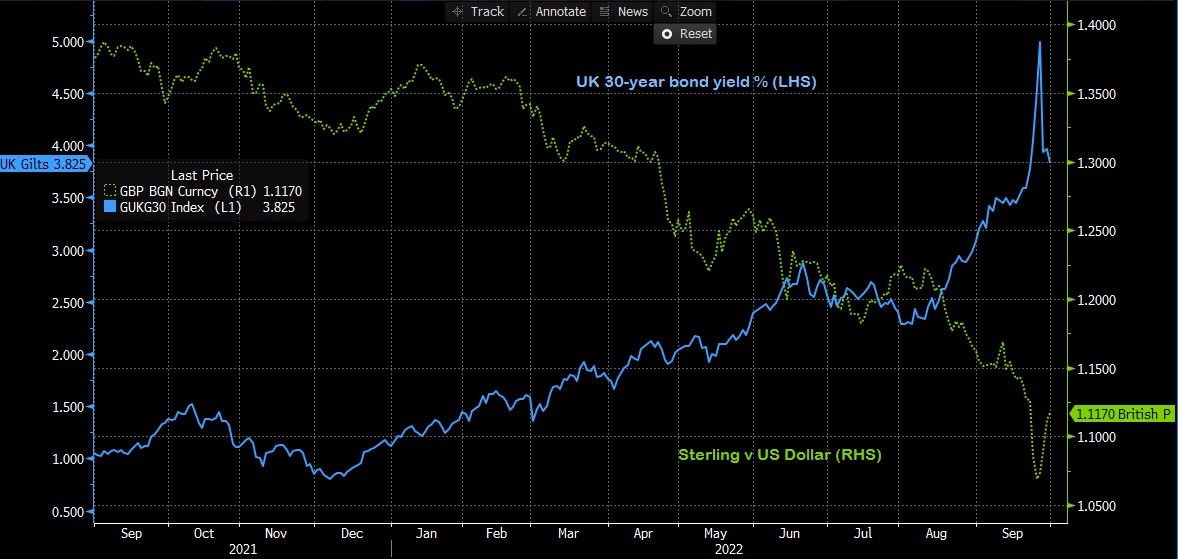
What is more interesting to me is the reaction of financial markets, which was initially very negative - reflected in the plunge in the value of sterling against the US dollar, and in the sharp spike in the long-term UK gilt (government bond) yield.
Mini-budget unleashes huge moves in sterling, UK bond yields
Source:Bloomberg
The 30-year UK gilt yield has risen from under 2.3% in early August to peak at 5% post-budget, less than two months later. It was this unprecedented move higher in bond yields and the subsequent threat of insolvency of UK final salary pension funds (for further explanation of this risk, see this article) that then forced the Bank of England to step in to stabilise the bond market with an emergency bond buying program.
"Were dysfunction in this market to continue or worsen, there would be a material risk to UK financial stability,"
the BoE warned.
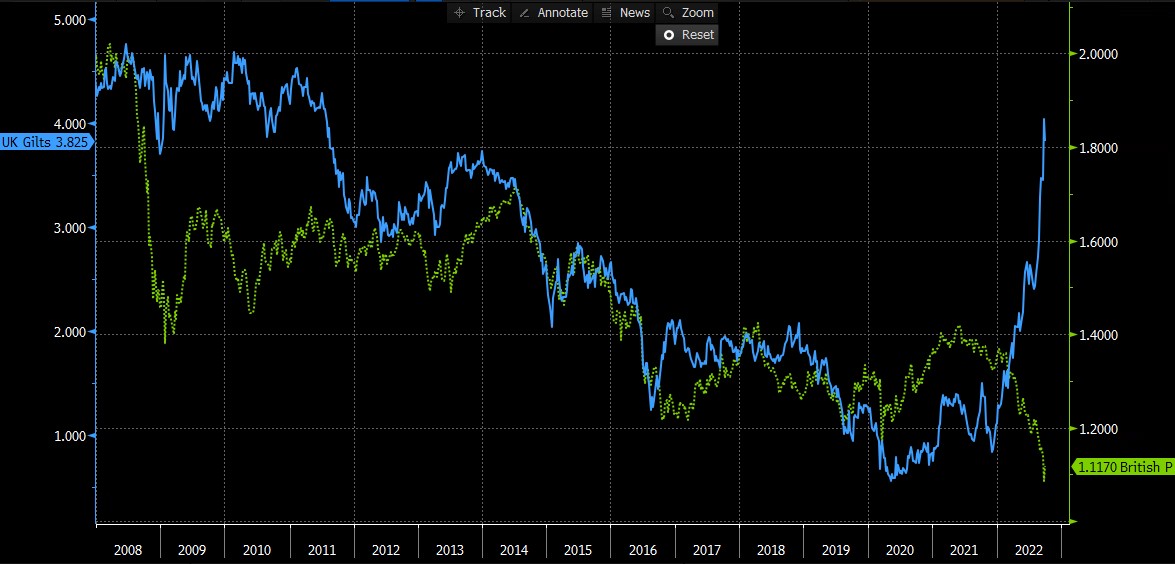
As a result, both sterling and UK gilts have retraced some of their post-budget panic reaction, with the 30-year gilt yield retreating to 3.8% and sterling recovering to $1.12 (EUR1.14).
37-year low for sterling v US dollar, highest 30-year gilt yield since 2009
Source: Bloomberg
The UK is not at all out of the woods yet. The Bank of England is certain to raise its base interest rate substantially at its next rate-setting meeting on November 3.
The interest rate market currently expects the Bank of England to raise its key base rate from 2.25% now to around 3.6% (+1.4%) on November 3, a huge move to support the currency and to calm UK inflation.
But that is not expected to be the last interest rate hike. By March 2023, interest rate markets expect the Bank of England base rate to have climbed further to 5.6%, another 2% higher than in November. That would put the UK base rate close to its peak back in 2009…
Markets price the UK bank base rate to rise from 2.25% now to 5.6% by March next year

Source: Bloomberg
This is all very bad news for borrowers, but good news for savers who finally will have access to relatively attractive interest rates on their cash ISAs and other savings accounts.
UK residential housing market at risk from historic hikes
Since late 2019, new UK mortgage borrowers have been spoiled with the ability to take a 75% loan-to-value (LTV), 2 year fixed rate mortgage at a rate of under 2% for these 2 years.
However, following the Bank of England’s emergency actions and the expectation of a jumbo rate hike in early November, mortgage lenders have been withdrawing fixed rate mortgage deals very quickly.
Of course, they will return to the mortgage market with a new range of mortgage offers, but clearly at much higher interest rates than previously. The average 2-year, 75% LTV fixed rate mortgage now stands at 3.5% according to the Bank of England, already more than 1.5% than the fixed rates available until February this year.
UK mortgage rates rising fast - standard variable rate could hit 8% in March 2023

Source: Bloomberg
But if interest rate markets are in any way accurate with their current predictions, we can expect to see the standard variable rate rise from 4.9% today to close to 8% in March next year (higher even than at peak in 2007). The 2-year 75% LTV fixed mortgage rate could equally rise to well over 6% over this period, higher than at any point since the Bank of England started tracking this data in 2012..
With at least a mild recession forecast for the UK in 2023, including an unemployment rate forecast to increase from 3.6% currently to 4.4% in 2023, the twin motors of employment and financing cost both promise to weigh heavily on house purchases.
Advance indicators of house buying interest in the UK, such as the August new buyer enquiries indicator from the Royal Institute of Chartered Surveyors, already point to falling interest in house purchases as mortgage financing becomes a lot more expensive.
UK RICS new buyer enquiries falling rapidly

Source: RICS, August 2022
Capital Economics is forecasting a drop in UK house prices of 10-15% in 2023, as a result of the drag from higher interest rates and weaker employment trends.
This has all been well integrated by investors into UK housebuilders’ stock prices, with the UK homebuilders’ index cut in half since the beginning of this year.
UK homebuilders index -50% in 2022

Source: Bloomberg
If I am to be honest, I see this as positive for the long-term health of the UK property market and in particular for the ability of younger first-time buyers to get a first foot on the property ladder.
Judging by official UK house price index trends, I would very roughly estimate that current house prices would need to drop by around 13% to return to their long-term trend, as occurred during the Great FInancial Crisis in 2008-09.
UK house prices around 14% above long-term trend

Source: Bloomberg
So where is the investment opportunity today?
UK assets are most definitely not the flavour of the month, year or even decade for overseas investors. Just look at the performance of UK gilts (government bonds), including all coupons paid, in US dollars since the beginning of 2021. A US dollar-based investor would have lost 43% of his investment in just over 1 year…
UK government bonds have been catastrophic for USD investors

Source: Bloomberg
But therein lies the interest today, as a contrarian investment, at a time when foreign investors have simply given up on UK assets.
I would focus for now on UK-listed companies that are:
- Heavy overseas earners, preferably in US dollars;
- Cash-rich or with a low level of net debt (as debt costs are rising);
- Cheap valuation on P/E and Enterprise Value/EBIT;
- Strong free cash flow generation and high and well-covered dividend yield
A number of sectors become immediately obvious in the FTSE 100 index:
- Oil & Gas
- Global miners
- Pharmaceuticals/healthcare
- Food & Beverages
- Industrial companies with heavy US exposure, like Ferguson
- Technology
Here are a number of UK FTSE 100 companies that fit this description in these sectors, with relatively high Stockranks:
- Oil & Gas: Shell (LON:SHEL), BP (LON:BP.)
- Mining: Rio Tinto (LON:RIO), Glencore (LON:GLEN), Anglo American (LON:AAL)
- Pharmaceuticals: AstraZeneca (LON:AZN), GSK (LON:GSK)
- Food & Beverages: Diageo (LON:DGE)
- Industrials/Aerospace & Defence: BAE Systems (LON:BA.)
In the FTSE Mid 250, I would also look at companies that would be attractive bid targets for larger international rivals (especially US companies given weak sterling) or private equity funds. We have already seen a couple of such takeover bids announced for UK companies (RPS Group, Biffa) in the last week or so.
Here is a list of potential UK takeover targets according to a number of brokers canvassed by Bloomberg:
UK companies highlighted by brokers as potential bid targets

Source: Bloomberg
DYOR of course…
Have a great week
Edmund
Disclaimer
This is not financial advice. Our content is intended to be used and must be used for information and education purposes only. Please read our disclaimer and terms and conditions to understand our obligations.
12 comments
I agree we could be due a short-term bounce. Sentiment is at all-time lows by all accounts. The drivers of this bear market have been the surging US dollar and higher government bond yields. Both are showing signs of at least a short-term top, last week.
There is the potential for headline year-on-year inflation numbers to begin moderating in the next few months. This is month-on-month US CPI, below. The September release is on October 13, when we'll drop the 0.4% from September 2021. Then, from the October release on 10 November, we'll begin to drop the big numbers... 0.9% from October 2021.
If current month-on-month figures remain relatively stable (like July/Aug 22) then the headline rate could be way down to say 3% by April.
The UK month-on-month rates are still quite high (0.5% for August) so the decline may be slower this side of the pond. However, if inflation does generally decline more quickly than expected, then that may create a significant change in the market narrative. The equity market will bottom when both inflation concerns and restrictive central bank policy are in the rear-view mirror.
thanks Edmund, I really enjoy these posts. Are there any UK focussed investment trusts (or tracker/ETF) that you/readers would look at for further research?
excellent article and podcast Edmund, thank you.
Hi Edmund
Is the rush by the Bank of England to increase base rate more to shore up sterling in reality, than it is to cool inflation? My vague memory of economics tells me that base rate rises can take many months to have any effect on the economy.
I’m sure Edmund will give a much better answer, but I’m going to chime in here with how I understand it.
The fall in Sterling is reflecting decreased confidence in the uk’s ability to reduce inflation, stabilise the economy and move back to growth.
To deal with inflation effectively, the government and central bank should implement policies which are politically unpopular, I.e. on the fiscal (government) side: higher taxes and lower spending, and on the monetary (central bank) side: lower money supply (quantitative tightening) and higher interest rates.
The “fiscal event” showed that government are loosening their fiscal policy, as truss and kwarteng believe controlling inflation is the BoE’s responsibility. This lack of coherence between fiscal policy and monetary policy is causing the markets to lose confidence in the uk economy and sterling.
Raising interest rates by a higher amount should in the short term increase confidence, by signalling to investors that the BoE is acting to mitigate the fiscal policies of the government. Medium to long term higher rates should help manage inflation by encouraging saving over spending, and increasing borrowing costs which will reduce output of goods and services.
Hi there
Yes in principle, you are right, there is typically a lag of 12+ months between a rise in central bank interest rate and effect on slowing the economy, and by extension of inflation pressures.
However in this case, remember that the UK imports a lot of goods from abroad - for instance, 2/3rds of the food in the UK is imported. In this case, a weak currency has a direct impact on raising the cost of importing goods, as those goods are bought typically in euros or US dollars.
So in this specific case, raising interest rates to support sterling can have a pretty quick effect on capping imported goods inflation, at least.
But for other sources of inflation like house prices/rents and employment/salaries, you are right, it will take time… That said, as I wrote above, I believe that the impact on the housing market will be pretty fast given the scale of the interest rate rises and the huge sensitivity of the economy, and of households in particular, to the cost of financing given high levels of debt.
Of course, this higher cost of mortgages risks arriving at the same time as higher energy bills, so potentially a double-whammy for a mortgaged homeowning household.
Edmund
Ok, so far so good Edmund and thanks BT for your input. BUT isn't one definition of inflation 'too much money chasing too few goods' ?
Since 2009 both the Fed and B of E have been pumping money into the respective economies (QE) and yet we have, for the most part, enjoyed record low interest rates during this period and record low inflation.
To my naive (but willing to be educated!) economic brain this simply doesn't make sense. It suggests to me that something else is driving inflation. Could this be supply side (closing, then re-opening economies, broken supply chains, rapidly rising shipping costs, stock piling etc) inflation we are witnessing post covid, rather than demand side? And if so, wouldn't it have worked through without intervention? Clearly the whole picture has been muddied by the dreadful events in Ukraine.
I'm guessing also that the US Dollar as a 'safe haven' has been strengthening against all currencies as world markets panic, which in turn hasn't helped Sterling or the Euro?
Not actually sure where I'm going with this ramble but I'm keen to try and learn about economics without stumping up for a degree!
Covid certainly produced the perfect cocktail for trouble - sky high public spending as productivity fell off a cliff. Inflation is the inevitable result, even though - and this is an objective observation, not political - at the time many were demanding even more spending and support from governments.
I'll let Edmund educate us both further.
From 2009 to March 2020 most of the QE done ended up in assets and didn't filter through to the wider economic system, covid required money to be given directly to the public, services like pubs were closed down, so money chased goods, inflation started emerging Jan 2021 and Russian invasion put rocket fuel under it.
Any thoughts on asset allocation in current environment Edmund for example is it to late to in the day buy an ETF that tracks the dollar ?
Regards Andy
yes, maybe 12 month delay. This is why Bailey of the BOE needs the sack. The current interest rate in no way is putting a brake on inflation. We should have started a year ago and be at 6 percent now. In which case inflation would be declining. Personally I think it is now too late, it is entrenched. Which means only a mayor recession will kill it.
It's worth noting that most of the import inflationary pressures are from the strong USD. Oil being a prime example. However EUR/GBP is trading in the middle of its 5 year average eyeballing the attached chart. .8700 or 1.15 if you prefer so the pressure from European imports should be considerably less or at least not currency related.
https://www.tradingview.com/sy...