Market Musings 040126: Chinese Tech and PDD

As we enter a new year, it is a good time to reconsider investment themes and portfolio holdings for the year ahead.
My convictions remain centred on the resurgence of a whole range of commodities on the basis of growing demand and restricted supply. This is true for precious metals such as silver,industrial metals such as copper and aluminium, and for energy-related metals such as uranium and lithium.
Outside of this commodity-focused exposure, I have been looking for new themes in which I have a high degree of conviction and where there is a potentially interesting entry point at present. This is not easy given that many stock markets have ended 2025 at or very close to multi-year or even all-time highs.
Time to look again at Chinese tech
One such area I am interested in is Chinese technology exposure, predominantly Chinese internet and e-commerce companies. At a broad level, Chinese mega-cap technology companies have been on the recovery trail since early 2024, after a brutal 3-year bear market that had started back at the beginning of 2021. They received a boost in January 2025 when the DeepSeek large language model (LLM) was launched globally, offering a Chinese challenge to US-domiciled LLMs. Chinese mega-cap technology companies such as Alibaba have benefited from resurgent interest related to Artificial Intelligence, as Chinese LLMs have focused more on efficiency and smaller-scale models in contrast to the processing-heavy brute force approach adopted by US LLM developers.
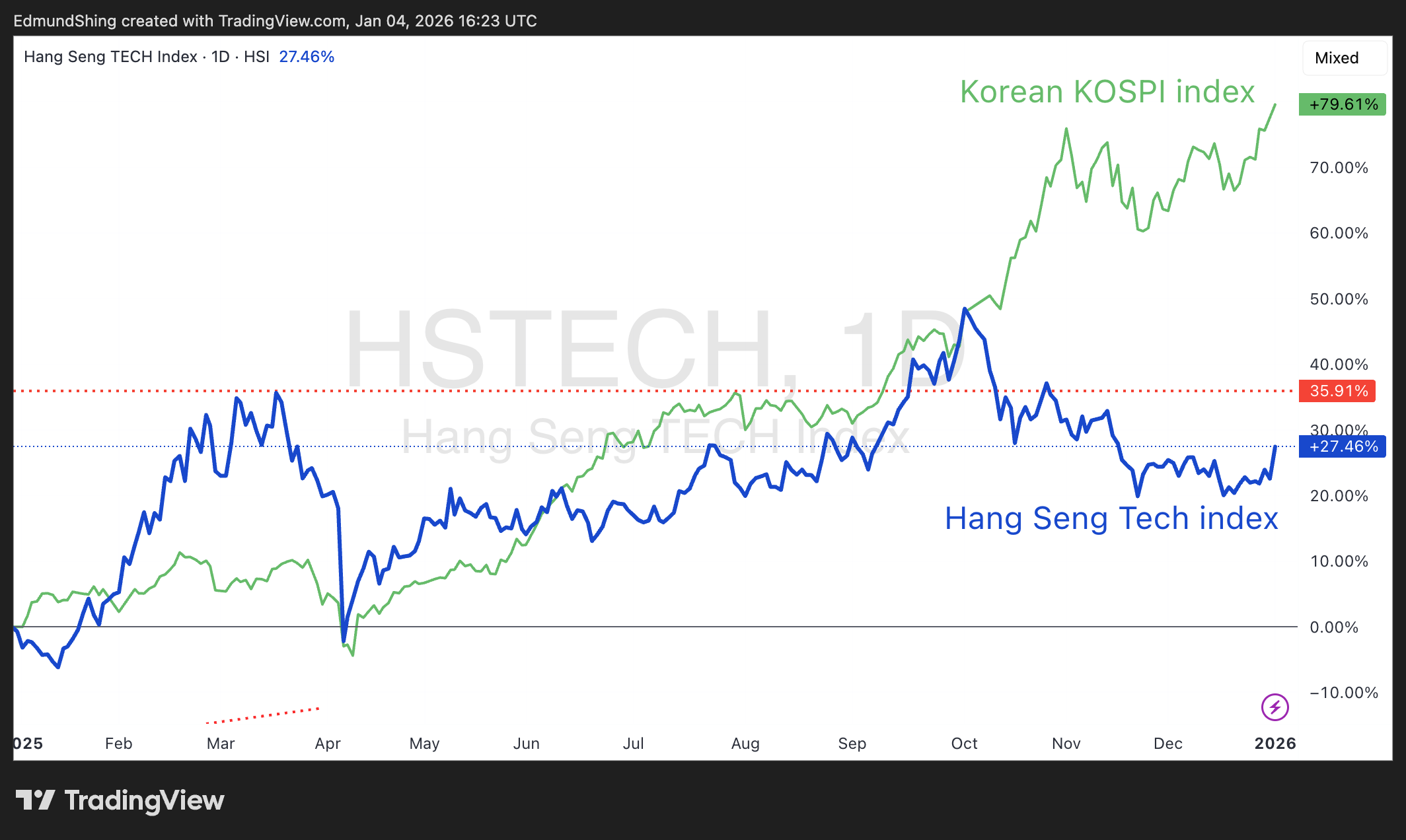
However, since October the Chinese technology sector has cooled, not following other Asian technology-oriented indices such as the South Korean KOSPI to fresh multi-year highs. Over the last 3 months of 2025, the KOSPI index has added over 20% propelled by AI demand for the high bandwidth memory chips produced by Korean companies Samsung and SK Hynix. In contrast, the Hang Seng Technology index has fallen over 10% over this same period, due in part to question marks over Chinese domestic consumption growth which remains relatively weak.
I believe that the Chinese government will introduce further measures to stimulate both domestic consumption and domestic investment in the stock market (as opposed to property and cash). Given that the average Chinese household financial exposure to the domestic stock market remains relatively low, there is still huge scope for the high Chinese household savings rate to be redirected in part to stocks, which would prove a potential motor for further performance.
Ultimately however, investors should be looking for top line and earnings growth, improving shareholder returns and a robust business model when looking at individual Chinese technology companies.
Pinduoduo (PDD)
My interest has been piqued by the recent disclosure that famed deep value investor Li Lu (who manages Himalaya Capital) has taken a new position in Chinese internet retailer Pinduoduo (PDD, listed in the US), worth nearly 15% of his concentrated value fund.PDD is the owner of internet retailer Temu, a close competitor in fast fashion and other goods to Shein.
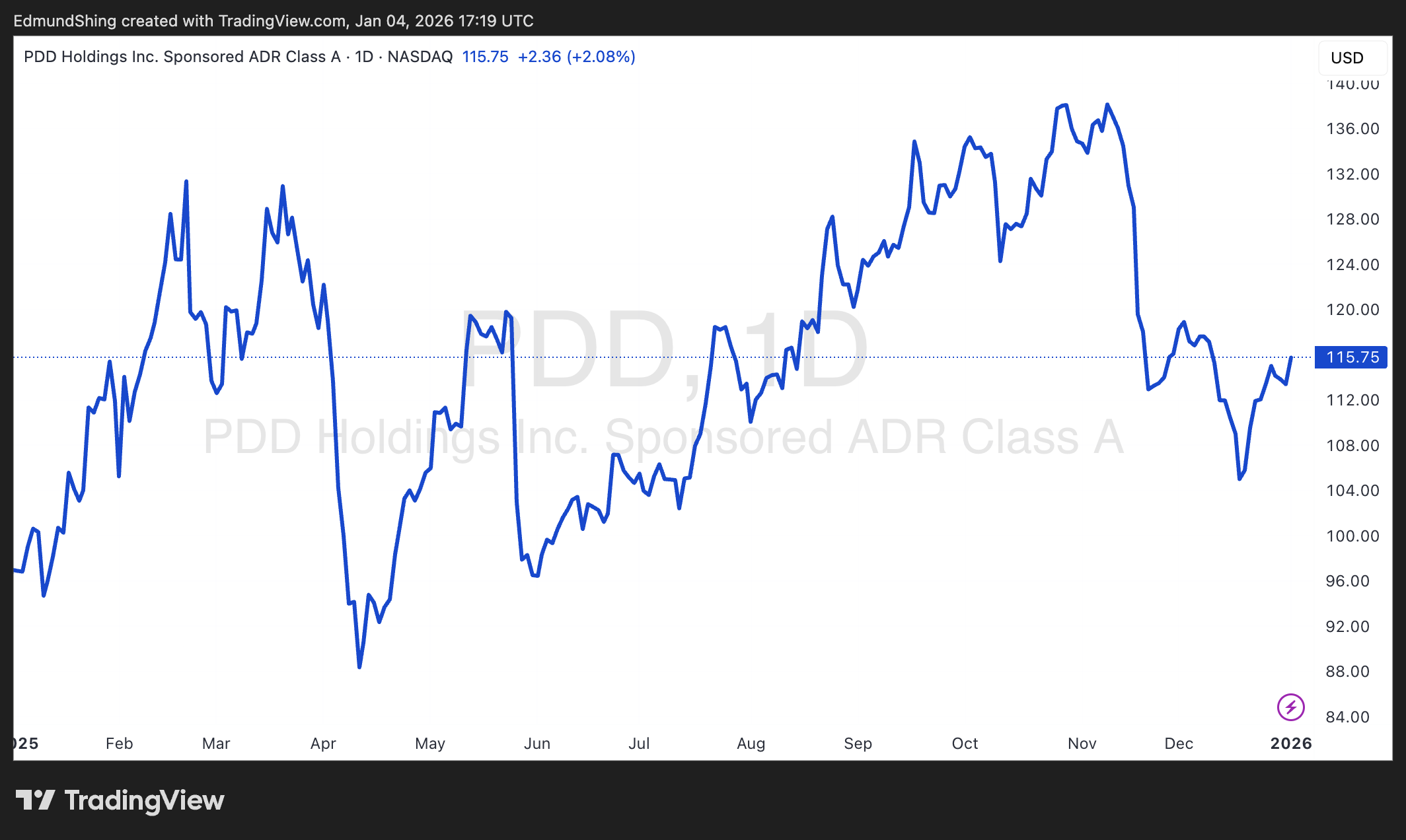
PDD is a mega-cap technology company with a market capitalisation of USD 166bn, and sports a combined StockRank of 98, ranking very highly both on Quality (89) and Momentum (86). Sales growth has been steady and impressive since 2019, and PDD is forecast to grow sales 10% in CNY (Chinese renminbi) in 2025 over 2024, with growth forecast to accelerate to 15% growth in 2026.
This is particularly impressive given that Temu has been a high-profile casualty of the imposition of US import tariffs by the Trump Administration on Chinese imported goods. As of May 2, 2025, Temu no longer ships goods directly from China to U.S. customers due to the expiration of the de minimis exemption, which previously allowed duty-free entry for packages valued under $800. The company has transitioned to a "local fulfillment model," with all U.S. sales now handled by locally based sellers and orders fulfilled from within the country.
In light of the imposition of US tariffs, PDD is reducing its reliance in the US market, with Temu’s US sales to account for around 1/3rd of total sales, as opposed to 57% at the end of 2023. Growth in other markets is still strong, i.e. in the UK and Europe. Temu had 416.5 million users as of Q2 2025, so has clear global reach and scale outside of China. The strongest growth in users comes from the European Union (140 million users, +74% year-on-year in 2025).
High Quality
Delving into PDD’s financials, the numbers look strong. The high Quality rank comes from high operating profit margins (22%) and returns on capital (23%), resulting in elevated free cash flow. This cash is piling up on PDD’s balance sheet for now, with net cash worth 36% of PDD’s market capitalisation (USD 68bn as of Q3 2025), a very high amount which seems rather inefficient from the point of view of capital allocation.
I believe that the power of the Temu business model is to provide unparalleled value to the end consumer in a similar fashion that Costco manages with its physical superstores in the US. Effectively Temu uses scale and cutting out the middleman (connecting suppliers directly to end-customers) to share the benefits of buying in scale with its customers, lowering prices and thus improving the value offer yet further over time.
This comes at a time when Amazon is pursuing a different strategy based more around delivering value to customers via packaged goods and services (e.g. via Amazon Prime membership which offers accelerated delivery, video and preferential access to special offers). Clearly, at a time when internet penetration of the retail market continues to grow (especially in Continental Europe), there is space for both to do well. Amazon focuses on convenience and speed of delivery, while Temu focuses on extreme value for the customer.
Good Value
The valuation also looks very attractive, with the cash-adjusted forward P/E of around 7x and a cash-adjusted free cash flow yield of 13%+. There is the question of what PDD will do with its fast-growing cash pile, with a number of options possible including paying a dividend (zero dividend for now) or buying back shares (it hasn’t bought any back thus far).
I like the combination of business model, quality and growth metrics and the attractive valuation.
Risks
There are of course a number of risks that should not be ignored, including the risk that PDD undertakes a massive acquisition with this cash pile rather than returning at least some of it to shareholders.
Secondly, one might worry about the risk that US-listed Chinese company ADRs (such as PDD) might be subject to stricter US SEC regulation or might even be forced to delist from US exchanges in the worst case. I see this risk as overblown, given the way that the Trump administration has already softened several times in its initially tough stance on tariffs on goods imported from China.
Overall, PDD ticks a lot of my boxes and is definitely worthy of further research.
All the best for 2026,
Edmund
Disclaimer
This is not financial advice. Our content is intended to be used and must be used for information and education purposes only. Please read our disclaimer and terms and conditions to understand our obligations.

6 comments
Late comment on this thread but I enjoyed listening to this relatively short GS Exchanges podcast on the US v China tech race. A number of different issues discussed including:
# China playing catch-up since the 80s/90s on software development. The US appears to have a clear lead on this.
# China still dominates rare earth mining and processing and the US is having to seek new deposits outside of China in order to complete. there is a one year agreement between the 2 countries to exclude rare earths from any trade discussions; this runs out later this year. In the meantime, the US is trying to source rare earths domestically and also from Australia. Greenland is now a known target!
# Chip development is ongoing. Deepseek has an advantage but it's AI model released in early 2025 cost considerably more than $10m (this was the cost of just the last stage).
# Cheap power sources are critical in order to operate huge data centres. The US may well use friendly nations in the Middle East in order to benefit from cheaper sources, presumably solar.
https://tinyurl.com/3tkyzytw
The problem is the processing of rare earth minerals, not the location, mining, nor ownership. The west has big issues trying to process them with all the ranting environmentalists. Everyone was happy for China to have the environmental mess and as a consequence we ended up having no processing worth a damn in the west. And it takes years to set it up. Now 'we' are ****ed!'
Thank you for highlighting the Chinese tech sector. Choosing a suitable ETF is always fun.....I plumped for HSBC Hang Seng Tech UCITS ETF HKD (LON:HSTC) which also gives me exposure to BYD.
3KWE 3x leverage shares ETP another way of direct exposure to this sector. Invests across the main players.
Leverage ETP is generally a bad idea. They tend not to do what is expected and even when they go up, a lot of the gain is eaten up by charges.
Agreed, incurs volatility drag that affects returns over periods longer than a few days. Should really only be used for short term trading strategies.