Market Musings 040223: Coppock Curve confirms bull trend

Market Musings 040223: Coppock Curve confirms bull trend
The long-term Coppock indicator flashes green for a potential long-term bull market
Summary
Coppock indicator turns positive for UK, France, US stock markets
US ISM Services PMI January report was surprisingly strong
Leading regions are: UK, France, Sweden, Mexico
Leading investment styles are Europe Value, US Mid-cap Value
Leading cyclical sectors are: Europe Banks, Industrials,Building + Construction
Leading growth sectors are: Europe Technology, US Semiconductors
The presence of Construction/Homebuilders is particularly surprising, given the global housing recession in progress…
Podcast: Real Estate blues or opportunity?
Is real estate still the biggest asset class worldwide?
What is the short-term outlook for European Real Estate?
Given today’s economic and financial context, shouldn’t investors avoid the Real Estate sector?
What are the long-term drivers for property demand?
What about the French market?
Coppock Curve indicator gives thumbs up to stocks
What is the Coppock curve? According to Investopedia:
The Coppock Curve is a long-term price momentum indicator used primarily to recognize major downturns and upturns in a stock market index. It is calculated as a 10-month weighted moving average of the sum of the 14-month rate of change and the 11-month rate of change for the index. It is also known as the "Coppock Guide."
Why is the Coppock Curve useful as a bullish stock market indicator?
The Coppock Curve is a technical indicator that provides long-term buy and sell signals for major stock indexes and related ETFs based on shifts in momentum.
The indicator is designed for use on a monthly candlestick chart, where each candle is one month.
A reading above zero on the indicator signals a buy, while a drop below zero is a sell signal.
In the case of the US S&P 500 index, this Coppock Curve has turned up from a low negative reading to positive, thus signalling a buy on US large-caps.
Coppock curve gives positive signal for S&P 500

Source: tradingview.com
The same can be seen on the FTSE 100 index:
Coppock curve gave a positive signal for the FTSE 100 too
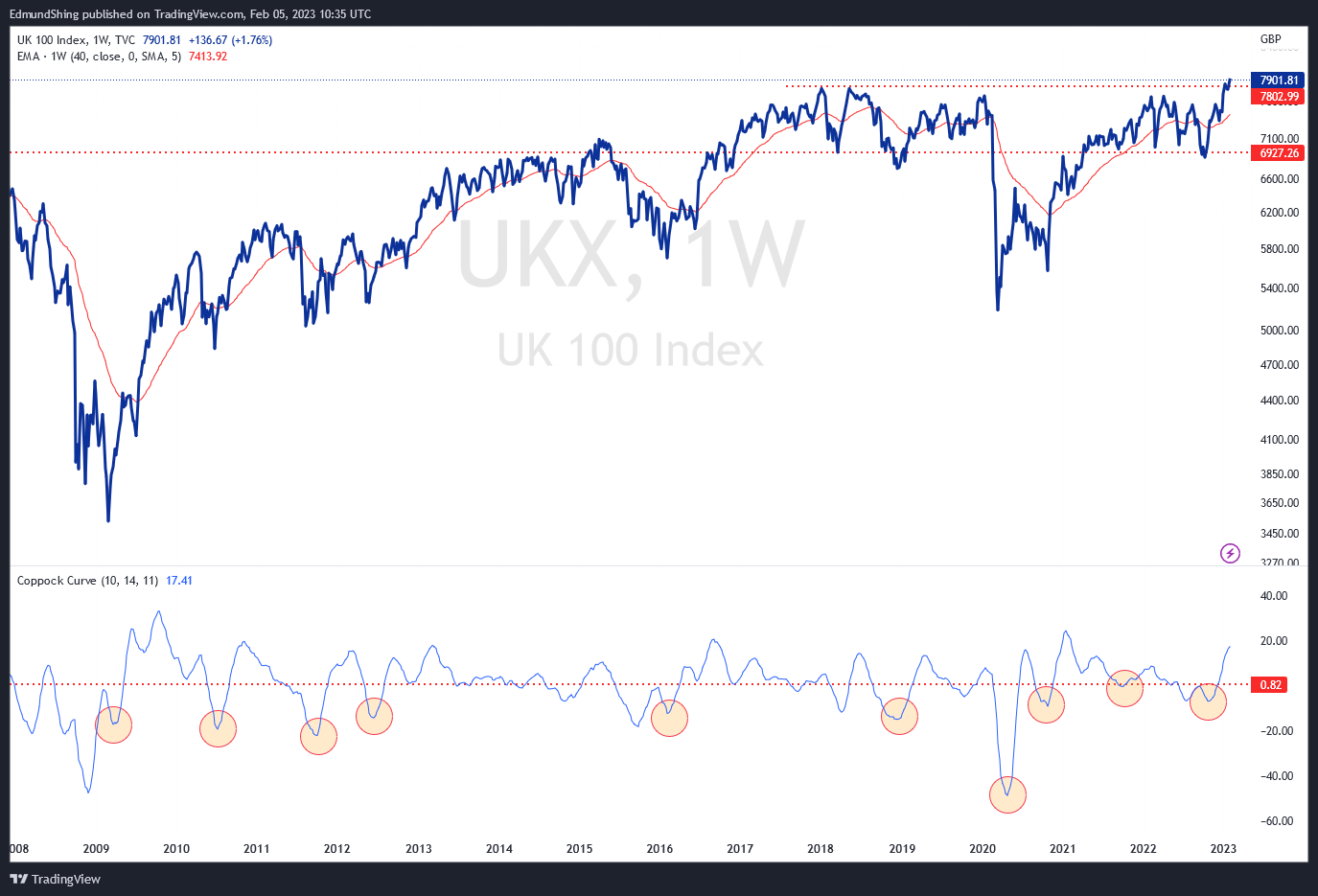
Source: tradingview.com
If anything, the FTSE looks more bullish because we can also add an All-Time High breakout signal to the Coppock Curve signal
Index breadth signals are also reassuring
For technical analysis fans, there are also a host of other bullish indicators based on breadth (the number of stocks above their own 200-day moving averages, or breaking to new 52-week highs) to add to this bullish outlook.
With the number of index components above their own 200-day moving averages, the key threshold for a fully bullish signal is 65% or more stocks above their 200d moving averages - the S&P 500 is at 71%, and is even higher for UK and European stock indices.
Breadth: 71% of S&P 500 stocks above their own 200-day moving averages

Source: barchart.com
All in spite of the rather gloomy economic outlook, with bond markets still predicting economic recession (the famous inverted yield curve signal) and with economic growth slowing on the back of the European energy crisis, slowing/falling housing markets and slowing consumer demand (in volume terms).
Surprising economic strength in the US ISM Services index
The key January US ISM Services PMI (remember that services are the bulk of the US economy) delivered a huge positive surprise last week:
January ISM Services PMI Index: 55.2 vs. 50.4 expected and 49.6 prior. Economic activity in the services sector accelerated during the month after contracting in December for the first time since May 2020.
Prices: 67.8 vs. 68.1.
Employment: 50.0 vs. 49.4.
Business Activity: 60.4 vs. 53.5.
New orders: 60.4 vs. 45.2.
Supplier Deliveries: 50.0 vs. 48.5.
It is difficult to see any signs of recession in this rather buoyant report of US services activity.
In many ways, the fact that stock markets are showing such strength in the face of obviously depressing economic trends is a positive sign in itself. At times like these, we have to remind ourselves that the stock market is a discounting machine that tries to look up to 12 months ahead. So perhaps the worst of the economic pain is now, with better times awaiting us in the months ahead?
What are the leading sectors, regions?
In the following section, I am simply going to highlight charts of regions and sectors that I think look particularly well-oriented to the upside, without further comment…This will show you where the best momentum at present can be found in stock markets…
French CAC-40 index

MSCI Mexico index (bottom chart is relative strength versus MSCI World)

OMX Sweden 30 index (bottom chart is relative strength versus MSCI World)

Europe Value style

US mid-cap value (bottom chart is relative strength versus S&P 500)

Europe Banks (bottom chart is relative strength versus STOXX Europe)

Europe Technology (bottom chart is relative strength versus STOXX Europe)

US Semiconductors (bottom chart is relative strength versus S&P 500)

Europe Industrials (bottom chart is relative strength versus STOXX Europe)

US Industrials (bottom chart is relative strength versus S&P 500)

Europe Building + Construction (bottom chart is relative strength versus STOXX Europe)

US Homebuilders (bottom chart is relative strength versus S&P 500)

Source: tradingview.com
Some ideas to ponder, have a great week,
Edmund
Disclaimer
This is not financial advice. Our content is intended to be used and must be used for information and education purposes only. Please read our disclaimer and terms and conditions to understand our obligations.

7 comments
Great article, thanks Edmund. I like to use the Coppock indicator on my monthly & yearly charts and have noticed it starting to turn up recently. It's only been wrong on two occasions since 1948, and the 11 & 14 month periods were selected because apparently that's how long humans take to recover from crises [such as losing a lot of money in the markets], which is why it doesn't work for predicting recession.
May i please enquire... How does one set up a chart to show this trend?
I think you use TradingView, it's a default indicator there [Coppock Curve], though not available on Stocko's charts.
Got it. Thank you. Have you customised it in a particular way at all?
No, I use it because of it's long term track record which would be lost if modified. I look for signs of an upturn from lows as confirmation of trend change.
The dollar seems to be turning bullish again. Will that spoil the positive set ups?
The dollar seems to be turning bullish again. Will that spoil the positive set ups?
It’s not really about the dollar. it’s the Fed and whether Friday’s upside surprise to the US employment data causes the Fed to hike higher and longer for fear of persistent inflation. Friday’s move in USD simply reflects that heightened risk..