Market Musings 051122: Does a bombing bond market herald a bonanza in 2023?

Market Musings 051122:
Does a bombing bond market herald a bonanza in 2023?
The 2022 bond market horror show could presage a huge comeback in 2023
SUMMARY
- Fed chairman Jerome Powell signals higher US interest rates ahead
- Bond markets have so far delivered terrible performance this year
- Previous years where US bonds lost 5% or more, the next year saw bonds rebound smartly
- Today could be an excellent entry point for bond investors
- Certain segments of stock markets could also benefit from falling long-term interest rates
PODCAST
Energy Efficiency
Why talk about energy efficiency? Edmund Shing, Global Chief Investment Officer at BNP Paribas Wealth Management, discusses the importance of #energyefficiency.
He describes the events over the past year that have ushered in a new era of #energy provision and explains what nations and the #EuropeanCommission are doing to adjust to changes in supply and demand.
2022 has been a bond bloodbath
Long-term government bond indices have traditionally been a safe haven for conservative investors, on the basis that they deliver relatively consistent returns to investors in the form of fixed coupons, have a very low (even negligible) risk of default (i.e. of investors not receiving their full principal amount invested back when the bond matures), and are typically not volatile at all, usually going up when stock indices decline.
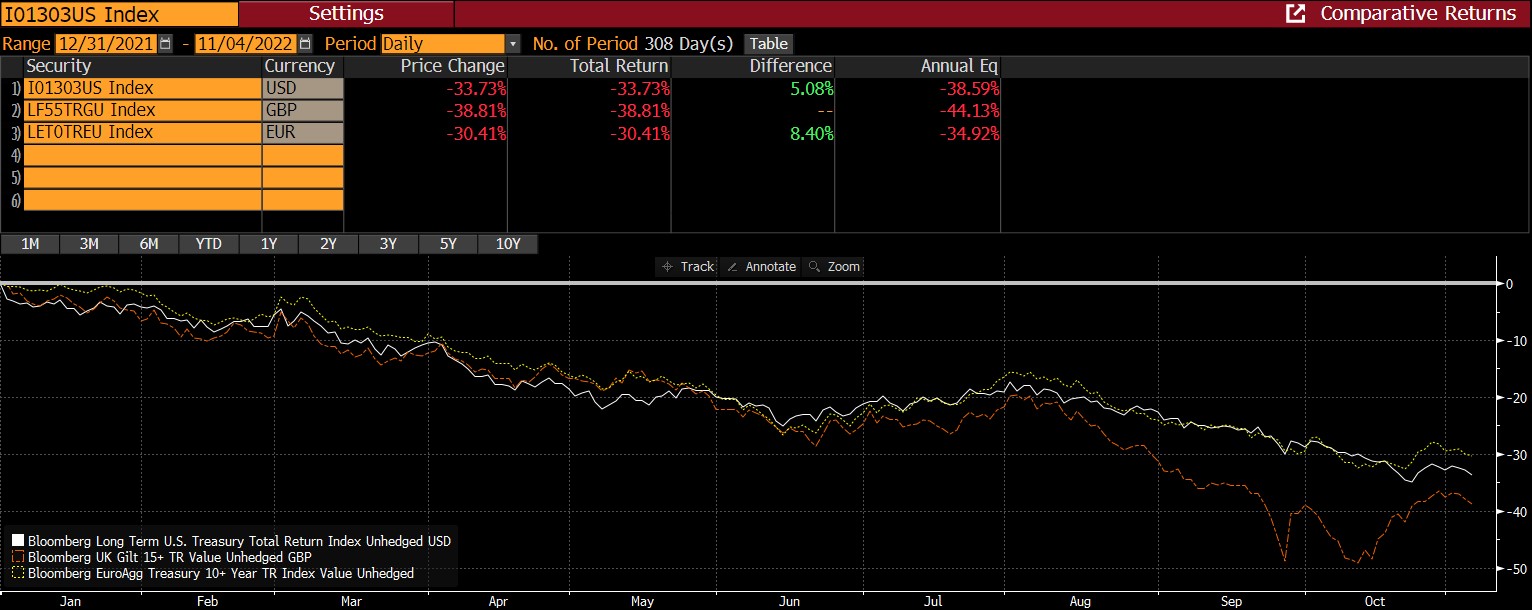
2022 has been a huge outlier for bond investors: long-term US, UK and Eurozone government bonds have all lost between 31% and 39% so far this year in their respective currencies, underperforming their local stock markets in each case.
2022 has been a horror show for long-term bond investors
Source: Bloomberg
For the period 2012 to April 2020, US and UK government bonds were showing very healthy long-term returns (capital gain + coupons received) of 6.6% per year (CAGR: compound annual growth rate) for US long-term Treasury bonds and 8.5% CAGR for UK long-term gilts.
However, following this year’s bond bear market, these 10-year returns have been reduced to almost zero…
The 2022 bond bear market has wiped out US, UK bond returns since 2012

Source: Bloomberg
The 2022 bond bear market is unprecedented…
To shed some historical light on the scale of this shock to bond markets, just look at annual returns from US Treasury bonds since 1928. There is no other year that comes even close to the damage done this year. Over 2022 to date, US 10-year Treasury bonds have returned -19.2%. The next worst year over the last 95 years for bonds was 2009, when US 10-year Treasuries returned -11.1%. On average, over these 95 years US 10-Year Treasury bonds have delivered an annual 5.1% average return.
No other year from 1928 comes even close to this year’s carnage in bonds

Source: BNP Paribas
Note that even during the inflationary 1970s decade, US bond returns were relatively healthy. Note too from this chart that it is very unusual to have two negative years of bond returns in a row - this was last seen in the 1950s, but even then, the bond returns were only modestly negative each time. Nothing like the scale of the losses experienced today.
The silver lining for bond investors, from here
There is a silver lining for shell-shocked bond investors, from this point on.
I would suggest that inflation rates have, or are about to, peak and then start to decline. Economic demand is slowing quickly on the back of the combined pressure from higher prices and from higher financing costs. Supply chain issues are easing after COVID-related disruptions last year which should help to stabilise goods prices, and even energy prices are on their way lower.
I believe that inflation rates will start to fall soon in Europe, and are already falling in the US. I further believe that this fall in inflation will accelerate over the coming months, and could even surprise economic observers and investors alike.
With central banks such as the US Federal Reserve and the Bank of England potentially signalling a slowing of the pace of future rate hikes over the next few months, we can see bond yields are starting to anticipate this change in tone from central bank governors. Typically, bond yields peak about 1-2 months before a peak in central bank base rates - so if you expect central banks to stop raising their reference interest rates (such as the Bank of England base rate) early next year, we should expect bond yields to peak very soon if not now.
Indeed, 10-year bond yields look to be peaking today, and may soon start to fall back after what has been a very sharp rise so far this year.
Remember that at the beginning of 2022, the UK government was able to borrow money for 10 years at a rate of just 1%, but now has to pay 3.5% for the same privilege today.
10-year US, UK and Euro government bond yields could be peaking now

Source: Bloomberg
Looking back once again at history, note that on each occasion that US 10-year Treasury bonds suffered an annual loss of 5% or more, the following year saw a sharp rebound in bond market performance of 14% on average.
Following a poor year for US bonds, the next year saw positive bond returns

Source: BNP Paribas
While 2022 has been an annus horribilis for bond markets worldwide, 2023 could see a big rebound in bond market performance given historical precedents and the expectation for a substantial fall in inflation rates.
Conclusion
Conservative bond investors could be forgiven for wanting to sell their bond exposure after a historically awful year from what are supposed to be low-volatility, boring investments.
But history suggests that investors should do the opposite, and actually increase exposure to bonds at this point given that bond yields on offer today are the highest since 2008 in the case of US Treasuries, and since 2011 for UK gilts.
There are a number of easy ways to invest in long-term bonds today via ETFs:
- For UK government bonds (gilts), there is the VGOV Vanguard UK Gilt UCITS ETF. For investors who specifically want exposure to long-term gilts, there is the GLTL SPDR Bloomberg 15+ year Gilt UCITS ETF.This latter ETF yields around 3.3% at present.
- For US Treasury bond exposure, you can look at the IBTL iShares $ Treasury Bond 20+yr UCITS ETF, which offers a 2.9% yield.
For investors prepared to look at single issuer bonds and preferred shares, there is a wide selection of long-term UK corporate bonds (often perpetual, i.e. with no set maturity) which can offer high yields at present, from issuers such as building societies and insurance companies.
For more information on this sector, I would refer you to Paul Scott’s recent interview with Paul Hawkins, a corporate bond specialist.
For stock market investors, there are several ways to benefit from slowing inflation rates and potentially lower bond yields.
- US Real Estate Investment Trusts should benefit from lower long-term US bond yields. In 2010, as US 10-year bond yields declined sharply, REITs returned 28% over the year (versus 15% for the US S&P 500 index); look at the IUSP iShares US Property Yield UCITS ETF.
- US high dividend stocks performed strongly as bond yields declined in 2010, gaining 21% versus the S&P 500’s 15%.There is the UDVD SPDR S&P US Dividend Aristocrats UCITS ETF
- European mining stocks rebounded very strongly (+29%) over 2010, outstripping the STOXX Europe index (+12%) as investors looked through recession to the economic recovery beyond. Today, any change in China’s zero COVID policy to gradually reopen their economy and help domestic demand could also boost commodity demand, which in turn could help global mining companies. One could consider the GIGB VanEck Vectors Global Mining UCITS ETF for exposure to this sector.
Have a great week,
Edmund
Disclaimer
This is not financial advice. Our content is intended to be used and must be used for information and education purposes only. Please read our disclaimer and terms and conditions to understand our obligations.
12 comments
All the other people commenting seem very wise. I just wanted to say thanks Edmund. You lay out arguments very logically and offer balancing arguments on both sides. Ive acted on some of your posts and not on others. Profoundly appreciative of your skill at this.
I don't really understand credit markets so probably way off here but won't rates have to go higher to control inflation, thereby causing bond markets to fall? More QE would reduce rates but who's going to buy bonds if the currency is being inflated away, does anyone expect growth to stay ahead of inflation if rates are to be kept artificially low?
"won't rates have to go higher to control inflation, thereby causing bond markets to fall?"
Hi XTR, my take on this is that the mathematics of inflation mean this is not the case. We know that inflation is simply today's prices compared with those 12 months previously. So if we know that prices in (say) September last year were super-high, and have since fallen back, then we can predict that all else equal, inflation this September will be lower because it will be measuring price increases from that level.
How much lower depends on various second-order effects and, of course, how significant the items whose price has fallen are in the scheme of things. As those things include energy and shipping, I'd say pretty significant.
I'd expect the Bank of England to look at the data and do one more raise to 4,5% and then that will probably be it. Inflation will fall of its own accord, quite sharply in Q3 and Q4. It could well get back to 2% by the end of the year, in my view.
Hi Whitbourne, Thanks for responding. I take your point about inflation being the year on year difference, I've heard some US based analysts refer to this as the 'comp's'. Even if inflation were to return to the target 2% [Sunak has essentially ruled this out by pledging to half interest rates from 10%], the recent increase still represents a loss of purchase power for companies, institutions, and individuals alike, which will impede economic growth. If so, then wouldn't there have to be either: higher rates for longer, QE, or a period of deflation to create the conditions for growth?
Edmund
As I suspected the inflation is proving more stubborn. However, I think you may be right about the BoE's reluctance to raise rates, despite wage inflation etc. In the EURO-zone and US it loooks like rates have further to go so maybe the correct way to play this is through the currency market? It seems that GBP is already weak but if US rates were at 5.5%+ and EUR rates at 4% then either GBP rates go higher or the GBP goes lower - more inflation ahead. I would be interested in your latest thoughts on this. It will be all very well to achieve reasonable returns on the FTSE but useless if the GBP falls by more. As a case in point I was mistaken to own SHEL last year versus CVX or XOM as the currency adjusted returns were way higher for the US companies.
Alex
Would you be going short duration to start with Edmund in case we are still six months off peak bond yields ?
Interesting article Edmund.
I see this as potentially being an ‘inverse burry’ trade. To explain; a year or so ago, Michael Burry was taking some pretty significant positions against long term US bonds, expecting rising inflation and interest rates to push the bond prices down. There’s a very good video on it here:
unfortunately for him, he was absolutely correct but I think he abandoned the positions before they really go going... I recall the bond prices held up quite well to begin with, which perplexed a few market commentators, but they did drop eventually:
With inflation potentially peaking now, and interest rate rises potentially slowing, this trend could start to reverse as you discuss above.
My only doubt is about timing.... are we likely to see a reversal only once interest rate hikes hit zero, or start to reverse? If so, we may be a few months away yet. If passing peak inflation would cause bond prices to rise, then I agree that it could be happening now.
I’m considering taking a position here and holding for 1yr+.
Way Off-topic
but the only way to ask Edmund Shing for an opinion.
He has, or had, family in Hong Kong.
EWH is the U.S. listed Hang Seng index etf just bought at historic lows.
However I have had direct investments in Hong Kong for 40 years. Three years ago I decided to pull out but it has taken all that time and constant bureaucratic obstacles to sell, transfer or close my accounts.
It used to be different and I wonder if politics and the brain-drain are the reason. Individuals there have been very helpful but every time I give instructions some one else refuses.
The peg has a good chance of staying and freedom of capital movements too according to my readings but Edmund's opinion would be appreciated.
China benefits from the electronic infra-structure for payments in both directions, import receipts and investments in bonds abroad.
That brings us a bit more on topic. If China, Russia and others develop their commodity-based-common-currency then China will sell down its massive U.S. Bond holdings.
Yields will rise, prices fall.
It is several years away
on the horizon
beyond the scenario described by Ed but we shall see what he replies.
Hello a flash
Yes I couldn’t resist replying!
So, there are several points here which I think bear mentioning:
1. Clearly the “One China, Two Systems” has taken a body blow from President Xi’s actions; in principle, not good for Hong Kong.
2. The consolidation of power by President XI at the recent CCP Congress is not good news either, as it signals a more autocratic regime ahead for China, including HK.
3. BUT foreign investors can see all this, and are today extremely pessimistic on all that is China or HK in terms of financial assets
4. While there may be a continued “brain drain” from HK eg to Singapore or even the UK, this will NOT undermine Hong Kong’s long-term position as a key financial centre in Asia.
5. I expect to see more softening of China’s zero COVID policy (already underway in HK) as I do expect a gradual pivot of policy towards supporting the domestic Chinese economy and employment.
6. I don’t think the HK/USD peg is at risk in the short- to medium-term. Interesting to note that the peg has held strong despite the political turmoil in HK, and with the HKMA not following the US Fed step by step in raising interest rates to the same degree.
7. I do think that there is a long-term strategic question mark over holding Chinese equities particularly in Chinese tech stocks, given the greater influence on corporate policy from the Chinese government. But this is unlikely to prevent a sharp tactical rally in Chinese/HK equities should we see more evidence of a XI pivot towards supporting domestic Chinese growth. From a very depressed point…
Hope that helps,
Edmund
Edmund, 2022 has been an historically bad year for bonds but they are coming off historically elevated prices. We are not even back to 'normal' rates yet in the UK and elsewhere and, if you take Jay Powell at face value, inflation is not yet under control. Indeed, we still have no clear idea of how much follow-through wage inflation there will be in most markets, and that issue is clouded with the very different demographic picture we currently have compared with historical precedent - there just aren't a lot of young people to come through to keep wages suppressed. We are also, possibly, moving into a bout of deglobalisation which could keep inflation higher for longer. I think one should be cautious about re-entering the bond markets, especially one should be wary of long duration bonds and, I, personally, would be extremely cautious on long Gilts - a massive current account deficit will need to be plugged with either higher rates or a much weaker sterling - neither a great background to owning GBP-denominated long-dated bonds. I remain short gilts.
Hi Alex,
All fair points, but in the shorter term, I believe that the combination of greater austerity policies plus a reversal in the UK housing market will calm yields.
The Bank of England will raise rates yet further in the months ahead to perhaps as high as a 4.5% base rate, implying mortgage rates more like 6%. Together with higher unemployment (on the back of UK recession), this will act to send house prices substantially lower.
This, together with much higher energy bills, will depress domestic demand. In addition, wage pressures should cool as unemployment rises - we are unfortunately about to see a surge in small company bankruptcies, in my view.
All of which suggests a better position for bonds.
I do agree with many of your points eg deglobalisation, but that this is more a medium-term inflation pressure rather than an effect in the next year or two.
Edmund
Great call for the short term. Well done. UK10Y has rallied 80bps or so in the last week. Is that the 2023 rally substantially done already I wonder?