Market Musings 071126: Not the end for the AI investment boom

Market Musings 071126: Not the end for the AI investment boom
Summary
A dramatic volatility event on 5 October, focused on the AI investment boom. Retail favourite stocks were particularly hard-hit in the rotation out of high momentum names
Despite this, most stock indices remain in solid medium-term uptrends, including the S&P 500 equal-weight index
Risks to the AI investment boom in data centres from Democrats are exaggerated
Short-term sector rotation towards low volatility and defensives is to be expected, but we continue to favour balancing technology exposure with Value.
The 5 October spike in the VIX index is the third-largest daily percentage gain in the VIX since 1990. Expect a reversion to mean (lower) in the VIX index, and positive returns to US stocks over the next few months.
Some interest-rate positives: fewer Federal Reserve rate hikes now expected, lower long-term bond yields.
Near-term risk: potential re-escalation of the Iran conflict
Even if near-term stock volatility persists, now is a good entry point for long-term investors into global stocks
Thursday 5 November: just how bad was it?
On Thursday last week, the tech-heavy Nasdaq 100 index dropped 6.6% on growing fears over slowing AI investment growth, post the Democrat sweep of both Houses of Congress at the mid-term elections. By the close on Friday, the Nasdaq 100 has dropped 14% from its 6 October all-time high. Emerging markets have suffered even more, off 17% from their 22 June high and now up just 9% in US dollars for the year to date.
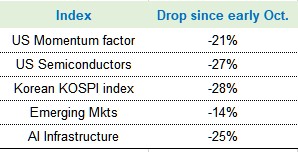
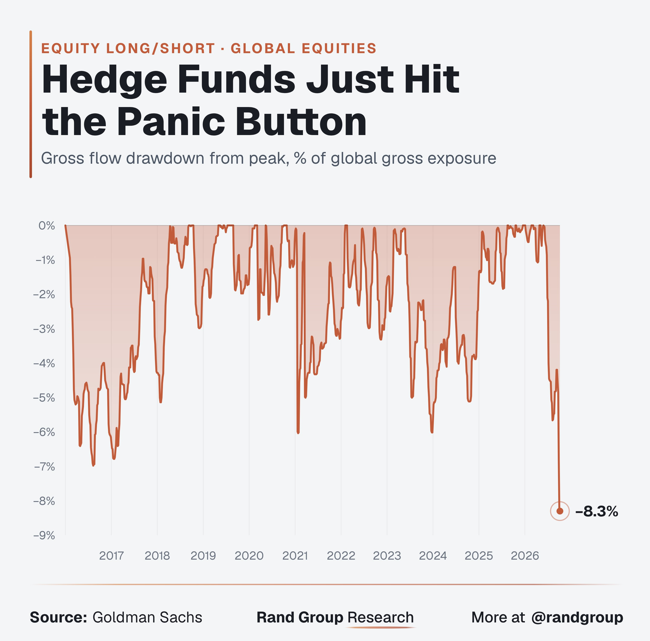
The trigger for this AI-related selloff was the fear of tighter regulations around US data centres, particularly in data centre-heavy states such as Texas (which has a new Democrat governor), Virginia and Ohio. The resulting caution over the growth in AI-related investment has triggered a wave of selling by hedge funds as they are forced to reduce their positions by their risk managers. Indeed, this wave of so-called “degrossing” by hedge funds is the largest such wave of selling seen over the last 10 years, according to Goldman Sachs and Morgan Stanley.
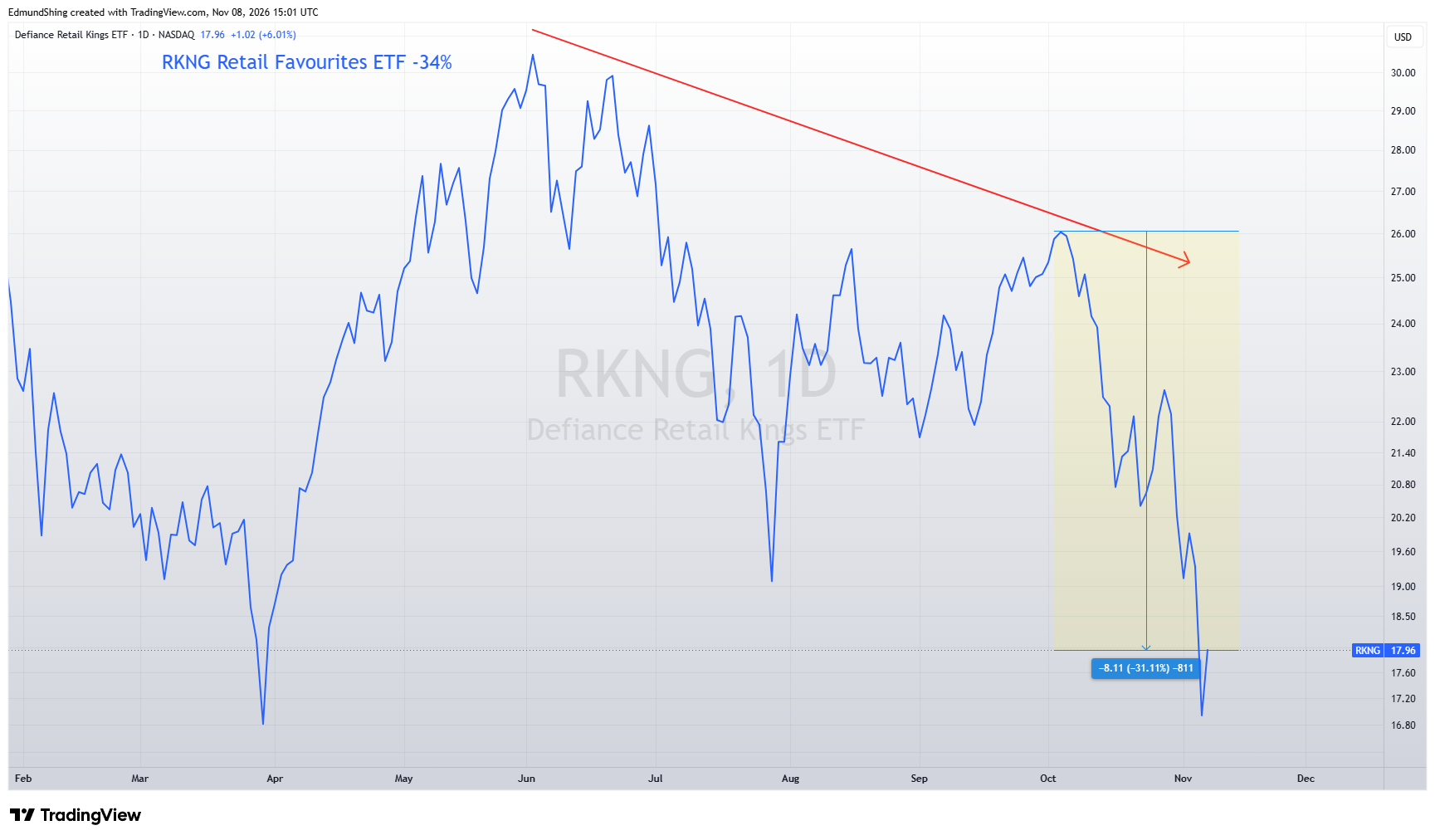
This has resulted in sharp drops in various AI-related regions, sectors and themes such as Semiconductors, AI Infrastructure, South Korea and the US momentum factor. Retail investor favourites have been particularly hard hit, with the Defiance Retail Kings ETF losing 31% from 5 October.
Defiance Retail Kings ETF loses 31% from 5 October
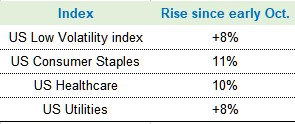
There has been a dramatic sector rotation in the US since early October back into defensive sectors and factors such as Low Volatility, Health care, Consumer Staples and Utilities. Of these sectors, I prefer Health care given the strong growth in GLP-1 drugs and the potential productivity gains to come in drug discovery and diagnostics from widescale AI adoption.
A dramatic volatility event: the VIX surges
The VIX index of US implied volatility surged by 70% on 6 October from under 17 to end at 28. This represents the third-highest daily percentage rise in the VIX index since its creation in 1990.
VIX index surges from 17 to 28 on 5 October
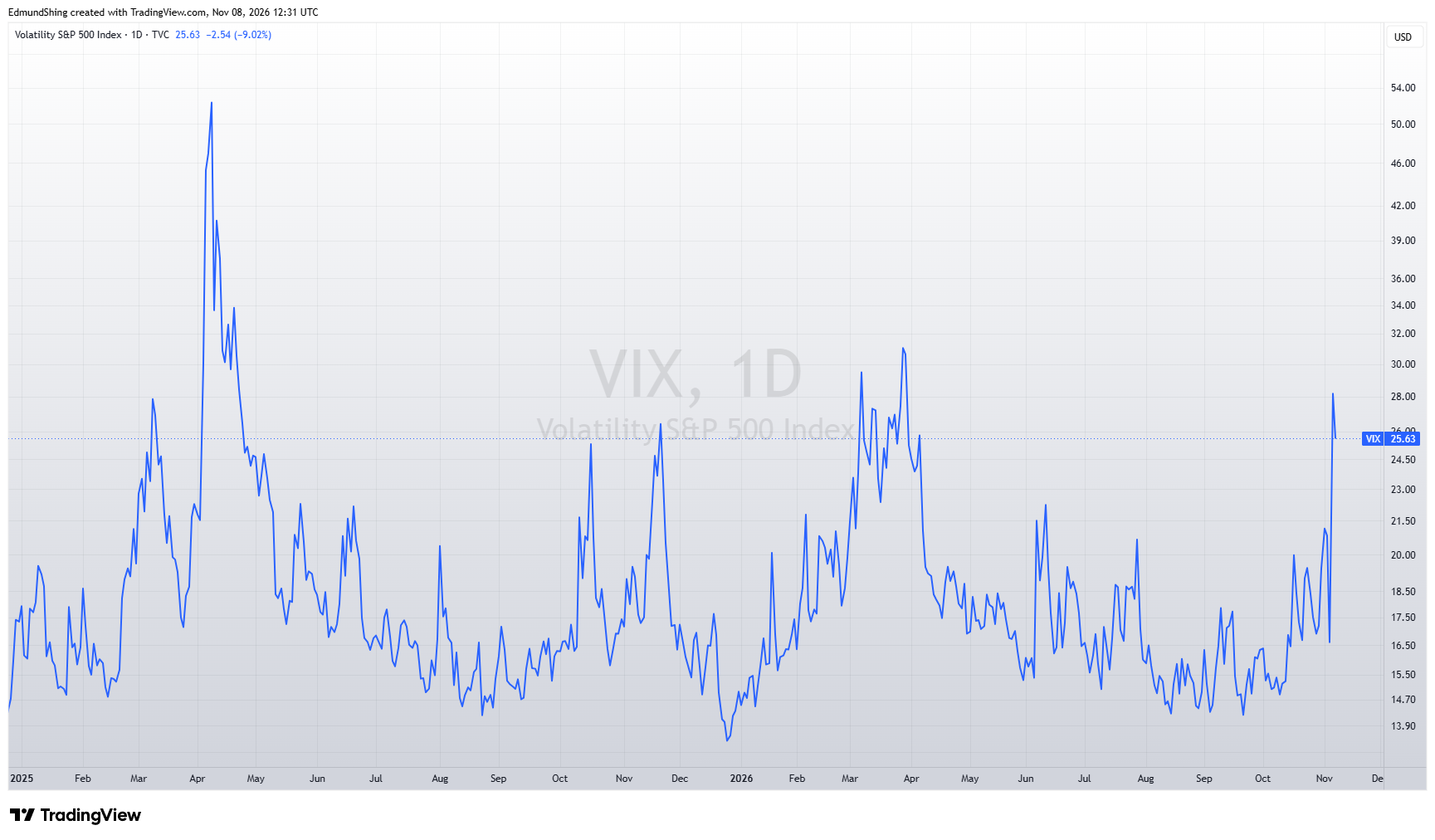
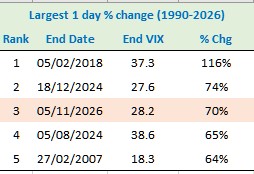
Typically, when the VIX index rises this sharply over one or a few days, there is typically a relatively quick reversion to mean in the following days and weeks. A good example of this is the sharp rise in the VIX index in April 2025 around President Trump’s announcement of widespread import tariffs on his so-called “Liberation Day”, when the VIX rose from 17 in late March to briefly touch 60 on 7 April, before then returning to a sub-20 value by 12 May.
In the past, taking the 20 largest 1-day moves for the VIX index, subsequent US stock performance was overwhelmingly positive from 3 months to 2 years following the VIX spike, on average +10% after 6 months and +17% after 1 year. This is particularly true once we see backwardation in the VIX term structure (as is the case at present), where front-month VIX futures are higher than later months - a relatively rare event.
VIX term structure: front month is higher than later months - as of 6 October
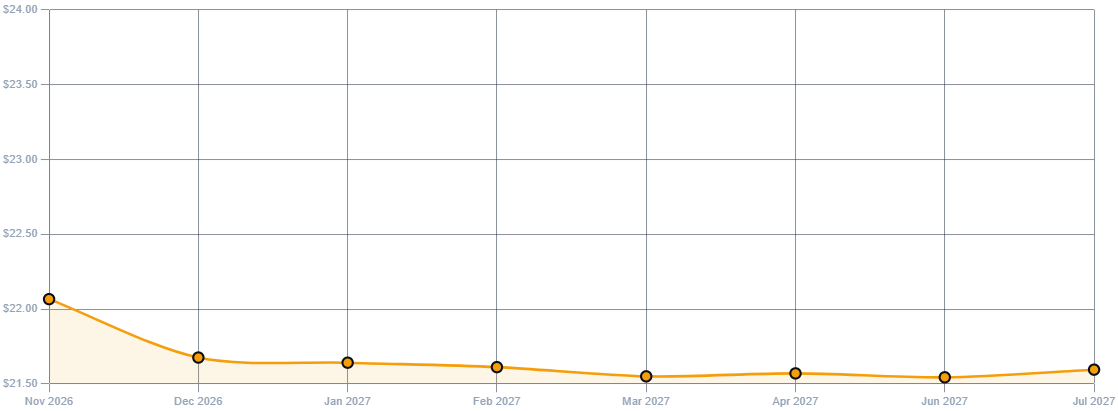
Following the largest VIX index spikes, US stocks usually rallied
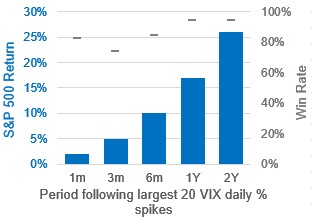
If we can assume that the bulk of the hedge fund selling to derisk their portfolios has already occurred, then there is good reason to believe that US stocks can recover in the months ahead, even if in the very short term they may remain volatile.
Indices with lower tech weightings retain double-digit returns this year
The damage done in stock markets has been mostly in the more popular technology-heavy indices, sectors and themes. But less concentrated, more diversified stock market indices with more modest weightings in technology continue to post double-digit returns for the year so far. The MSCI All-Country World Index is still up 8% this year in USD and +14% in euros. Europe-heavy investors have been hit less by the AI selloff, with the STOXX Europe 600 index only 2% from its all-time high and +12% for the year, and the UK FTSE 100 index still over 10% up this year in pounds sterling.
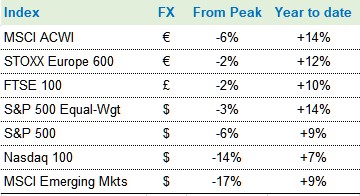
Equal-weight indices with lower concentration risk have also weathered the October storm well, with the S&P 500 equal-weight index still up 14% this year given its relatively modest 16% technology sector weighting, compared to 48% for the classic cap-weighted S&P 500 index and 68% for the Nasdaq 100.
Value factor indices have also performed well, with the MSCI World Enhanced Value index up 26% in USD this year thanks to a relatively high weighting in the Energy sector, while the Avantis US large-cap Value index is up 22% for the year.
Some positives: fewer interest rate hikes now priced, lower long-term interest rates
The switch in focus from a potential overheating of the US economy to questions over the sustainability of AI-related growth have triggered a reassessment of both short- and long-term interest rates. In the US, interest rates futures now price 1.8 Federal Reserve rate hikes by mid-2027, down from nearly 4 rate hikes at the end of September. The US 10-year bond yield has also retraced some of its move higher since March, now 4.85% from an early October high of 5.3%. Even the French 10-year OAT yield has cooled modestly from 5.1% in mid-October to 4.76% today.
This is interesting as these falls in US yields come as the US economy is, if anything, accelerating judging by latest economic data on the labour market and factory orders.
What to watch for in the days ahead
While I believe that the current technology selloff is an overreaction to the risks to AI data centres posed by Democrats in Congress and at the state level, there are still risks to be navigated in the near term.
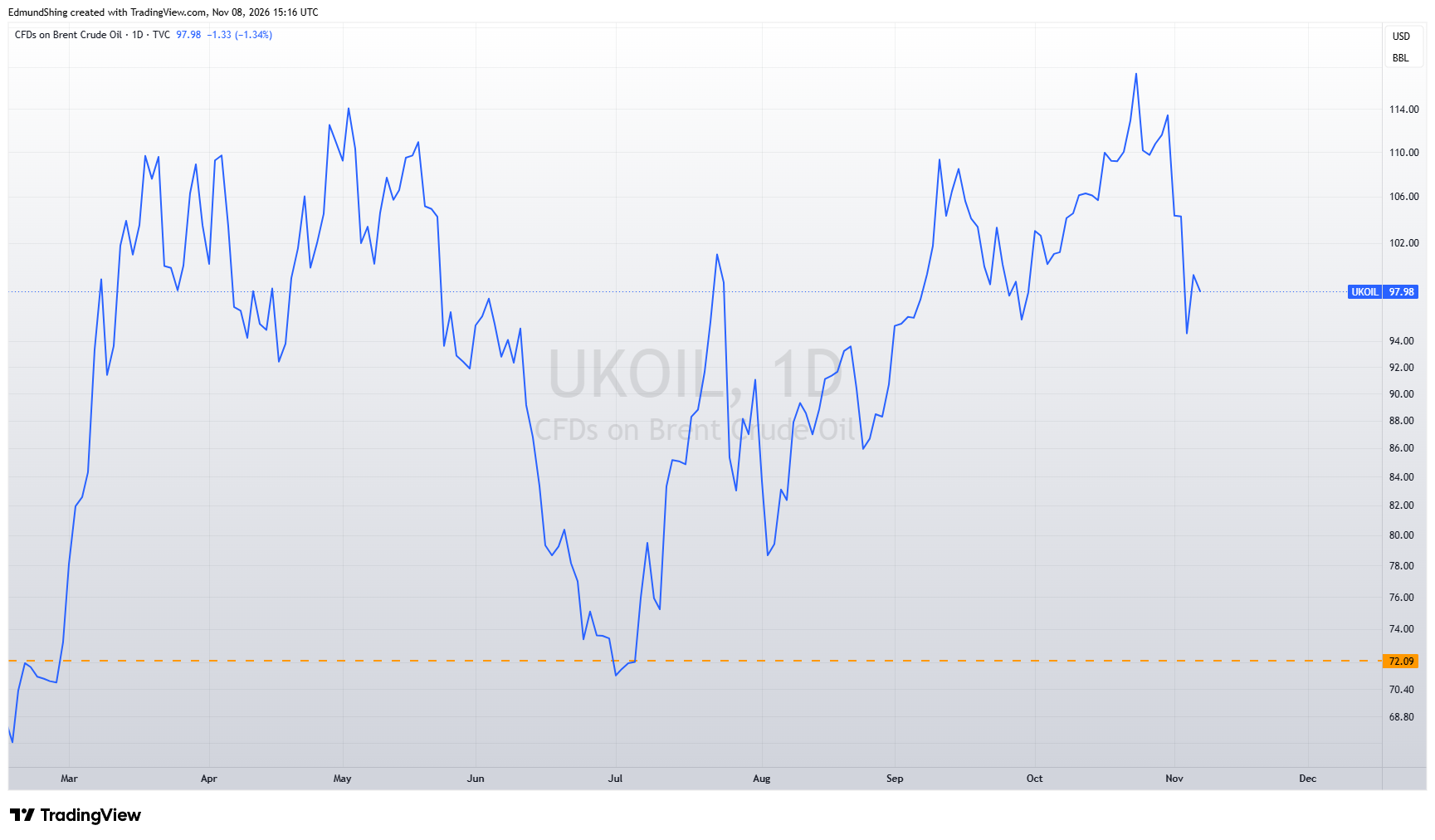
The most important of these risks is that of a potential re-escalation of the US-Iran conflict in the absence of a new ceasefire agreement. Such a military re-escalation could trigger a new surge in oil prices, after an easing both in crude oil and European diesel prices over the last 2 weeks.
Brent crude oil has fallen under $100/barrel for now
It is certainly not the time to reduce holdings in stocks today; if anything, the next few days should present a good opportunity for long-term investors to increase their stock positions at more attractive levels. I retain my positive view on global stocks, expecting further robust returns over the next 12 months.
Parallel to the 1990s internet boom
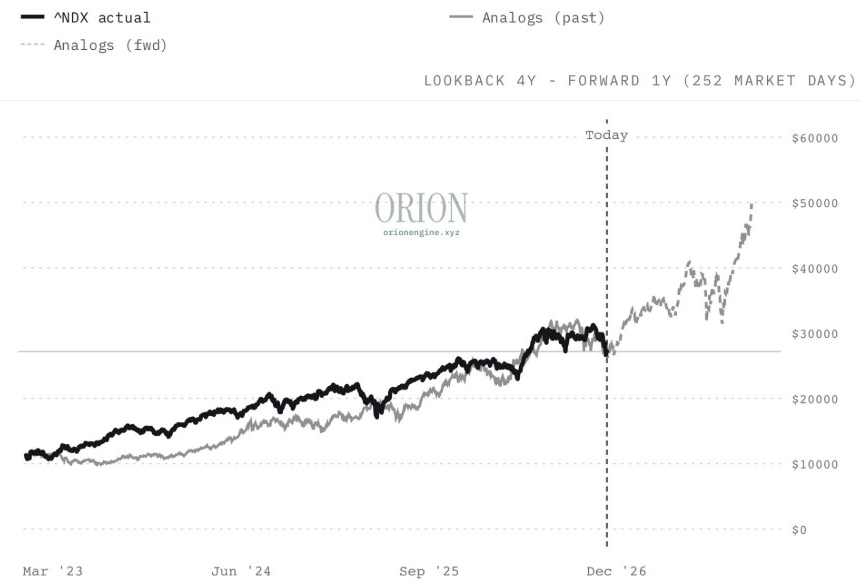
One interesting parallel to this AI sell-off today is the similar bouts of volatility experienced by the Nasdaq index during the 1990s internet bubble. One can potentially argue that the current sell-off is similar to the 16% selloff that occurred at the end of 1997. Back then, it did not spell the end of the internet boom, as the Nasdaq went on ultimately to nearly 4x from this point by early 2000.
Nasdaq analogue: AI boom today versus 1990s internet bubble
Disclaimer
This is not financial advice. Our content is intended to be used and must be used for information and education purposes only. Please read our disclaimer and terms and conditions to understand our obligations.
No comments yet
No one has commented here yet! Why not be the first one?