Market Musings 080423: Charting the markets

Market Musings 080423: Charting the markets
When a picture is worth a thousand words
(and when I don’t feel like writing much over a long weekend…)
Summary
Price pressure PMI components point to lower inflation ahead
GBP Sterling has been the strongest major currency over Q1 2023
US dollar looks set to follow US manufacturing activity lower
European company profit margins at a record high
Long-term asset class return expectations from JPM
Trend-following hedge funds are max short stocks at the moment
Nasdaq 100 still trending higher, Euro STOXX 50 back at year high
UK long-term bonds should rally, following US bonds
An interesting read on 35 years of financial crises and stock market reactions
Podcast: The Opec+ Oil Ambush
The facts
The crude oil price
Political tensions
What is your 12-month forecast for oil?
What is your current view on Commodities as an asset class?
Interesting charts I have found over the last few weeks…
I thought that this week, I would highlight some interesting charts that I have found over the last week or so, together with the conclusions I draw from them.
1. Price pressure PMI components point to lower inflation ahead
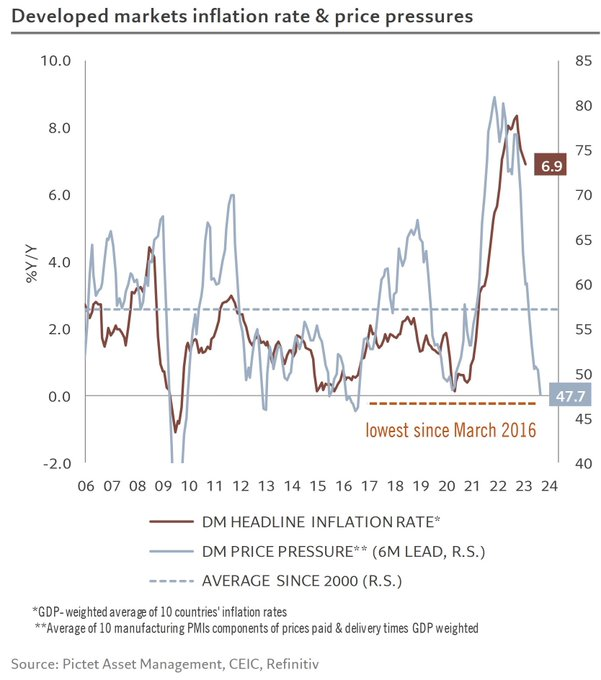
Source: Pictet AM
Conclusion: leading price indicators suggest that price pressures have essentially all but evaporated over the last few months. This suggests that inflation across developed economies should ease much lower in the months to come.
2. GBP Sterling has been the strongest major currency over Q1 2023

Source: tradingview.com
Conclusion: despite all the doom and gloom surrounding the UK economy post COVID and post Brexit, sterling has been gaining versus its main trading partners this year. This underlines the fact that the UK economy may still escape a recession this year, with the domestic economy still robust and the housing market not collapsing under the weight of higher interest rates.
3. US dollar looks set to follow US manufacturing activity lower
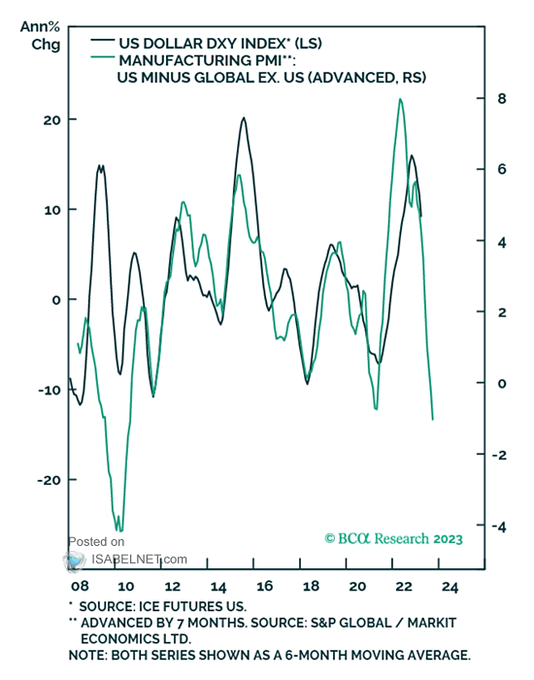
Source: BCA Research
Conclusion: US manufacturing is in recession according to the US ISM manufacturing PMI survey, which stands today at well under to 50 breakeven level, pointing to a manufacturing recession. But this is not evident in the rest of the world, suggesting the path for the US dollar could be lower still against major currencies.
4. European company profit margins at a record high

Source: Eurostat
Conclusion: we know that the European stock market is heavily weighted towards economically-sensitive cyclical companies. So it should be no surprise really to find that European companies have benefited from this recent surge in inflation to raise prices to not only cover increases in cost, but also to make extra profits too. In fact, this very point has been noted by the European Central Bank itself… Of course the big question is then, as inflation cools down, can companies hold onto this excess profitability?
5. Long-term asset class return expectations from JPM

Source; JP Morgan
Conclusion: over the very long term, valuations matter – a lot. This is evident from JP Morgan AM’s long-term asset class return expectations, with the cheapest stock markets of China, the eurozone and Japan offering the highest theoretical returns. In contrast, US large-cap stocks are expected to offer the lowest stock market returns - consistent with its high current valuation and fantastic trailing 10-year historic performance.
6. Trend-following hedge funds are max short stocks at the moment

Source: Goldman Sachs
Conclusion: contrarians should buy when this CTA hedge fund positioning indicator suggests that they are at max short positioning, as appears to be the case presently. It certainly worked well in October last year, and again at the beginning of this year…
7. Nasdaq 100 still trending higher, Euro STOXX 50 back at year high

Source; JP Morgan
Conclusion: despite the tightening financial conditions resulting from higher central bank interest rates and the US regional banking stress, both the Nasdaq and the Euro STOXX 50 stock indices continue to trend higher. Even the FTSE 100 is only 3.5% off its 2023 highs…
8. UK long-term bonds should rally, following US bonds

Source; JP Morgan
Conclusion: inflation rates may still be uncomfortably high today, but with the full impact of previous interest rate hikes still to hit the economy, both growth and inflation should slow over the rest of this year, boosting long-term bond prices (on lower yields).
9. An interesting read on 35 years of financial crises and stock market reactions

Source: Jeffries
Jeffries article: Normalcy Returns Faster Than You’d Think After Financial Crises
Conclusion: The Jeffries “glass half-full summary -
“Our world always finds a way forward. In fact, things are usually pretty darn good in a surprisingly short period of time after we avoid the often anticipated “end of the world.” “
Have a great Easter weekend,
Edmund
Disclaimer
This is not financial advice. Our content is intended to be used and must be used for information and education purposes only. Please read our disclaimer and terms and conditions to understand our obligations.
7 comments
I find contrarian indicators fascinating. If short positions are high it means there has been a lot of selling already which indicates less selling in the future. However, it could also mean that the smart money can see big problems ahead and has already sold.
Hope you can do a short article on this sometime, it would be very useful.
I really like the format along with others, easy to read charts with a logical and simple explanation. You should look back on this Edmund in two/three months time. Keep up the good work.
Thanks Edmund, extremely interesting, explaining the situation with OPEC+ very beneficial, Jeffries article really added to the piece. Keep going everyone good times are ahead. Happy Easter.
Love the format of this article, like you say, the charts say a lot! Thanks
Always interesting, today more than so. Many thanks Edmund.
Thank you for sharing this, Edmund. You summarised an awful lot here in an easy to understand way. Regarding chart 8, what do you see as the trigger for UK bonds to follow the US. I hear plenty about the Fed cutting US rates at some point but I’m not sure I’ve heard so much for the UK (sorry if that is overly simplistic non-economist thinking on what drives this), or is it simply the fact the chart shows historically the UK does eventually follow?
Hi there
Regarding UK bond yields, the most convincing argument is that inflation will fall sharply in the UK over the remainder of this year, as in the US. Food prices and energy prices are already declining, and this should make its way into lower inflation. Higher interest rates should eventually cool both the housing and labour markets, with the greatest impact probably by early next year. Ed