Market Musings 1209026: Bonds: Bargains or Bust?

Market Musings 1209026:
Bonds: Bargains or Bust?
Podcast this week:
French budget and political concerns return (click link to listen)
France has returned to the spotlight for investors as concerns over public finances, weak economic growth and political uncertainty weigh on market sentiment. Government bond yields have risen sharply, with French 10-year sovereign debt now offering a significant premium over German Bunds and, unusually, yielding more than equivalent Italian government bonds.
At the same time, French equities have lagged broader eurozone markets, reflecting growing investor caution. The country’s budget deficit remains elevated at around 5.1% of GDP, while economic activity has stalled, with weak GDP growth contrasting with a more resilient euro area backdrop. Adding to these concerns, opinion polls ahead of the 2027 presidential election point to a highly fragmented political landscape.
Nevertheless, France retains important strengths, including a diversified economy and a stable A+ sovereign credit rating, suggesting that market concerns should be balanced against longer-term fundamentals
Report this week:
Investment Strategy Focus September 2026 - The bond vigilantes are back (click link to read)
Jumbo sovereign + corporate bond supply: the German 10-year bund yield has risen to its highest in 15 years at 3.2% as global debt sustainability concerns rise. Debt issuance volumes are greatest in the US given the need to finance a 6%+ (of GDP) Federal budget deficit, plus heavy tech sector credit supply.
A good entry point in euro bonds and credit: we see value in both core eurozone sovereign bonds (upgrade to Positive) and in euro investment-grade credit (we stay Positive). Increase long-term euro bond and credit allocations now given these more attractive starting yields.
Is the Japanese yen finally set to strengthen? The end-July coordinated Japanese/US currency intervention has reversed some yen weakness, USD/JPY going from JPY 164 to USD 159 per USD. It is too early to conclude that this represents a trend change for the yen, given 3 prior failed reversals this year. Modest further yen appreciation expected to JPY 155 in 12 months.
Stock markets at new all-time highs, thanks to positive earnings revisions, buoyant sentiment and plentiful liquidity. US equal-weight indices, banks and resource sectors lead, while the former momentum darling Technology lags. We upgrade our global equity view to Positive as we see these positive trends persisting into 2027.
Keeping the faith in gold: gold has rallied 16% since mid-July to USD 4640/ounce as US Fed rate hike expectations have eased and central bank buying has picked up. We could see even lower US short-term rates and USD ahead, particularly if the oil price cools. We maintain a Positive stance and a 12-month USD 5000 target.
Long-term interest rates continue to rise: is this an opportunity?
This week, US 30-year government bond yields (a de facto benchmark long-term interest rate not only for the US but also for the world) rose to 5.2%, a level not seen in over 20 years.
US 30-year Treasury Bond yield increases the US government’s cost of borrowing
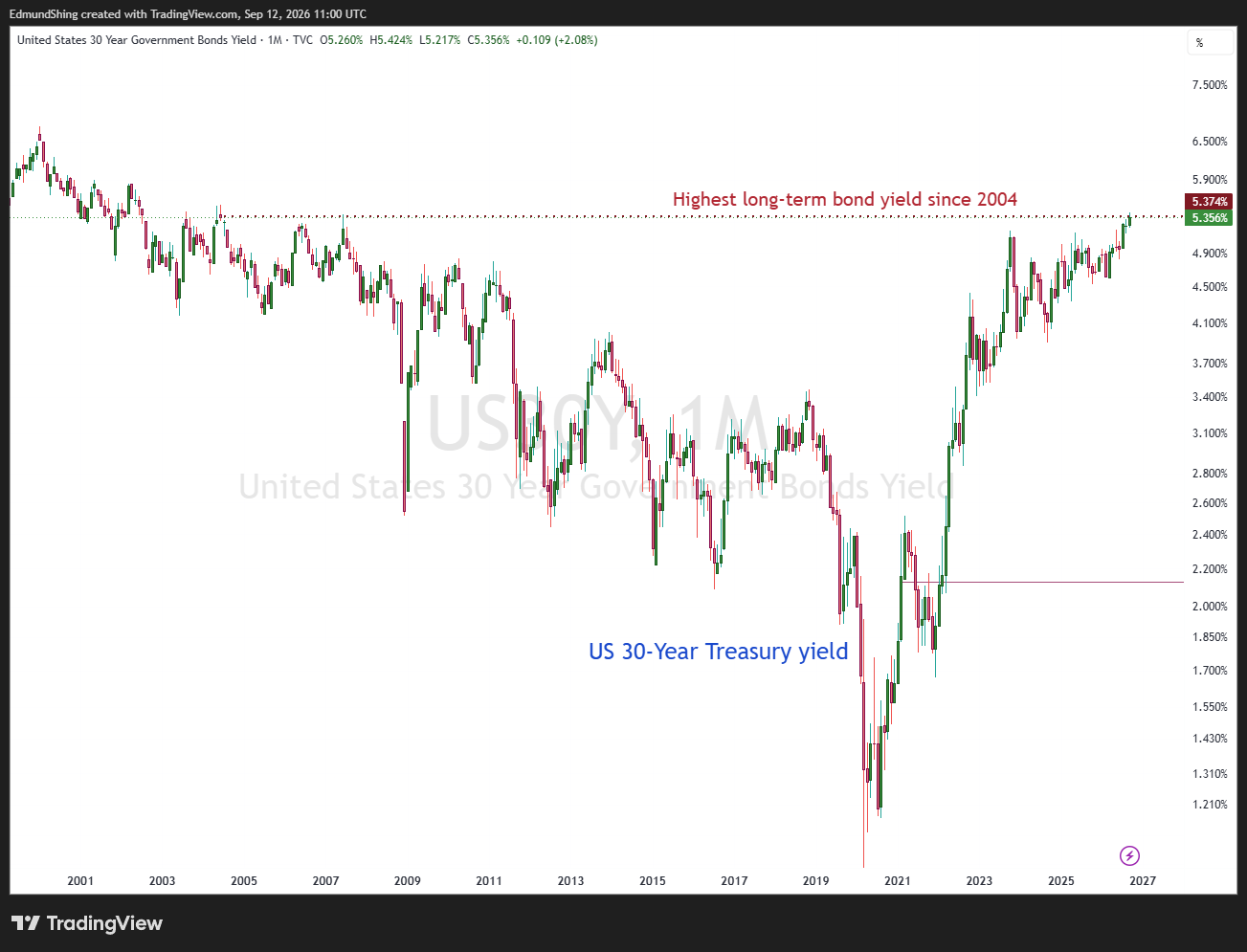
Rising long-term interest rates are a global phenomenon, seen also in the eurozone, UK and Japan since 2022. You could argue that this is a continued process of renormalising of interest rates after the period of abnormally low, zero or even negative interest rates that existed worldwide from 2008 (Global Financial Crisis) until 2022 (invasion of Ukraine).
UK 30-year gilt yield close to 6%, first time since the 1990s
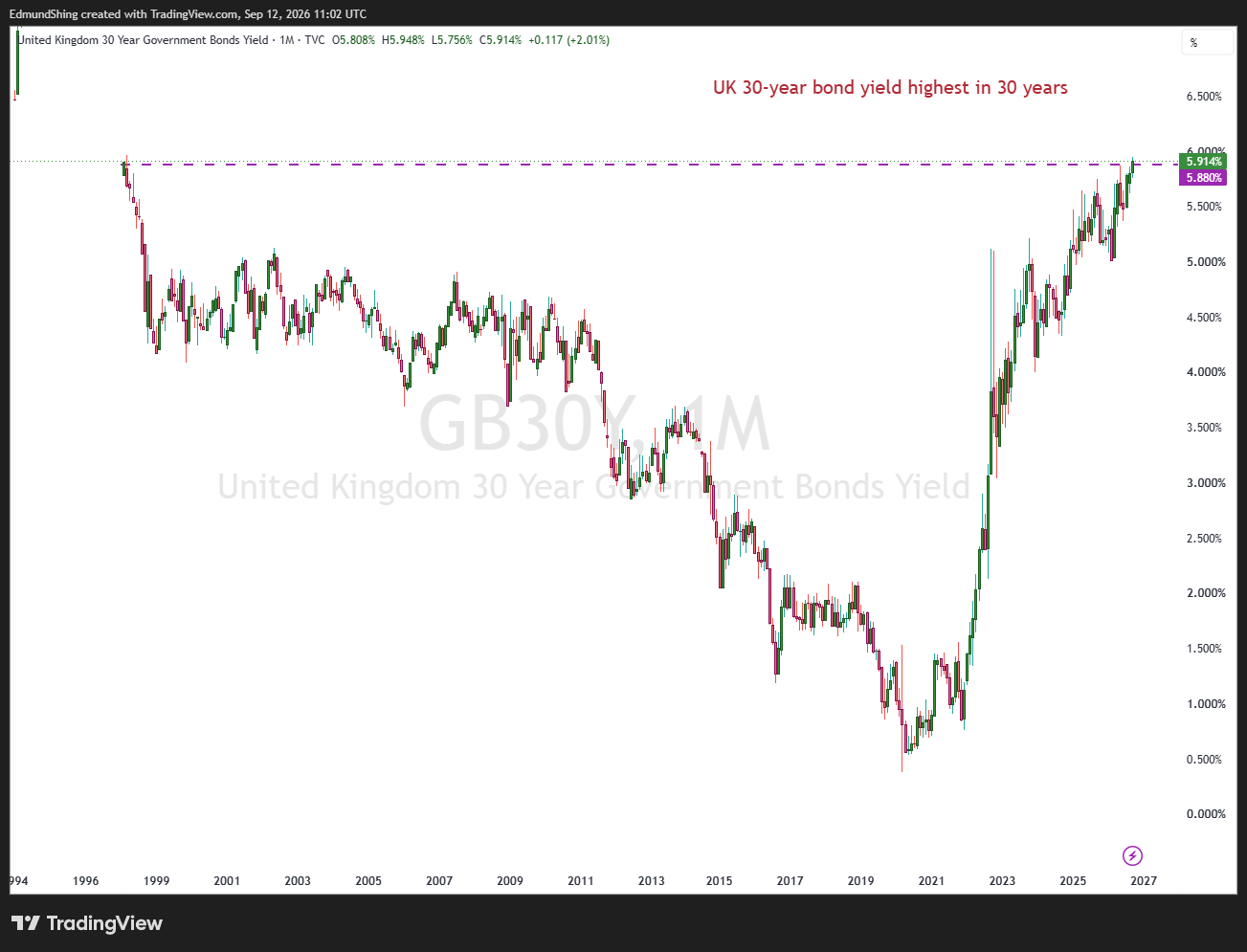
Now you might be nervous about lending the UK government your money for as long as 30 years, which I would understand. There is a reason that the 30-year bond yield is more than 2% higher than the Bank of England’s base rate of 3.75%. The principal risk for which you are paid an extra 2% is the risk of higher-than-expected inflation reducing your purchasing power steadily over the next 30 years.
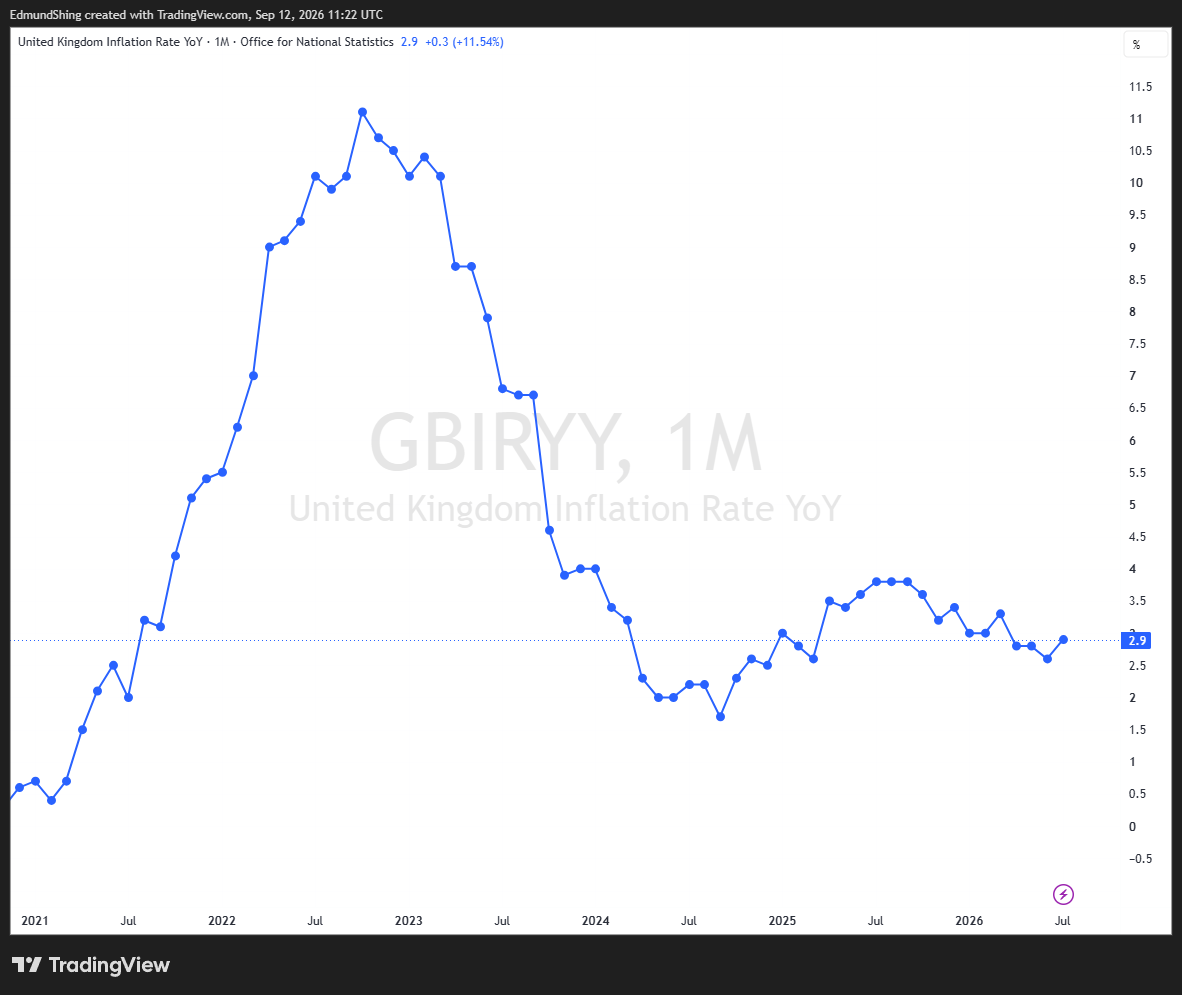
Currently, UK inflation is running at around 3%, which remains well above the Bank of England’s long-term inflation target of 2%. But if you believe that inflation will fall closer to 2% over the medium-term, then a 30-year fixed interest rate of nearly 6% sounds attractive as this would still return nearly 4% above a 2% inflation rate. This clearly requires some confidence in a) the ability of the Bank of England to get inflation down by raising its base interest rate in the short term, and b) the will of the current Government to curb government spending to bring it closer to total tax revenues and thus stabilising the debt/GDP ratio. Official data puts this ratio at just over 100% of GDP. According to the National Institute of Economic and Social Research, this ratio has nearly tripled over the past two decades.
UK inflation rate: still 2.9%
But if you don’t want to take on such a long-term risk, there are other options available in shorter-dated bonds, for example in 5-year Gilts (where the Government pays you an annual coupon and then returns your money in 5 years rather than 30). In 2020, the UK 5-year gilt (government bond) yield briefly dropped below zero. At this point, if you bought a 5-year UK government bond, you were effectively paying the UK government for the privilege of lending them money for 5 years. Today in hindsight, this simply sounds crazy. The 5-year UK gilt yield today has recovered to 4.9%, the highest yield offered since 2008 and much more in line with interest rates in the pre-2008 era.
UK 5-year government bonds offer nearly 5% annual income
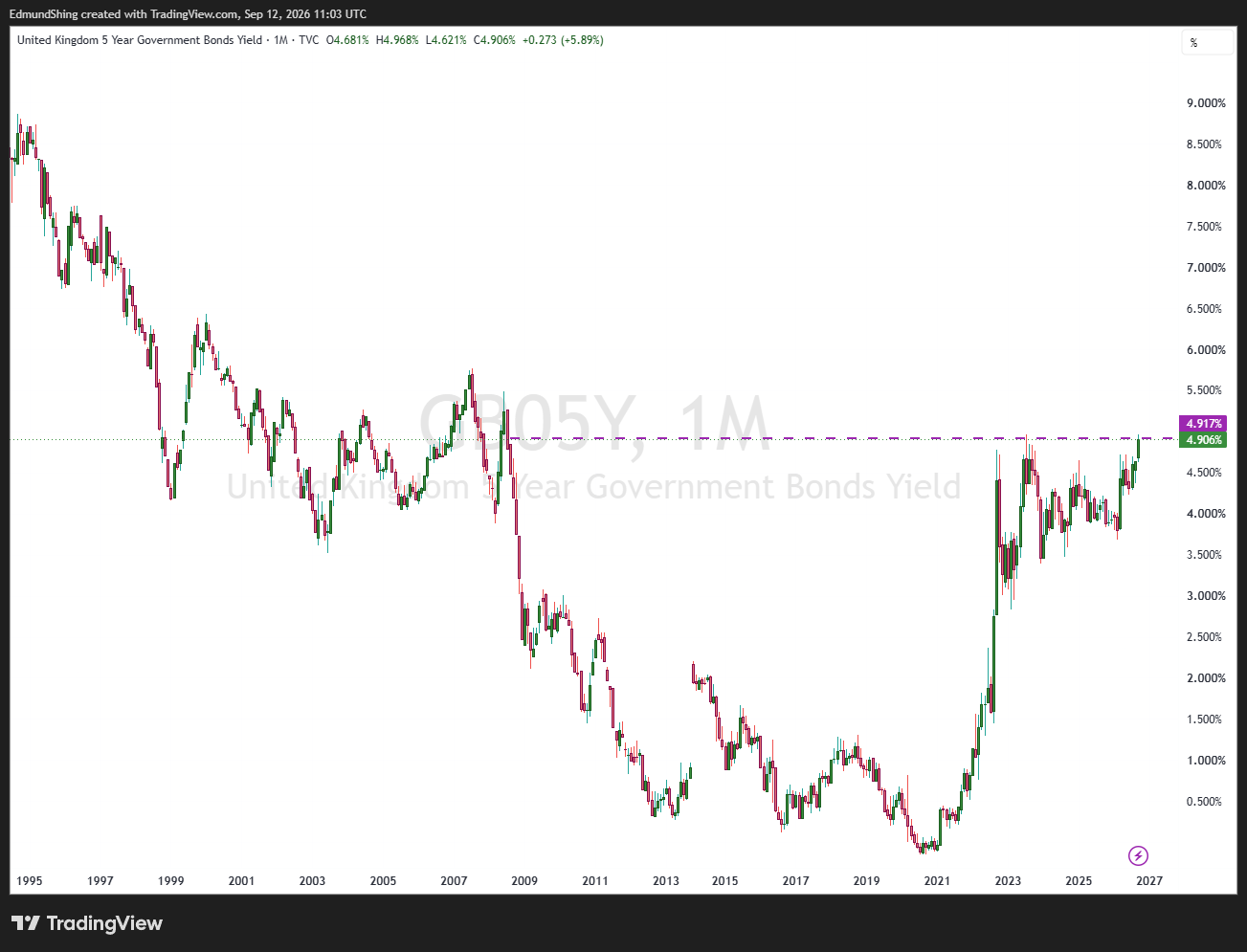
I have to say that while locking in nearly 5% for 5 years may sound attractive, it is best done in an ISA to avoid paying tax on this income. Also, I would note that you can also find cash ISAs offering around 4.5% for a 1-year fixed term if you shop around.
In the short term, the oil (and gas) price is a huge driver of bond yields
Note the tight correlation between the US 10-year bond yield and the Brent crude oil price. This is logical, since energy prices remain a key determinant of inflation rates over time.
US 10-year Treasury bond yield (blue) has been correlated with the oil price (green)
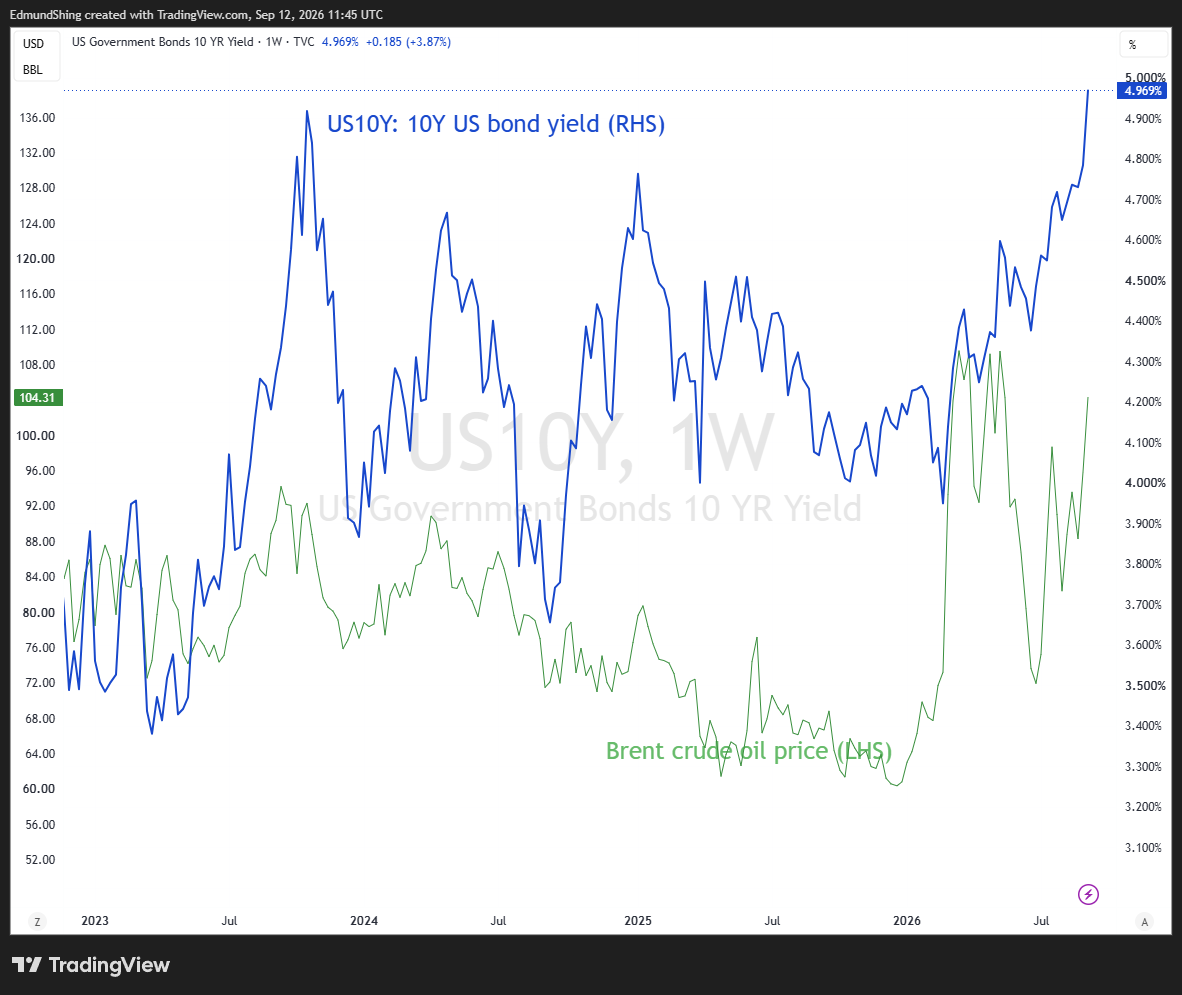
So any sustained fall in oil prices on the back of a ceasefire or agreement between the US and Iran and a reopening of the Strait of Hormuz to tanker traffic should also result in reducing pressure on inflation rates and thus on bond yields, allowing them to fall.
Also on a technical note, sentiment is very negative on the US bond market after the sustained run up in yields, in fact at its lowest in 4 years. This suggests that the slightest better news on the Iran/oil and inflation fronts could trigger a rebound in bond prices and a fall in yields.
Will Governments consolidate their budgets?
In the longer term, the direction of bond yields (and thus bond prices) will be linked to the evidence (or not) of government efforts to limit public spending, particularly in terms of benefits spending.
In the UK, the real test for the current Labour government’s resolve on curbing public spending will be whether they are prepared to scrap the triple-lock on the UK state pension.
In 2026, public spending on pensioners will account for about 55% of total benefits spending, of which 45% is for the UK state pension (£146 billion in 2025/2026). With the current triple lock guarantee (annual pension increase = highest of average earnings, inflation or 2.5%), this state pension burden has grown from £127.5m in 2022/23 to an estimated £154.2bn in 2026/2027, a 21% or £26.7bn increase in just 4 years. With the number of pensioners also projected to continue to grow, this is simply becoming unaffordable.
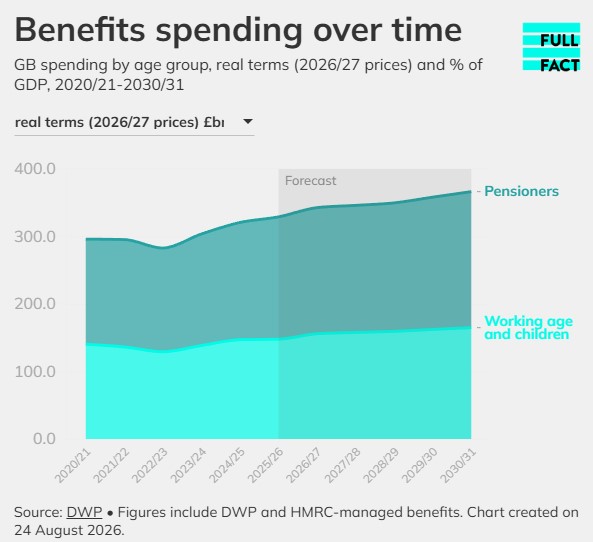
Of course, the cost of state pensions is a huge issue not only for the UK, but also for other ageing European countries such as France…
Conclusion: are bonds good value at last?
I think conservative investors who want to lock in higher fixed interest rates should look at buying into bonds today, as there is a good chance that yields have made the bulk of their move higher for now. Should oil and gas prices cool from today’s elevated levels, this would presumably cool inflation fears, allow central banks to put off any further interest rate hikes and allow bond yields to ease lower.
An investor in a typical UK gilt fund such as Vanguard’s UK gilt ETF has suffered a 1.5% loss even including coupon income since the beginning of this year, due to the sharp rise in yields. But remember that long-term future returns from bonds are typically very close to the starting yield. This starting yield is much higher today than at the start of the year (UK 10-year gilt yield is 5.35% today, up from 4.47% at the beginning of January), pointing to higher long-term future returns to come.
At this point, I would not necessarily rush to buy the longest maturities such as 30 years until I see some proof of government spending restraint, but you can lock in a 5-year UK gilt yield of 4.9% that is 1% higher than at the start of this year. Even if yields move a bit higher from here, you won’t suffer much in a 5-year bond compared to much higher risk in a 30-year bond.
Have a great week and keep an eye on long-term bond yields as the biggest danger to the current bull market in stocks,
Edmund
Disclaimer
This is not financial advice. Our content is intended to be used and must be used for information and education purposes only. Please read our disclaimer and terms and conditions to understand our obligations.
12 comments
Interesting. With the pressure on US interest rates from the bond markets there is a knock on effect on Government bond yields across the UK and the EU as part of a synchronized global repricing of debt. The question here is how strong is the link this is and looking at https://www.arlingclose.com/in... & https://bankunderground.co.uk/... then it seems gilt/Treasury correlations have run above 90% across maturities since 2018. The UK has more control over the short term rates and less over 10 / 30 year. OK those links are from 2015 & 2024 but it seems https://www.fisherinvestments.... (8/2025) that divergence on the 10 year was roughly from Jan 2016 to Jan 2020 make of that what you will.
I mention this only because there is a lot of press talk about the UK situation and pressure on the forthcoming budget, which is undoubtedly true. However my point is a lot is outside the UK Gov's control and a lot depends on Mr Trump (how he handles Kevin Warsh / US spending etc etc and as Edmund mentioned Strait of Hormuz/oil). Add to this the pressure on majority of Western Governments spending (also mentioned in the article and general press) does not help sentiment.
It will be interesting to see how the oil price which Edmund flags as being a big influence on the US 10 year will affect the UK in future years. Presumably if it helps the US yield the knock on effect will help the UK and others.
It's easy to paint the gold bug argument as intact in the big picture, too easy perhaps, but hard (for me) to argue against even after the raise in rates yesterday.
Despite these slightly gloomy thoughts the markets are of course capable of acting independently, so while macro is unhelpful the markets will decide where they go next.
However my point is a lot is outside the UK Gov's control
i would argue its very much under our control - all we need to do is stop excessively racking up more and more debt and then our borrowing rates would fall into line with more sensible countries.
I understand that aint gonna happen with the current lot - but it could be very much be within our remit not to spend 2% **more than we can afford each year which is the underlying problem.
** i will perhaps be generous and say if debt is going up by inflation only its not going up in real terms.
to me common sense is that you only borrow when you are in or leaving recession/covid time - and that in normal times you pay debt down in real terms - so that next time you need to borrow big it aint the end of the world.
the ruling elite are idiots who shouldnt be in charge - as all they ever do is spend big near election time to bribe us for our vote
It is worth noting that long bonds have a higher return because they are more volatile. They rise and fall much more in response to changes in interest rates.
A rise in interest rates means a fall in the price of bonds that are on the market. Therefore buying a long bond in a regime of rising interest rates is a bad idea. Better to focus on the very short end, less than 3 years to maturity or perhaps a money market account or bank deposit.
Any thoughts on Index-linked gilts, Edmond (or anyone else)? . Rates in excess of 2.5% plus inflation at the long end seem good value to me. I have a reasonable amount in the wealth preservation part of my portfolio.
Yes that makes sense to me. Traditionally a real rate of over 2% on US inflation-linked bonds (TIPs) has been a good long-term entry point…
edmund
Ed or anyone who knows the answer to this question aren't index linked bonds/gilts the most volatile bond class of all as normally long dated and would you only want to enter into the trade when you think interest rates have peaked.
So good question. I looked at the holdings of the INXG iShares UK index-linked Gilt ETF. Major holdings include index-linked bonds maturing in 2027-2032, so in the next 1-6 years... So there is a choice of shorter-term maturities available. But it is also true that much of the supply is long-term; the average weighted maturity of this ETF is nearly 14 years...
I use my ISA entirely for stocks so I use shorter term bonds up to 5 years to reduce tax paid on cash. I buy GILTS with a low coupon in exchange for a higher capital gain which is tax free. By buying bonds that mature each year I get a nice tax free payment every year and roll the original cash into the next bond.
You are also getting some decent fixes on some good bank accounts - up to 5% for 5yrs - with a savings guarantee and no worry about any CGT or any tax on the coupon.
I thought about buying some bonds recently, but in the end decided I'd rather at this point use a savings ladder over some 1,2 & 3 yr savings. All not far off achieving 5%.
Obviously everyone is different with different needs & requirements so do your own research. Pros & cons.......
That 5 year guaranteed return is looking very attractive atm. Return of the 60/40 portfolio?
"In 2020, the UK 5-year gilt (government bond) yield briefly dropped below zero. At this point, if you bought a 5-year UK government bond, you were effectively paying the UK government for the privilege of lending them money for 5 years. Today in hindsight, this simply sounds crazy"
Yes and it sounded crazy to me in 2020 too but I remember vividly a number of reputable wealth/asset managers encouraging investors to do just that. At around the same time, and with 2020 being my successful year ever in the stock market, I finally became convinced that if I were going to lose money it would be by my own hand, as opposed to paying someone to do it for me.
At last I begin to understand the role/benefit of bonds. Only taken 67yrs. However I think some REITs are worth looking at too. See the IT strand on Stocko. London Metric for 1.