Market Musings 121025: Will Friday trigger a market correction?

Market Musings 121025: Will Friday trigger a market correction?
Podcast this week:
Our Investment Strategy for October 2025 (click link to listen)
How low can the Fed go? Not just a fundamental question based on a weak labour market, but now also a political one. We now target 3.25% as the cycle low, but political pressure and a weaker economy could take the Fed even lower in time. Favour below-benchmark US sovereign and corporate bond duration.
Why is the ECB stopping at 2%, while inflation has returned to 2%, the euro is strengthening and eurozone growth is modest? Remember that it takes a long time for interest rate cuts to help growth. We raise our 12-month EUR/USD target to USD 1.24, given converging US and EU rates.
Tech is no longer just about the Mag 7: the increasing excitement over homegrown AI models and hardware in China is driving Hang Seng Tech outperformance vs. the US Nasdaq 100 this year. We think this can persist, with foreign investors still largely underweight China. Positive on Chinese stocks, particularly Tech.
We advise commodity exposure in diversified portfolios. Raw materials are a real diversifier, at a time when bonds no longer act as a hedge for stocks. The Equal Weight Commodities Index is +14% this year in USD, led by precious metals and copper. The precious metals bull market has not yet run its course, so we remain positive on gold and silver.
Upgrading equities to Overweight: Global equity markets are showing incredible strength on the back of economic resilience. We upgrade US equities to Neutral over lower interest rates and downgrade European equities to Neutral given potential FX headwinds. Stay positive on Japan, South Korea, China, UK
Friday: Trump threatens China with more tariffs
(from Bloomberg)
China said the US should stop threatening it with higher tariffs and urged more negotiations on outstanding issues to agree on a trade deal, responding to President Donald Trump’s latest measures against Beijing.
China’s recent trade countermeasures on US-related issues were necessary, defensive actions, the Ministry of Commerce said in a statement on Sunday. Beijing will take corresponding measures to safeguard its rights if the US persists in its actions, it said.
Trump on Friday announced an additional 100% tariff on China as well as export controls on “any and all critical software” beginning Nov. 1, hours after threatening to cancel an upcoming meeting with Chinese leader Xi Jinping. That came after China added new port fees on US ships, started an antitrust investigation into Qualcomm Inc., and unveiled sweeping new curbs on its exports of rare earths and other critical materials.
US S&P 500 index dropped 2.7% on Friday post Trump’s post
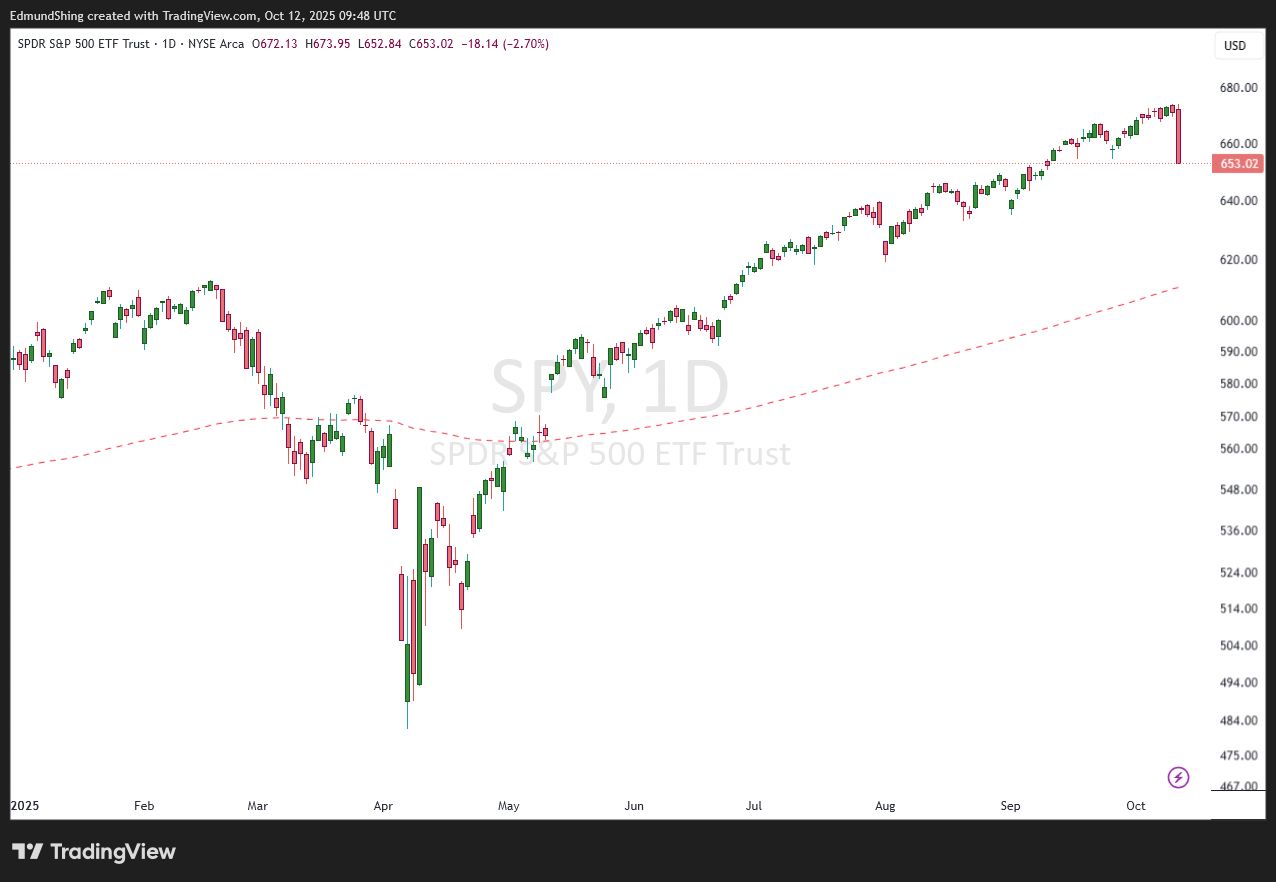
This marks the end of the uneasy trade truce that had been reached between the US and China, following from the restriction by China of exports of rare earth minerals, a business it currently dominates. These rare earth metals are key for applications in Technology, Defence and Renewable Energy amongst other sectors.
China has also restricted the export of batteries, again another area where China dominates and where the US is vulnerable given the lack of domestic battery production:
China's new restrictions on the export of batteries could have major impacts on US companies, analysts say, as the US increasingly needs energy storage to support data centers and stabilize the grid.
The restrictions, which take effect Nov. 8, include large-scale lithium-ion batteries, cathode and anode materials, and battery manufacturing machinery, and require battery companies to receive licenses from the Chinese Ministry of Commerce before exporting their goods.
The export curbs would affect US companies that rely on Chinese battery components, with analysts saying that much of the supply needed to meet US demand for energy storage will need to come from China and can't be easily replaced by other countries.
(from Bloomberg)
Is this the start of a market correction?
Since the market sell-off in April following the announcement of Trump’s reciprocal tariffs, the MSCI World ex US index has risen 35% and the S&P 500 index +38% without a notable correction. Today, the US market in particular is vulnerable to such a correction given the relatively high valuation (22x estimated P/E) of the US market.
In addition, the stock market has become notably “frothy” with the signs of a grossing stock market bubble in hyped themes such as Space, Quantum Computing and Artificial Intelligence.
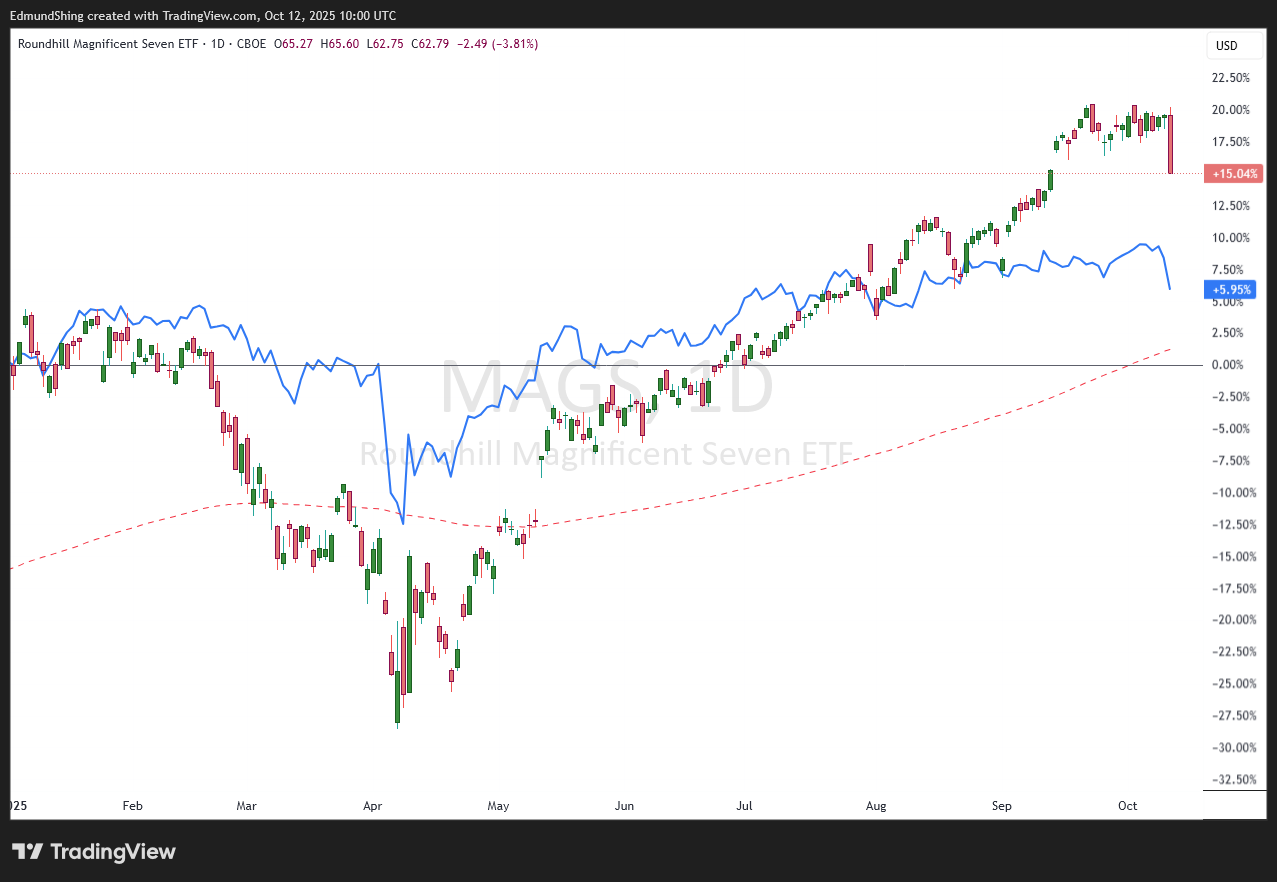
Even after a 3.8% drop on Friday, the Magnificent 7 group of leading tech stocks have still gained 15% for the year to mid-October, while the average S&P 500 stock (represented by the equal-weight S&P 500 ETF in blue) has rallied 6% over the year.
Magnificent 7 fell 3.8% on Friday, but still +15% for the year so far
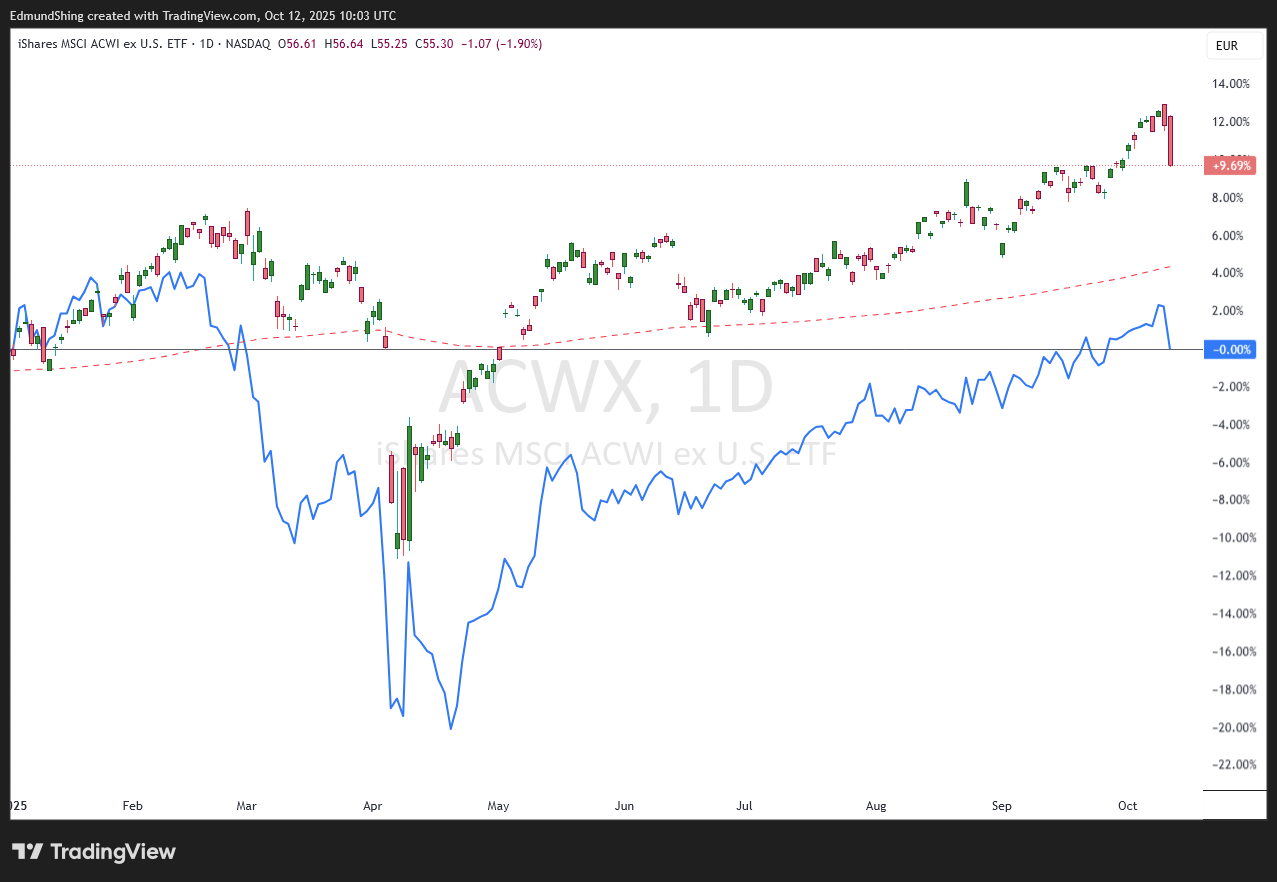
World ex US stocks still lead for the year, however. As of the close on Friday, the MSCI World ex US index (including Europe, UK, Japan, and Emerging Markets) had returned 16.5% in British pounds including dividends over the year to date, while the S&P 500 had only gained 5% in GBP over the same period, given the depreciation of the US dollar against most currencies this year.
MSCI World ex US outstrips the US in 2025
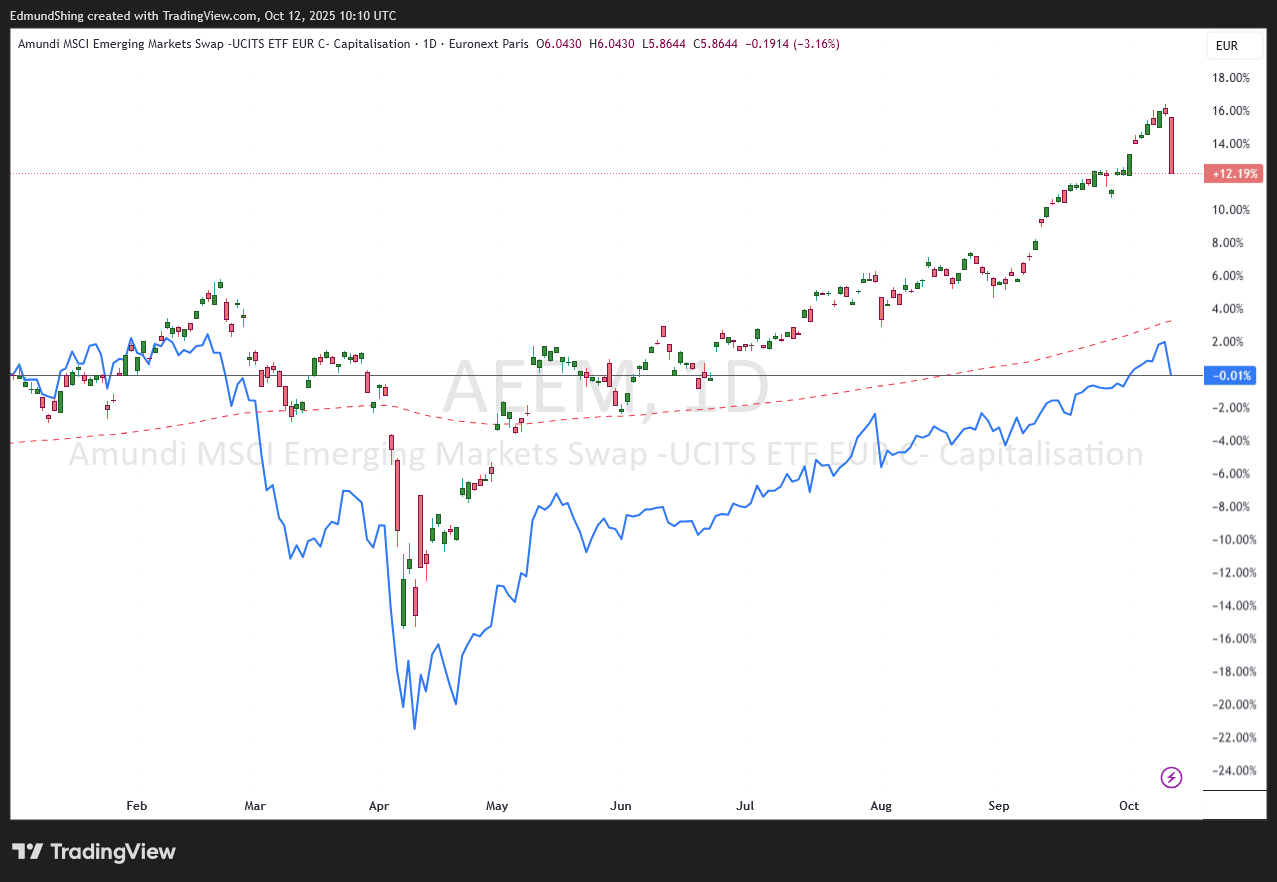
Emerging Market stocks (led by China, but with strong performance also from South Korea, Taiwan and Poland) have also been in the lead this year, +12% in euros so far versus flat performance for US stocks in euros.
Emerging Markets lead, the US lags
Remember that stock market corrections of 10% or more are actually quite common over time. Taking the S&P 500 index as an example, there has been at least a 10% market correction in 29 out of the past 50 years, about once every 19 months. So if this current tariff shock turns into a 10%+ drop in stock markets, we should not be all that surprised.
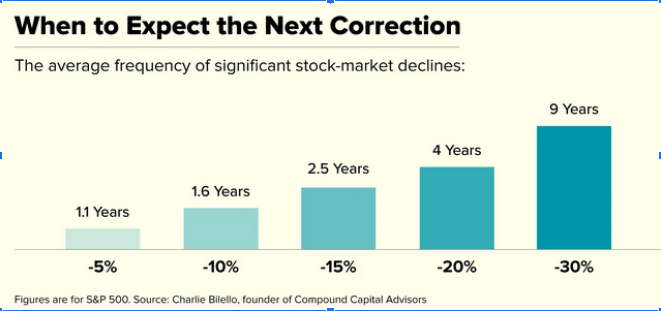
Note that up to now, retail investors have typically “bought the dip” as this has been a successful strategy for the past few years, even including the 34% drop in the MSCI World index experienced in March 2020 as the world suffered from the COVID-19 outbreak and subsequent lockdowns.
Bull markets usually end in crisis or recession
Generally, bull markets in stocks end when the global economy is in recession, or when a crisis hits as in 2000 (bursting of technology bubble) or 2008 (Global Financial Crisis triggered by subprime lending problems).
Currently, the world economy continues to grow at a modest pace, helped by central banks generally lowering interest rates (led by the Federal Reserve). There is little sign of a crisis, even if the current excitement over Artificial Intelligence resembles the forming of a bubble. Remember that investment bubbles can go on for a surprisingly long time and grow to surprisingly large proportions (as in 1989 in Japan, in 2000 and in 2008). So there is no saying that the current AI frothiness is anywhere near its end.
Modest growth in the world economy, helped by lower interest rates and the lack of a real crisis of any sort all tends to suggest that this will not develop into anything more than a standard market correction, a mere interruption in the current bull market which is not even that old, having started in October 2022.
According to Fidelity:
Historically, long-term uptrends have lasted decades. If this cycle follows that pattern, the S&P 500 could keep rising well into the 2030s.
Even after a more than 30% rally since April 2025, the market is not at an extreme compared to past peaks.
If the current artificial-intelligence-fueled Nasdaq Composite rally were to mirror the length of the 1990s tech cycle, it could continue for several more years without a major correction.
Shifts in sector composition—more information technology and fewer energy and financials stocks—may help justify historically high valuations.
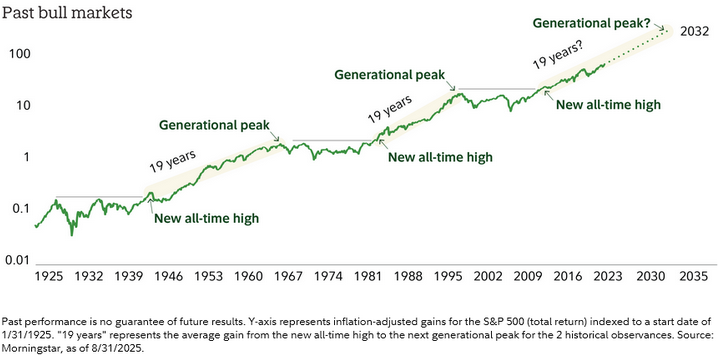
The chart, Average bull market timeline, shows the long-term trend from the “generational low” in the market from the trough price of the consolidation period to the generational peak, at which point consolidation begins again. By this measure, the past 2 secular bull trends lasted about 30 years, on average, from peak to trough.
Conclusion: Look for interesting uptrends to buy in the pullback
The long-term uptrends I will look to buy in any continuing market correction include:
Gold and silver miners
Uranium/nuclear-related miners and stocks
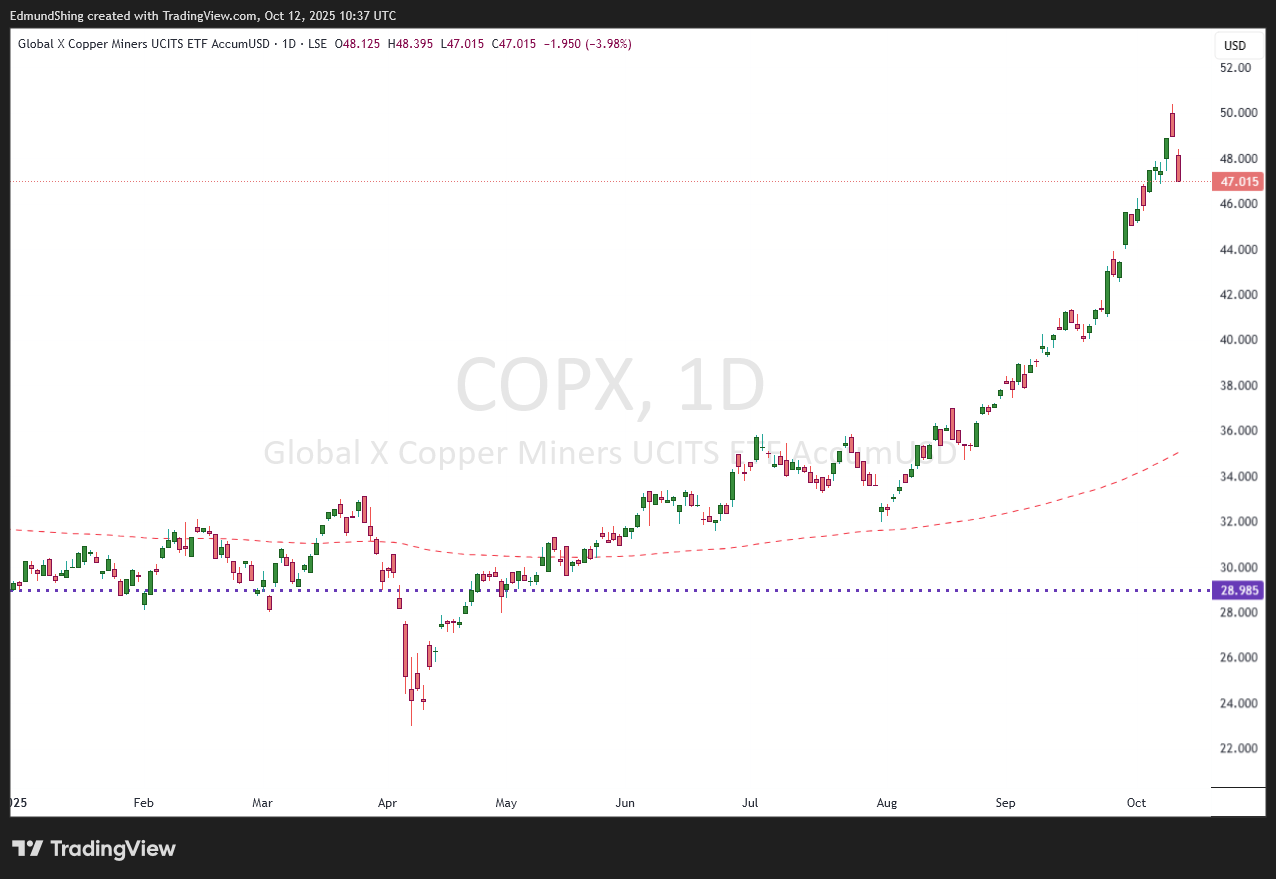
Copper miners
Biotech
European Banks
European small-caps
Emerging markets including Chinese Tech, Vietnam and South Korea
US electricity infrastructure
Copper Miners correct after a strong run-up since April
Have a great week everyone,
Edmund
Disclaimer
This is not financial advice. Our content is intended to be used and must be used for information and education purposes only. Please read our disclaimer and terms and conditions to understand our obligations.
18 comments
Smart money: How digital currencies will shape the new world order by Rosa and Larsen is a great read on China and the future of money. For the crypto sceptics, 'digital currencies' includes state backed versions of fiat money, an interesting future to contemplate. Well worth a read!
I think your doing yourself a disservice Edmund as the ETF you mention is up over 14% on the rolling 12 months
Hi Edmond, thanks for your article. You mention US electrical infrastructure. Could you name a few companies to research or are there any funds for this area. Any companies you mention I realize is not advise to go and buy. thanks
Hi Alex
2 ETFs you can have a look at include:
FGRD First Trust Smart Grid infrastructure ETF
PAVG Global X US Infrastructure Development ETF
You can see the companies each ETF owns using justetf.com if you want to research individual companies!
Best
Edmund
Hi Alex,
Edmund has kindly responded, but for future reference, a list of ETFs accompanies his posts. If you’re viewing the post on a laptop, the ETFs appear as links to the right of the post. However, when I look at the same post on a tablet, they’re not as visible or easy to use. I haven’t tried viewing it on a phone, but I suspect it’s even less convenient. Maybe this your position.
I always pay attention to Edmund’s musings. Although several of his ideas and suggestions have often already made significant moves by the time he mentions them, I’ve bought into a few after doing my own due diligence—and I haven’t been disappointed. Some have even been exceptional. Thanks, Edmund!
CHINA. Or as POTUS say "Chinnaa".
They are not the future of financial stability.
Gold is (and better Silver) is. And a nuclear race to see who owns the most - put the wad on the table.
Did Musk see Fort Knox before the fall out?
But to see values climb from 1700 - 4000 in a short time is vey vey scary.
Thanks! I always enjoy your Macro insights.
Is last Friday an indication of what will happen in the near future? My portfolio took a battering - 1.6% in one day but, it's really interesting to look at how the individual sectors performed. If these drops continued over the next few days or even weeks this would constitute a major correction. Should we be diverting more of our funds into consumer defensives, healthcare, utilities and financials as well as gold and silver?
1) Geographic ETF's and Trusts: mostly UK, Japan, Emerging Asia, Germany, Europe , China Tech. - 1.7%
2) Defence: Global, European ETF's and Individual shares mostly UK. - 2.1%
3)Metals: including gold and silver. -1.6 %
4) Income and Bonds: including good dividend shares and wealth preservation trusts. -1.0%
5) Infrastructure and Utilities: -04%
6) Technology: - 3.8%
7) Consumer Defensive: - 0.4%
8) USA: -4.5%
9) Industrials: - 1.8%
10) Financials UK and Europe: - 0.5%
11) UK Oil & Gas: -4.3%
12) Healthcare: - 0.98%
13) Global & European Property : -0.73%
14) Consumer Cyclicals: -1.5%
Let's hope it's all TACO!
Interesting - thanks. China is very strong on resource collaboration and ownership of assets in Southern Africa e.g. DRC, Zambia, Zimbabwe etc. I expect, as has already been seen, and continues to happen in Zambia, additional collaboration efforts with USA, UK, UAE, India etc. within that region. There is already movement and investment in that direction on several fronts. Mining JVs, Infrastructure Support, etc. An uptick in activity is very likely.
We live in interesting times. Trump will not stop until he triggers a market crash. But once out of the bottle, you can't put that genie back in. Gold's rise indicates that the smart money is exiting equities and bonds.
Playing the market for his longs and shorts
Awesome stuff as always Edmund, would there be any chance at some point if you could do an update on the ETF portfolio you covered a year or so back, from memory split gold, world equities, bonds and cash equal weight.
Would be interested to here if you would retain the old weightings or if you would be rebalancing.
Sure I will give an update as to the performance of the Permanent Portfolio over the last 1 year.
So the results of the GBP permanent portfolio over 1 year to October 10 is
+18.2%. 12% of this was contributed by gold (+49% in GBP over 1 year), then nearly 4% from global stocks and just over 1% each from cash and global bonds (currency hedged).
And yes after 1 year I would rebalance, otherwise gold would be far too large a share of the portfolio today given the scale of the outperformance…
Edmund
Presumably your measuring the global stocks element in dollars Edmund given I think your memory MSCI World in GBP is up 14-16% ytd ?
Hi there,
no this is in GBP, using the MWRL ETF (Amundi MSCI World acc in GBP).
Here is the chart of returns in GBP over the last 1 year from justetf.com (very useful website)
Ed
So to be clear,
the performance numbers I mentioned for the Permanent Portfolio in GBP for for the last 12 months from Oct 24 to 10 Oct 25...
Thanks Edmund, very interesting.
Does this add education.