Market Musings 140123: Climbing the wall of worry

Market Musings 140123:
Climbing the wall of worry
Stocks rise further in the face of still-bearish sentiment
Weekly Podcast - Our Investment Strategy for January 2023
In this podcast Edmund Shing unveils his investment strategy for January 2023.
1. Just how bad was 2022 for investors?
2. Why might any global recession be more modest than feared?
3. What is happening to energy prices?
4. Why do we recommend Equities?
Summary
Stocks rise further in the face of still-bearish sentiment
World ex US leads, with the FTSE 100 and CAC 40 indices close to all-time highs
Banks a surprising leading sector, given recession risks
Banks’ sector earnings momentum remains robust on the back of strong recent results
Retail banks are helped by rising short- and long-term interest rates
Risks to banks are evident: deep recessions can result in a surge in bad debt costs, hurting both profits and balance sheets
For now, UK and European Banks remain cheaper than their long-term average, with rising profitability and earnings trends.
6%+ sector dividend yields are also attractive, as long as banks can maintain or grow these dividends over time.
Stocks, Gold rise but sentiment still poor
So far so good, another positive week for stocks after a very poor 2022. For now, the consensus remains for a weak first half of this year before a potentially better second half.
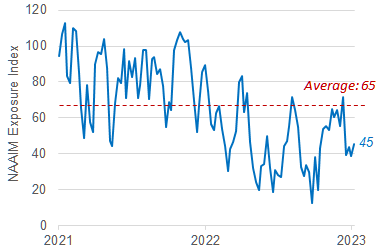
Reflecting this cautious consensus, both retail and professional investor sentiment remains somewhat depressed, judging by the low levels on both the AAII bull-bear survey and also the Institutional Investor sentiment survey.
We might then characterise this rally as a short-covering rally. The general feeling remains that it will likely only be a short-lived bear market rally, with the dominant downward market trend to resume relatively soon on the back of approaching economic recession and a fall in 2023 corporate profits.
Still-bearish US professional investor sentiment
Source: NAAIM
The World ex US continues to lead the way
In Europe, leading markets are the UK (FTSE 100) and France (CAC-40). Both are approaching not only multi-year highs, but in fact all-time highs, after a long period of relative underperformance versus more dynamic stock markets such as the US.
FTSE 100 long-term

Source: tradingview.com
French CAC 40 long-term

Source: tradingview.com
Leading companies in both indices come from Oil & Gas, and perhaps more surprisingly, Banks.
Why are Banks rising?
Oil & Gas was the standout sector performer from 2022, pretty much the only sector to register a positive annual return.
But Banks is a less obvious sector to pick out, at a time when recession seems to be beckoning. Recessions should be bad news for Banks, as generally demand for credit falls (lowering revenues) and bad debts (from bankruptcies etc.) tend to rise (eating into profits as bad debt provisioning has to rise).
European Banks sector rallies hard

Source: tradingview.com
So why are Banks performing so well at the moment?
There are several positives for Banks at the moment, particularly in the UK and Europe:
Both benchmark Bank of England and ECB interest rates have risen substantially, allowing retail banks to rebuild their “net interest margin” from a widening gap between lending and deposit rates (i.e. a wider gap between what banks charge you for borrowing money, and what you can earn from saving money in a bank).
Up until now, lending growth has been solid in the post-pandemic period both on mortgages and also on business loans, driving underlying revenue growth.
Household consumption has also been very strong in the post lockdown recovery, boosting revenues from spending via debit and credit cards.
Bad debt levels have remained very low, given historically high employment levels and stronger-than-average household and corporate balance sheets post pandemic.
Bank regulatory capital is far higher today than in the 2008 Great Financial Crisis, given the huge changes in banking regulation that followed 2008.
Dividend yields offered by banks remain generous, to which they may be able to add share buybacks too given their strong balance sheets.
But, I believe that an implicit condition for buying into the Banks sector today has to be a belief that any 2023 economic recession will be modest in both its duration and impact on growth.
Investors in Banks need to believe in a modest and short-lived recession (or no recession at all), followed by a subsequent rebound in economic growth and thus demand for financial products.
Encouraging news from Retailers, energy prices
On this front, there has been some encouraging news of late.
Firstly, inflation rates are on the decline, although admittedly from very high levels. I believe that this decline should continue over the next few months, providing some respite to households.
Secondly, as part of this, energy prices have declined rapidly from post-Ukraine peaks. This is key to relieving some of the near-term pressures on the UK and European economies, supporting a more modest setback to growth.
Thirdly, trading statements from UK retailers such as Next, DFS, Tesco and Sainsbury have been rather encouraging, with like-for-like sales growth over recent weeks that has remained robust, even better than expected. There is little sign of a slump in household spending from these figures, at least.
Banks have a long way to catch up to poor performance since 2010
In general, investors would have been well served since the Great Financial Crisis by NOT investing in banks at all, given their heavy under-performance over the last 12 years. Heavier regulation has been a main reason for this under-performance, as banks have had to rein in their growth and dividend payment plans in order to build up bigger capital buffers, reinforcing their balance sheets at the cost of benefits for shareholders.
But the good news is that this work is now done, with European banks all possessing strong double-digit Tier 1 capital ratios, i.e. far bigger capital buffers to protect against more difficult economic conditions such as what we potentially face today.
But European Banks have trailed the market drastically since 2010

Source: tradingview.com. Europe Banks in Blue, European market in Green
Banks are cheap, OK. But earnings momentum is key
While we can perhaps all agree that Banks are a cheap sector in terms of P/E and price/book value metrics, this by itself is not enough to act as a catalyst for the sector. Rather, the near-term driver continues to be robust earnings momentum, as analysts continue to expect positive earnings growth over the year ahead for the sector in aggregate - both for UK and European banks.
What is evident from the 2 charts below is that banks’ share prices did not keep up with these surprisingly resilient earnings trends over last year, after having broadly tracked these higher earnings estimates all through 2021.
UK and European Bank earnings forecasts remain solid, but price has not followed


Source: Bloomberg
UK banks have become progressively cheaper over the last 2 years in spite of positive earnings trends. Even after this latest nascent rally, both UK and European banks are valued at 7 - 7.5x prospective P/E for 2023, well below their 9.4 - 10x long-term average P/Es.
UK and European Banks far cheaper than long-term average

Source: Bloomberg
Conclusion
With sector dividend yields for 2023 estimated at over 6% both for UK and for Euro Area banks, there are obvious attractions to owning bank stocks IF you believe in relatively modest economic recessions, with no surge in bad debts to result for banks.
However, this is rarely a sector to own for the long term, as one of two things tends to happen at some point:
A deep recession or financial crisis which leads to a massive sell-off in banks as their profits and balance sheets take a heavy hit (as in 2008-09), or
Bank CEOs become too aggressive in chasing profitability and take bigger and bigger risks (think the Royal Bank of Scotland/Santander/Fortis takeover of ABN Amro in 2007), stretching balance sheets and taking undue financial risks.
However, for now I think that we are a long way from either of these two risks.
Investing in exposure to banks can be done in one of three ways:
Buying individual bank stocks, if you have a view on their fundamentals and strategy;
Buying an ETF of the European or World Banks sector, both available in UK-listed or European-listed ETFs, e.g. the CB5 Amundi ETF MSCI Europe Banks sector ETF;
Buying a European Value ETF, which will typically contain up to 30% exposure to European Financials (largely Banks and Insurers), e.g. the EVAL SPDR MSCI Europe Value UCITS ETF.
Have a great week, let’s hope the current rally is extended!
Edmund
Disclaimer
This is not financial advice. Our content is intended to be used and must be used for information and education purposes only. Please read our disclaimer and terms and conditions to understand our obligations.
2 comments
Thank you Edmund, food for thought as always. I purchased Standard Chartered sometime ago but started to question why. I am now seeing an uptick but remain cautious. Also have had my eye again for sometime now on (BOCH) Bank of Cyprus. I missed an opportunity to buy previously however I feel now I am being presented another opportunity. I will make a purchase and monitor closely.
Many thanks Edmund, Brilliant summary.
Personally though I don't own any of the main commercial, mortgage &/or investment banks - simply because their balance sheets tend to be total 'black boxes'. Very difficult to understand.
In fact just look how thick their 'window-dressed' ARs are. Typically >300 pages each & stuffed full of derivatives, non 'marked-to-market' private loans & off-balance sheet vehicles. Who knows how these assets would ultimately hold up during a major credit event (eg LDI crisis), where there the centrals banks didn't step in (re counter-party risk & financial contagion).
For instance, Credit Suisse, Citi, Barclays &/or Deutsche Bank appear all cheap for a reason.