Market Musings 151125: The Energy Boom is here!

The energy boom is here
Energy demand continues to grow, spurred by growing demand related to data centres and also to emerging markets such as India. And yet US natural gas and global oil prices remain somewhat suppressed, given the near-term forecasts of continued increase in OPEC+ oil supply.
However, note that the OPEC+ countries have seemingly not been able to increase oil production in line with the increase in OPEC+ quotas in recent months. Note too the resilience of Europe, US and Canadian oil stocks in recent weeks. This is to some extent due to the strong refining margins that are being achieved in the downstream operations of integrated oil companies and also by refiners such as Valero, with 321 crack spreads in excess of $30/barrel at present.
European oil & gas sector hits a new high

Ultimately, there is no technology without energy. Data centres are remarkably energy-hungry, and are driving a US and global boost in electricity demand after years when developed market electricity demand has been flat. We already see the effects of this data centre demand growth in US electricity infrastructure buildout, with demand for gas turbines from companies like GE Vernova and Siemens Energy increasing sharply. These bulging order books are already reflected in the valuations of these two makers of power generation equipment, with PE multiples between 35x and 49x.
This electricity demand growth is setting off bull markets in a number of energy sources. The nuclear renaissance trend is already firmly entrenched, with the spot uranium price at nearly $80/pound from an early 2020 level of $24. But new nuclear energy power generation will be relatively slow to come online once idle reactors are brought back into operation in the US, Europe and Japan. China is the only country that is managing to install new nuclear reactors relatively quickly, over the next few years.
Uranium miners have rallied hard since 2020

Renewable energy will also have an important role to play, in spite of its status as an intermittent source of electricity. Solar panels are relatively quick to install versus other forms of electricity generation, but for the purposes of supplying a more constant flow of electricity to grid networks they will need to be paired with storage solutions, most commonly industrial battery storage which continues to fall in terms of price.
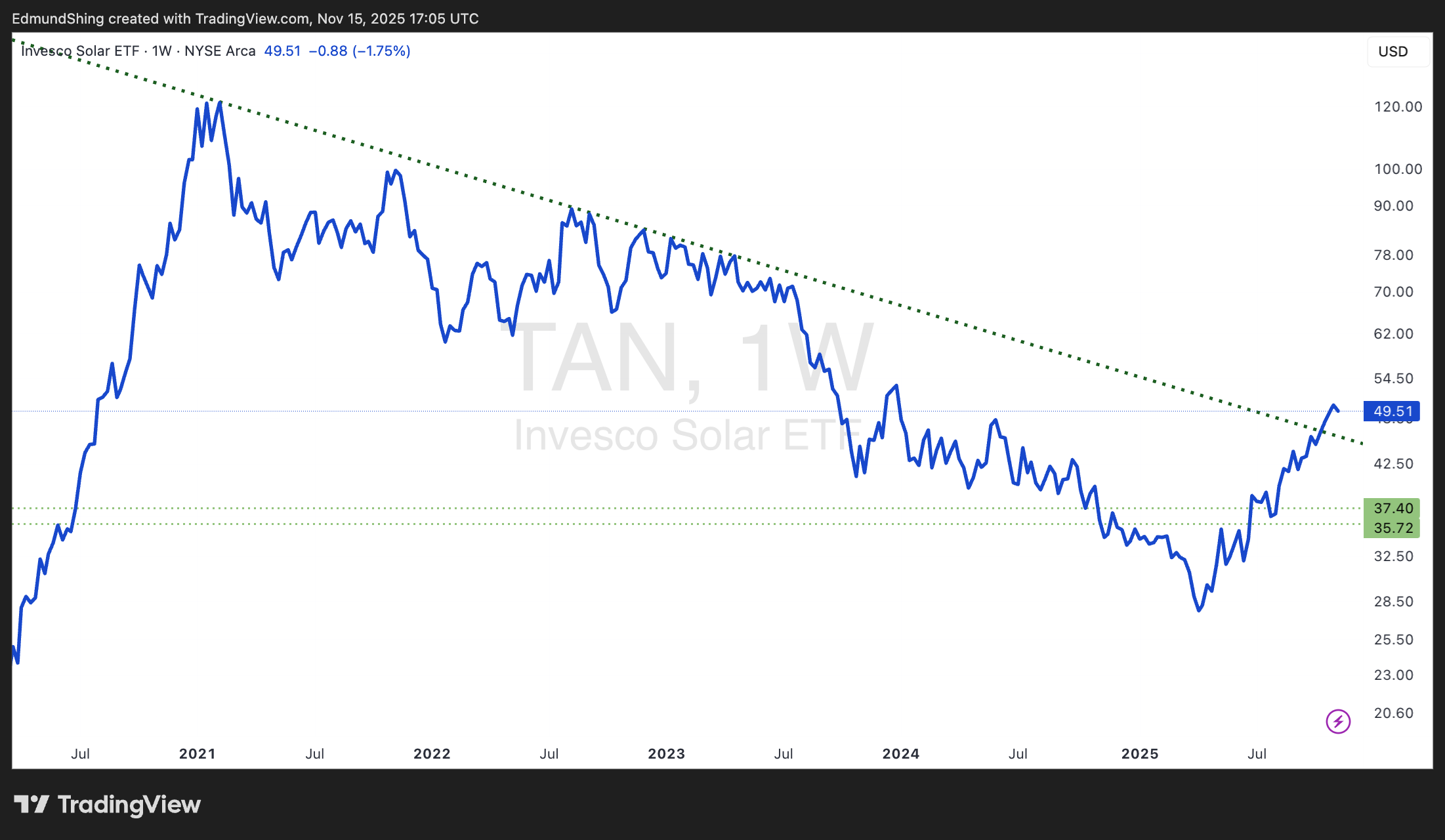
Solar energy on the rebound after a tough period
There is no doubt that in the US, natural gas will be a key source of added electricity generation in the next few years. This allows the US to exploit their competitive advantage in terms of cheap natural gas from Texas shale basins such as the Permian.
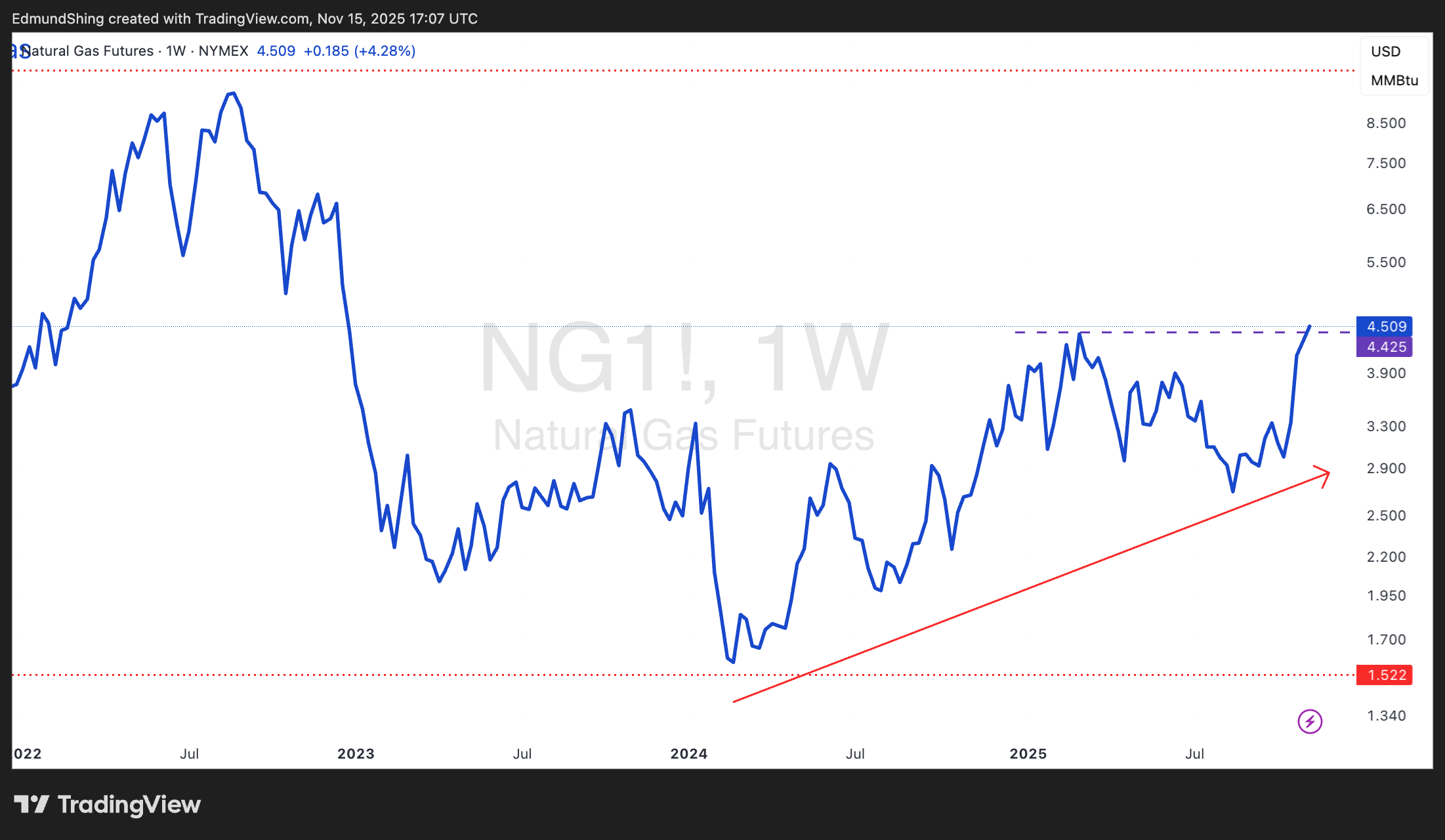
US natural gas prices are rising, in line with the rise in US domestic electricity prices. The Henry Hub natural gas futures price has risen to $4.50/mmBTU, which represents one of its highest levels in 15 years excluding the mid-2021 to end-2022 period. Yet US natural gas producer stocks have not performed well this year and don’t seem to integrate the risk of higher gas prices into the future.
US natural gas prices at highest since 2022
Electrification: watch copper and copper miners too
A commodity that is intimately related to this energy boom via its link to electrification of the global economy is copper, the industrial metal most used in electric cables due to its high conductivity (not as good as silver, but silver is far more expensive). The London Metals Exchange copper price has recently hit a new historical high of nearly $11,000/ton, reflecting growing global demand linked to electrification and technology together with supply restrictions in Chile and Indonesia, two of the world’s key sources of copper production.
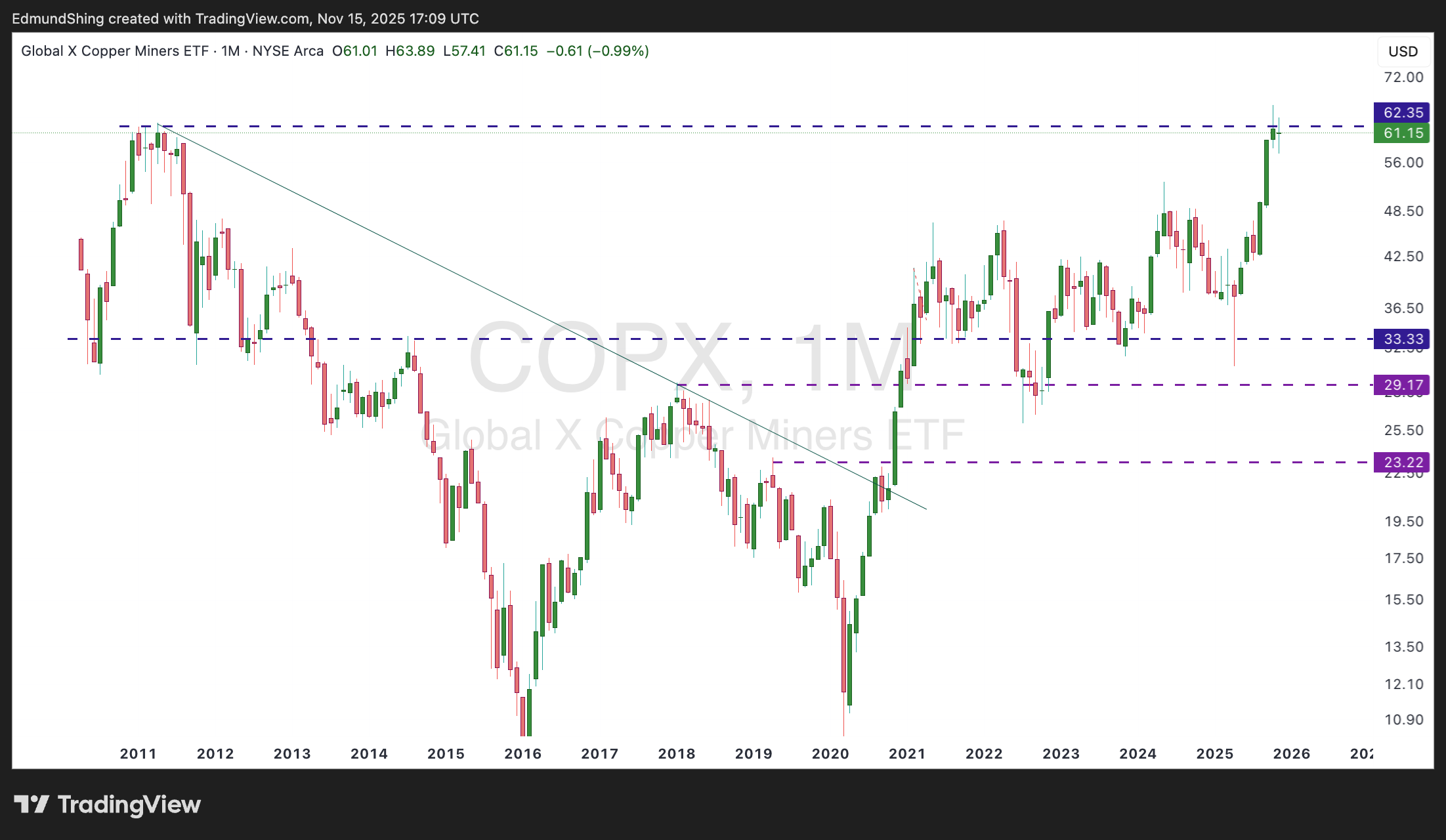
Copper miners are equally poised to break out to a new historic high as these high copper prices translate into higher profit margins for copper producers
Copper miners threaten a new all-time high
Peak oil? Oil demand is NOT declining
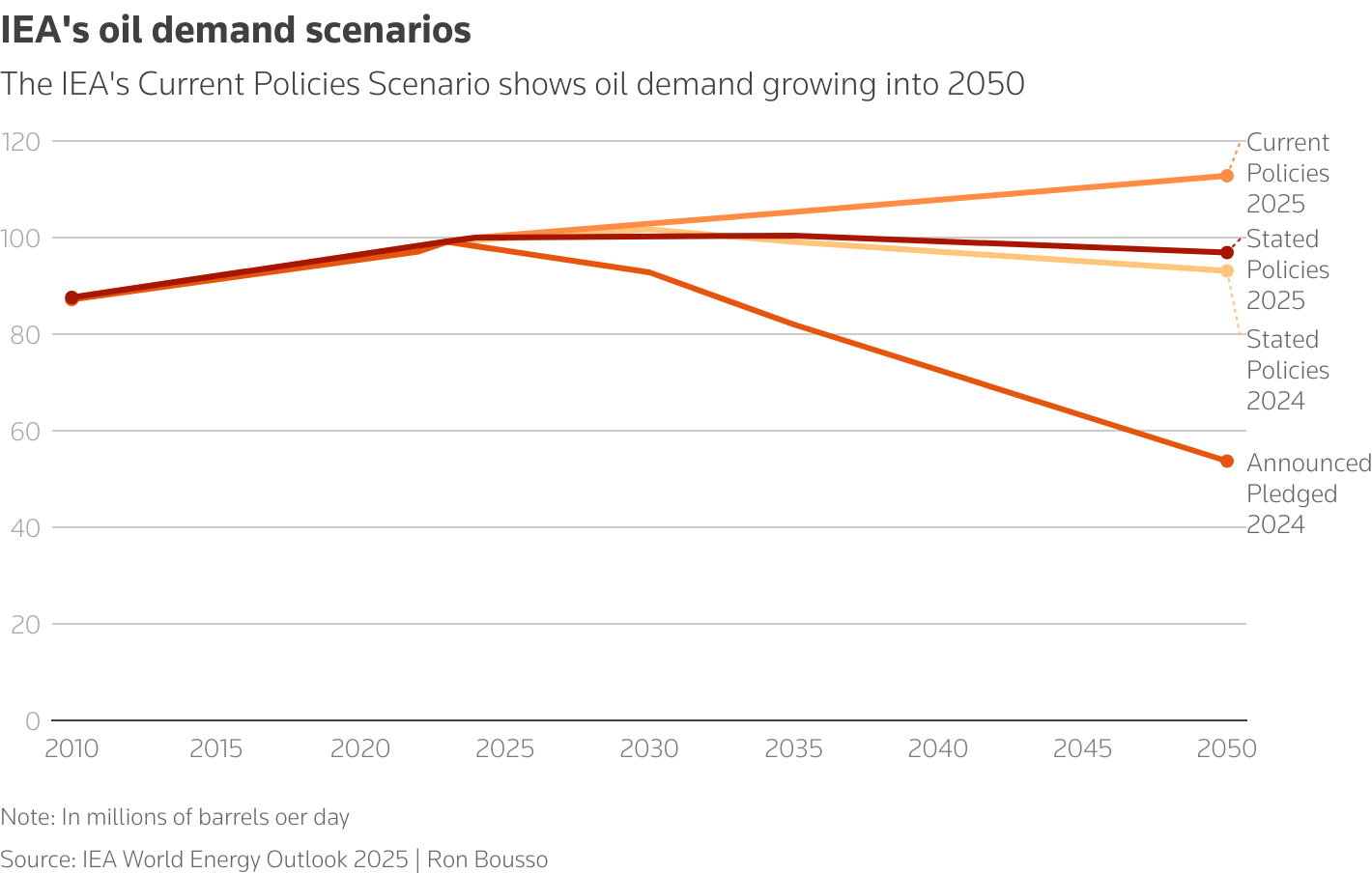
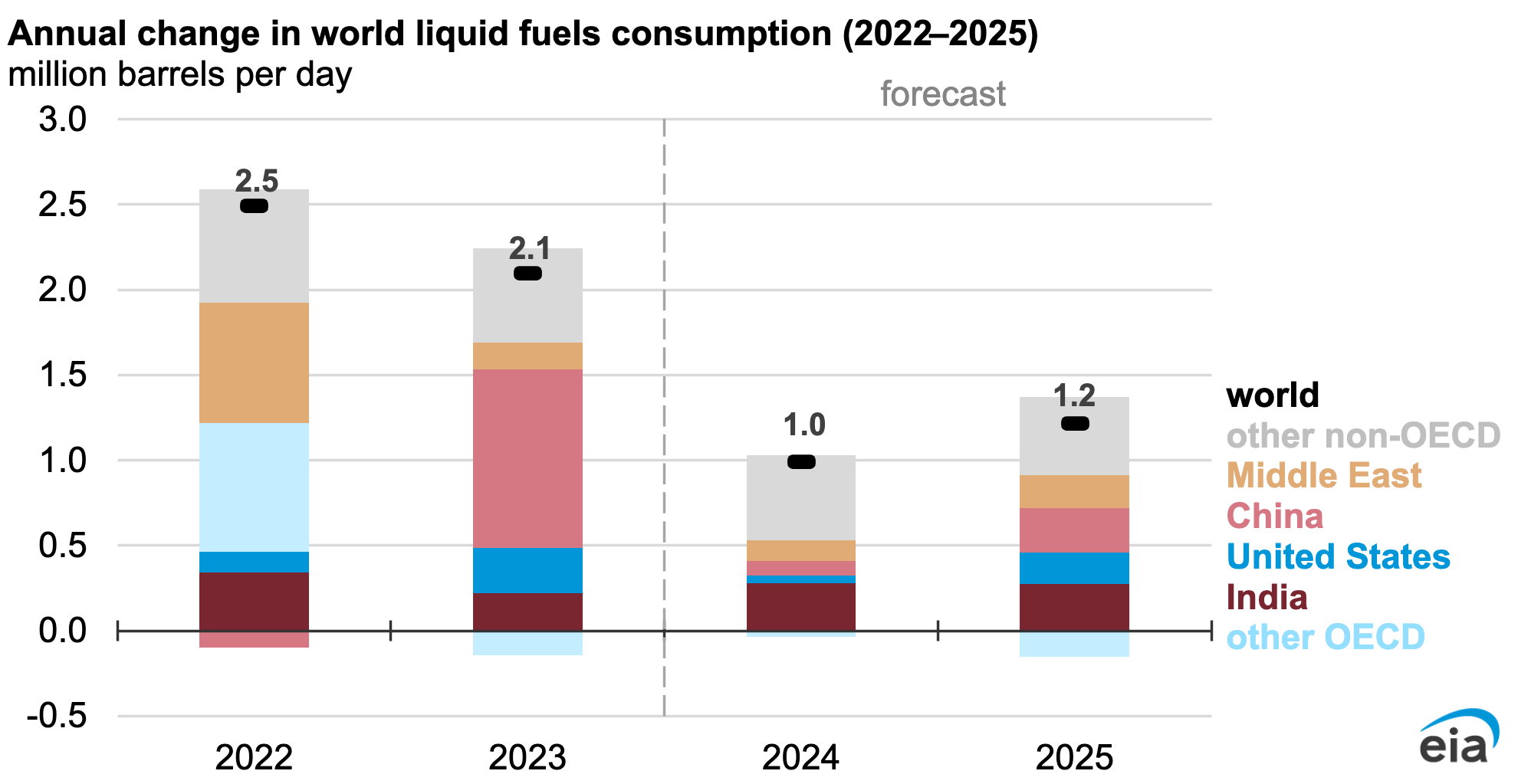
The International Energy Agency marked a 180 degree turn in their latest World Energy Outlook 2025. They have reinstated a scenario for oil in which global demand increases annually until 2050. Goldman Sachs analysts published a similar long-term forecast, projecting that global oil demand will rise to 113 million barrels per day in 2040 versus 103.5m barrels/day consumed in 2024.
In the short term, the world is well supplied with oil, But there are good reasons to suspect that global oil supply may not grow much beyond current levels, suggesting the potential for demand to exceed supply in future years. Since 2015, the US has been by far the largest contributor of new oil supply to the global market thanks to shale oil production from Texas. In 2008, the US produced 5 million barrels of crude oil per day. This year, the US is projected to hit annual oil production of 13.7m barrels/day (of which 9.7m barrels from onshore shale fields), making the US the largest oil producer in the world ahead of Saudi Arabia and Russia.
While the US oil production growth has been impressive over the last decade or so, there are good arguments that the bulk of this production growth is now past, with the risk of declining shale oil production over the next few years given the lack of new investment together with the elevated depletion rates of onshore shale oil wells. In addition, new US shale wells are producing more natural gas and gas liquids and less actual crude oil, On the demand side, note that US oil consumption is actually increasing with 20.6m barrels/day of oil expected to be consumed this year, the highest in 18 years and just shy of the all-time annual record of 20.8m barrels set back in 2005.
In emerging markets, India with its 1.3 billion population remains the largest source of oil demand growth, with plenty of scope for Indian demand to increase further due to a growing middle class, a relatively young population and increasing access to cheap cars sourced from China and other Asian producers. Note that as of 2023, total Indian oil consumption at 5.3m barrels/day was just 1/3rd of China’s despite the same size of population.
Could easing of Russian sanctions drive oil and gas prices lower?
Any easing of Russian sanctions as a condition of a potential Ukraine ceasefire might be seen as a negative factor for global oil and gas prices. However, bear in mind that 95% of current Russian seaborne exports are sent to China, India and Turkey so it remains to be seen to what extent Indian refiners in particular reduce their purchases of Russian crude as a result of tighter sanctions on Russian exports.
In any case, it is not evident that Russia could pump greater volumes of crude oil even if they wanted to - in October, Russia produced around 9.4m barrels/day according to OPEC data, some 70,000 barrels below its revised OPEC+ quota. The lack of investment to maintain and upgrade ageing critical oil & gas infrastructure is likely resulting in a slow reduction in Russian oil production capacity over time.
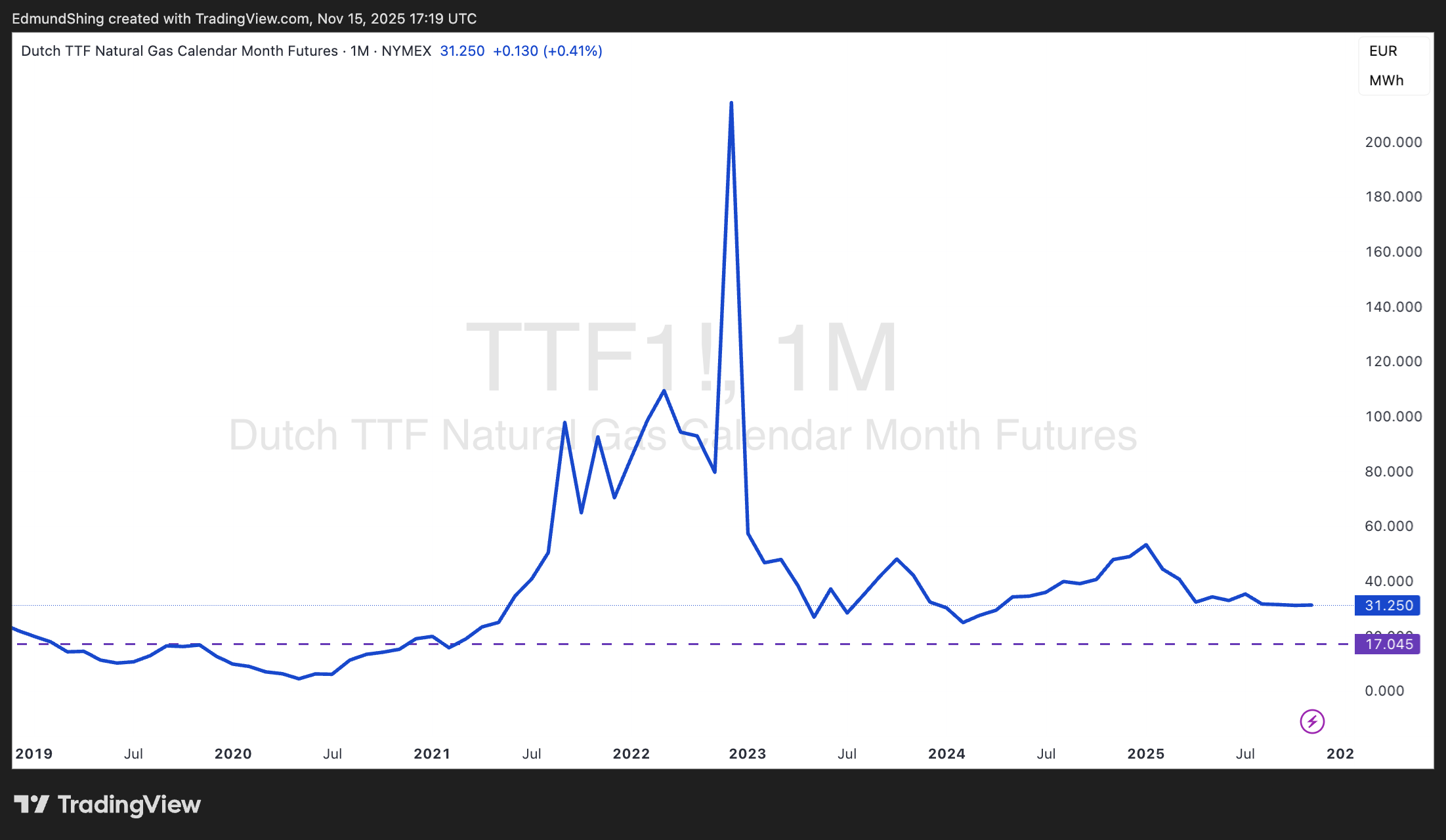
Resumption of the supply of Russian pipeline gas to Europe would in theory reduce gas prices for European countries, but it is unclear if they would be willing to buy pipeline gas from Russia in great quantities once again following their chastening experience in 2022 when European TTF gas prices soared from EUR75/MWh to over EUR300/MWh at worst by August of that year. Even at the current TTF gas price of EUR31/MWh, European companies and consumers pay far more for their natural gas (and thus also for electricity) than they did prior to 2022, when it averaged closer to EUR17/MWh.
European TTF gas prices have declined, but are still expensive v pre-2022
If anything, the wild card that could keep oil prices lower for longer would be regime change in Venezuela, accompanied by investment in Venezuelan oil production by US oil companies such as ExxonMobil. After all, we should not forget that Venezuela, not Saudi Arabia or Russia or the US, have the largest declared oil reserves in the world, even if they only produced 1.1m barrels/day in October of this year, only 8% when compared to US production.
Investment Conclusions
In the short term, the stronger momentum in energy subsectors is to be found in the following areas:
Renewable energy, especially solar - after a huge bear market from 2021 to 2024, solar is making a comeback as it is more and more cost-effective to install even without subsidy;
Battery value-chain and storage - renewable energy generation paired with industrial battery storage is seeing strong demand, with battery storage solving at least part of the intermittent electricity generation of renewable energy. This is particularly important for datacentres which require a constant supply of power.
European integrated Oil & Gas stocks and US oil refining stocks - benefiting from wider crack spreads (profit earned from refining crude oil into various end-products such as petrol, diesel and heating oil).
Canadian oil & gas producers
Integrated uranium/nuclear mining companies such as Cameco, who are benefiting from new orders for nuclear reactor installations.
Physical copper and copper miners, given the demand growth to come from electricity generation and transmission investment.
For 2026, I am watching other subsectors that should outperform once the market begin to believe that global oil supply will return to a balanced picture, leading to higher oil and gas prices:
US integrated oil majors;
US natural gas producers;
Relevant ETFs to look at:
RAYS - Invesco Solar UCITS ETF in GBP
INRG - iShares Global Clean Energy Transition UCITS ETF - GBP
BATG and LITG - L&G and Global X battery and lithium UCITS ETFs - both GBP
ENGE - SPDR MSCI Europe Energy UCITS ETF - GBP
URNP - Sprott Uranium Miners UCITS ETF - GBP
COPG - Global X copper miners UCITS ETF - GBP
XWES - Xtrackers MSCI World Energy UCITS ETF - GBP
For individual companies, you can look at the top holdings of each of these ETFs published in their factsheets.
Have a good week
Edmund
Disclaimer
This is not financial advice. Our content is intended to be used and must be used for information and education purposes only. Please read our disclaimer and terms and conditions to understand our obligations.

14 comments
Thanks Edmund. Any thoughts on geothermal? There seem to be some interesting developments on this in both the US and Europe.
Edmund - To what extent is Russian oil production capacity degradation suffering from Ukrainian drone attacks, or are these solely targeting refining and excluded from the data you are considering? I've heard these attacks have removed at least 25% of Russia's entire refining capacity. You don't mention Ukrainian attacks at all, but I find it unlikely they aren't having a significant impact on the oil-production figures to which you refer. I've also heard that economic sanctions have significantly reduced availability of replacement parts (such as valves) from Europe, for Russia's oil and gas industry, on which Russia has been highly reliant.
Another informative article from Edmund.
"The International Energy Agency marked a 180 degree turn in their latest
World Energy Outlook 2025. They have reinstated a scenario for oil in
which global demand increases annually until 2050"
Pretty much what many of us suspected. May well be worth a punt on Serica after all.
As regards Hydro, geography is a key consideration. In the UK they are nearly all in Wales and Scotland making use of the natural landscape. Also, these tended to be pump storage, which I think uses more energy than they produce. They do however, have the capacity to produce energy very quickly when demand soars.
Dinorwig ( the largest in the UK) was quite a feat of engineering and not that cheap to construct. I dont have any figures, but suspect that pump storage in the UK would be difficult to justify as an investment, but certainly needed as a back up capacity.
Edmund
Interesting article but you didnt mention the use of fuel cells, there has been a significant interest in the use of this tech as seen from the increasing share values after a much depressed period.
Global X Hydrogen UCITS ETF USD Acc (LON:HYGG) there's Hydrogen too which is doing well
Always look forward to your weekend commentary, many thanks.
Great summary Edmund, much like your BNP Paribas podcasts. Keep up the excellent work.
Interesting stuff, thank you, but what about the Cinderella of electricity generation - hydro? Unlike wind and sunlight it is predictable and reliable, obviating the need for storage. Existing technology does the job without needing scarce materials. Installation can be achieved relatively quickly and cost effectively. Gravity and the moon will always be with us!
Were it a practicable proposition surely China would be bigtime into hydro now. Once upon a time I had shares in Scottish Hydro, it wasn't a growth industry and was soon to be absorbed into Wessex Water and is probably still trickling along. The UK is certainly not in a position to find the funding for any mega civil engineering project as far as I can see and expanding nuclear appears to be more manageable.
Hydro is great but you need the right geography for it, hence will always be limited in terms of its overall contribution except in countries such as Sweden and Switzerland...
Thanks Edmund. I would also add that, with reference to the UK, all the major political parties seems to be taking a more favourable view towards the exploitation of oil and gas from the North Sea. I am trying to exploit this through holdings in Serica Energy and Ithaca Energy.
Agreed, although this Labour government suffers from too many u-turns at present! But it certainly makes sense, I also like these two.
Edmund
Clear, precise and informative. Thank you
https://www.justetf.com/uk is an excellent resource on all things ETF.
Thankyou Edmund for sharing your thoughts.