Market Musings 161223: Winners from Lower Rates

Market Musings 161223: Winners from Lower Rates
Some relief for borrowers, at last
Summary
Long term interest rates fall hard
Who benefits from lower interest rates? Real Estate, Housebuilders
Utilities too
Podcast this week:

In this podcast, Edmund Shing, Global Chief Investment Officer of BNP Paribas Wealth Management gives his outlook for 2024.
• How far can inflation fall?
• Lock in attractive bond and credit yields
• Identify attractive regional stock markets
• Are illiquid assets a good card to play?
Long term interest rates fall hard
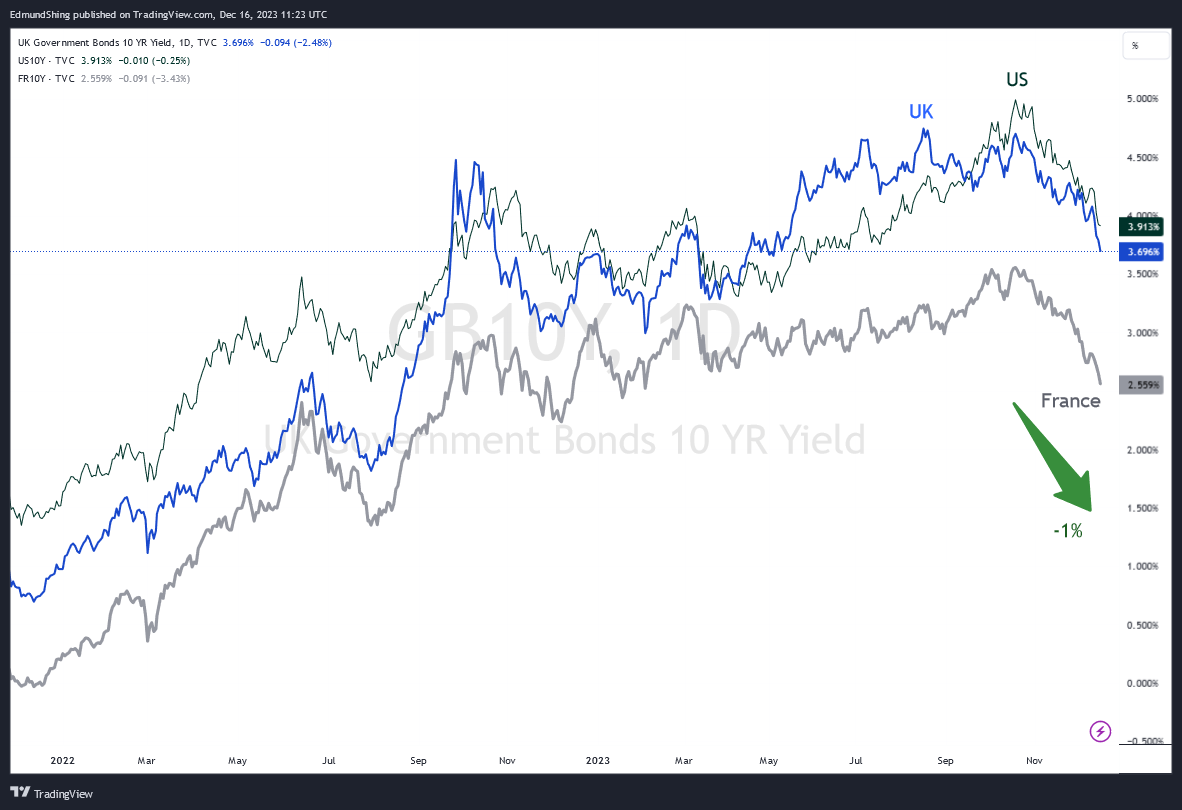
Since peaking in mid-October in the US and France, and in mid-August in the UK, long-term interest rates in the form of 10-year government bond yields (the fixed rate investors receive for lending money to the government for 10 years) has fallen from peak by 1%, to 4% in the US, to 3.7% in the UK and to 2.6% in France.
Long-term interest rates (10-year government bond yields) fall 1%
Source: tradingview.com
This drop represents a sharp reversal of the upwards march in long-term interest rates in place since late 2021, when the UK 10-year gilt (government bond) yield rose from 0.7% to as high as 4.75% at peak.
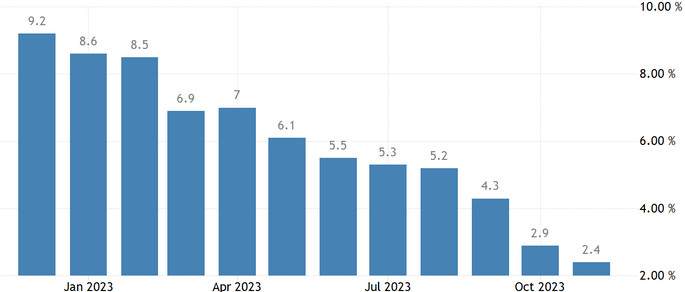
Long-term interest rates are following, in a lagged fashion, the path of inflation which rose to peak at the end of 2022, and which has since fallen sharply to 2.4% in the Eurozone as of November.
Eurozone inflation drops from over 9% to 2.4% in November
Source: tradingeconomics.com
It seems likely that inflation rates will continue to ease lower in Europe, the UK and the US in the months ahead, judging by the underlying disinflationary trends in key inflation components such as rents, Chinese export goods prices, energy prices and even food prices.
With inflation rates now approaching the official 2% target of major central banks, interest rate markets have now begun to anticipate interest rate cuts from early 2024 by the US Federal Reserve, the European Central Bank, and the Bank of England.
This anticipation of lower central bank reference interest rates in the months ahead has sent 2-year government bond yields sharply lower, with the 2-year UK gilt yield falling from 5.5% at peak to 4.3% on Friday.
UK 2-year gilt yield has dropped 1.2% to 4.3% now

Source: tradingeconomics.com
There has been a similar fall in the cost of borrowing for high quality European companies, in the form of a falling Eurozone investment grade corporate bond yield (from 4.6% at recent peak to 3.7% now).
Eurozone investment grade corporate bond yield falls to 3.7%

Source: S&P Dow Jones Indices
Who benefits from lower interest rates?
In general, lower interest rates are a benefit to borrowers (who pay interest costs), but bad for savers (who receive interest income).
Falling 2-year gilt yields are leading to lower 2-year fixed mortgage rates in the UK, now below 6% for the first time in almost 6 months.Prospective borrowers with larger cash deposits (and who are thus better risks from the perspective of a bank) can borrow at far lower rates than this - the Nationwide, for example, is offering movers with a 40% deposit a two-year mortgage deal fixed at 4.65%, and a five-year fix at 4.29%
So the first beneficiaries should be sectors and industries that are largely financed with borrowed money, namely Real Estate and Housebuilding.
As expected, both UK commercial property funds (see the IUKP ETF below) and UK housebuilding stocks such as TW. Taylor Wimpey have recovered a lot of lost ground since the end of October.
UK 2-year gilt yield has dropped 1.2% to 4.3% now

Source: tradingview.com
Bear in mind that even after this latest recovery, both UK housebuilders and UK commercial property REITs remain cheaply valued.
TW. Taylor Wimpey still offers a 6.4% dividend yield and holds 15% of its market value in cash on its balance sheet.
BLND British Land still trades at 0.71x Price/Book Value, i.e. a 29% discount to their underlying stated value of their property assets.
Building aggregates suppliers should also benefit from a pick-up in building activity as interest and mortgage rates decline. After all, in the long term there remains a shortage of decent housing stock in the UK.
BREE Breedon Aggregates and MBH Michelmersh Brick Holdings are two smaller companies that have also started to see a share price bounce over the past month or so.
Aggregates suppliers and brickmakers bounce

Source: tradingview.com
Utilities sector is sensitive to long-term interest rates
The Utilities sector, which includes companies involved in power generation and distribution of electricity and gas, is a highly regulated sector with stable revenues which is sensitive to the direction of long-term interest rates, as utilities companies are generally heavily indebted.
Utilities companies SSE and National Grid surge on lower interest rates

Source: tradingview.com
Income seekers may still be attracted to NG. National Grid, as it still offers a 5.6% dividend yield even after its latest share price move.
Conclusion
Lower interest rates have been a strong following wind for stock markets in general since the end of October. The Santa Rally period kicks in now until early January, and could be a further factor in driving stocks higher in the very near term.
Lower inflation and lower long-term interest rates are clearly helping long-suffering sectors such as listed Real Estate, Housebuilders and Utilities companies all recover, in spite of the relatively weak economic growth outlook.
Expect central banks to begin to cut interest rates before mid-2024 on the back of persistently lower inflation rates. Even if stock markets have already rallied hard and look extended in the short term, the next few months could still prove positive for global stock markets, and in particular for interest rate-sensitive sectors and stocks that have lagged up to now.
All the best for the week ahead,
Edmund
Disclaimer
This is not financial advice. Our content is intended to be used and must be used for information and education purposes only. Please read our disclaimer and terms and conditions to understand our obligations.

14 comments
Hi Edmund,
Your podcast in particular is offers a very optimistic outlook. There are some very contrarian views out there. A summary on the Money Makers website https://money-makers.co/catego...of an interview with Felix Zulauf, apparently a well respected Swiss investor, by a Wall Street commentator (Steve Blumenthal) offers a very doomsday scenario. His main points were
A some what different perspective!!
ACounsell.
His guesses might or might not prove correct. Just as the guesses from a bullish commentator might or might not prove correct.
It’s the same when supposed “experts” guess where markets are heading. They don’t know and neither do we. And when their market guesses got wide coverage they were wrong time and time again, and now there are far fewer such “expert” guesses.
So is it better instead to focus on what we DO know,instead of what we don’t?
e.g like many UK shares being at bargain basement levels and the UK Market being around the lowest it has ever been compared with other major Markets? And Investment Trusts being at unusually big discounts and Trusts that usually trade at a premium going to discounts too.
My investment performance improved dramatically once I focused on things like that and whether or not a lot bad news was already priced in (or good news well and truly priced in with that share overvalued) instead of forecasts from supposed experts who so often got it wrong.
Ken Mitchell
Agree with your view of macro forecasting and I hope your view on Investment Trusts turns out to be accurate! I hold rather too many sitting a huge discounts though I don’t intend to sell . Anyway when I sell anything these days it promptly goes back up - Albemarle (NYQ:ALB) being the latest example despite a 60%+ fall from peak in last year and a crash in Lithium prices.
ACounsell
It’s the Investment Trusts at undeserved big or much bigger than usual discounts that I invest in and not those where the discount is merited either because that sector (e.g some renewable energy Trusts) had perhaps been overhyped, or because of lousy performance.
As for those “expert” commentators/forecasters. Is there also a danger if factoring their opinions into our investment decisions, of buying near peaks and selling near the lows? So many investors buy near the top when money pours in to Investment Funds and then sell at a loss and money flows out of those Investment Funds. And they do the same with their share buying and Fund buying. i.e doing what nearly always doesn’t work instead of what nearly always does work!
Also worth mentioning that Fund Manager shares reflect this. They do very well in bull markets when money is flowing in to their Funds and badly in bear markets when £millions and even £ billions flow out of them.
I hold Polar Capital Holdings (LON:POLR) Liontrust Asset Management (LON:LIO) Premier Miton (LON:PMI) Abrdn (LON:ABDN) and Jupiter Fund Management (LON:JUP) because they fell for above reason and high chance they will outperform IFIF 2024 turns out to be a decent year for investors, And there’s a chance of bids or mergers, and some pay big dividends to provide useful income if we have to wait a while for the share prices to perk up.
It's reasonably easy to make a persuasive (and seemingly intellectual) bear case on the facts that the Western world is a bunch of Empires built on debt etc. Mr Zulauf was quite intellectually bearish when I last watched something of his around 12/5 years ago!
But stock markets have a knack of climbing a wall of worry. Personally it feels like the giant cogs are spinning in a positive direction....for now!
Doom forecasts are more exciting that boom forecasts. So there is a bias towards having more of the former than the latter. However, i agree with with Ken Mitchell that both are very close to being entirely guesswork.
a good read for new young investors when the next meltdown comes be prepared for all builders and suppliers to be booted first wait until they are bobbing along on the floor i buy 3builders 3 suppliers without any fear because when its over they come back like a steam train with wagons on back full of divis idid it in 2008 and beginning of this year
Very good article Edmund. What you wrote reminds us all that at the end of the day it is macro events driving the sectors up and down not what the companies do. I hardly read the details of the company accounts because if you are in the wrong sectors at the time , very little the chief can do to change their fortunes.
I shouted out in this site when Taylor Wimpey was under £1 and Persimmon under £10.
It was fear ( sentiment) which was driving the prices down rather than facts.
One sector Edmund has missed are the financials, Banks and asset managements which I think will do well next year.
Let's hope so!
Don't banks benefit from high interest rates? On current accounts they don't oay anything or very little, yet rake in at high rates on loans. Was some talk about a windfall tax on banks but that was a whike ago.
A few months a go I created a 'sub portfolio" of house builders, estate agents, mortgage brokers, building suppliers etc and it's working well so far!
A few months a go I created a 'sub portfolio" of house builders, estate agents, mortgage brokers, building suppliers etc and it's working well so far!
I did similar, possibly a little earlier with a couple of the names below to no extra advantage. I like building suppliers most because there is an element of intellectual property and good returns on capital for the higher quality names, then housebuilders whose moat is their banks of land, but I eschew the obvious value in estate agents and the like as I see little in the way of moats.
Geberit AG (SWX:GEBN)
Kingspan (ISE:KRX)
Genuit (LON:GEN)
Advanced Drainage Systems (NYQ:WMS)
Volution (LON:FAN)
Howden Joinery (LON:HWDN)
Brickability (LON:BRCK)
Headlam (LON:HEAD)
Luceco (LON:LUCE)
Plenty to choose from amongst housebuilders, but I like MJ GLEESON (LON:GLE)
BnB thanks for putting a list of companies up for consideration. I always find that helpful as it provides something tangible.
My preferences for building ancillaries extend to include Eurocell (LON:ECEL), Tyman (LON:TYMN) , Epwin (LON:EPWN) and more directly involved Michelmersh Brick Holdings (LON:MBH). Mostly paying decent divis while we wait and starting to move up in anticipation of lower rates/ recovery of build rates. I suspect we might have to wait another 12 months or post any snap election for any real prospect in build numbers really starting to head up but the market is already on the case.
I like Epwin and Eurocell’s fundamentals but I hate their products! Off limits for me. But I understand the appeal as stocks. I expect good money will be made on them
Thanks Edmund, I always your commentaries.