Market Musings 180623: A glass half-full view of the global economy

Market Musings 180623:
A glass half-full view of the global economy
Is a soft landing still possible?
Weekly Podcast:
Our investment strategy for June 2023
Will US, EU and UK central banks raise interest rates further?
Could we see surprisingly large falls in inflation over the summer months?
Is global economic growth also slowing rapidly?
What supporting factors do you continue to see for stocks?
Should one follow the retail crowd and invest today in US mega-cap tech?
Summary
Rising interest rates usually result in recession
Rising unemployment appears with a lag - still waiting…
Construction demand still surprisingly robust
Manufacturing activity has weakened, but the momentum has improved
Inflation is falling in US, Europe, not a problem in China
An Optimist’s View of the Global Economy
Fears of economic recession - i.e. of a sustained fall in economic activity including higher unemployment and company bankruptcies - are widespread, and have been for some time.
Rising interest rates usually result in recession: The sharp increase in interest rates by key central banks such as the US Federal Reserve, the European Central Bank and the Bank of England over the last 12 months are having the intended effect of slowing demand by making loans and credit more expensive for households and companies to finance.
Slowing of consumer and investment demand, combined with more cautious company expectations, tend to result in a rising unemployment rate. This then has the effect of slowing consumer demand yet further.
At this point, households become more cautious on the outlook for their own future income and so spend less and save more (so-called “precautionary saving”). Economic activity then slows yet further, encouraging households and companies to become even more cautious, ending up in a spiral into recession.
Rising unemployment appears with a lag: Thus far, higher interest rates is indeed slowing demand, but this has so far not resulted in higher unemployment in the US, Eurozone or the UK. Rather, in each region total employment remains at historic highs…
US Non-Farm Payrolls Grow, Well Above Pre-COVID Levels

Source: St. Louis Fed FRED
UK Total Employment Back to Pre-COVID Peak
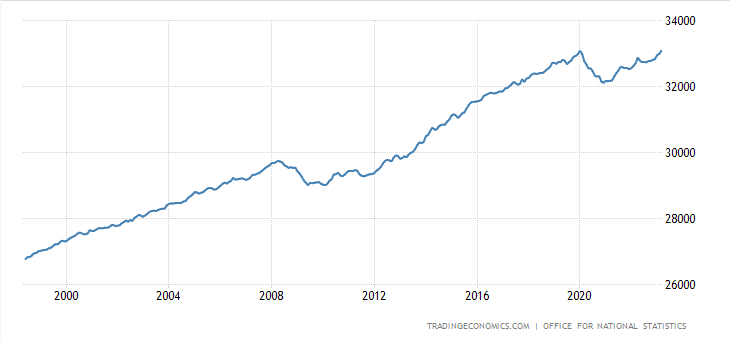
Source: tradingeconomics.com
Construction demand is still surprisingly robust: aside from consumer spending, construction spending is a major component of total economic activity that tends to suffer heavily when interest rates (and thus mortgage rates) rise substantially, due to the effect in cooling house purchases.
What is surprising so far is that US construction spending has not slowed, despite long-term fixed mortgage rates rising from 3.5% to 7% over the last year. In fact, since July 2022 US new home sales have actually been consistently rising from 543,000 sold in that month to 683,000 sold in April this year.
US Construction Spending Still Climbing

Source: St. Louis Fed FRED
In the UK, construction output growth is clearly slowing, but remains positive at 3.6% year-on-year in April. This will likely slow further in the months ahead, given that the Bank of England will have to raise interest rates further given persistently high inflation.
Manufacturing activity has weakened, but the momentum has improved: as the goods demand that had been turbocharged by reopening post COVID lockdowns in 2021-22 has calmed, manufacturing activity globally has inevitably dipped.
The US ISM Manufacturing PMI survey sits in May at 46.9, below the 50 breakeven level and thus indicating manufacturing recession since late 2022. But even in US manufacturing, activity levels are improving according to the latest survey results from the Philadelphia Fed and New York Fed manufacturing surveys.
US Manufacturing Activity rebounds in Philadelphia, New York

Source: Renmac, Philadelphia Fed, NY Fed
Aat a global level, manufacturing activity looks a lot healthier. The JP Morgan Global Manufacturing PMI output component remains robust at 54.4, well above 50 and thus still signalling positive manufacturing growth around the world…
Global manufacturing activity has rebounded since late 2022

Source: JP Morgan, S&P Global
Inflation is falling in US, Europe, not a problem in China: yes of course, inflation rates are still generally too high for comfort in the US, Europe and UK right now.
But the good news is that inflation rates are falling in each of these geographies, and are likely to fall even faster over the next 6 months. Moreover, China simply does not have the same economic cycle and has no issue with inflation at present - China core CPI is only 0.6% year-on-year as of May, allowing the Chinese authorities to try to stimulate the economy via lower interest rates to boost domestic growth.
This fall in inflation rates is exactly what Western central banks have tried to engineer with their programme of higher interest rates, and it seems to be working. Albeit more slowly than we would like.
Macro Conclusion: Not all is doom and gloom…
Statistically speaking, a “soft landing” where central banks raise interest rates to slow inflation and growth, but manage to bring inflation down without triggering economic recession, is a rare beast. So we should not expect this to occur, in the normal course of events.
However, we have all been surprised by the resilience of the global economy in the face of a concerted campaign of higher benchmark interest rates in most countries. Inflation is coming down, but growth has not (yet) evaporated.
In the US, the Atlanta Fed GDPNow indicator points to a 1.8% GDP growth forecast (annualised) for Q2 this year, which is still a decent rate of growth given the huge hike in interest rates.
Atlanta Fed GDPNow indicator forecasts 1.8% growth for Q2 2023

Source: Atlanta Fed
Perhaps then, the chances of achieving one of these rare “soft landings” has improved, and this is what is being priced by stock markets in Europe, Japan and the US at present.
In my view, the jury is still out, as the lags raising interest rates and resulting slower growth and inflation have been variable in history. We may not have seen the worst of the effects of higher rates on the economy just yet.
But we may still get lucky…
Idea of the Week: Optimism in Industrial Stocks
Note the strength of the US and Europe Industrials ETFs since the September 2022 lows. The XLI US Industrials ETF has recently breached a new post-COVID high, while the industrial-heavy Japanese Nikkei 225 index continues to surge higher to new 33-year highs.
US, Europe, Japan Industrials all Show Strong Momentum

Source: tradingview.com
This global sector should benefit from any resurgence in global manufacturing activity, plus heavy investment in the energy transition over the next few years.
One such electric engineering stock very close to a new all-time high is SU Schneider Electric in France, another is ABBN ABB in Switzerland.
In the UK, SFR Severfield is a cheap engineering stock producing structural steel products. A Stockrank of 99, strong FY23 results and a dividend yield in excess of 5% are all attractive at the current 70p share price.
Have a great week ahead,
Edmund
Disclaimer
This is not financial advice. Our content is intended to be used and must be used for information and education purposes only. Please read our disclaimer and terms and conditions to understand our obligations.
3 comments
Great piece as usual from Edmund.
What concerns me about taking an overly optimistic view is that around 50% of GDP is government [deficit] spending which means more borrowing, that will exacerbate inflation and require more rate hikes, that in turn require the government to borrow even more to pay the higher coupons on the debt and so it goes. This will of course benefit the markets, but at the cost of higher debt to GDP ratios, which some might say, are already un-payable. Japan has probably gone further down this route than most and now has a debt to GDP ratio of over 250%, and finances themselves by buying their own bonds, all at the expense of the [negative yielding] Yen.
Soft landing for a while perhaps, but won't this all end in some sort of monetary reform?
Schneider Electric is my largest holding outside the usual suspects of MSFT, GOOG etc and is a standout stock in the energy transition. It's been a great investment and has consistently beaten expectations over many years. Compared to high quality industrials like Spirax, Atlas Copco etc it's less expensive on fundamentals yet has the most powerful growth drivers. Not expensive today, it will definitely fall hard on any conclusive signs of a recession in its markets and I would recommend taking a good look in advance of that possibility. Meanwhile, today's levels remain reasonable for a structural winner. ABB is much more cyclical so I would be more wary.
Thanks Edmund. What is surprising is how difficult this is to forecast. In 6 months we could be in an enormous recession, or perhaps have just suffered a slow down.
FWIW i think a recession is 'overdue'. In some ways we need one to clear the dross and then build on solid foundations.