Market Musings 200124: S&P breakout to new All-Time High

Market Musings 200124:
S&P breakout to new All-Time High
Key Points:
Technology sector leads, drives US to new highs
Rest of US stock market not really following, yet
Japanese Nikkei index also pushes new 34-year highs
Continental Europe settles, above old highs
Laggards; UK, Emerging Markets (China)
Share buybacks continue to be a strong support for stocks in US, Europe, Japan
Macro liquidity still positive
Bonds: US bond yields edge back up, towards 4.2% on 10-year Treasury
Gold hovers within sight of $2070/oz all-time high
US Natural Gas: Focus on long-term bull case
Technology stocks, AI still in the driving seat
With the US technology sector still in the momentum driving seat in January, as for most of last year, the S&P 500 benchmark index has risen yet further, above the key end-2021 peak level and to a fresh all-time high.

Stocks in the rest of the world are not yet following with the exception of Japan. The Nikkei 225 index has also edged higher this year, remaining around a 34-year high but still some way below its 1989 all-time high around 39,000.

Eurozone stocks continue to consolidate above the ultimate-year high established in December, but have not so far followed the US or Japan to fresh highs. Nevertheless, Eurozone stocks remain well-oriented above old highs, and should move higher if the banks sector can follow through on positive trends. This will likely be triggered by any modest recovery in Eurozone economic sentiment, which remains relatively depressed for the moment.
The UK and Emerging Markets (principally China) remain laggards in this global stock market rally.
Drivers for stocks: Liquidity, buybacks, lower volatility
According to Crossborder Capital, macro liquidity continues to improve, led by the US Federal Reserve and the Peoples Bank of China.
Given the need for the Federal Reserve to support smooth functioning in the US bond market and also to continue to support US Regional banks, I would expect that the Fed continues to push more liquidity into the US financial system. The PBOC in China will need to do similar, given the difficult economic situation surrounding the property market, consumer confidence and the emergence of deflation once again.
Two other factors that also help stocks are ongoing share buyback programs in the US, Europe and Japan (companies providing demand for their own shares) and falling bond market volatility, as measured in the US by the MOVE index. A lower MOVE index is correlated with a higher stock market.
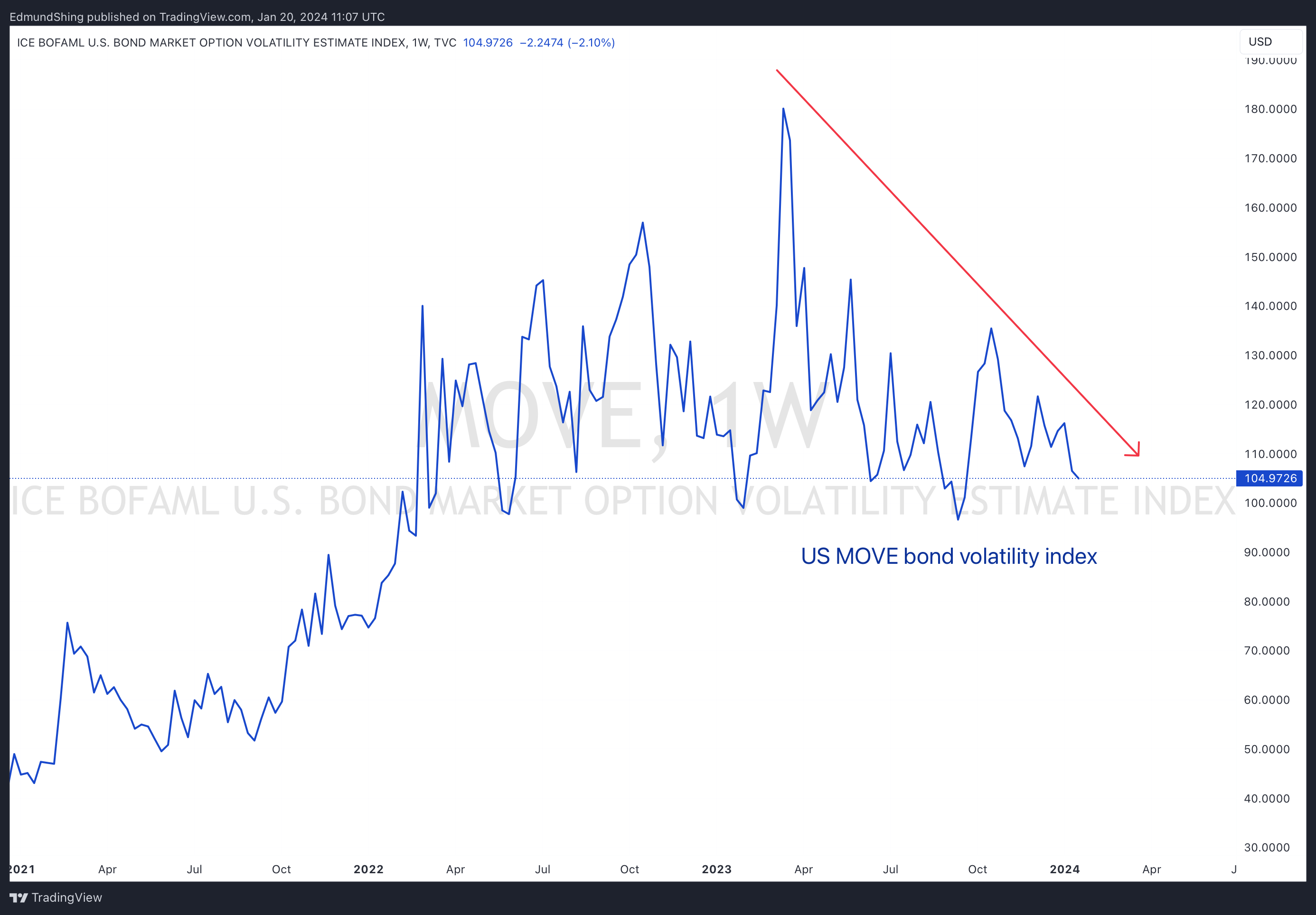
Are bonds re-entering the Buy zone again?
After a substantial rally in bonds at the same time as stocks over November and December, bond yields have drifted higher so far in January (and thus bond prices lower) a central bankers in the US and Europe have tried to calm expectations of rapid and deep interest rate cuts this year.
I believe that inflation rates will continue to fall both in Europe and the US over the next few months resulting in disinflation (inflation well below 2%) in the Eurozone sooner rather than later.
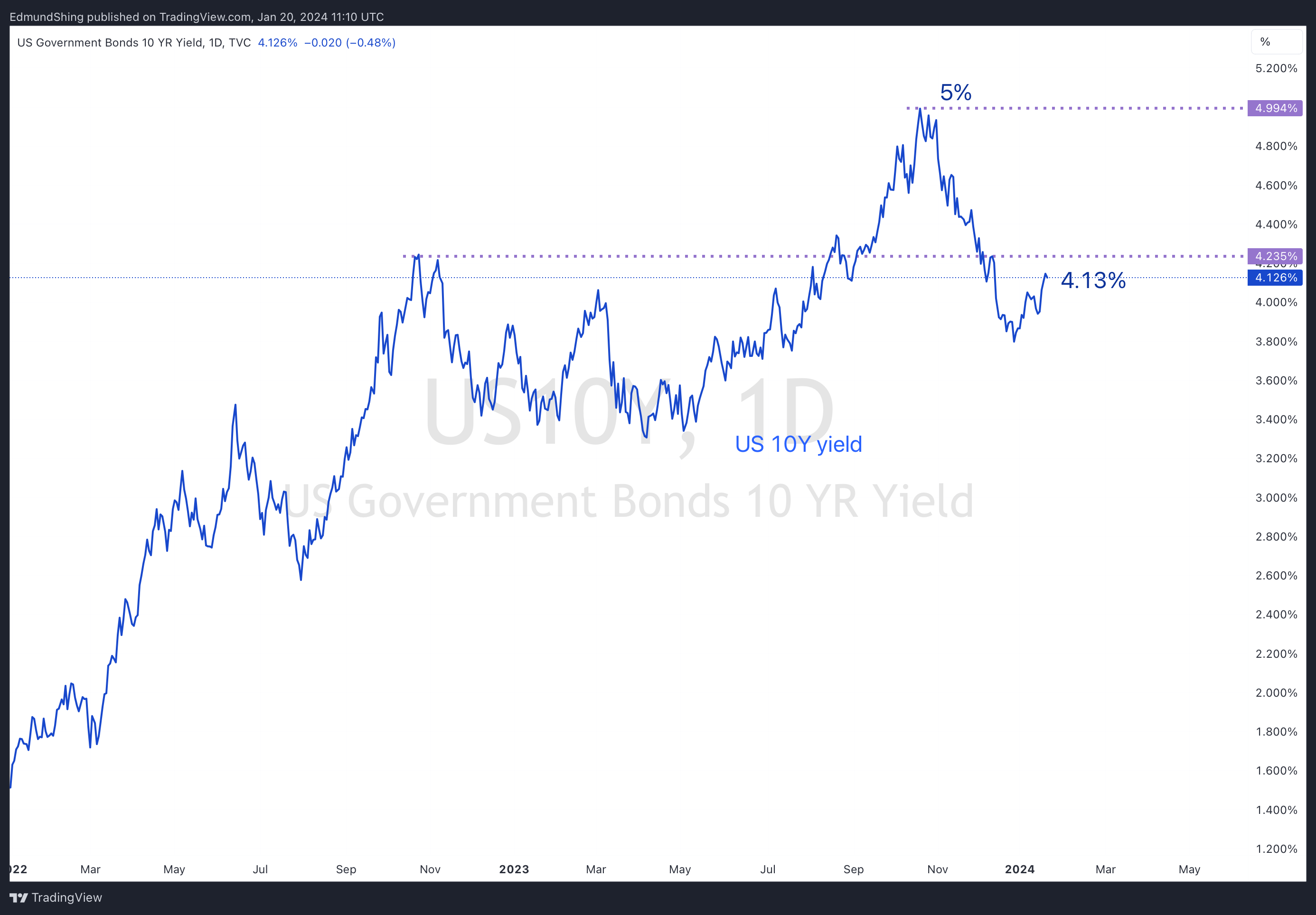
My suggested buy point for bonds would be when the benchmark 10-year Treasury bond yield reaches 4.2% again - we are not far off, at 4.13% currently.
Gold: I am keeping the faith
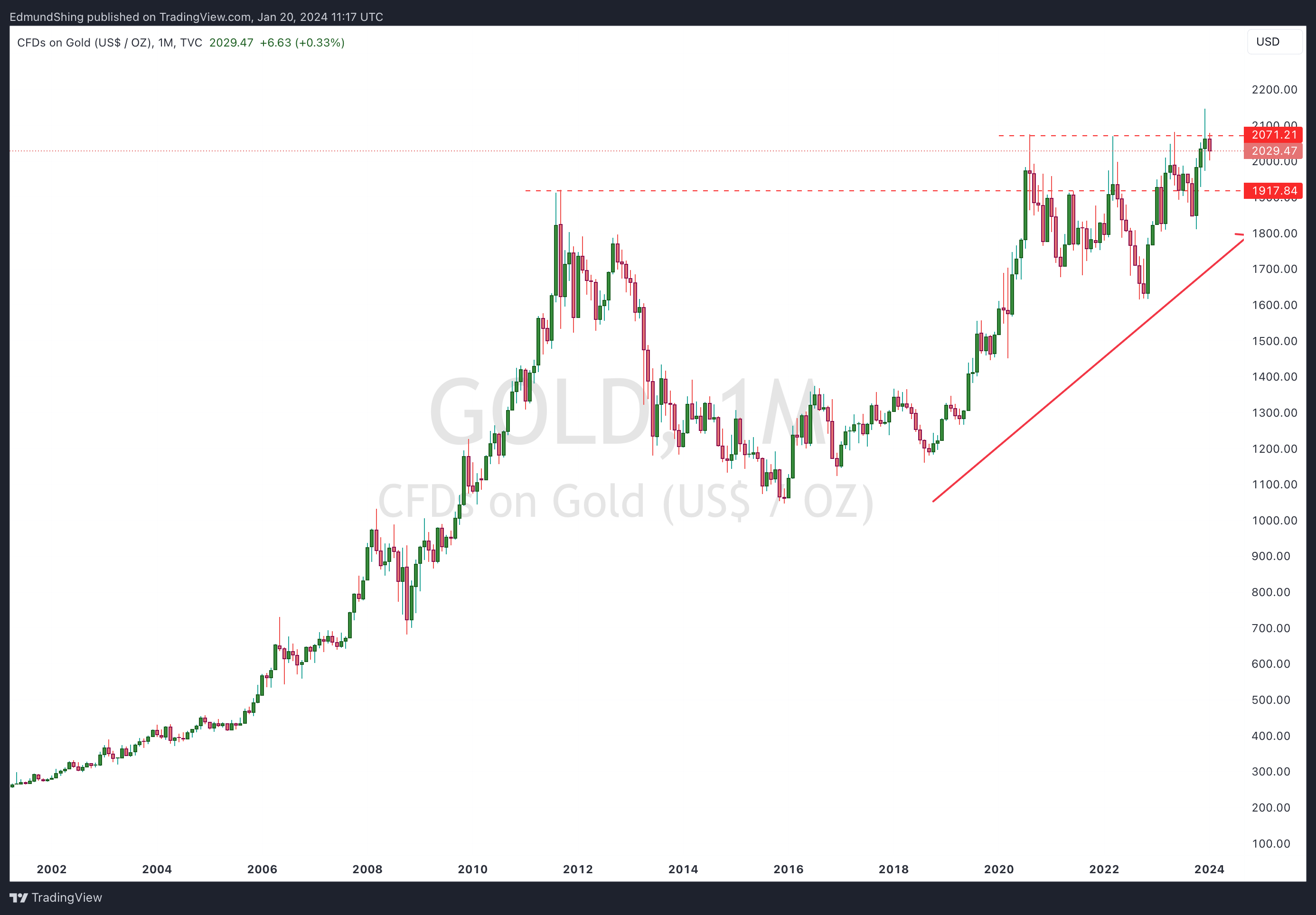
Gold continues to hover just below the $2070 all-time high, cooled for now by a bounce from lows in the US dollar and the rebound in bond yields. Gold prefers a lower US dollar and lower long term bond yields. But the demand for gold from global central banks, combined with heightened geopolitical risks and gold’s excellent diversification benefits all argue for a sustained breakout of gold above the $2070/ounce level soon. We have already breached this level recently, but only very briefly. Once this key level is passed definitively,, I would expect gold to go on to further highs on the back of these drivers, particularly if the US dollar and US bond yields resume their downwards trend when the Federal Reserve starts cutting its benchmark Fed Funds interest rate.
During the three past US Fed interest rate-cutting cycles, gold rallied impressively each time, and I look for the same to occur this time, once the Fed stars cutting rates in perhaps May.
US natural gas: an interesting long-term bull case
This week I read an interesting blog post written by the commodity-focused investors Goehring & Rozencwajg (click on this link to read the article), about a long-term bull case for US natural gas and gas producers.
They believe that the ongoing demand from Europe for Liquefied Natural Gas, combined with a peak and potential slowdown in US shale gas production from the Permian Basin and other areas could lead to US gas prices surging well above the current $3/MMBtu price. Remember that this gas price surged to over $10/MMBtu in the wake of the outbreak of the Ukraine conflict in early 2022.
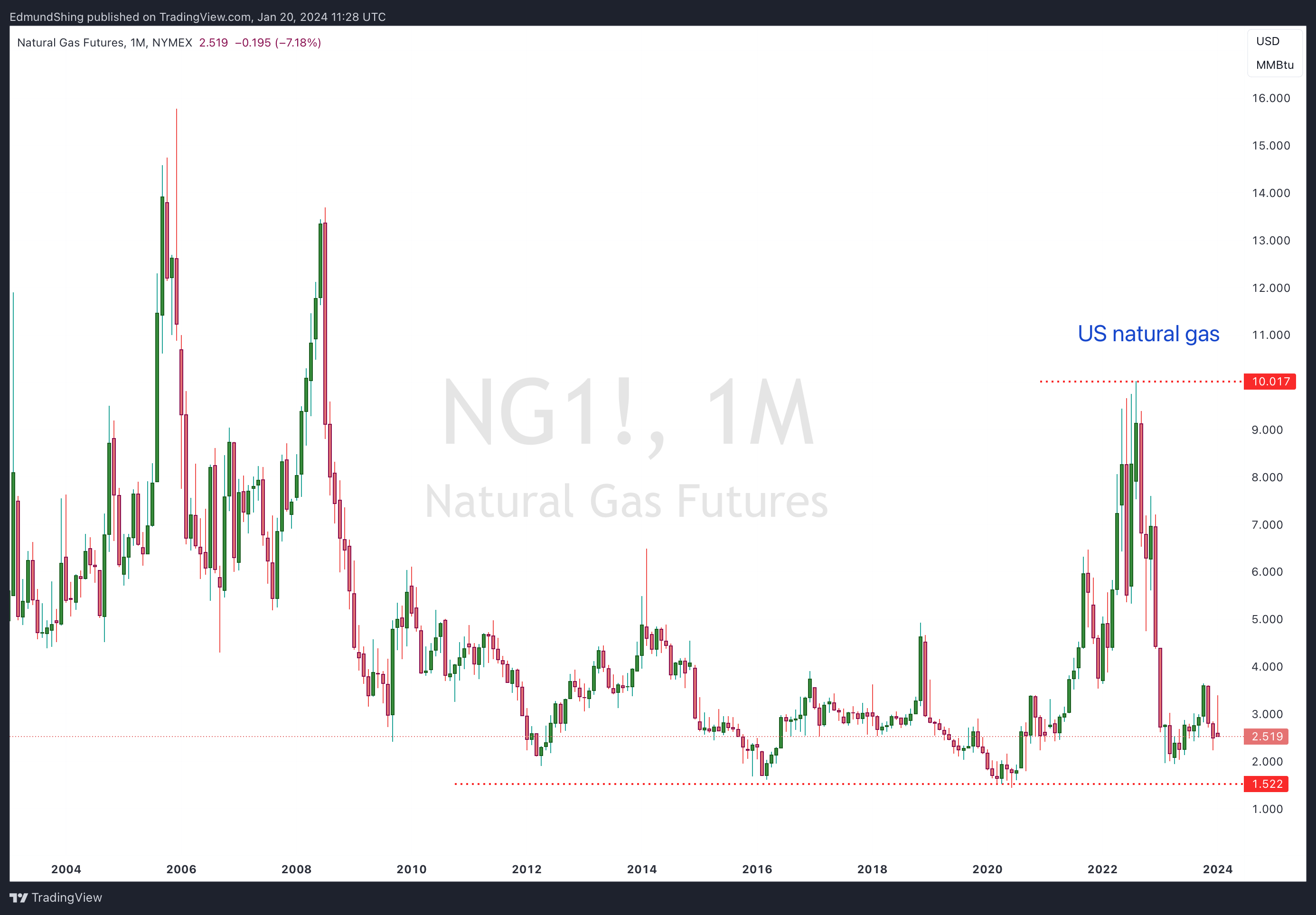
This would represent a substantial extra cost for the US economy via higher energy prices (gas and electricity), but would of course be a boon for US natural gas producing companies.
Have a great week ahead,
Edmund
Disclaimer
This is not financial advice. Our content is intended to be used and must be used for information and education purposes only. Please read our disclaimer and terms and conditions to understand our obligations.

5 comments
US technology stocks are up Friday, mainly due to chipmaker Super Micro Computer (NSQ:SMCI), who were up 35.9%.
The problem with AI software is its needs a lot more memory to run, I have some on my photo editing. I've had to buy a new computer with a uprated graphics card, many others will be doing the same. NVIDIA (NSQ:NVDA) will be doing well for some time.
The problem with AI software is its needs a lot more memory to run
This. I bought Micron Technology (NSQ:MU) a while back for this reason. A number of analysts have the name as their top semi pick for 2024 - though that doesn’t always work out well. It’s a horribly cyclical company, but the stocks of almost all semi cos give a wild ride!
Hi Edmund
I really must have the wrong selections for my Japanese exposure! Baillie Gifford Japan Trust (LON:BGFD) is down 20% over the last 2 years and Baillie Gifford Japanese Smaller Companies B Acc Fund is even worse!! I know that part of the issue is the foreign currency effect but this Investment Trust and Fund from the Baillie Gifford stable have woefully underperformed the Japanese market. I also have gold exposure (physical ETF) and gold miners ETFs (large & small) and bond exposure (UK gilts, Corporate Bond Funds and ETFs) and yet my portfolio value continues to sink. Maybe your analysis will be accurate and the year will see a turnaround. I won't hold my breath!
I also hold Baillie Gifford Japan Trust (LON:BGFD) I'm down 31%, very disappointing. However on gold I bought early 2020 and those are up over 40%.
Hi AC
I think much of the performance in Japanese smaller caps has been more the value end of the market which is more targeted by the activist funds AVI Global Trust AJOT / Nippon Active Value Fund (NAVF). This prompted me to have a look at the performance of these (Trustnet data) and its interesting that NAVF is by far leading the pack. BG generally have a more growth mentality.
Of course the currency movements do not help either
Nippon Active Value Fund PLC ORD X 3YR = 56.70% / 1 YR = 24.50%
AVI Japan Opportunity Trust Plc ORD 1P X 3 YR = 12.40% / 1 YR = 5.90%
The Baillie Gifford Japan Trust PLC Ord X3 YR = -32.20% / 1 YR = -7.60%
JPMorgan Japan Small Cap Growth & Income Plc X3 YR = -37.20% / 1 YR = -1.30%
NAVF was featured on the Moneymasters podcast around 22/4/23
https://www.trustnet.com/news/...