Market Musings 220325: Just a correction, or a bear growling?

Market Musings 220325:
Just a correction, or a bear growling?
Podcast this week:
Extreme US bearish sentiment marks a tactical turning point
(click on link to listen)
Edmund Shing, Global Chief Investment Officer at BNP Paribas Wealth Management, discusses the bearish sentiment among US investors and the possible implications for future returns from US stocks.
Poking the bear?
The Trump presidency has certainly set the proverbial cat amongst the pigeons. Since inauguration on 20 January, Donald Trump has unleashed a maelstrom of Executive Orders that have created a record amount of geopolitical uncertainty in just 2 months.
The Economic Policy Uncertainty index published by Baker, Bloom & Davis illustrates just how extremely unpredictable the US and global geopolitical landscape has become, following a flurry of announcements regarding tariffs, the Department of Government Efficiency, NATO and the war in Ukraine.
According to the US version of this index, uncertainty today is higher than at any time bar the beginning of the COVID pandemic in early 2020.
Record surge in US economic policy uncertainty

Source: www.policyuncertainty.com
The result of this extreme unpredictability in US economic and foreign policy has been a plunge in the level of confidence of both consumers and businesses, as measured by recent surveys.

This plunge in confidence is beginning to weigh on both consumer spending and business investment, and thus on US economic growth prospects. This weakening growth outlook has transmitted to the US stock market, with an interruption in the bull market in place since late 2022. From mid-February peak, the S&P 500 index has fallen 8% and the Nasdaq 100 11% to date.
US stocks suffer from this collective loss of confidence

This still leaves the S&P 500 58% higher than its trough in September 2022, but it does sit below its 200-day moving average for the first time since late 2023. Back then, this breach of the moving average was quickly reversed. Time will tell as to whether the S&P 500 has rebound above this key moving average. If not, then we have to conclude that the current US bull market may have ended, and that a new bear market may have begun.
Not mirrored elsewhere in the world
We should note that this phenomenon is largely US-centric, and is not yet evident in other stock markets around the world.
European stocks (using the STOXX Europe 600 index that is a Pan-European index including the UK) remain solidly in an uptrend, boosted of late by the passing of the German defence and infrastructure spending plan. Eurozone stocks remain in a bullish trend, with the Euro STOXX 50 index only 2% below its recently-set all-time high.
European stock market close to all-time highs

We could equally look to Japan: Japanese stocks may have stalled since mid-2024, but again remain solidly above their 200-day moving average and have provided handsome returns to investors since mid-2022. The Japanese TOPIX index sits only 4% below its all-time high.
Japanese stocks look set to move higher

Even China is now responding to a combination of stimulus help from both the government and the Chinese central bank, in an effort to stabilise the local property market and support domestic consumption. Additionally, the arrival of DeepSeek and other generative AI large-language models from Alibaba and Baidu has boosted the Chinese tech sector, driving a big rebound in Hong Kong-listed Chinese stocks (represented by the HSCEI Hang Seng China Enterprises Index)..
Hang Seng China Enterprises Index +70% since start-2024

Rotation of stock market leadership
Within the US, profits have been taken in the former market leaders - the US mega-cap tech stocks, i.e. the Magnificent 7.
Magnificent 7 now 19% below December 2024 peak

As an example of this, look at Microsoft that has sunk 16% below its mid-2024 high.That said, it remains over 80% higher than its late-2022 low point.
Microsoft is trending lower

If we look at performance from the beginning of 2022, we can see that European Banks (represented by the EXV1 STOXX Europe Banks sector ETF) have far outstripped the Nasdaq 100 at +80% (not including dividends, which are generous in this sector) versus +21%.
European Banks still trend higher

Even in the Tech world, since September 2024 when the first round of Chinese stimulus efforts were announced, Chinese tech companies have far outstripped US tech companies in terms of stock market performance, boosted by the DeepSeek AI announcement in January…
Hang Seng Tech index wins hands down

What am I watching for confirmation of rebound or bear market?
High yield credit spreads
First, a word of caution. There is no perfect single indicator of impending economic recession or bear markets in stocks.
Of all the financial market and economic indicators that I have tested, the best single indicator is the index of US high yield credit spreads.
Ths US high yield credit index is an index of US corporate bonds which have a “junk” credit rating of BB or below. For note, corporate bonds rated AAA - BBB are considered investment grade and thus much lower risk. These credit ratings reflect the quality of a company’s balance sheet and cash flows, and thus the probability that an investor in the company’s bonds will receive their interest payments (coupons) and all of their initial investment back when the bond matures, without that company defaulting on these payments.
The high yield credit spread is the extra yield that an investor demands to own these high yield corporate bonds instead of an equivalent maturity US government bond, as compensation for taking on the extra risk of lending to these riskier companies as opposed to the US government.
In good economic times, the risk of default is lower as the economic backdrop is more favourable to these higher-risk companies, and thus the high yield credit spread is lower. In contrast, when the economy slows or looks like it might go into recession (economic contraction rather than growth), then this high yield spread rises to reflect the higher consequent risk of default, and an investor thus not receiving all of their money back when the bond matures.
How is the US high yield credit spread behaving at the moment? Well, it is rising to reflect the slowing US economy and the rise in economic uncertainty.
US high yield credit spread has risen, a little

Source: FRED database from the St Louis Fed
So according to this indicator, the risk to financial markets and to stocks has risen, with this credit spread at its highest in over 6 months at 3.2%.
But when we take a longer-term perspective, this rise in spreads seems very limited, at least so far.
High yield spreads remain very low by historic standards

In previous recessions (the shaded areas in the chart above), this credit spread index has surged well above 7.5%. Even at 3.2%, this high yield credit spread is still amongst the lowest recorded since 1997.
In the past, a move above 5% in credit spread has indicated widespread stress in financial markets, as observed in early 2022 post the Russian invasion of Ukraine. The current spread is actually one of the lowest readings recorded since 2008…
A strange way to start a recession
Ultimately, we are in a strange situation where this rising risk of US recession is entirely triggered (whether deliberately or not) by the actions of the Trump administration. This suggests that if President Trump wants to avoid a US recession, he has the means to achieve this by reducing peak economic uncertainty with his rash of Executive Orders and with his policy of raising tariffs on allies and perceived economic enemies alike, which has raised fears of a renewed surge in US inflation and erosion of household purchasing power.
For now, the credit markets suggest that we are seeing a stock market correction, rather than a slide towards a US economic recession. In addition, I expect further action from central banks around the world (US, Eurozone, UK, China) to reduce benchmark interest rates and thus the cost of borrowing for households and companies. This should boost both growth prospects and also liquidity in the global financial system, which should help stocks.
Let's see if the Trump administration worsens the situation or tries to reduce the pressure on the US economy in the coming weeks...
One last note: investor sentiment already extremely pessmistic, a good sign...
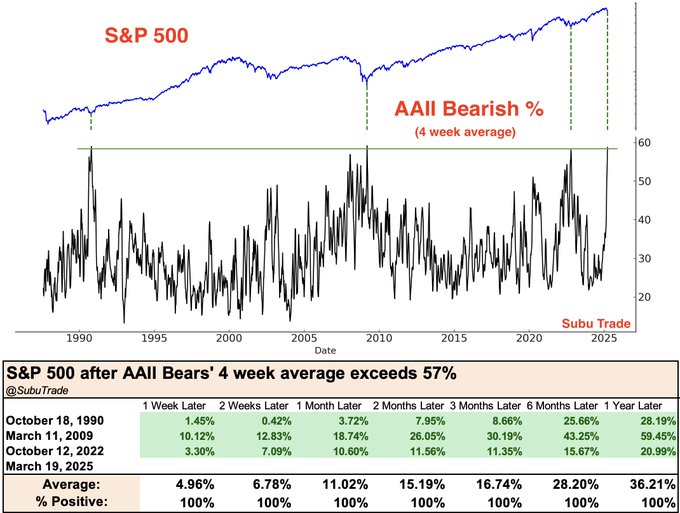
US investor sentiment surveys such as the weekly AAII investor sentiment survey below indicate extreme pessimism. These extreme bearish readings have only been rarely seen before, in 1990, 2009 and 2022. In the past, these extremes have proved good buying opportunities for the months that followed.
When AAII retail investor survey extremely bearish, S&P 500 has rebounded
Source: SubuTrade via X
Best
Edmund
Disclaimer
This is not financial advice. Our content is intended to be used and must be used for information and education purposes only. Please read our disclaimer and terms and conditions to understand our obligations.
15 comments
Thanks for posting your thoughts Edmund and also for the podcasts. They are short, straightforward, based on facts and easy to follow the logic.
I tend to focus on quality shares and investment trusts trading at a discount to NAV. I find the number of ETFs overwhelming! Although, maybe if I spent the same amount of time reviewing ETFs, I would have a better understanding of relative performance.
Largest ETFs: Top 100 ETFs By Assets
List of top ETFs & ETCs | Hargreaves Lansdown
I should perhaps spend more time as my defined contribution pensions funds are invested in very similar investment vehicles.
I thought the following substack article by Stephen Clapham was interesting.
https://tinyurl.com/bdz42z4x
The growth of ETFs has been extraordinary:
And it's no wonder when you think about the underperformance of actively managed funds:
SSB
deleted
Seconded here Edmund would be great if you got time to finish off the second part of your previous ETF article.
Dont worry, it is coming soon. I needed to put the explanation of the High Yield credit spread as an indicator in this article, as I will refer to it again in the next articleon an ETF investing system...
Thanks Ed I have just ordered your "idle investor book" I'm moving out of buying direct equities as although I work in the finance industry with access to loads of fund managers I'm not averaging much better annual performance than putting the whole pot into Rathbones Global Opps.
So I'm hoping a tracker ETF portfolio along the lines of what you outlined in your previous article might be a simple/better way less time consuming way to go moving forward.
Someone once said "its easier to make it as an Olympic athlete than beat the stock market consistently" and even though I put in 15-10 hours per week research and have access to the top managers after 15 years effort I still haven't cracked it.
So hopefully your ETF portfolio approach will grind out 8-10% per annum most years and I can put the sixty odds hours a month saved into something I'm more suited to.
Regards
Andy
Japan: you say, as do many, 'We could equally look to Japan: Japanese stocks may have stalled since mid-2024, but again remain solidly above their 200-day moving average and have provided handsome returns to investors since mid-2022. The Japanese TOPIX index sits only 4% below its all-time high.
Yet the AIC charts for Jap IT funds show dismal performance for the last year (apart from one). So is currency the problem? Do you need to buy a hedged etf? Can some expert tell me the truth about investing in Japan because I have never got it right. And have given up atm.
Currency is the issue Snowdrop Japan funds did well in 2023 but when converted back to sterling/gbp you made about half the gains shown from holding in yen, that said if the yen is now in a period of rising it could move in the investors favour.
Indded, historically the way to avoid this would have been to invest in currency-hedged Japan equity ETFs... But given that the yen may finally strengthen from here, I am not sure that is any great idea any longer. So the ITs should perform better on the back of a Japanese yen no longer weakening significantly
The market is about psychology. The 2008 recession was a long time ago, People are used to markets rising, which means they are reluctant to sell.
My guess is that it needs another two months of falling markets for investors to get weary and start selling in large numbers. Only at this point will a significant bear market commence.
Alternatively if Trump stops his manic policies in the next two months there is no reason for a recession. But on past experience he cannot help himself. So yes i think there will be a major slump this year.
This is as always the risk, that we follow the pattern of early 2022 once again and see a 10% drop in the S&P 500 turn into a 23% drop before finally bottoming ion October 2022... As I said, depends largely on Trump...
Thanks Edmund for another extremely interesting article relating a singular indicator to Investor sentiment but then being put in perspective by the reaction of the S&P. Rather emphasises the need to be rather simple in ones approach to gauging Market / Economic directions, particularly as one rarely follows the other.
On another of your very interesting articles relating to Longer term Model ETF's; i had hoped , this week, you would have published your work on this for your friend, as mentioned last week , but possibly i missed it if published elsewhere..
There were quite a number of thumbs up so a lot of interest. I do understand that Stockopedia is geared to direct equity investing but i do mine in two halves ,with one long term in stocks and funds ,the other more shorter term for which Stocko is essential.
Hi Founderstruck
Edmund has a great book, it's called "The Idle Investor" it is worth the time to read it, I just wish that I could find my copy of it to read again.
Cheers
Tommy
True.... I read a copy from my local library.
Thanks Tommy H, now on order.
Dont worry it is coming, but needed the credit spread explanation first as I will use this as part of the system!