Market Musings 220423: US recession hides in shadows of strong Q1

Market Musings 220423:
US recession hides in shadows of strong Q1
Don’t be fooled by today’s strength in US consumption
Summary
Strong Q1 economic activity globally, led by Europe, China…
But US recession still expected by H2 2023
Inflation is falling, led by the US
Q1 results season: okay so far in the US
Corporate profit margin boom in Europe
A word on precious metals
Podcast this week: Unravelling the impact of banking stress on the global economy
Edmund Shing and Guy Ertz discuss the events leading to the banking stress and the ensuing impact.
· The background
· The events contributing to the banking stress
· The economic impact
· Investment recommendations
Recession lurks in the shadow of a strong Q1
A US recession in the second half of 2023 is now becoming the consensus. This is something I've believed in for quite a while now. This week, key indicators such as the US Leading Economic Indicator (from the Conference Board) and the Philadelphia Fed manufacturing business outlook survey point to a looming US recession.
Philadelphia Fed manufacturing survey points to US recession
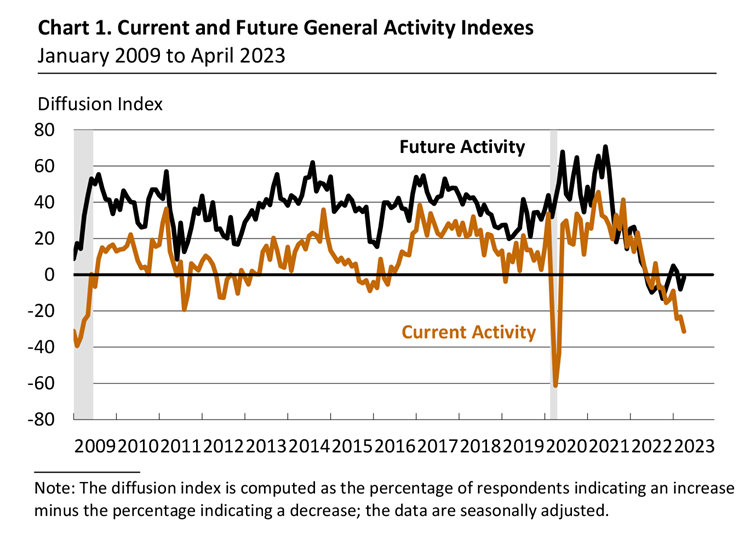
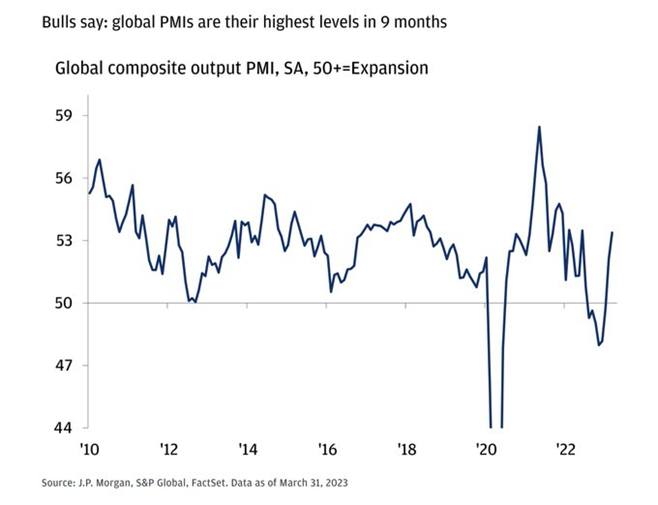
However, Q1 2023 data has been surprisingly strong. US, Europe and UK economic activity data have all surprised to the upside in economic terms, led by services rather than manufacturing. Clearly, the consumer remains in good health despite the sharp rises in interest rates that we've seen in the US, UK and Europe over the last few months.
S&P Global composite PMIs turn up, lead GDP growth
As does the S&P Global US PMI (for now)
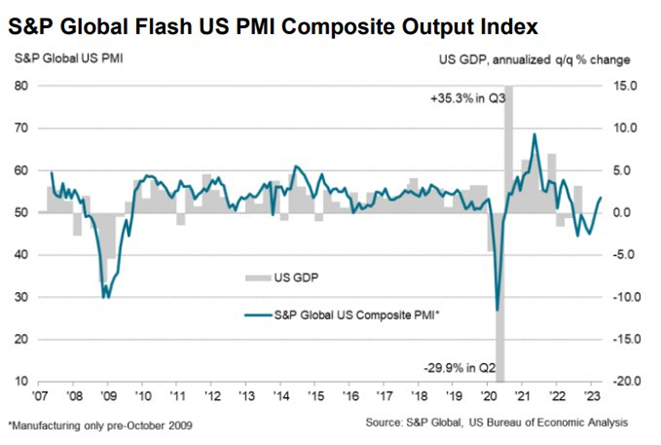
Source: S&P Global
UK consumer confidence rises to highest level in 1 year
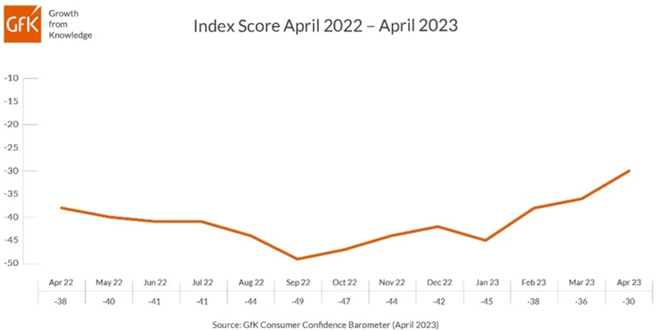
Source: GfK
Remember that manufacturing tends to lead and services tend to follow. So the fact that services are so strong today but manufacturing is weak everywhere suggests that at least a modest US recession is still coming.
Of course, another point helping the global economy in the first quarter has been the reopening of the Chinese economy. Again, manufacturing has rebounded but not so strongly. Whereas the really strong rebound has been on Chinese consumption once again, like the rest of the world.
JPMorgan raised its 2023 growth outlook to 6.4%, up from a previous forecast of 6%, saying the latest quarterly report points to further growth ahead. Citi raised its forecast to 6.1% from its previous forecast of 5.7%, saying the Chinese economy is “well on track on its post-Covid recovery led by consumption and services.
Chinese growth rebounds in Q1 to 4.5% y/y
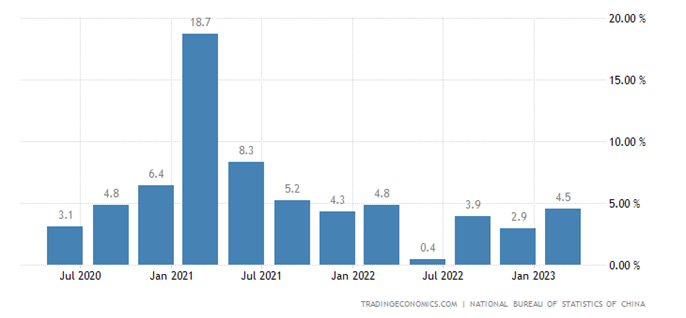
Source: tradingeconomics.com
Conclusion: don’t be fooled by the strong consumer in Q1 - as labour markets weaken, this trend will also ease. China should post strong economic growth this year as the reopening momentum continues, the Eurozone and the UK may still yet escape recession, but the US should see negative economic growth by H2 of this year as tightening credit standards and high interest rates take their toll.
Inflation is falling, led by the US
If we turn to inflation now, inflation rates are falling everywhere. And this is exactly what I expected. In fact, I expected inflation rates to fall pretty much as quickly as they rose last year. We have a number of factors that are fading:
Supply chain disruptions relating to COVID have melted away;
Energy prices in Europe in particular have come right back down, but so to have gasoline and crude oil prices;
We should expect food prices to ease given that the UN food price index has been falling for several months and is now in negative territory on a year on year comparison basis.
Philadelphia Fed prices paid component leads US CPI (lower)
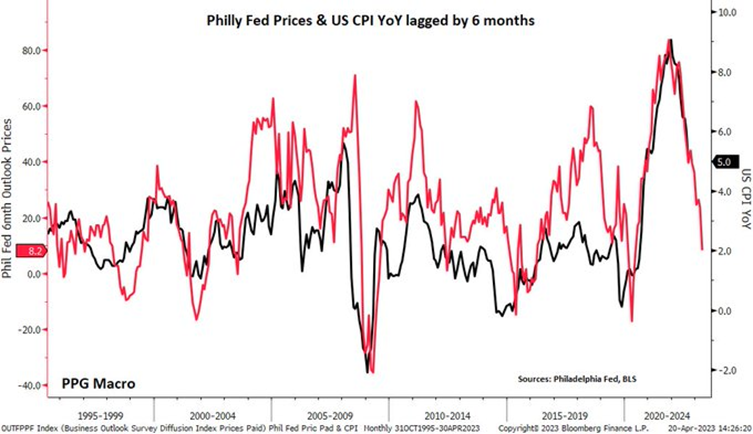
Source: PPG Macro
The UK is perhaps a standout in this respect, as UK inflation is proving more stubborn than elsewhere for country-specific reasons.
Conclusion: the European consumer might actually remain more robust than one might expect, as inflation pressures on households ease while rising salaries boost purchasing power. However I am more cautious of US consumption, as warning signs such as rising credit card delinquencies (defaults on repayments) suggest that Q2 and beyond will be tougher as labour market momentum reverses.
Looking ahead to Q1 results season
This next week will be dominated by corporate results in the US. So far, corporate results have actually been pretty decent for the first quarter. Banks in particular, have given better than expected results in spite of the US regional banking crisis.
According to Factset:
Overall, 18% of the companies in the S&P 500 have reported actual results for Q1 2023 to date. Of these companies, 76% have reported actual EPS above estimates, which is below the 5-year average of 77% but above the 10-year average of 73%. In aggregate, companies are reporting earnings that are 5.8% above estimates, which is below the 5-year average of 8.4% and below the 10-year average of 6.4%.
Factset S&P 500 earnings scorecard for Q1 2023
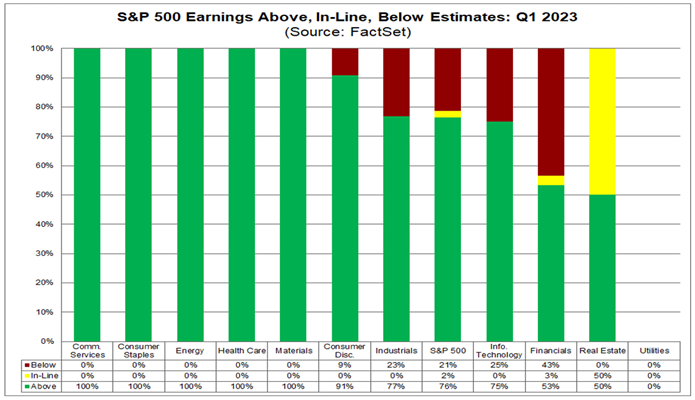
As a result of better-than-expected US bank results, note the calming of the stress in financial markets such as the low reading of the St. Louis Fed financial stress index.
St Louis Fed Financial Stress index eases lower after banking crisis spike
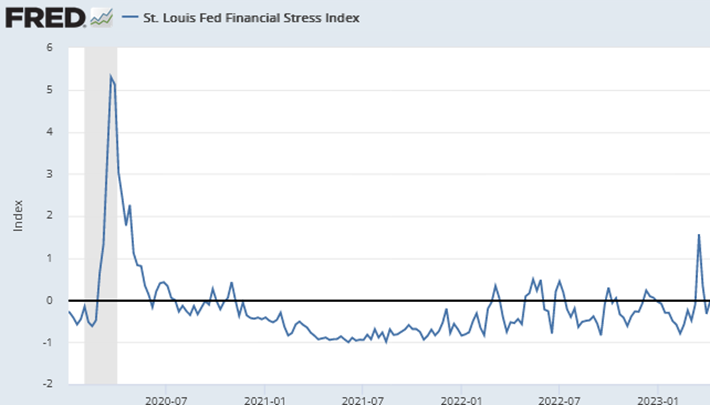
Source: St Louis Fed
Ultimately, I remain positive on the outlook for stocks particularly in the world ex US. European stocks continue to perform particularly well with new all time highs for the French CAC 40 index. And the Euro stocks 50 index is performing well in spite of the drag from financial stocks.
In the US the S&P 500 index remains somewhat range bound as does the NASDAQ 100. The key level for the S&P 500 seems to be around 4200 resistance. Let's see if this breaks during or after the first quarter results season.
Corporate profit margin boom in Europe
A couple of notes about Q1 that should be notable. Firstly, note how even the European Central Bank has put some of the blame on current high inflation rates on companies.
How is that? Well companies as a whole have been profiting from the rise in prices to add even a little bit more than was necessary to cover their own costs, i.e. raising prices, therefore reducing inflation but at the same time, of course, boosting their own profit margins.
This trend has been particularly evident in Europe, according to the ECB. So even when inflation comes down, as I think it will, do not necessarily expect companies profit margins to return to where they were before inflation took off.
In the Eurozone, profits rather than labour costs and taxes have accounted for the lion's share of domestic price pressures in the euro zone since 2021, according to ECB calculations based on Eurostat data.
ECB calculations showing companies have raised inflation to profit more
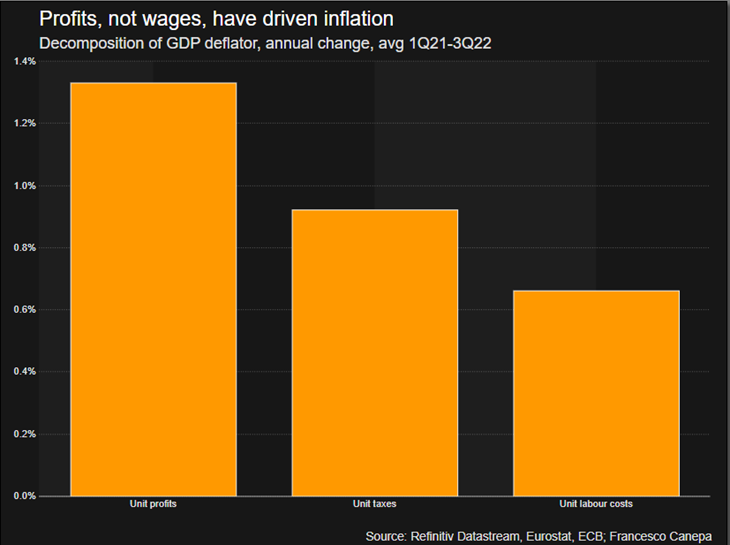
Source: Datastream, ECB
Why? Because companies, as you would imagine, are quick to put up prices and to increase profit margins when they can. And they've used inflation as a sort of cloud cover, as it were to to raise profit margins across industries, so temporarily suspending normal competitive practices to some extent, I would argue
They will, of course, try to defend their profit margins even as input costs come down. So even as company costs come down, they will not necessarily post all of this improvement in input cost back to the final client, which should result in profit margins staying higher, for longer.
I think this is particularly true in the more cyclical, industrial and consumer sectors, which of course tends to favour European companies, as the European stock market is more cyclical, compared for instance, to the US.
In contrast, in the US, this may be more difficult to achieve, given the tougher headwinds that now face the US economy. Why because the US Federal Reserve has tightened interest rates more aggressively than than elsewhere. And therefore, there will be a bigger hit to prices.
Secondly, note that before this recent inflation wave, US corporate profit margins were already at an all-time high. And so it's difficult to stay there in the face of declining activity, i.e. recession, which is what we expect by the end of this year. And thirdly, there will be huge profit pressures in a number of key sectors such as banks, given the regional banking crisis.
One of the ways that US regional banks can hold on to their depositors will simply be to raise interest rates on deposit savings accounts, but that will cost profitability that will cost the bank's money and therefore, their profits should decline.
So which sectors should benefit most from this maintenance of higher profit margins in Europe?
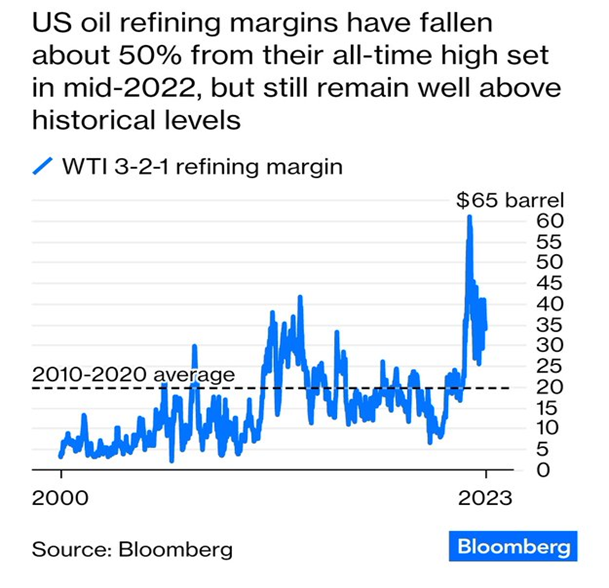
Well, oil companies for one because their refining margins remain higher than average, even though they have come down over the last few months. So there's one example here where integrated oil companies can continue to make more money than on average. Not so much from crude oil extraction, but more from the production of finished products such as diesel petrol and airline kerosene.
US refining margins remain above average
Secondly, I would argue that profitability of global mining companies should stay higher for longer given:
the very low current levels of base metal inventories,
the potential improvement in global demand coming from Chinese reopening and
the oligopolistic nature of mining of a number of base metals such as aluminium, nickel, copper, and even tin where very few global actors control a very large proportion of global mining supply.
The third sector which should do well, particularly over the summer, is bizarrely the transport sector. Airline companies should benefit from very strong consumer demand yet again over the summer holiday period.
They again will maintain high pricing just as they did last summer, because they have artificially restricted the supply or ie the number of flights available. So as a result for airline companies, load factors should be higher closer to 100% full and on top of that average prices should be higher. And this is not just an energy effect from the price of airline kerosene. But is in fact also simply airline companies extracting higher profitability from each passenger. How long will this last? Well, airlines are a very cyclical industry. So maybe not that long, but it's certainly going to be the case for this year at least. And until they increase capacity once again.
I think the interesting sector to watch will be the food and beverage sector, particularly the big food companies such as Unilever and Nestle, which have raised the average prices by something like 14% Over the last year and we are seeing something similar in the US for instance with Procter and Gamble with their consumer product, however, they are seeing a decline in volumes. So it seems that Yes, they've extracted extra profitability as a result of price increases during this inflationary wave. But I wonder to what extent they can continue to play the same card when consumers seem to be reacting and moving away from their products towards lower priced, owned brand products or even going wholesale to discount retailers such as Lidl. And Aldi who are gaining huge market share at the moment
A Word on Precious Metals
Finally, keep an eye on precious metals. There seem to be some very big moves in play at the moment. Gold hovering relatively close just underneath in fact, its all time high of $2,075 per ounce, and has broken out or to a new all time high in many other currencies such as Sterling, Euro, Yen and so on.
Secondly, this has been followed by strong momentum in other precious metals, notably silver, but probably most notably this last week, in platinum and palladium. So watch platinum to give us a clue of where gold and silver may be going next, but my thinking is ultimately they will be going higher after a period of consolidation, which is normal after the strong run that they've had over the last few months.
I do expect to see new all-time highs in gold, and much higher prices in silver and the platinum group metals in the weeks and months to come. And that should be good for precious metals miners, who have up to now lagged the movement in the underlying gold price in this latest rally.
Gold has outpaced silver and gold miners since the 2011 peak
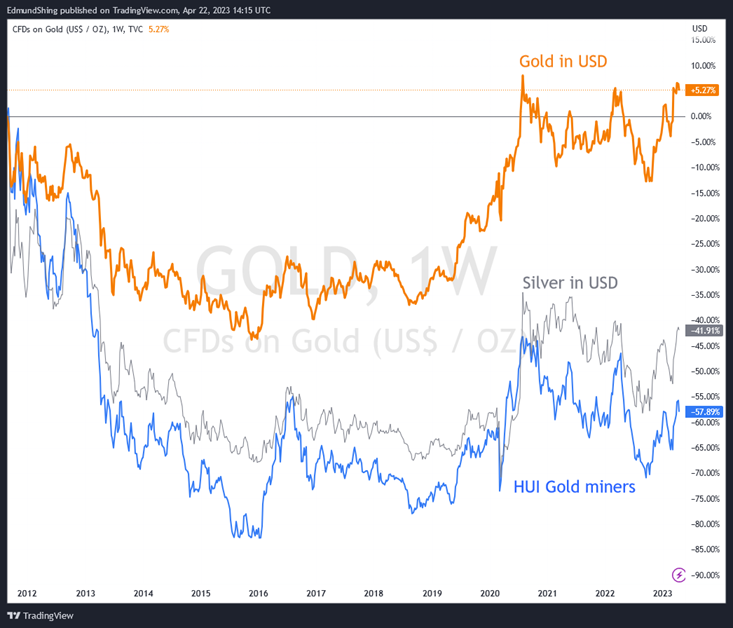
Source: tradingview.com
Have a great week ahead,
Edmund
Disclaimer
This is not financial advice. Our content is intended to be used and must be used for information and education purposes only. Please read our disclaimer and terms and conditions to understand our obligations.

9 comments
Thanks Edmund.
A straightforward and easily digestible article for people who generally don't follow the macro trends and like them condensed.
Thanks again
Gold and silver on sale. Buy before the jump.
Palladium and Platinum may be doing well but holders of Slp and Tharisa are worrying not benefiting.
I agree, fingers crossed for a bounce in Rhodium, that's what SLP needs to see a decent SP climb. Platinum maybe in the company name but Rhodium brings home the cash.
Indeed, but therein lies the bear case for Sylvania Platinum (LON:SLP) , as the primary demand for Rhodium is (was) catalytic converters. With governments around the world now pressing the case for EV's, this is a structural reduction in demand for Rhodium as far as I can tell...
It's interesting that the peak on SLP came around the same time as the EU announced their effective ban on new ICE cars by 2035...
Super article again!
Whilst monetary policy is no doubt a force slowing economic activity there are other factors boosting activity, demand and even inflation.
Re-shoring from China, the re-arming of the west with top 10 economies (such as Japan, Germany, South Korea, UK) adding hundreds of billions to defence budgets, fossil fuel investment catch up (including the move to sovereign independence in the west) and green energy transition as well as stimulus packages such as the IRA in the US point to growth not recession.
The link below shows industrial construction in the US in rude health. With much of it government funded or deemed to be essential to survival I think this is less susceptible to economic downturn.
https://www.constructconnect.c...(PDF)/Construction_Industry_Snapshot_Package-February_2023.pdf
In summary, I suspect inflation, interest rates AND growth could all be higher for longer than consensus expects.
Hot off the press is March's report of February activity.
To contradict my point above, the graphs show rapid reversals in growth from January to February. Although there is still year on year growth between Feb 2022 and Feb 2023 it points to the potential impact of rate rises and bank failures potentially impacting growth.
Despite this volatility there is a good summary on page 7 describing overall positive 'above trend' growth in the non residential construction sector and a positive outlook out 2025 and beyond.
https://www.constructconnect.c...(PDF)/Construction_Industry_Snapshot_Package-March_2023.pdf
To capitalise on the industrial and infrastructure trends mentioned above I think companies like CAT, LIN, HAL in the US and AT. and RNO in the UK could outperform market expectations despite being categorised as cyclical.
A recession before the 2024 president elections?
There definitely was a race to put shop prices up Edmund, those companies who got in first got away with the largest rises before people got wised-up. Here's hoping you are right about the precious metal miners, especially the ones unable to pay investors a return as yet.