Market Musings 230923: The Detente into the Downturn

Market Musings 230923
The Detente into the Downturn
Central Banks pause now, but will later have to cut
Summary
Central banks in US, Europe, UK, Switzerland at peak interest rates
Economic activity slows, including employment
Next Central bank moves will be cuts, like Brazil
After the Fed pauses, bonds typically perform well
Constrained capex, robust demand boosts integrated oil & gas producers
Podcast
Top investment themes to year-end
In this podcast, Edmund Shing, Chief Investment Officer, unveils his refreshed Investment Themes for 2023.
When consistent losers become winners
Scarcity and Security are the new watchwords
New income opportunities: from TINA to TARA
All my recent podcasts can be found on Apple podcasts (search for “BNP Paribas Wealth”) or Spotify (click on link here).
Have we seen the peak in central bank interest rates?
That is the key question. The last 12 months have seen sharp rises in reference interest rates of central banks across the world, from the US to Europe to the UK.
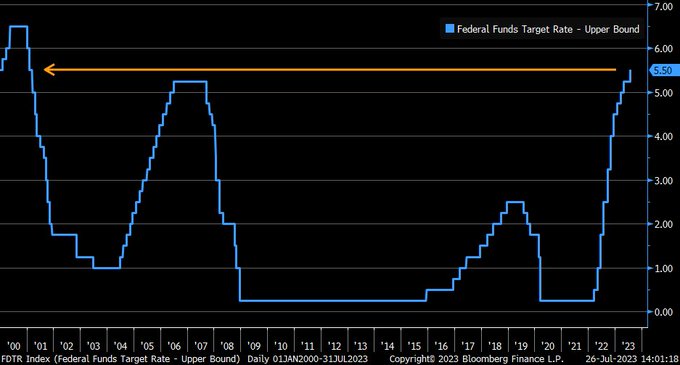
Remember, just over 12 months ago, interest rates were close to or even below zero in these regions. Today in contrast, we see central bank interest rates that range from 4% in the euro zone to 5.5% in the US - a very sharp increase in a very short space of time, historically speaking.
US Fed Funds rate rises from 0.25% to 5.5% in record time
Source: Bloomberg
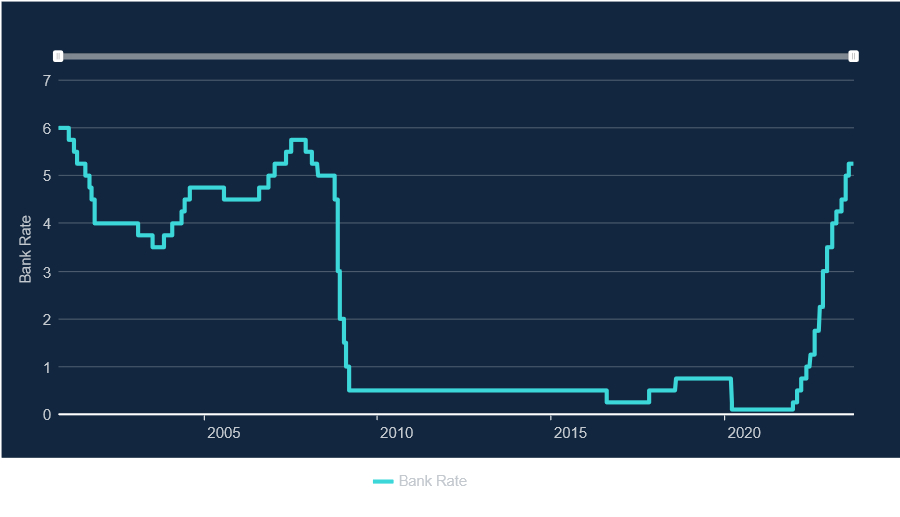
But the inflection point seems to have been reached. The UK surprisingly did not raise interest rates in the last week, rather maintaining its base rate at 5.25%.
Bank of England has followed the Fed, but has paused now at 5.25%
Source: Bank of England
Neither did the US, and while the ECB did raise European interest rates to 4%, this looks likely to be the last rise, no matter what central bankers communicate.
Why do I say that? Well, I have several reasons.
Slowing economies, slowing demand
Firstly, remember what central bankers are trying to achieve when they raise interest rates. They are trying to curb (above-target) inflation, but the way they achieve this is by first curbing economic activity.
So you need to cool the economy first. In particular, central banks aim to cool household and corporate demand, in order to then cool inflation as a consequence.
Well, the evidence is that economic activity is cooling everywhere, just as the central bankers wanted. In the eurozone, activity indicators suggest the economy is already on the edge of recession.
Eurozone PMI surveys below 50 = negative economic growth

Source: S&P Global
Similar can be said for the UK, where we start to see the employment market weakening fairly dramatically.
UK companies race to cut employment

Source: S&P Global
In the US, while economic growth is arguably still strong for the moment, indicators for the employment market such as job openings suggest exactly the same thing: a sharp slowing in progress.
US job openings diminish quickly

Source: St Louis Fed
This is why I maintain my out-of-consensus view that the US economy will not only slow down, but will likely enter a modest recession early next year.
So step one, economic activity slowing, tick.
Inflation still on the wane
Step two, inflation rates: are they slowing? Yes they are. inflation rates have already slowed to around 3% In the US, looking at CPI. They have taken a bit longer to come down in the UK and Europe, but they are clearly trending lower on the back of this weaker activity.
US headline inflation has declined to 3.2% y/y

Source: St Louis Fed
Okay, we may not yet be back at the 2% target that Western central bank's prefer, but we are getting there.
Key components of inflation, such as housing costs, energy costs, and food are all easing. We are also starting to import deflation in goods, notably from China. And with the weakening in employment markets, it is unlikely that wage growth will stay as high as it has been and will very likely slow which in turn should slow inflation in the services sector.
Conclusion: Central banks in the US eurozone, UK and Switzerland have reached peak rates in our view, at 5.5% in the US and 4% in the eurozone.
The next question is then: when will central banks then cut rates? The answer is not anytime soon. In the US where inflation has come down faster, we would suggest that the US Fed could start to cut interest rates in the second quarter of next year. The ECB in Europe will cut later, in Q3 of next year.
The key conclusions for investors are:
Economic activity has or is slowing quite markedly and that includes the key employment markets.
Inflation will continue to trend lower in these key economies with potentially a catch up on the downside in the UK and the eurozone.
This could be better news for bond investors. Remember, lower inflation (and in particular lower inflation expectations), are good news for bond investors and typically lead to lower yields and higher prices.
Bonds could benefit
Statistically speaking, US bond yields have typically declined following the last hike in interest rates by the US Federal Reserve. I believe that we have already seen that.
So I would expect moderate declines in 10 year US bond yields over the next 12 months, from 4.5% today to 3.75%. As a US bond investor today then you not only get a yield of 4.5% to lock in now on a 10 year bond, but you also have in our view the potential for moderate price gains to come as well.

Source: JP Morgan
Why I maintain a bullish long-term stance on commodity stocks
Let’s be honest: commodity stocks tend to be cyclical, and have often in the past destroyed their own long-term profitability by overinvesting in new capacity at the top of the business cycle, thus eventually destroying pricing by adding a lot of new production.
However, I am more optimistic that this will not be the case for a long time in this current business cycle. For one simple reason - companies have been under-investing in new mining production over the last few years, with ESG (Environmental, Social and Governance) investment policies also proving a headwind to commodity-related investment.

Source: Topdown Charts
For now, which commodities have the best momentum in terms of supply/demand and thus prices?
I focus for now on energy: global oil demand remains robust (still growing steadily despite decarbonisation efforts), while global supply is constrained by OPEC+ quota cuts and a lack of growth in US shale oil supply. Once again, a lack of long-term investment in oil exploration, production and refining supports higher energy prices (for both crude oil and oil products) over the medium-term, until global demand finally starts to decline.
Brent crude oil +27% from March low

Source: St Louis Fed
Integrated oil companies such as Shell and Totalenergies have performed well this year, but remain attractively valued with top Stockranks.
SHEL Shell tops the StockRanks, and remains cheap

Source: Stockopedia
Italian oil & gas major ENI is another cheap integrated oil company that tops the Stockranks, with a greater bias towards natural gas.
ENI sports even higher stockranks than Shell

Source: Stockopedia
Bonne chance!
Edmund
Disclaimer
This is not financial advice. Our content is intended to be used and must be used for information and education purposes only. Please read our disclaimer and terms and conditions to understand our obligations.
4 comments
Thanks Ed. Another interesting article
Thank you for another good article. Looking at 10 year US yields they continue their upward trend from May 23 (see below). I wonder if this means that perhaps we havent seen the last of the rate rises, or whether 2023 is the year that breaks the rule. I will wait until the current trend reverses before investing in US 10 yr Treasurys
Great article.
China is entering deflation, this has been under reported. However wage growth in the UK has been about 8%, presumably this has to be passed on.
Great piece as always. I have tried to purchase Shell on three occasions, selling quickly having not had any success, however I note the share is at its highest point in five years and feel the potential of the share. Is it time to jump on for the ride?