Market Musings 240126: US dollar at a critical juncture

Market Musings 240126
US dollar at a critical juncture
Weekly Podcast and Snapshot:
Infrastructure: Laying the foundation for growth
Infrastructure is the economic backbone linking people, goods, data and markets. Recent years have seen a rapid evolution of the sector sustained by robust economic growth and breakthrough technologies, sparking strong investor appetite.
Today’s demand is powered by three key forces: (i) digitalisation and electrification (AI‑driven data centers, EV‑charging networks), (ii) renewed government commitments, and (iii) the need for assets that hedge geopolitical and macro‑economic uncertainties.
AI, 5G networks, cloud computing and EV‑charging are spurring a massive build‑out of hyperscale data centers, and a resilient power grid. In parallel, the electrification of transport and heavy industry fuels unprecedented demand for both conventional and clean‑energy generation, transmission and battery storage. This propels record‑level investment across the entire infrastructure sector.
Similarly, governments are putting in place spending plans to revive and upgrade their infrastructure driving major infrastructure investment.
Finally, infrastructure is emerging as a natural inflation hedge with low correlation to the public markets providing investors the hedge they need in times of uncertainties.
US dollar: teetering on the edge of a breakdown?
This has been a potentially pivotal week for the US dollar. Several factors have driven recent weakness in the US dollar against other major currencies and against gold, including:
- Lower US rates: Further expected Federal Reserve interest rate cuts (at least 2 more cuts this year), undermining the attractiveness of holding cash on deposit in US dollars as US interest rates converge on those available elsewhere such as in Europe or the UK;
- Fed leadership uncertainty: while Trump’s choice for the next Fed President (current Fed President Jerome Powell’s term ends in May) remains unclear, there is nervousness that the new Fed President will have to bow to Trump’s wishes and lower interest rates perhaps more than is prudent from a purely economic point of view. This potentially undermines the independence of the Fed, by extension undermining the status of the US dollar as a safe haven asset to be preferred in times of crisis.
- Structural difficulties around current account and budget deficits: President Trump seems set on increasing US Federal spending in order to boost household spending, thereby picking up votes ahead of November’s crucial mid-term elections. A persistently large US budget deficit (gap between tax receipts and government spending) is expected this year, of the order of 6-7% of GDP (close to USD 2 trillion). This excessive spending needs to be financed by borrowing even more money in the bond markets, pressuring the US dollar over the long term as the sustainability of US federal debt is called into question.
- Geopolitical uncertainty: US foreign policy has raised the global political temperature dramatically in recent weeks. Trump’s alienation of European allies over the issue of Greenland and his extraction of Maduro from Venezuela, plus continued exertion of pressure on the Iranian leadership with the sending of US aircraft carriers to the Middle East, leaving open the threat of military action against the Iranian regime. In my view, this all undermines the status of the US dollar as other countries then prefer to hold other assets rather than US asserts in dollars. Here, gold is the clear alternative that has benefited from greater US-centric geopolitical volatility and unpredictability
Of these arguments, I believe that it is the last that weighs most heavily on the US dollar at present.
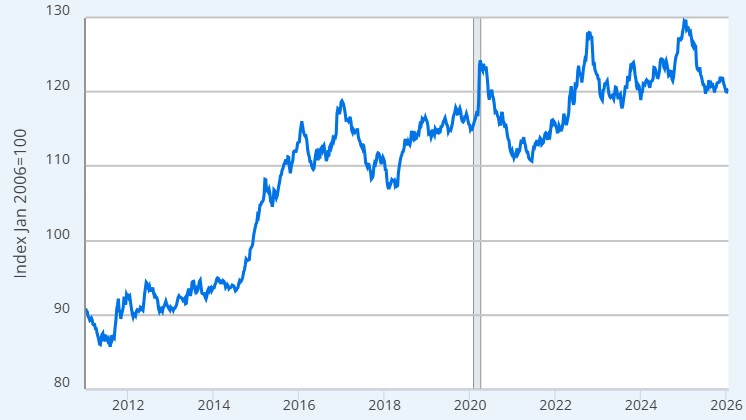
The starting point is that of a US dollar that remains strong compared to history according to the Federal Reserve US dollar index, despite the weakness seen last year.
Long-term US dollar index: Still high versus history
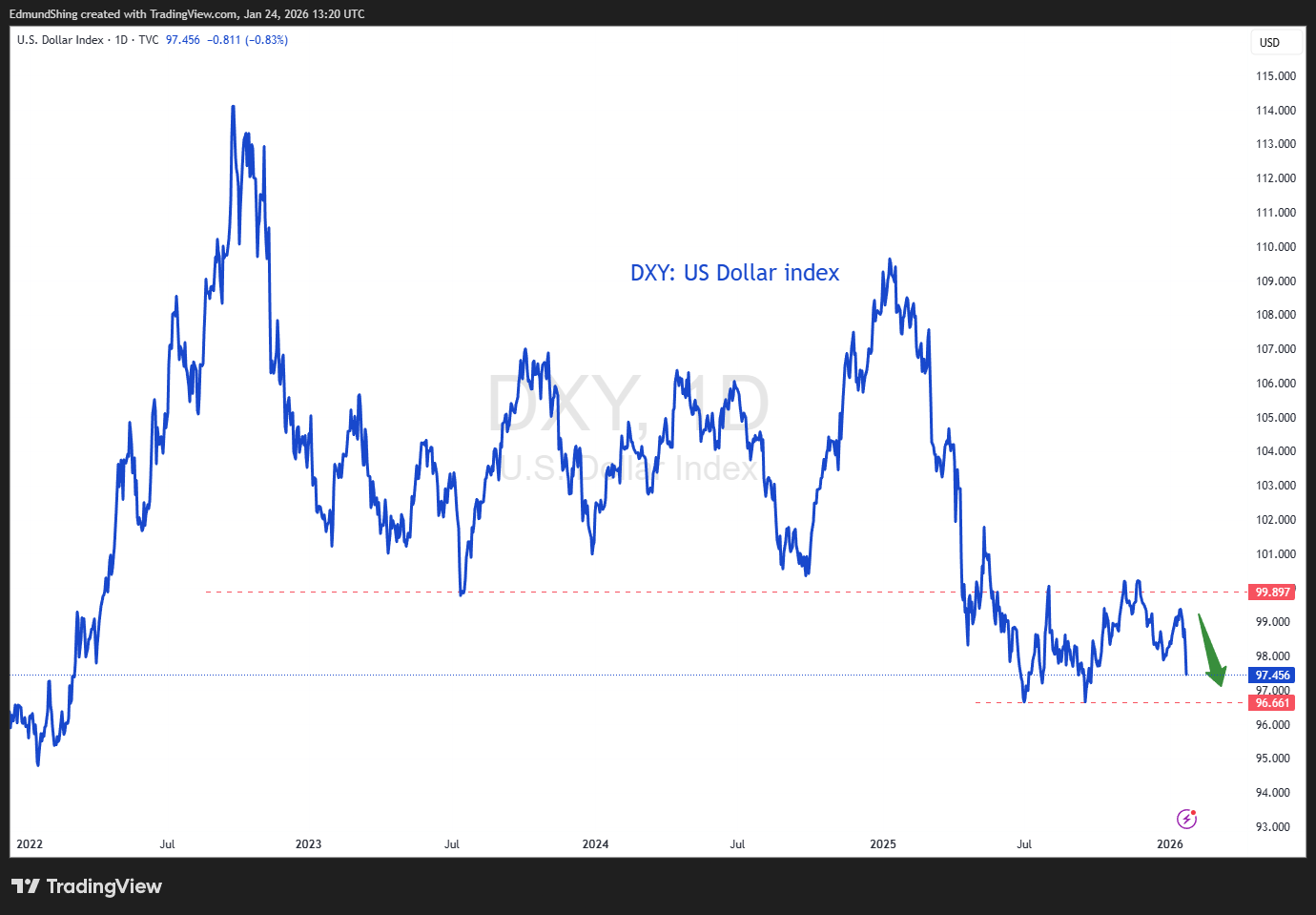
If we look at the DXY US dollar index, we can see that the US dollar has suffered 2 major drops since peaking in 2022. On this chart, the key level seems to be 96.7 for the DXY, below which accelerating weakness could potentially be seen.
US dollar takes a dive this week
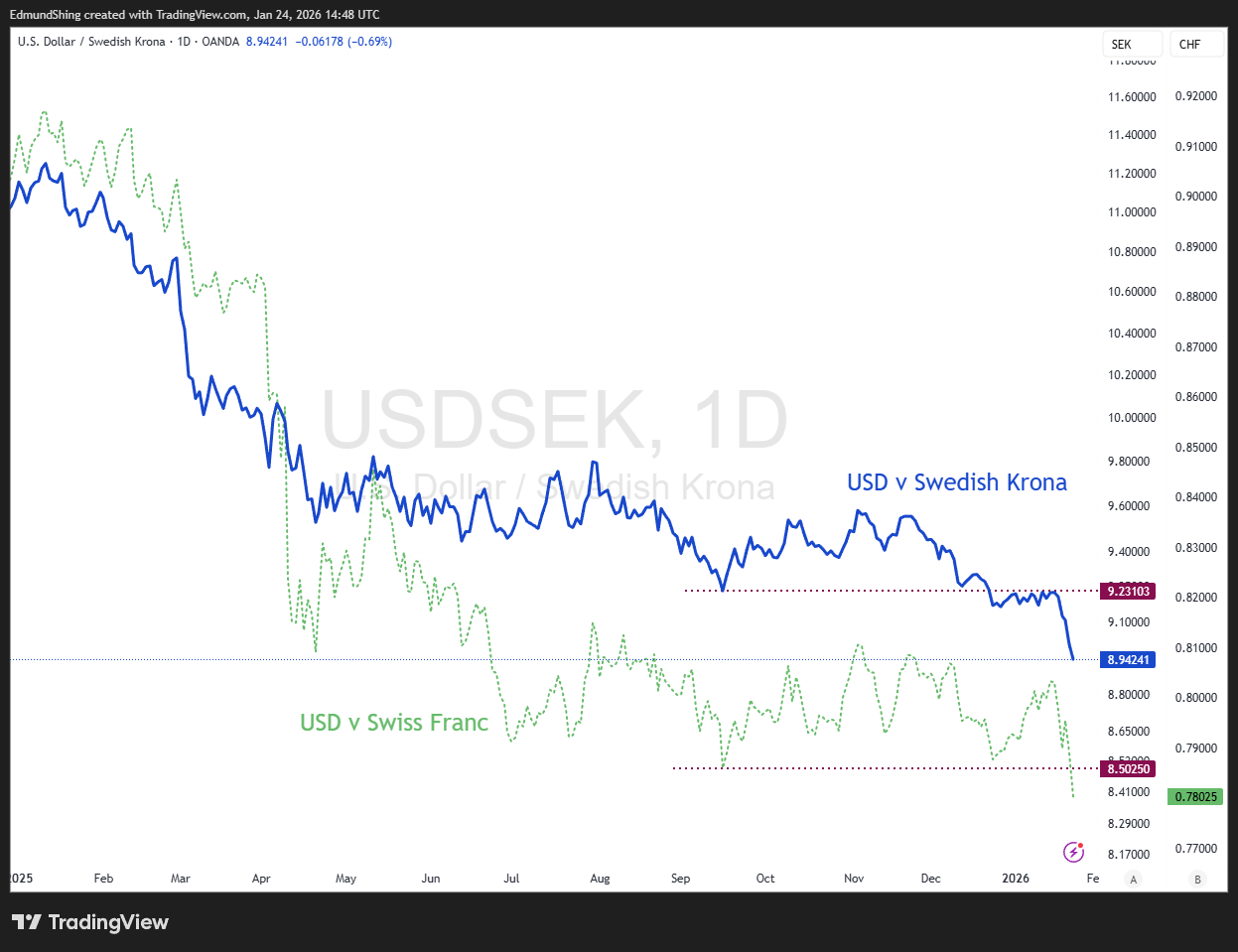
In many currencies such as the Swiss Franc and Swedish Krona, the US dollar looks already to be in a down trend.
The risk to US assets held by non-US investors
As of mid-2024, non-US investors held a massive USD 31.3 trillion in US financial assets, including USD 17 trillion in US stocks and USD 13 trillion in US bonds of various types. Today’s total is likely to be far larger still, given the strength of the US stock market since then.
The US has been the investment destination of choice for over a decade given the combination of a stronger US dollar and strong US stock market performance, led by US large-cap technology companies.
As an example of how the US has come to dominate the investment world in recent years, consider that a broad global stock market index such as the MSCI ACWI (All Country World Index) was 40% composed of US stocks in 2011. By 2025, this proportion invested in the US had risen to 63% thanks to the outperformance of US tech stocks and the dollar. The next largest country weighting is in Japan at under 5%, less than 1/12th of the US weighting.
MSCI All-Country World Index Country Weightings (end-2025)
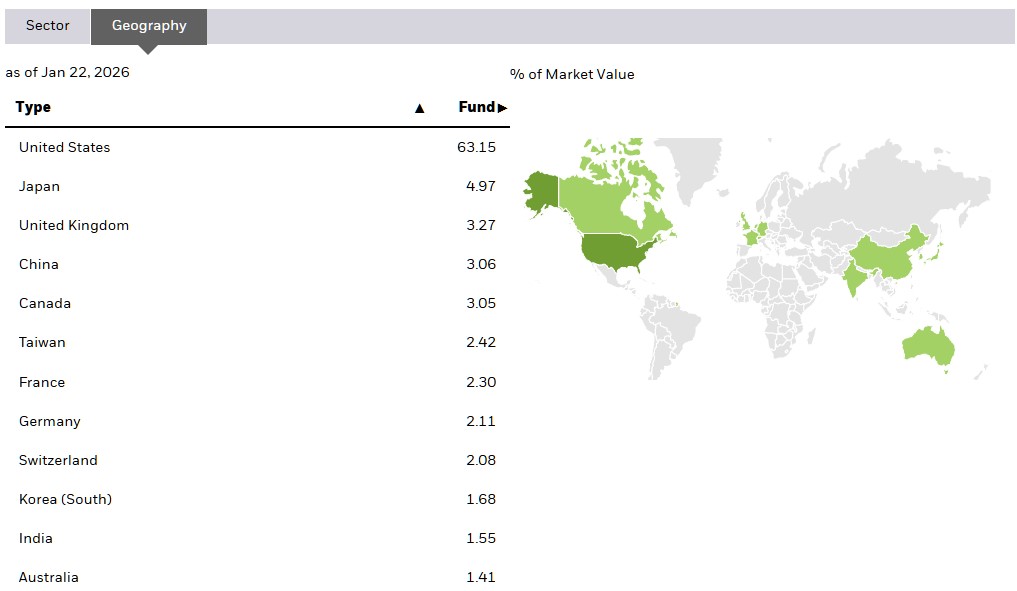
A good question to ask today is whether such a global stock market index can truly be called diversified when so much of its assets are held in 1 country, 1 currency and overwhelmingly in one sector, technology.
A breakdown in the US dollar could prompt foreign investors to start to sell down their US holdings and repatriate assets, leading to huge outflows from the US dollar into their home currencies (e.g. euro, yen, pound, Canadian dollar, Korean won).
I believe that any such repatriation flows would be slow and steady and last years rather than days or weeks. But it would have a circular effect: a weaker dollar (and underperformance of the US stock market versus the world ex US) would prompt selling of US stocks and repatriation of the cash, creating selling pressure on the US dollar and potentially then further weakness.
There is little evidence that European, Japanese or Canadian institutional investors have been drastically reducing their investments in the US as of yet, but it is a risk for the future.
Recent performance continues to favour World ex US over US
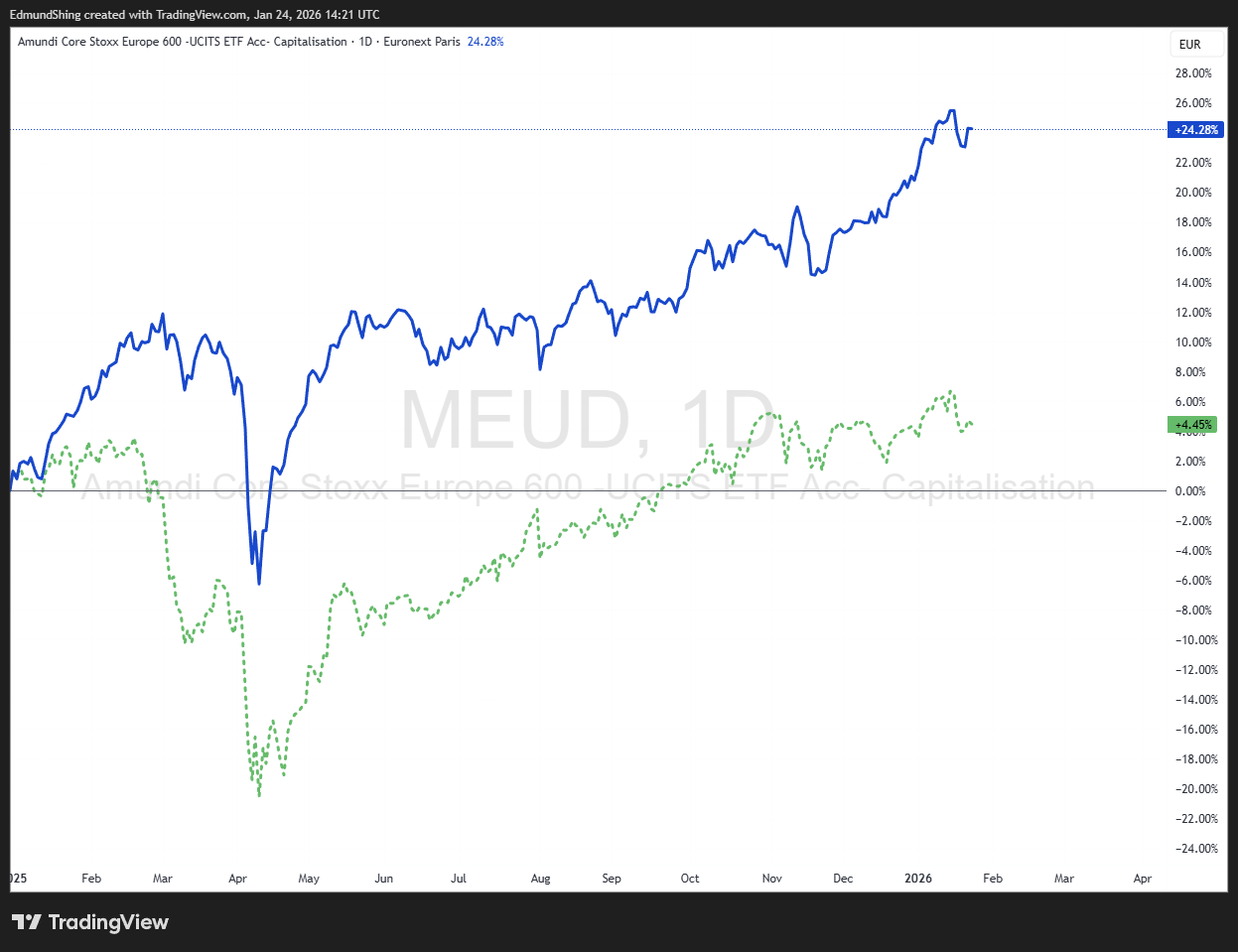
As of Friday 23 January, 2026, US stocks have underperformed European stocks by a wide margin since the start of 2025 (+4% for US stocks in euros versus +24% for Europe including the UK, a 20% gap) due to differing stock market performance in local currencies, plus a 10% depreciation of the US dollar against the euro.
STOXX Europe (blue) v S&P 500 (in euros, green)
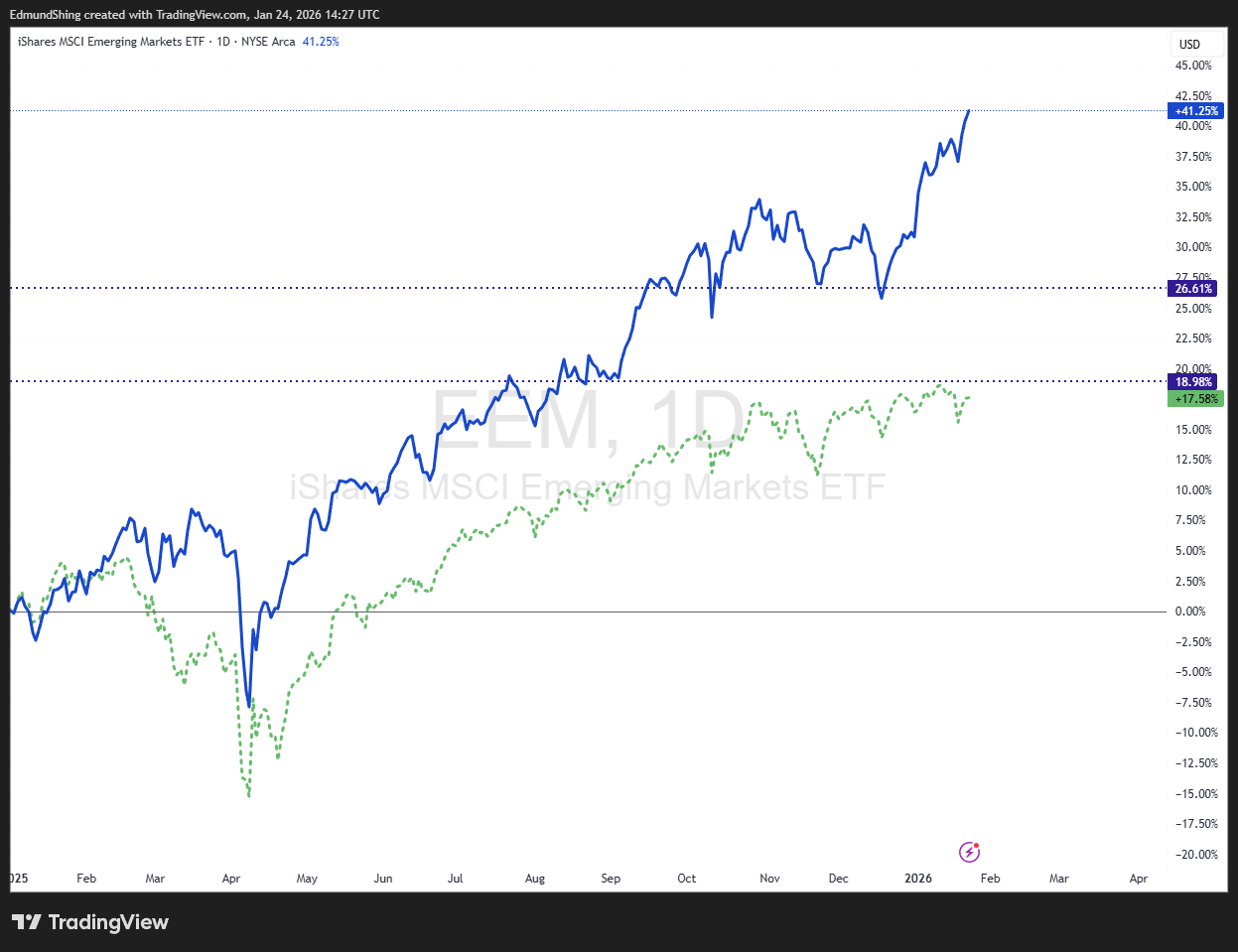
Even for US-based investors, emerging market stocks have been a far better motor of performance (+41%) than the S&P 500 index (+18%) over the last year:
MSCI Emerging Markets (in USD, blue) v S&P 500 index (green)
Where to be invested when the US dollar is trending lower
In a weaker dollar environment, assets with foreign-currency or real-asset exposure tend to benefit most.
- Non-US equities and bonds: International equities (developed and emerging markets) often gain for a dollar-based investor, because local stocks can rise and their currencies appreciate versus the dollar.
- Commodities and precious metals: Commodities priced in dollars, especially gold and other precious metals, often rise when the dollar weakens because they become cheaper in other currencies and are used as an alternative store of value.
Broader commodity baskets (energy, industrial metals, agriculture) also tend to benefit as global demand improves and the weaker dollar eases financial conditions for many importing countries. - Select foreign currencies: Currencies of economies with relatively strong fundamentals and higher real yields (for example some G10 and emerging-market currencies) are positioned to appreciate against an overvalued dollar.
Strategists highlight the Japanese yen, Scandinavian currencies, and a range of emerging‑market currencies as likely beneficiaries if dollar weakness persists.
I would favour two areas right now:
- Precious and strategic industrial metals: gold has been the obvious choice, just hitting USD 5000/ounce for the first time this week. Despite the sharp rise in price, I would hold onto physical gold exposure at this point, given its diversifying properties particularly in times of crisis and geopolitical uncertainty. Central banks continue to amass physical gold as they reduce their US dollar holdings in their monetary reserves.
I would also favour copper, aluminium and other industrial metals such as lithium necessary for electrification, technology and in particular for the data centre buildout that we are seeing in the US and globally. Demand growth is clear, while global supply of these metals struggles to keep up. - Latin American stocks: these should benefit from growing economies and strengthening currencies, lower interest rates as their central banks follow the Fed in cutting rates, commodity exposure in their economies and stock markets and relatively low valuations.
LTAM Latin America ETF has been a star performer in 2025-26
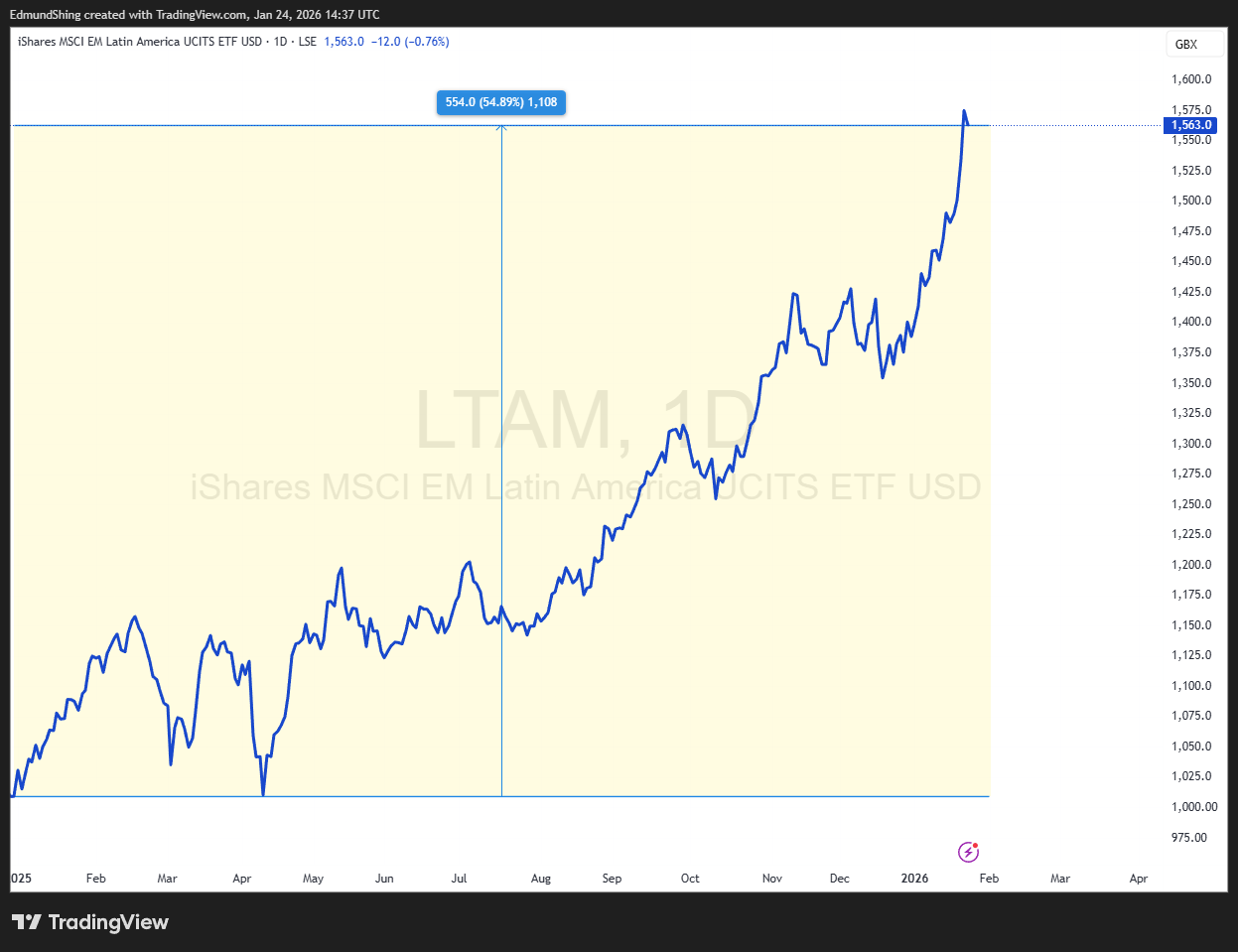
But could still have a long way to go… Long-term chart of Latin America ETF (in $)
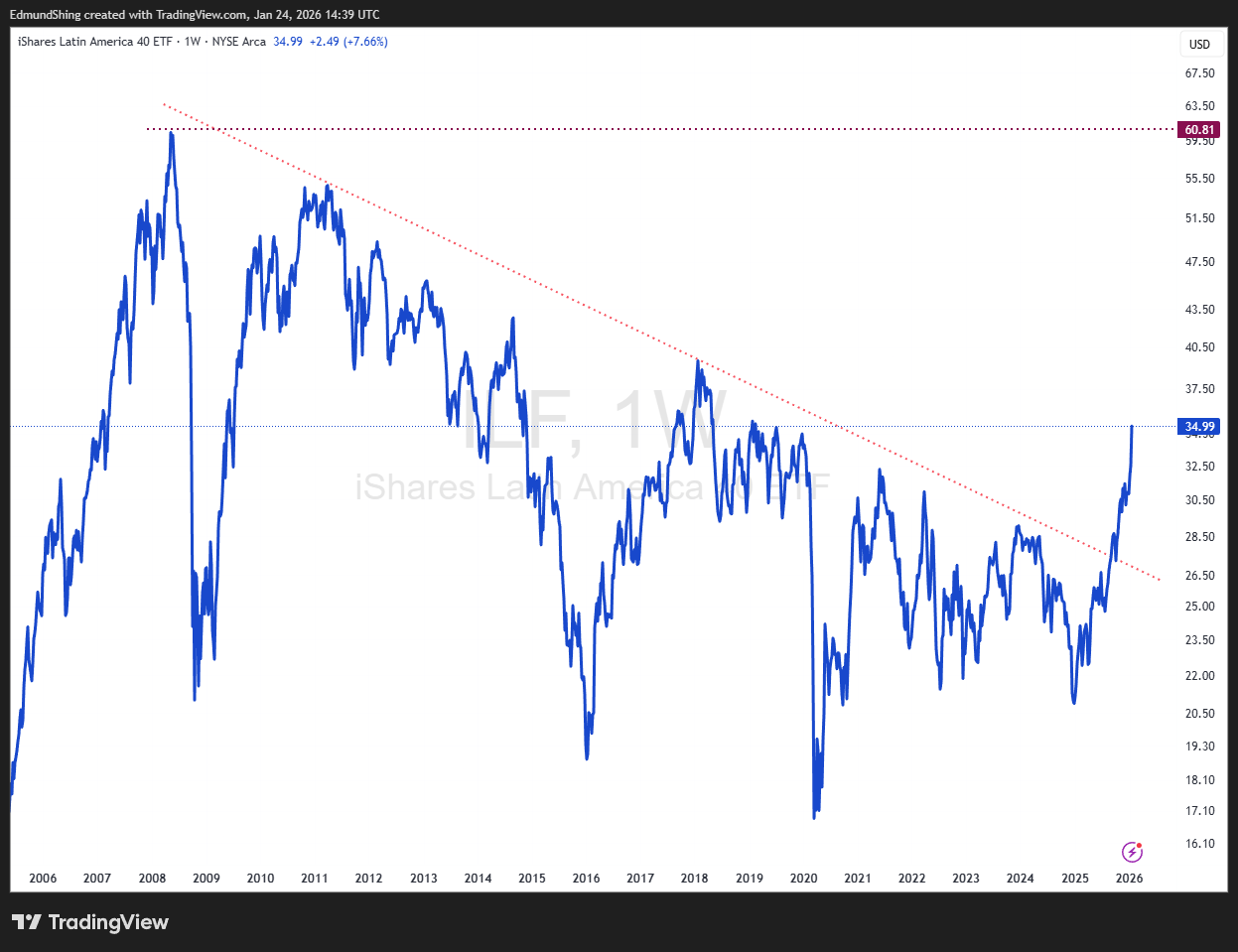
Have a great week ahead,
Edmund
Disclaimer
This is not financial advice. Our content is intended to be used and must be used for information and education purposes only. Please read our disclaimer and terms and conditions to understand our obligations.
18 comments
An excellent analysis. I have to say that we (our family based in London and San Francisco) foresaw as economists a weak dollar and as investors opportunities in small- and mid-cap UK and Euro stocks and we haven’t been disappointed. Bur we have never lost sight that it’s a small minority of stocks that yield the real gains and quantity will always lead us to US stocks with best potential even discounted for a falling dollar. And as an aside, what hits us worst in falling currencies is capital gains tax on loss making trades where the rate of exchange tells the tax man, IRS or HMRC that we’ve made a taxable gain, however phantom, in their currency.
I liked the following chart from the Ironsides Macroeconomics Substack page....
Many thanks Edmund, your view is always insightful and beneficial. I appreciate your comments very much.
I have a perhaps esoteric question. Many of the North American gold and silver mining stocks are listed in Canada and the US. Is the consensus that the Canadian dollar may strengthen relative to the US dollar in which case the Canadian listing might be preferable for a U.K. investor?
It should not make a difference really, as they should track each other over time irrespective of base currency. After all, the economic interest is the same, so the USD price should "rise" more than the CAD price if CAD appreciates... I just go for zhere the greatest daimy volumes are traded. Edmund
Great article. Much appreciated.
Trump wants to be in the news and to do that he has to be more outrageous over time. The last 10 days has seen the kidnapping of a foreign President and a threat to invade another Nato member.
Already the world has adjusted to the Maduro kidnapping, so something bigger will inevitably occur. This points to invading another country, bombing another country, a trade blockade or rounding up political opponents. Take your pick.
This suggests that the dollar will continue to fall, combined with a sell off in US government bonds and a rise in gold, silver and platinum. The US stock market has plateaued for the last 6 months, eventually it will go down.
The old boy is clearly bonkers a man who has never put himself in harms way insults allied soldiers, I think he really is trying to do everything he can to break up nato with a view to once that's done he can stay in power forever under the Putin playbook.
When you see these ICE agents running amok I don't think it will be to many more months before we see vans turning up full of masked men snatching people off the streets just like we saw in Russia before the population was totally crushed.
Trump markets the US as the international police force whilst masked men visit cities in the country he governs when carrying out their duties shoot citizens who appear to be going about their daily business and/or protesting peacefully. Whilst he’s being the international messiah the US has the potential for civil war. No wonder the US dollar is falling. And why is the US so offended when ICE agents are compared to the Gestapo? They arrive without prior arrangements, armed and masked.
I suppose the question will be who will they offload the $8-$9 trillion of bonds they need to roll over this year as other have mentioned there is the inflation risk from a weaker dollar and they are turning the money printers are being turned back on which should also be inflationary.
They don't want the 30 year yield going much higher and I would have thought if they signal yield curve control coming that would have people offloading in spades.
Welcome any other views on this scenario.
Hi Phoenix, my view is that the American banks will be told to buy the $8 - $9 trillion of USA bonds. The Nordic countries are reducing their exposure to USA bonds. China has reduced its holding of USA debt by about half and its buying gold instead. Japan has its own problems and Japanese institutions can buy Japanese bonds at a similar rate to USA bonds so why buy USA bonds and take the risk. India has reduced its holding of USA bonds by around 25% since the USA slapped it with 50% tariffs. So who is left to buy America's debt when Trump is alienating everybody??
My view is that all it will take is for an American bank or a Financial Institution to fail and it will cause the USA stock market to panic.
Some interesting numbers:
Since the private Federal Reserve was established in 1913 the Dollar has lost 97% of its value.
Since Nixon decoupled the Dollar from the Gold standard in 1971, the Dollar has lost 99% of its value against gold.
The prediction over the next 10 years is that the Dollar will lose another 75% of its value when compared to today.
America has lived beyond its means for over 30 years and its chickens are starting to come home to roost.
Global GDP is around £150 trillion but global debt is around $350 trillion.
Turning on the MMT Magic Money Tree will push up USA inflation and speed up the debasement of the Dollar as a fiat currency as it loses credibility. Americans will find themselves becoming poorer. The USA government can print more money but it cannot print more gold and silver. I believe the smart money is moving away from USA Tech stocks and the overvalued American stock market and into Strategic metals which have held their value over millennia. Silver was around $25 per ounce not so long ago, now it is around $100 per ounce. People in the industry are saying silver will easily rise to $200 - $300 per ounce and maybe over $500 per ounce because of industrial demand but who knows!!!
The American Mint has stopped selling silver coins to retail investors due to the squeeze on silver.
Gold at its last low point during 2015 was around £1,050 per ounce. Typically when gold rebounds it increases in price by around 8 fold. That would suggest gold could theoretically hit a price between $8,000 - $8,500 per ounce. However, this time things don't appear to be cyclical but structural, so who knows where the price of gold and for that sake silver will end up.
Ref Trump and MAGA, I believe he is doing the opposite and isolating America from the rest of the world with his bully boy tactics.
I own several mining stocks which can be viewed by clicking on my avatar.
David.
Thank you Edmund
Always an interesting macro read for someone who concentrates on UK
USA Rare Earth (NMQ:USAR) - US govt investing in domestic mines.
China is the largest global processor of rare earths, a group of 17 minerals used to make a range of electronics and military equipment. The U.S. produces only small volumes of rare earths, which has sparked a push in recent years from Washington to increase output.
USA Rare Earth has been developing a mine in Sierra Blanca, Texas, with Texas Mineral Resources TMRC.PK that is slated to open by 2028 and has a magnet manufacturing facility in Stillwater, Oklahoma, that is expected to launch later this year.
As part of the USA Rare Earth investment, Washington will receive 16.1 million shares in the company along with warrants for an additional 17.6 million shares, according to the sources. Both would be priced at $17.17 a share, near where the company's stock traded earlier this month.
I won't follow the government but does appear to validate the prospect. Also VanEck Rare Earth and Strategic Metals UCITS ETF (LON:REMX.
Interesting trend the 'nationalisation' of natural resources.
And before you throw away that old drill etc perhaps strip it down. Could be nuggets in that ol scrap pile one day.
VanEck Rare Earth and Strategic Metals UCITS ETF (LON:REGB) if you prefer in GBX.
Thank you, Edmund. In these troubled times your posts provide a much‑needed island of sanity for me.
Regarding copper etc — what do you think of an alternative approach to the theme: buying miners rather than an ETF such as COPA, mainly for the equity risk premium, the dividends, and the long‑term story you highlight?
Hi Peter - look up Global X Copper Miners UCITS ETF USD Acc (LON:COPG)
Isn't the US problem that they need to sell a lot of bonds to the people that Trump has been insulting.
I understand the flight to gold (central bank buying) but silver and platinum are also flying...yet that other "store of value" crypto and Bitcoin are weak.
And he also treats the US's number one allie and biggest foreign holder of treasuries Japan like dirt also.