Market Musings 250525: The bond market is now in charge

Market Musings 250525:
The bond market is now in charge
Podcast this week:
US growth concerns and the attractions of infrastructure
In this podcast, Edmund Shing, Global Chief Investment Officer, discusses the potential disconnect between the stock market rebound and the risk of US economic growth slowing down.
Biggest risk to global stocks? The US bond market
The biggest concern of investors today should be the bond market. The direction of the bond market will largely determine trends in stock and FX markets over the next few months.
The concern? That the “beautiful big tax bill” proposed by the Trump administration and passing through Congress currently could potentially worsen the US government debt burden by reducing tax revenues, without a sufficient reduction in federal spending to offset this. The resulting gap would need to be filled by even more issuance of government debt in the form of bonds. This, on top of what is already a huge $9 trillion issuance program to roll over existing maturing Treasury bonds and to fund the existing budget deficit.
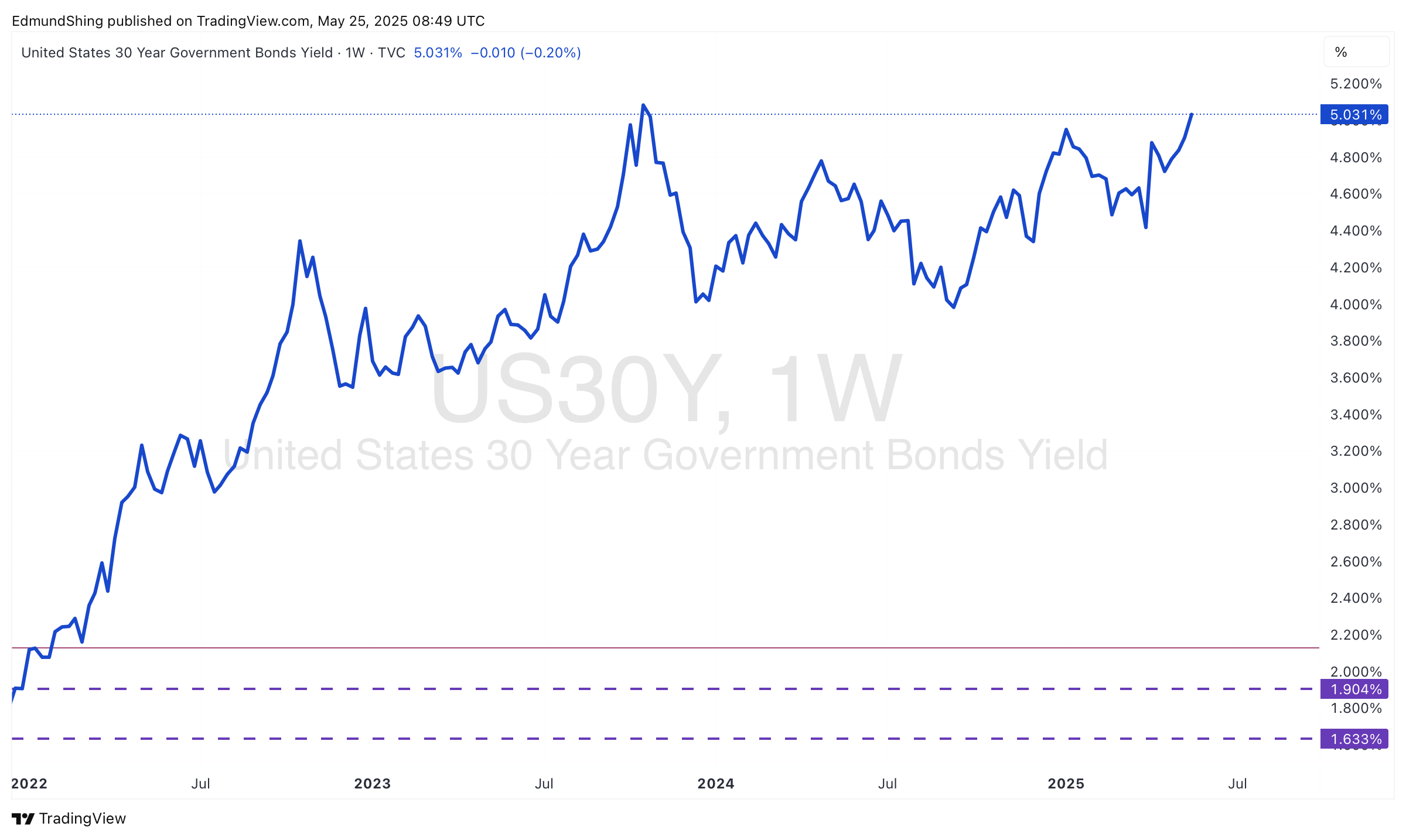
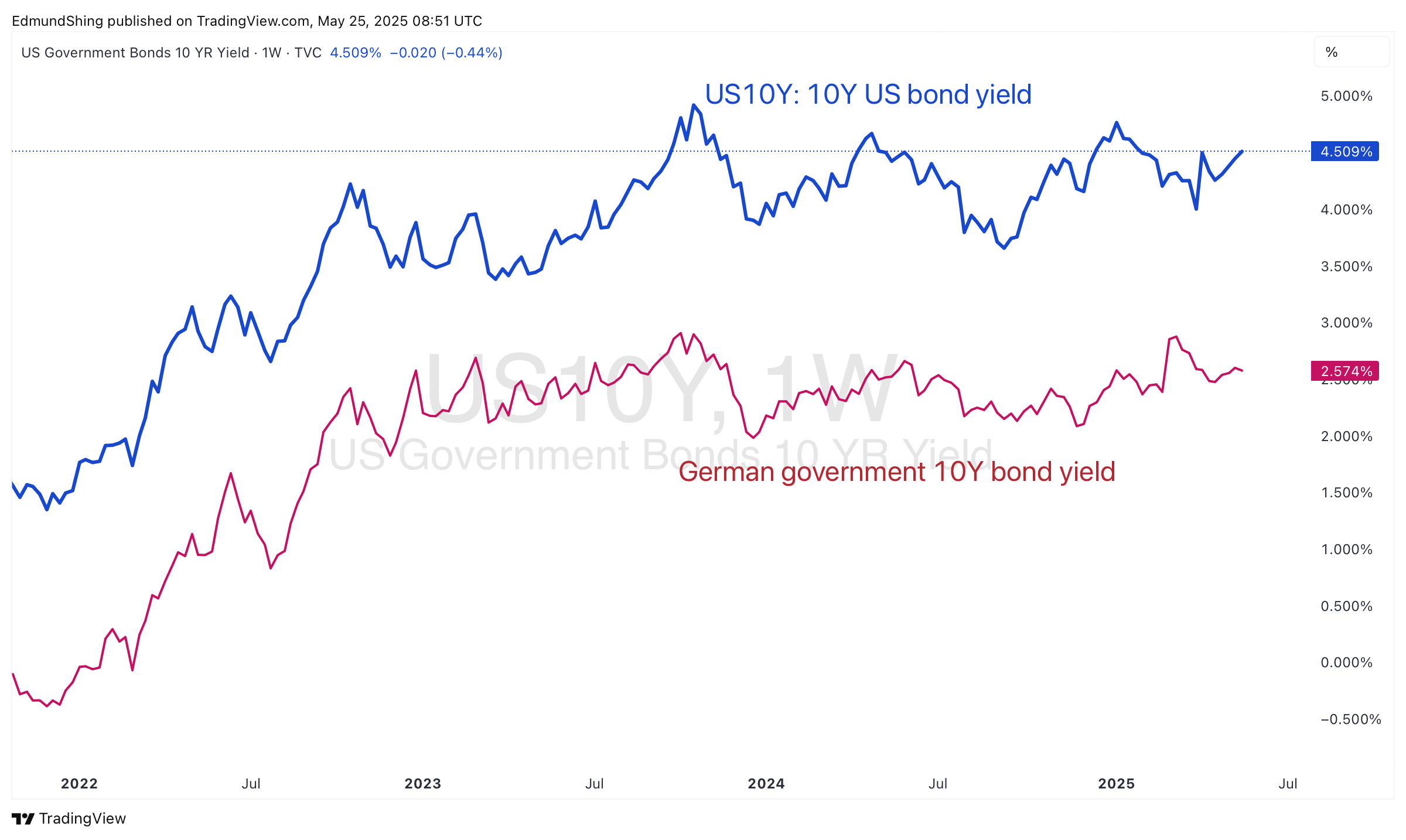
While the ultra-long 30-year US Treasury bond yield has risen to a new decade-plus high of over 5%, thus far the benchmark 10-year Treasury yield has remained reasonably calm at around 4.5%.
Were this 10-year yield to rise above 4.8% for an extended period, then I would expect pressure on US stock valuations, given that the S&P 500 forward P/E has recovered to a relatively expensive 21x during the current rebound.
At least market volatility is cooling
Trump continues to fan the flames of global uncertainty with further pronouncements on tariffs, most recently threatening a 50% tariff on EU exports to the US and also heavy import tariffs on Apple products (unless Apple significantly increases domestic US iPhone production).
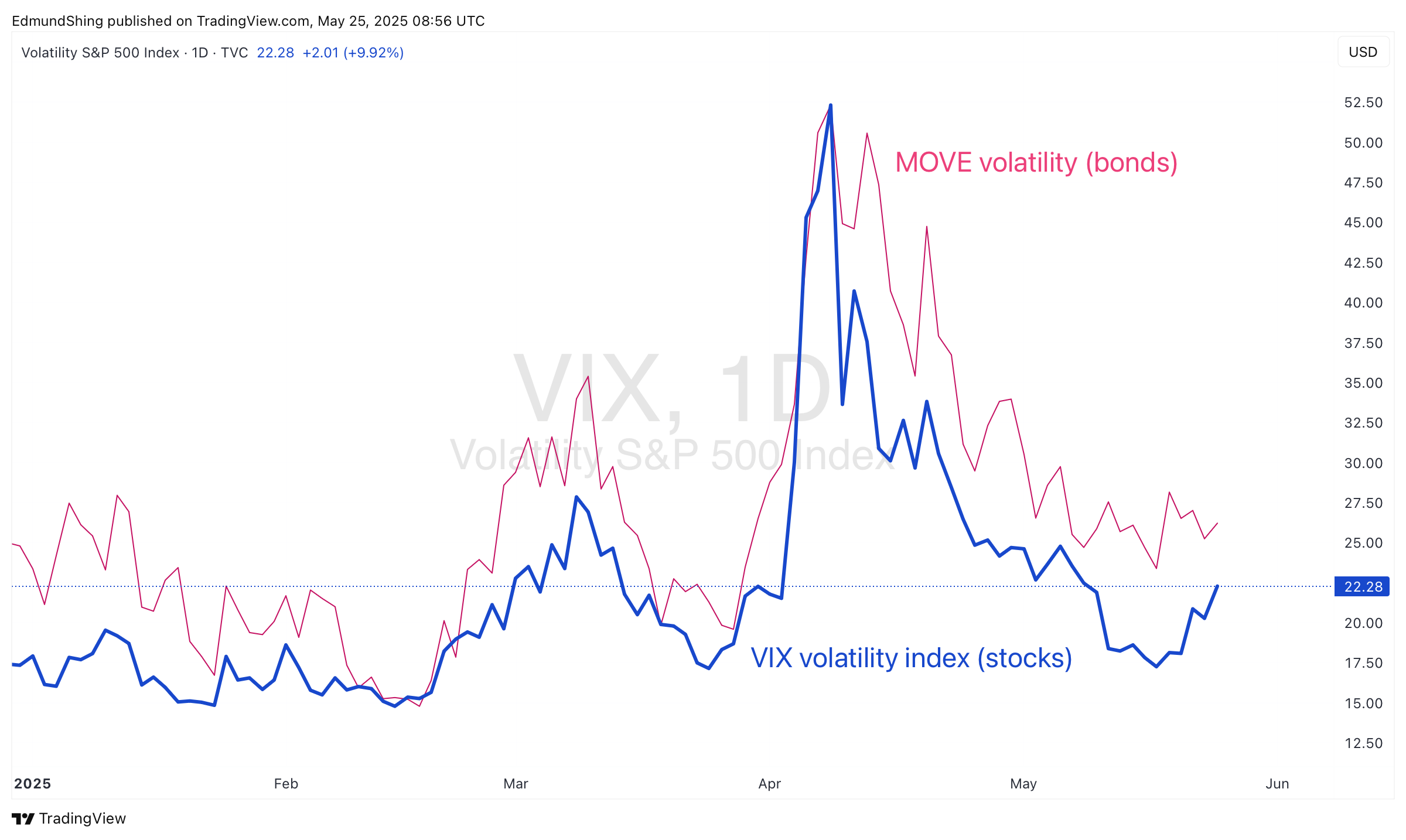
Nevertheless, market volatility in stocks, bonds and FX are all declining in a classic reversion to mean pattern. Markets seem to be taking Trump’s announcements more in their stride, perhaps expecting that much of these extreme measures will never be implemented in the end (“the art of the deal”).
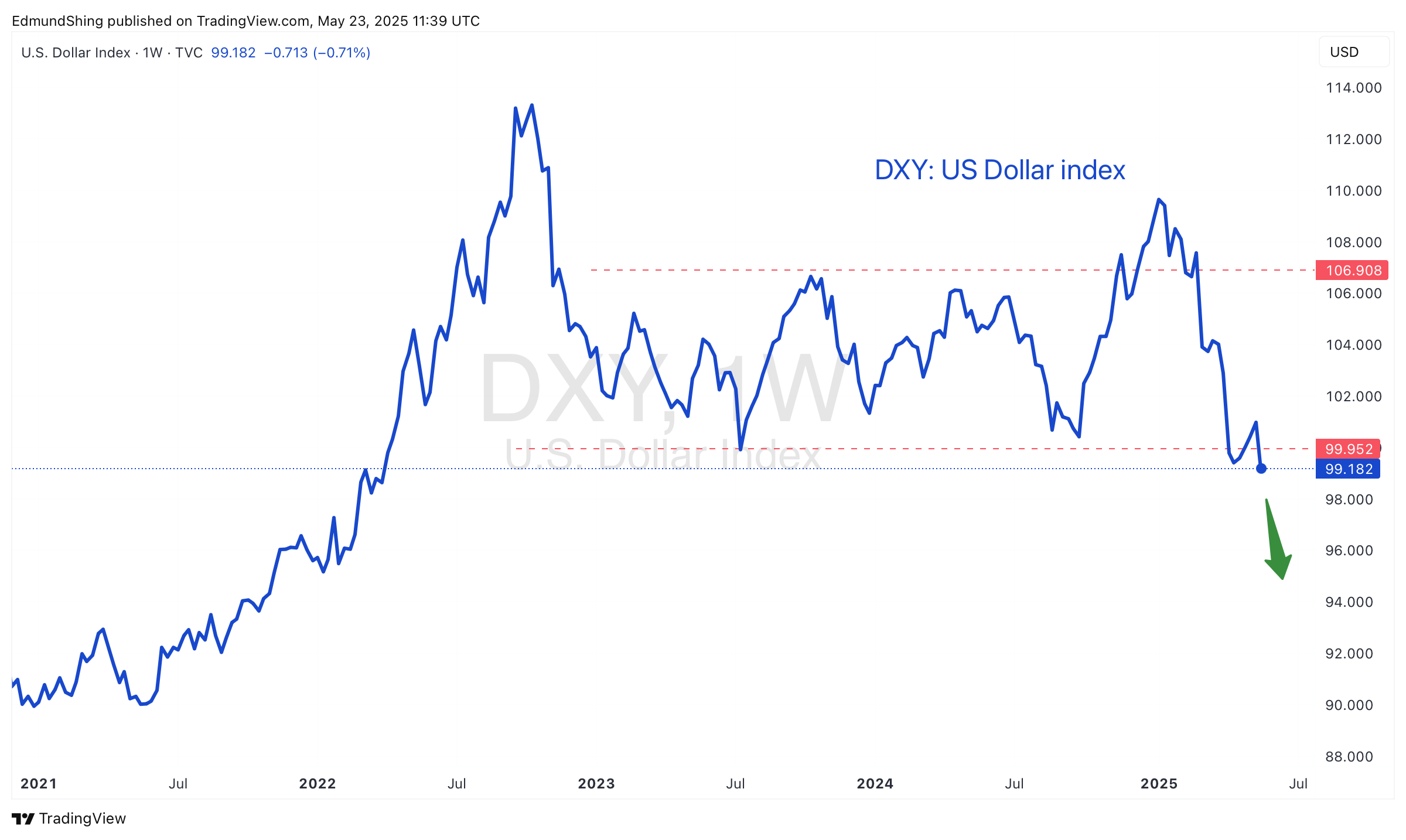
The combination of lower volatility, a weaker US dollar, and the US economy avoiding recession would be a positive cocktail for stocks, corporate bonds and commodities.
Stock markets already price a relatively optimistic outlook
European and UK stock markets hover very close to their all-time highs. In fact, in spite of the environment of uncertainty, the German, Italian, Spanish and UK large-cap stock indices all rallied to or close to new all-time highs in the past week. Even the underperforming US market is only now 7% off its all-time high after a 20% recovery since early April.
Q1 results were relatively strong globally, with relatively little damage to earnings done so far from the tariff turmoil. Time will tell if we are being lulled into a false sense of security before the real tariff storm hits…
What is clear is that global stocks do not price a US recession at current valuations.
A number of defensive sectors now lead
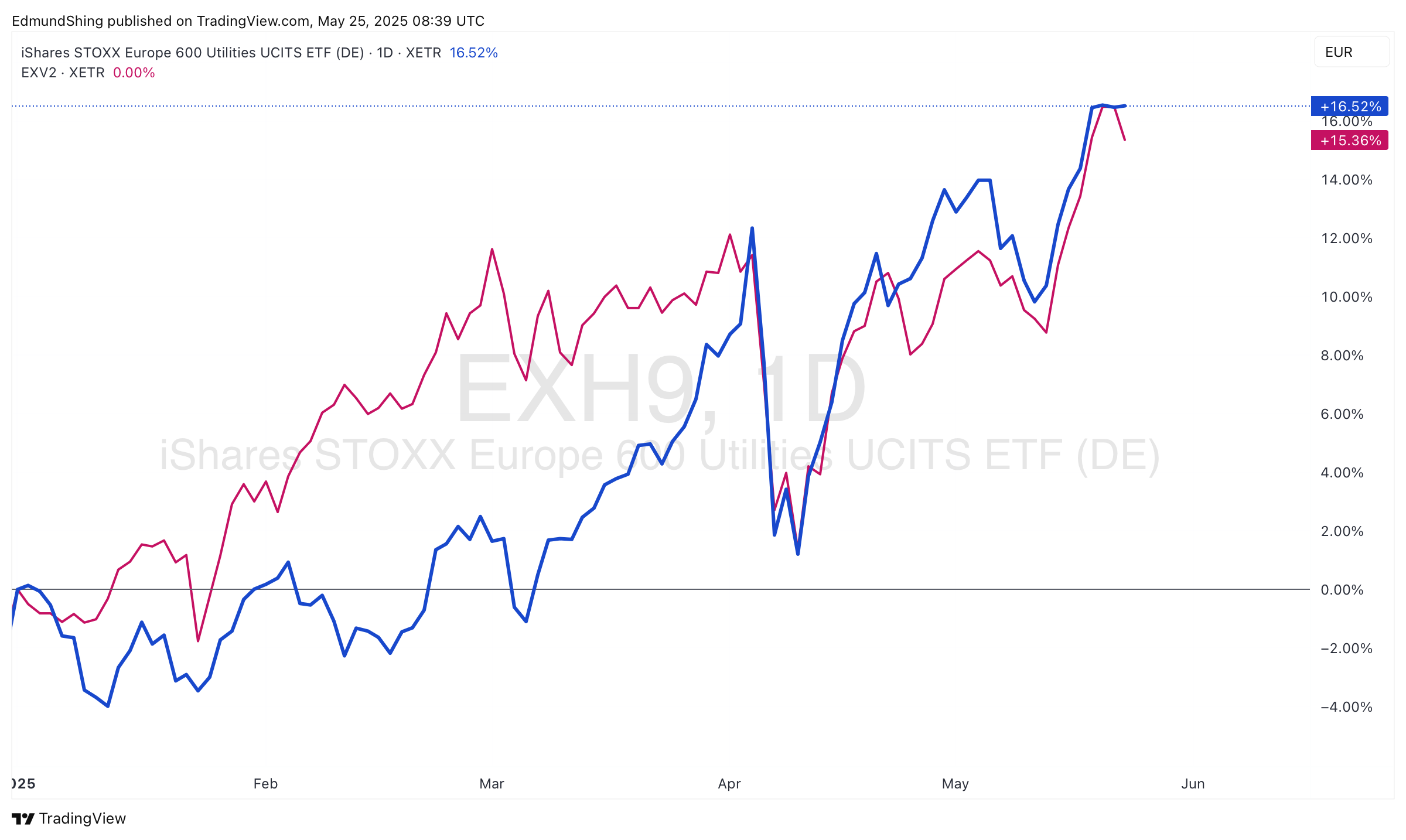
However in Europe, some sector rotation towards less economically-sensitive, more defensive sectors and stocks is in evidence. The Utilities (+17% year to date) and Telecoms (+15% ytd) sectors are recent leaders, while Technology continues to lag.
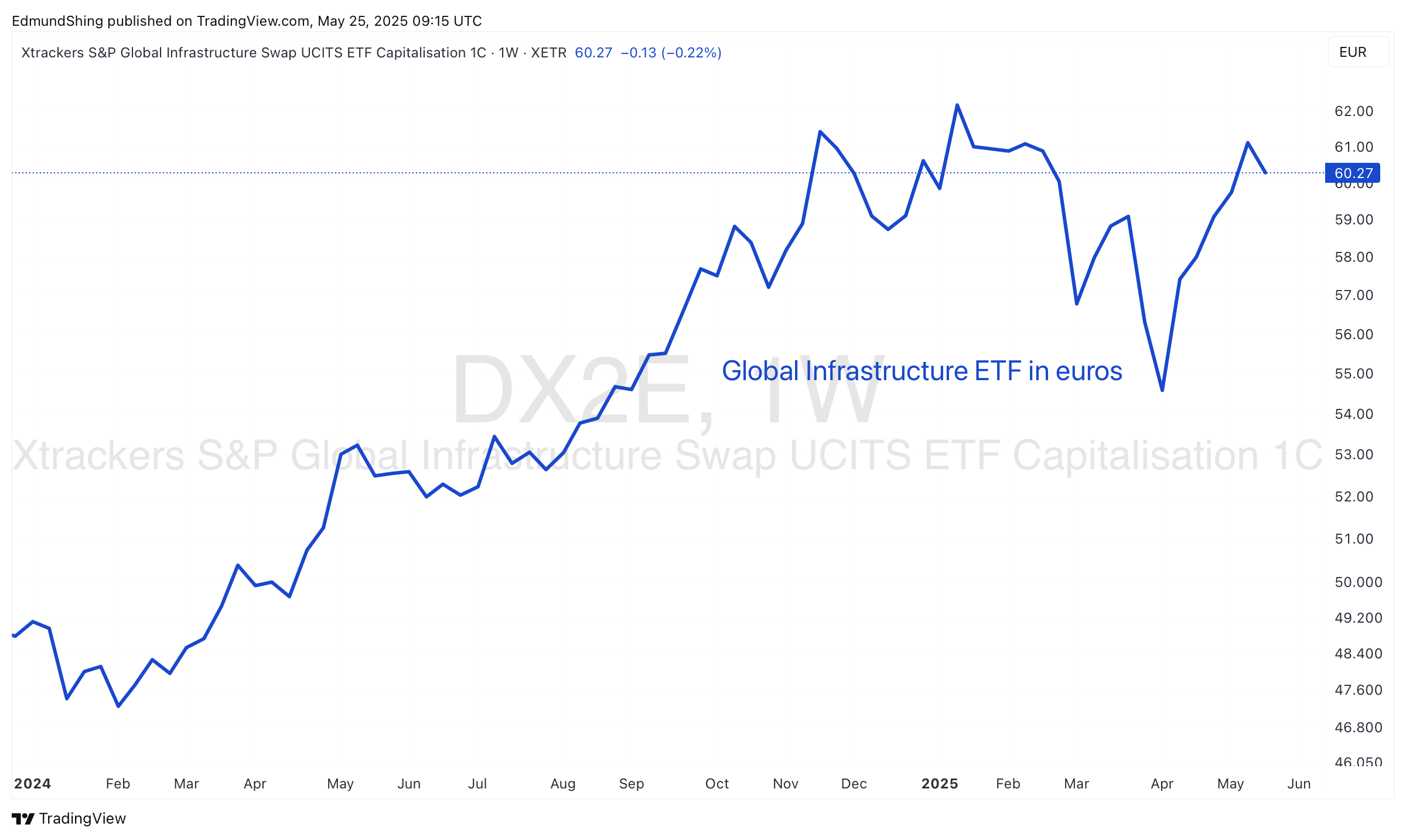
As mentioned last week, infrastructure-related stocks and funds are likewise performing well, given their relatively defensive nature and ability to deliver positive inflation-linked returns over the long term.
US 30Y bond yield reacts to potentially wider budget deficits
But US 10Y bond yield reacts less, still around 4.5%
VIX (stock) and MOVE (bond) volatility indices fall fast
US dollar index points to weaker USD
Defensive sectors outperform: Utilities (blue), Telecoms (red)
Global listed infrastructure ETF outperforms
Have a great week
Edmund
Disclaimer
This is not financial advice. Our content is intended to be used and must be used for information and education purposes only. Please read our disclaimer and terms and conditions to understand our obligations.

11 comments
Attributed to James Carville former adviser to President Clintion.....
I used to think that if there was reincarnation, I wanted to come back as the President or the Pope, or as a 400 baseball hitter. But now I would want to come back as the bond market. You can intimidate anyone.
Any thoughts on the current yield situation on Japanese bonds Edmund and how this could impact on the Japanese carry trade ?
Regards
Andy
Hi Andy
seems that the Japanese governùment has finally blinked given the surge in ultra-long Japanese bond yields.
they have just announced that the Finance ministry will adjust their debt issuance, likely to issue more short-dated bonds to relieve the pressure on long-dated JGB bonds.
Not sure that the Japanese carry trade is about to explode...
Edmund
Thanks Edmund switching to short dated they are taking a leaf out of Janet Yellen's book, Bessant now in the same trap.
I commend a post from Paul Krugman on Substack : https://substack.com/home/post...
Dornbusch’s Law:
indeed, my current trend is to re-read the (rather good) stocko post on when to sell https://www.stockopedia.com/ac...
And so I have sold out of my american stocks (I bought LMT in 2014) and am taking profits on the UK stocks I am less sure about should there be a 'period of instability in the US'.
Sorry
but you are just continuously posting different things from people that have been wrong for the last 200 years!
We had a good overdue correction (as I have been saying) after the new administration came to power. The market is still priced at multiples that need to adjust 20% lower but with the ongoing buybacks and the reduction of the share count, 10% lower is more likely to be justified.
You are totally missing the point that the US market and in general the US economy and the US government are so financialized that any correction is unlikely to be bearish in the near future. It is simply another great opportunity to make more money.
All the best
why has UK infrastructure like HICL and INPP done so badly
UK gilt rates have increased over the last year while the European government yields have declined. This means valuation of European infrastructure assets have increased as the discount rate has come down while the U.K. infrastructure assets have declined as discount rate has increased. As U.K. rates come down this should boost U.K. infrastructure assets going fwd.
10 year above 4.75% then QE kicks in.
As for the long end basically no one pays any attention.
All the best