Market Musings 251123: Which Stock Market is Leading?

Market Musings 251123: Which Stock Market is Leading?
Summary:
A simple method for identifying stock markets that are trending higher
US S&P 500, Euro STOXX 50, Japan Nikkei 225 are major stock markets in uptrends
FTSE 100 and Emerging Markets overall are NOT
Within Emerging Markets, Brazilian BOVESPA and Indian SENSEX stand out as in uptrends
Since March, the BOVESPA and Nikkei 225 indices have the strongest relative momentum
Some UCITS ETFs for investing in these indices
- Gold and bitcoin also in strong uptrends
Podcast this week:
Can we expect a year-end rally in the stock market?
Edmund Shing, Chief Investment Officer, gives his reasons for a stock market rally at the end of this year.
• What do the S&P 500, the Euro Stoxx 50 and the Nikkei 225 tell us?
• Where are the famous Magnificent Seven heading?
• Catalysts for a rebound explained
Which stock markets are trending higher?
In stocks and stock markets, momentum tends to perpetuate - i.e. those stocks and markets that are rising tend to continue to rise. Just look at the US Magnificent 7 for an excellent example of this persistence of momentum.
One easy way to spot a stock market that is trending higher is simply to test for two conditions:
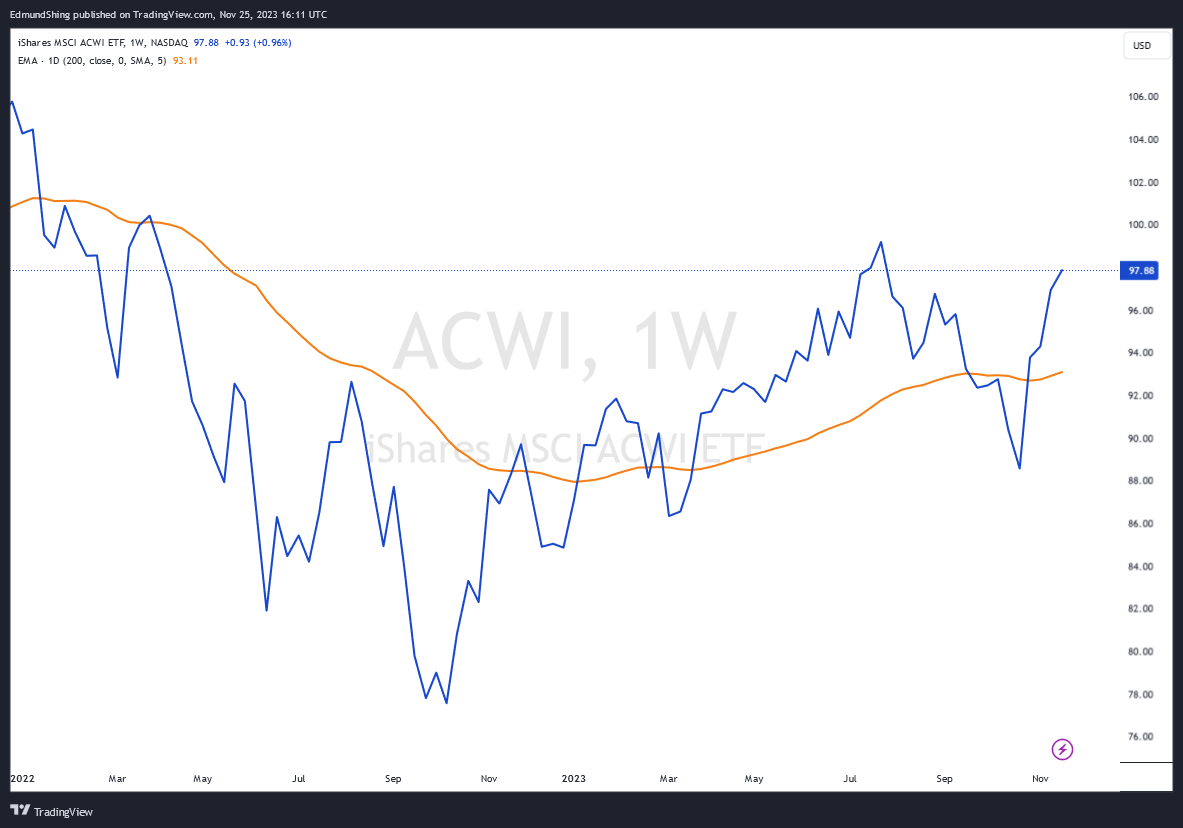
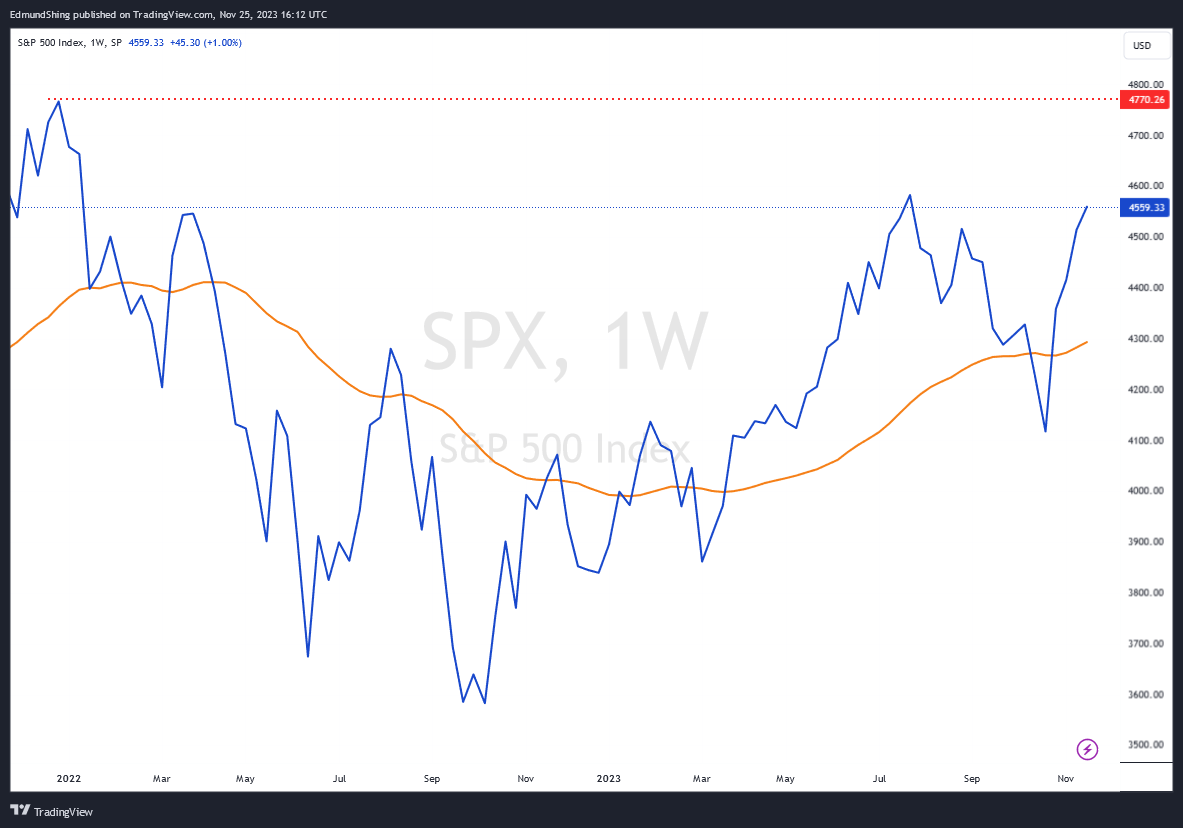
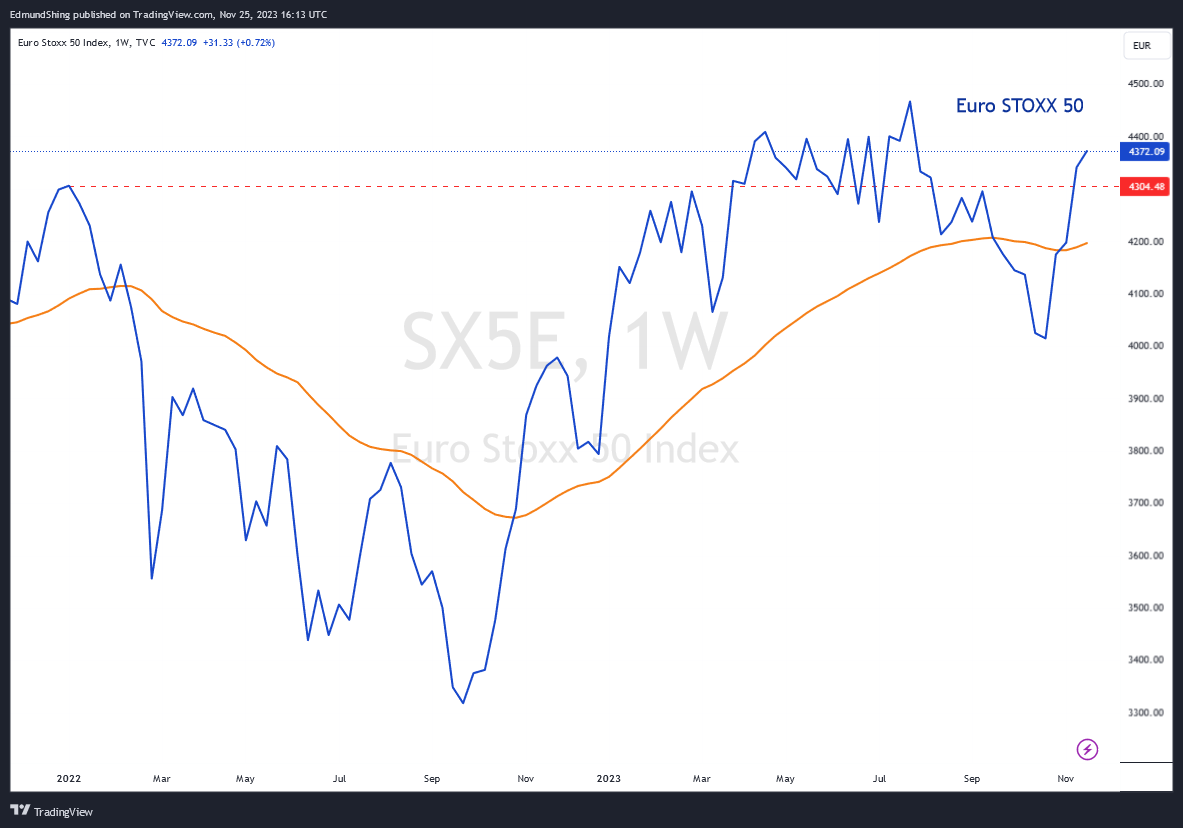
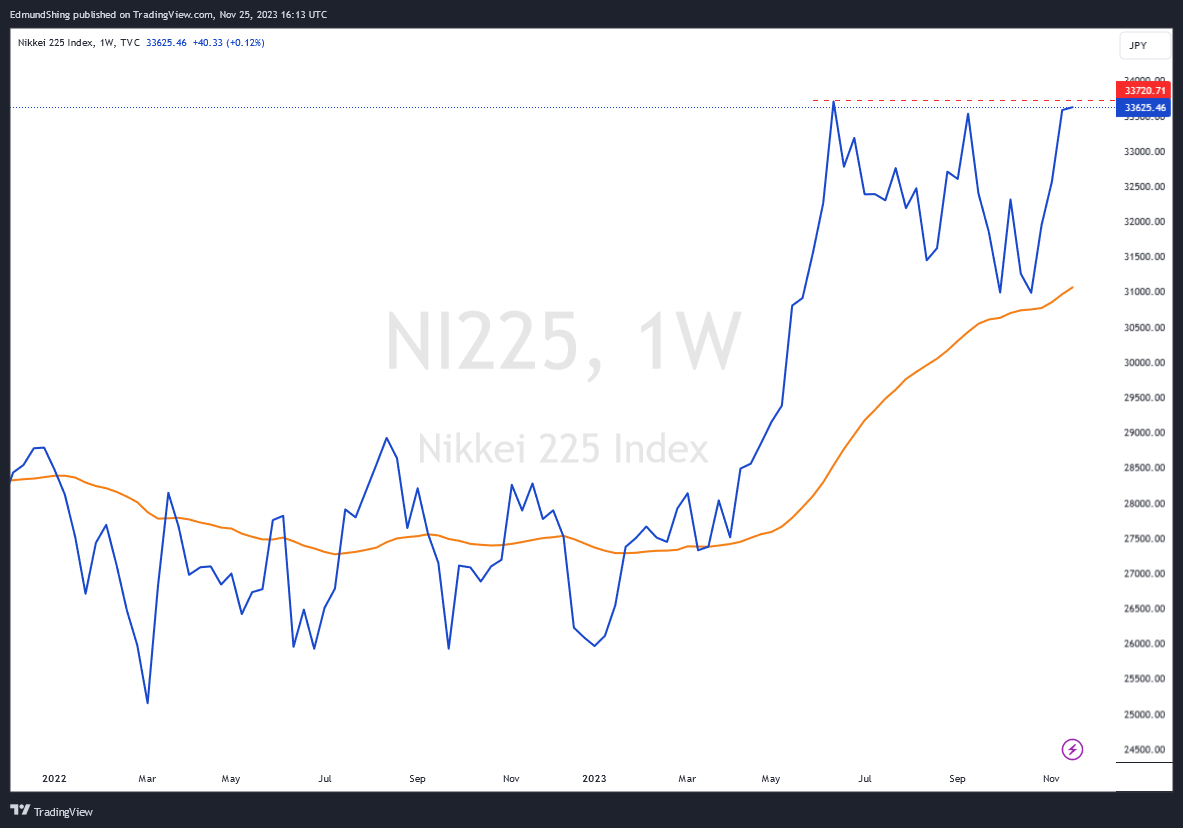
Is the stock market higher today than it was 6 months ago?
Is the stock market above its own 200-day moving average (200d MAV)?
While not a foolproof method, it has the advantage of simplicity.
So, which stock markets around the world satisfy these two conditions currently?
First of all, these stock markets all satisfy these two conditions and thus can be said to be trending higher (in the following charts, the orange line is the 200-day moving average):
MSCI World ACWI index: Yes, trending higher and above its 200d MAV
The dominant US market: S&P 500 also trending higher,
Buy still some distance below the start-2022 high
Euro STOXX 50: trending higher too, approaching recent multi-year highs
Japan Nikkei 225: a strong trending market, back to recent multi-year highs
Source: tradingview.com
Now, we turn to those stock markets that do NOT satisfy the two conditions, including the FTSE 100 and Emerging Markets…
UK FTSE 100: unlike the indices above, the FTSE continues to struggle

MSCI Emerging Markets: as a whole, emerging markets are also struggling

Source: tradingview.com
But it is perhaps wise to no longer lump together all emerging markets, as Chinese stocks have clearly struggled, but there are other emerging markets that continue to perform well.
Brazilian BOVESPA index powers to new highs

Indian Sensex index is also trending strongly higher

Source: tradingview.com
Choosing between the markets trending higher
But as always, it is difficult to invest in every market that is moving higher. One way to narrow down the choices is one again quite simple - the concept of relative momentum.
Put simply, which markets have gained the most over the last 6 months or so?
In the chart below, I have charted the positively trending stock markets rebased to early March this year, when the US regional banking crisis hit stock market confidence (with the failures of Silicon Valley, Signature and First Republic banks).
Since March, the BOVESPA and Nikkei have led the pack

Source: tradingview.com
Of the broad stock market indices shown above, when rebased to 100 in March, it becomes clear that the strongest uptrends can be found in the Brazilian BOVESPA and the Japanese Nikkei 225 indices.
How can you invest in these leading indices using ETFs? Well, for a specific exposure to Brazil, there is the RIOL Lyxor MSCI Brazil UCITS ETF. Alternatively, there is the LTAM iShares MSCI EM Latin America UCITS ETF, which is dominated by Brazil and Mexico.
Note that in the case of these two ETFs, you are buying mainly exposure to Oil & Gas, Mining and Banking companies.
For Japanese exposure, one could look at the VJPN Vanguard FTSE Japan UCITS ETF or the XMJP Xtrackers MSCI Japan UCITS ETF. In Japan, you are buying a fairly broad spread of industries, with plenty of financials, technology and industrial companies.
Leading sectors: Technology/Semiconductors
Technology remains the clear momentum leader over the last few months at a sector level. Outside of the Magnificent 7, Semiconductors has been a leading segment within the wider Technology sector.
SMH Semiconductor ETF has risen above its start-2022 high

Source: tradingview.com
Outside of stocks, Gold is also trending higher
Within the broad commodity complex, gold is the commodity that shows the most promising uptrend, boosted by falling long-term interest rates and a weaker US dollar.
Physical gold looks ready to challenge recent highs

Source: tradingview.com
But for you crypto lovers, we also have to admit that “digital gold” i.l,e. Bitcoin is also trending higher on the back of the expectations of the announcement of the launch of new Bitcoin spot ETFs, which some think will further boost demand.
Bitcoin has rallied strongly of late, but still far below the Nov 2021 peak of over $65,000

Source: tradingview.com
We remain overall within a positive seasonal period for stocks and gold, historically speaking, but let’s see how the S&P 500 and Euro STOXX 50 react as they rebound to recent highs. Can they break through to new highs, or will around 4600 on the S&P 500 and 4400 on the Euro STOXX 50 act as strong resistance?
Equally, will gold be able to break through its $2040/ounce high?
We should find out soon…
Have a great week,
Edmund
Disclaimer
This is not financial advice. Our content is intended to be used and must be used for information and education purposes only. Please read our disclaimer and terms and conditions to understand our obligations.
11 comments
The Argentinian market has been outperforming all of the above. Argentinian banks also outperforming US banks for the last few years.
Good shout, Argentina has been a doozy. While they've been in stagflation for a couple of years, they do produce a lot of commodities and natural resources which tend to do well when prices are going up.
Hi Edmund,
I believe that to get maximum benefit from the gains seen on the Nikkei 225 and Topix you need a GBP currency hedged Japan ETF. I made a mistake here and just purchased a GBP currency fund which is only up very slightly. When the Yen weakens these index go down in GBP terms but up in local currency terms as the underlying investments benefit from their exports with a weak Yen and that's pretty much cancelled each other out.
At the appropriate time I will switch to a GBP currency hedged ETF eg when the Yen falls back to average or below average levels. I believe the Yen will strengthen when we start decreasing our interest rates. Didn't appreciate that the Yen was so volatile when I invested. Ho hum.
As an example Xtrackers (XMJP) is up approx 10% YTD compared with WisdomTree (DXJP) is up approx 35% and most other GBP hedged Japan ETFs are up 25%.
Yes this is all true Andy
bear in mind that the Yen is very cheap now,, and is quite likely to rebound significantly over the next few months. So yes, I would certainly not switch for a currency-hedged etf at this point…
edmund
Great thread, I use a similar momentum based approach for trading indices, although I use a three month time-frame. Strongest indices right now are VanEck Egypt Index ETF (PCQ:EGPT) Global X MSCI Pakistan ETF (PCQ:PAK) and iShares MSCI Poland ETF (PCQ:EPOL), I trade these with spread bets to avoid the FX risk.
Hi XTR,
You wrote:
"I use a similar momentum based approach for trading indices, although I use a three month time-frame."
Out of interest, how successful has this approach been for you?
From where do you get your information about the indices and ETFs you trade?
Hi pka,
I screen a list of country ETFs for relative strength over three months and look at what's moving, see below for my screen. It's mainly a technical assessment although I also check for accelerating GDP growth to confirm. I find it most profitable with short to medium holding periods.
Resources are SharePad for screening and TradingEconomics.com for GDP data.
Hi XTR, Thanks very much for your useful reply to my question.
I think a possible drawback to your momentum-based approach for trading indices is that, in the event of serious bear market in the USA, past history suggests that most country ETFs are likely to drop together in a highly correlated manner, and the ones that had shown the highest recent momentum might be the ones that fall most quickly. But this is also likely to be the case with momentum-based strategies for trading ordinary stocks.
No problem. I would point out that that the US economy has been in a deflationary bear market since mid-2022, and US GDP has been declining for even longer but there's still been several bull markets in that time. Of course anything can happen anytime, regardless of the type of market or trading style.
As usual a great round up. For me the strange thing about this market is that the UK small cap sector is trading at historically low prices. The US magnificent 7 as Ed calls them are trading at historically high prices. Which is right? I can only assume that the gap will narrow and UK small cap will rise.
The US magnificent 7 as Ed calls them are trading at historically high prices. Which is right? I can only assume that the gap will narrow and UK small cap will rise.
Why? Because UK small caps are better companies? I know this sounds crazy, but, if Nvidia forecasts are to be believed – and they have been exceeding them by a huge margin of late – it is cheaper on a variety of metrics than it has been for some time. Alphabet and Meta are priced on a par with the index for better growth. Why can’t they keep rising?
Prices are a product of flows - and there is no question which nation and its companies are plugged into the future and which is fading fast on the fumes of its past. I’ve got skin in both games, but if I had to choose only one for the rest of my investing career, it would not be a hard choice.