Market Musings 260323: No let-up in banking stress, yet

Market Musings 260323:
No let-up in banking stress, yet
Gold is potentially breaking out to a new all-time high…
Summary:
Friday Banking Freak-out: Deutsche Bank in the cross-hairs
Bond markets start to price the end of interest rate hikes
Stock markets are still trending higher in many cases…
Gold is playing its role of a safe haven
Podcast this week:
There are decades where nothing happens; and there are weeks where decades happen.
What is the fallout from this current banking stress?
Will there be a US recession?
What’s been happening in bond markets?
What about stock markets?
Is this banking stress over?
Why BNP Paribas is not changing its strategic views substantially.
Friday Banking Freak-out
Quite clearly, we are not anywhere near out of the woods with regards to banking stress, either in the US or in Europe.
Deposit outflows from US regional banks continues to be a big problem for the US banking sector, which numbers around 4000 banks in all (yes you may ask yourself the question: “why exactly do the Americans need so many banks?”)...
JPMorgan Chase & Co analysts estimate that the "most vulnerable" U.S. banks are likely to have lost a total of about $1 trillion in deposits since last year, with half of the outflows occurring in March following the collapse of Silicon Valley Bank.
Accelerating deposit outflows from US banks
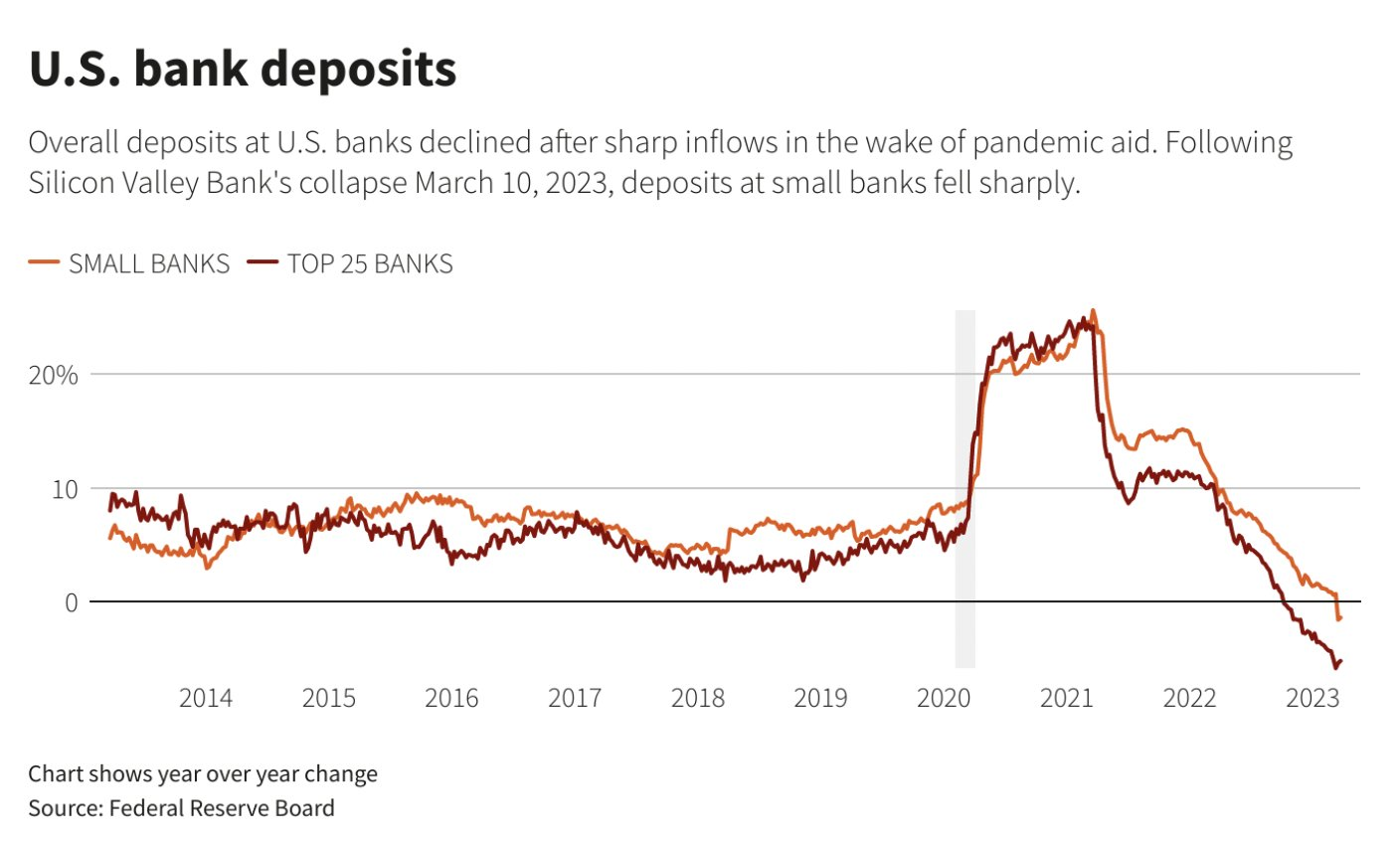
The basic problem remains this: with the advent of mobile banking, it is increasingly easy for households to switch their cash savings out of poorly-remunerated bank deposit accounts into money market mutual funds that yield up to 4.7% gross.
A huge gulf between money market yields and savings account interest rates

The latest news flow is this: Small US commercial banks lost 2% deposit base over the week ending Mar 15 (SVB collapse Mar10). But there are some hints that the situation has stabilised since:
- H4 release: Fed's emergency lending hadn't spread past NY, SF Fed districts
Fed commentary: Powell, Bostic say deposit flow stabilised
This pressure on banks has driven the main XLF financials ETF in the US back to recent lows, as bank shares sink under selling pressure.
US Financials still under pressure (XLF ETF)

Source: tradingview.com
This pressure on banks has yet again not been confined to the US; the financial markets seem to have decided that Deutsche Bank is the next candidate to follow Credit Suisse into difficulties… This is also pressuring the European banking sector, as in the US.
Euro Banks also falling, led by Deutsche Bank

Source: tradingview.com
The stress on European banks is particularly evident in the price of European bank credit default swaps (CDSs), which show the annual cost of insuring a banks’ bonds against the risk of default (i.e. the bank not paying the interest and eventually the principal amount of the bond at maturity). These CDS prices have surged, reflecting the rising stress on European banks, Deutsche Bank in particular.
Euro Banks Credit default Swaps show stress

Source: tradingview.com
Note: Credit Default Swaps represent cost of insuring bonds, in this case bank bonds
But the chart below shows why Credit Suisse can be considered a particularly bad banking apple - all other European banks on this chart apart from CS are profitable, and generally have a higher percentage of their deposits as insured, thus protected even in the event of a bank running into difficulties as occurred at CS.
Why Deutsche Bank is not Credit Suisse Mark 2

Source: tradingview.com
A further reason for not believing that Deutsche Bank is not a Credit Suisse mark 2 in spite of its historic problems is the behaviour of its share price in recent months.
Unlike CS, the Deutsche Bank share price has held up reasonably well, until the last few days.
Why Deutsche Bank is not Credit Suisse (Part 2)

Source: tradingview.com
Bottom line: the banking stress is not over yet, but I still believe that it is containable and that the markets are potentially overreacting at present. We will see…
Bond markets start to price the end of interest rate hikes
Short-term bond yields continue to fall in the US and UK, suggesting that central banks are close to the end of their interest rate hiking cycles now that the US Federal Reserve has raised its Fed Funds rate to 4.75-5%, and the Bank of England has taken its Base Rate up to 4.25%.
The fact that 2-year bond yields in both countries are now far below these benchmark interest rates points to the expectation from bond market participants that these central banks will cut these interest rates sooner rather than later.
Why Deutsche Bank is not Credit Suisse (Part 2)

Source: tradingview.com
One indicator that needs to ease lower if stock markets are to continue to make headway is the MOVE index of US Treasury bond volatility - this volatility index remains very high at present given the uncertainty over central bank policy in the face of relatively high (but falling) inflation, a slowing economy, and ongoing stress in the US banking system.
MOVE index of US bond volatility at highest levels since Global Financial Crisis

Source: tradingview.com
Stock markets are still trending higher in many cases…
Despite this banking stress and the sharp fall in financials stocks, the average US stock (as measured by the ValueLine Arithmetic index) continues to mark a series of higher highs and higher lows - the classic definition of an uptrend.
VALUA Valueline arithmetic index: The average US stock is trending higher…

Source: tradingview.com
The same is true for the S&P 500 index excluding financials (yes there is an ETF for this, SPXN)...
US S&P 500 ex Financials trending higher too…

Source: tradingview.com
In Europe, despite a relatively chunky index weighting in Euro banks, the flagship Euro STOXX 50 index also continues to mark out an uptrend.
SX5E Euro STOXX 50 also trends higher despite drag from Banks

Source: tradingview.com
Naturally, the Euro STOXX 50 index ex financials (yes there is also an index for this plus futures contract on this index!) looks even better…
Euro STOXX 50 ex financials close to recent highs

Source: tradingview.com
Gold is playing its role of a safe haven
Gold is surging towards $2000/ounce as investors look for a safe haven from the banking turmoil, which is infecting not only stocks but also bonds.. Note how gold has hit a new high in pound terms this week.
Gold in GBP has hit a new all-time high

Source: tradingview.com
Note too how gold miners have not really followed: since the March 2021 low point for gold, physical gold has since gained 31% while gold miners (again, priced in pounds) are flat over this period.
Similar can be said for physical silver, which has also lagged the move in gold since early 2021:
Silver in GBP has not really reacted yet to the latest gold move

Source: tradingview.com
Conclusion: try to keep calm…
I know it is difficult when the newsfeeds scream headlines about a banking crisis, but please try not to overreact.
The average US stock and the Euro STOXX 50 stock index both continue to trend higher for now in spite of this volatility.
Looking at other asset classes, precious metals such as gold and silver look attractive, as do gold miners. Both silver and gold miners have clearly lagged the move higher in gold, thus far…
Let’s hope for a calmer week ahead,
Edmund
Disclaimer
This is not financial advice. Our content is intended to be used and must be used for information and education purposes only. Please read our disclaimer and terms and conditions to understand our obligations.
5 comments
Surely there is some advantage in having a lot of smaller banks as some of them can be allowed to fail. When they are too big to be allowed to fail like Lloyds and RBS the tax payer picks up the bill!
Thanks for your post
Great article Edmund
Thanks Edmund for all your weekly comments, much appreciated!
Alb
Thanks Edmund for informative article...'The stress on European banks is particularly evident in the price of European bank credit default swaps (CDSs)' - these instruments are quite illiquid so small buy/sells can exacerbate movements
Very true Colin, but AT 1 bank bonds have also sold off heavily post the Credit Suisse wipeout, so clearly banks are under a lot of stress at present, even if rate hikes have not had the same economic effect on European banks as for their US counterparts.
One positive for the banks in Europe is that in general, bank clients are stickier and less prone to switch money out of low-yielding savings accounts into higher-yielding savings products - plus the interest rate spread to gain is not as wide as in the US.
Edmund