Market Musings 270523: Is AI the next Big Thing (for investors)?

Market Musings 270523:
Is AI the next Big Thing (for investors)?
Nvidia’s post results surge underlines the hype over ChatGPT and AI
Summary:
Artificial Intelligence: A Bubble, or the Next Big Thing?
Gartner’s Hype Cycle
ChatGPT the trigger for AI excitement
Nvidia the Poster Child for Investing in AI
If you want to invest in AI, how else can you invest apart from Nvidia?
Finally, what could the macro impact of AI really be?
Weekly Podcast:
The US debt ceiling: the final countdown
Is 1 June a scary date?
Can the American President really invoke the 14th amendment?
Why are CDS prices so high but the probability of the US default is not?
Why is the T-bill dislocated?
Artificial Intelligence: A Bubble, or the Next Big Thing?
There is no doubt that there is a huge amount of hype in today’s financial markets around the theme of Artificial intelligence (AI).
While AI has been around for many years (I myself completed a Doctorate in Artificial Intelligence in the early 1990s), the technology finally seems to be hitting the mainstream in terms of applications in the everyday and business worlds.
For many in Main Street, the image of Artificial Intelligence is perhaps best personified by the risk that one day, computers will rule over people, Terminator-style.

However, I would rather argue that Artificial Intelligence and Machine Learning are technologies that can potentially magnify once again the impact of Information Technology on our everyday lives, after the advent of the Internet/World Wide Web and then of Smartphones.
Of course, as Artificial Intelligence captures the imagination of investors in much the same way that the Metaverse did a couple of years or so ago, there is always the risk that investors today will price in over-optimistic sales and earnings expectations. This is a hype pattern that repeats itself over and over again, as it has done for over a hundred years in stock markets with former “technologies” such as railroads, radio and mainframe computers.
I am not saying that there is no solid reasoning behind this excitement. For instance, consultancy PwC sees AI-related productivity savings and investments generating $15.7 trillion worth of global economic output by 2030, almost equivalent to the gross domestic product of China.
But I would temper my excitement, for historical reasons…
Gartner’s Hype Cycle
The advent of new technologies tends to follow the Hype Cycle mapped out by consultancy Gartner.
According to Gartner,
The Hype Cycle is a graphical depiction of a common pattern that arises with each new technology or other innovation. Although many of Gartner’s Hype Cycles focus on specific technologies or innovations, the same pattern of hype and disillusionment applies to higher-level concepts such as IT methodologies and management disciplines.
Hype Cycles characterize the typical progression of innovation, from overenthusiasm through a period of disillusionment to an eventual understanding of the innovation’s relevance and role in a market or domain.
Gartner’s Hype Cycle
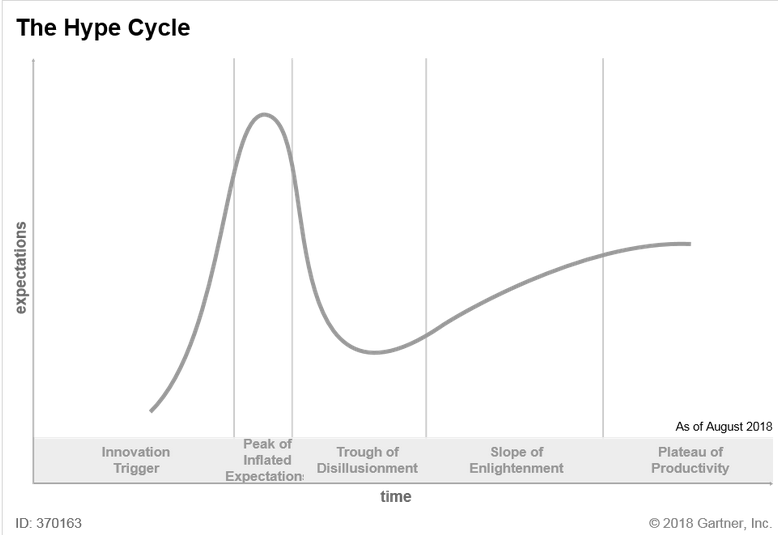
Source: Gartner
This hype cycle can be then closely linked for investors to asset bubbles, which have occurred many times in the past with new and hyped technologies such as cryptocurrencies, the Internet and radio.
The Psychology of Asset Price Bubbles
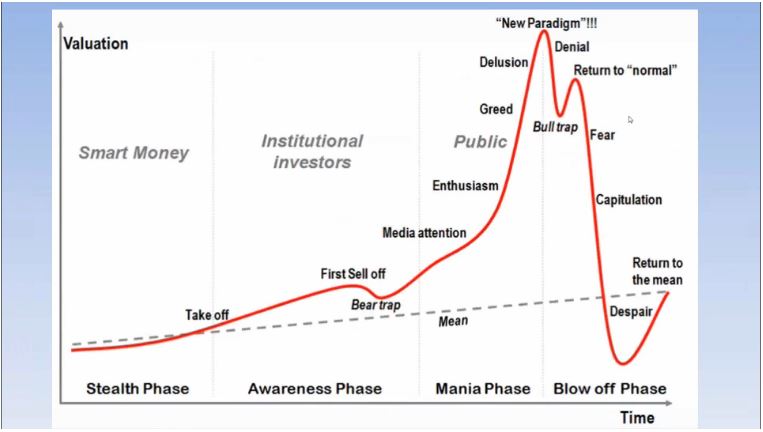
Source: Dr. Jean-Paul Rodrigue
This is most certainly a psychological phenomenon and not a question of intelligence - in the past, there have been plenty of examples of famous intellectuals being sucked into asset bubbles, such as Sir Isaac Newton in the South Sea Bubble of 1720. Greed and the madness of crowds can get the better of even the most intelligent amongst us…
Examples of Asset Bubbles in History
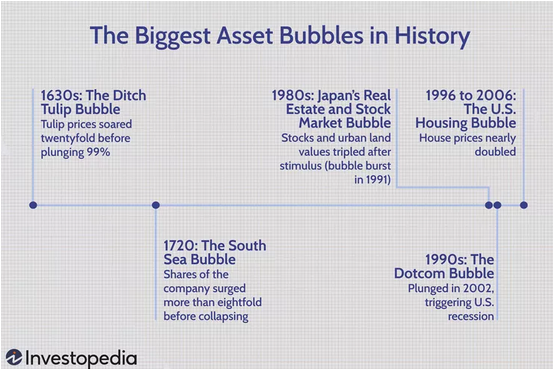
Source: Investopedia
Conclusion: Investors should beware the hype around the “next great thing”, as it can often mean investing in an asset bubble when asset valuations are already heavily inflated, running the risk of taking a huge loss when the asset bubble finally bursts.
ChatGPT the trigger for AI excitement
The trigger for this latest excitement around AI comes from the mainstream adoption of the use of ChatGPT, which holds much promise in a number of different types of business.
Reuters reported that AI bot ChatGPT reached an estimated 100 million active monthly users last month, a mere two months from launch, making it the "fastest-growing consumer application in history" according to UBS.
ChatGPT outstrips adoption speed of all previous technologies
Technology is adopted ever faster in today’s world
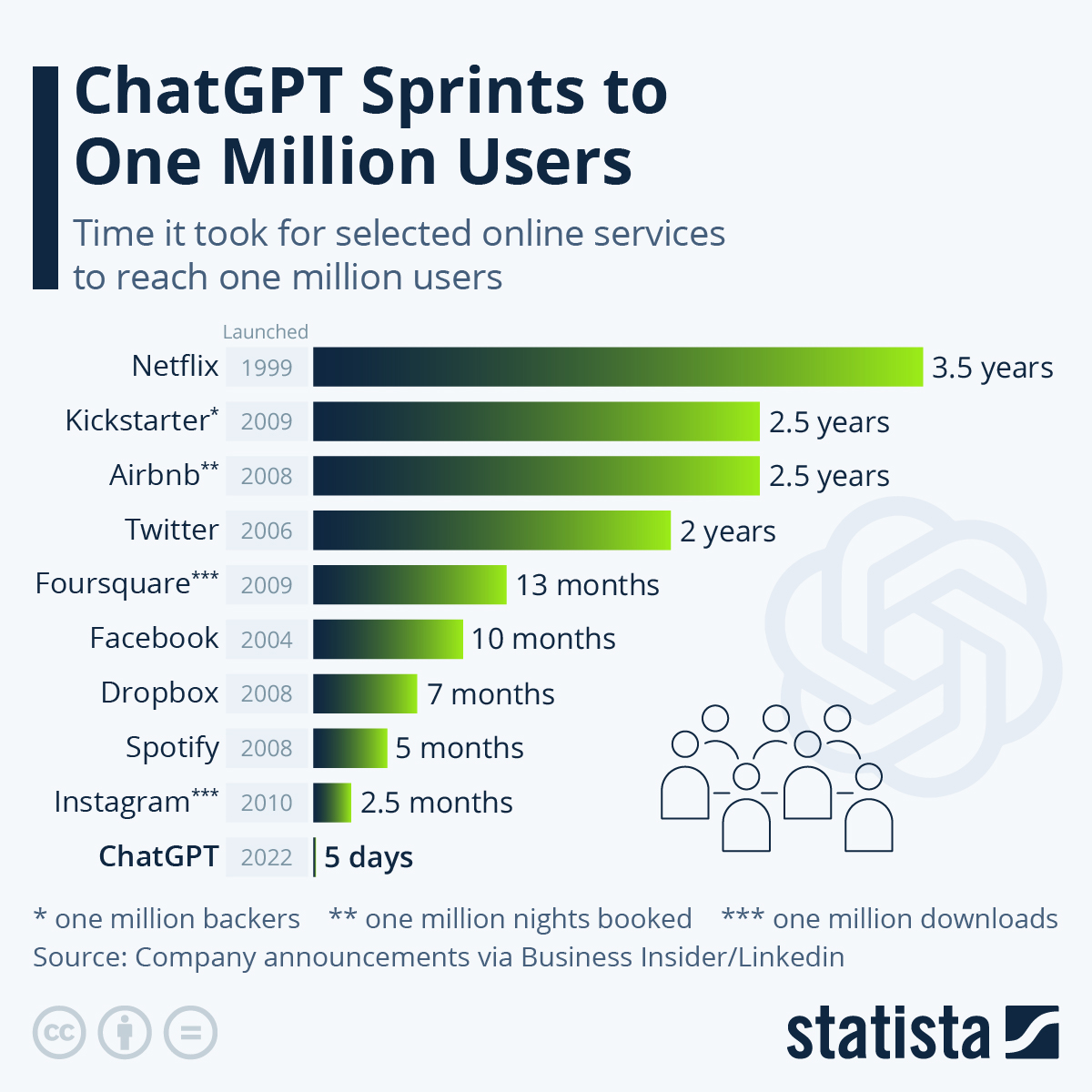
Source: Statista
Nvidia the Poster Child for Investing in AI
To be frank, we are too early in the adoption cycle of Artificial Intelligence techniques and programs to know who the real long-term corporate and business winners will be.
I have long advocated a “picks and shovels” approach to investing in AI for this reason - preferring to invest in sectors and companies that will provide the hardware and software tools necessary for the widespread adoption of AI and machine learning in large corporations. I have thus advocated investment in both semiconductors and cybersecurity subsectors of Information Technology.
It seems that investors are going one further in this approach in identifying Nvidia as the key long-term winner of the boom in AI applications - given that their Graphic Processing Units are well-placed to provide the heavy processing power necessary for AI models to “learn” by training on large datasets.
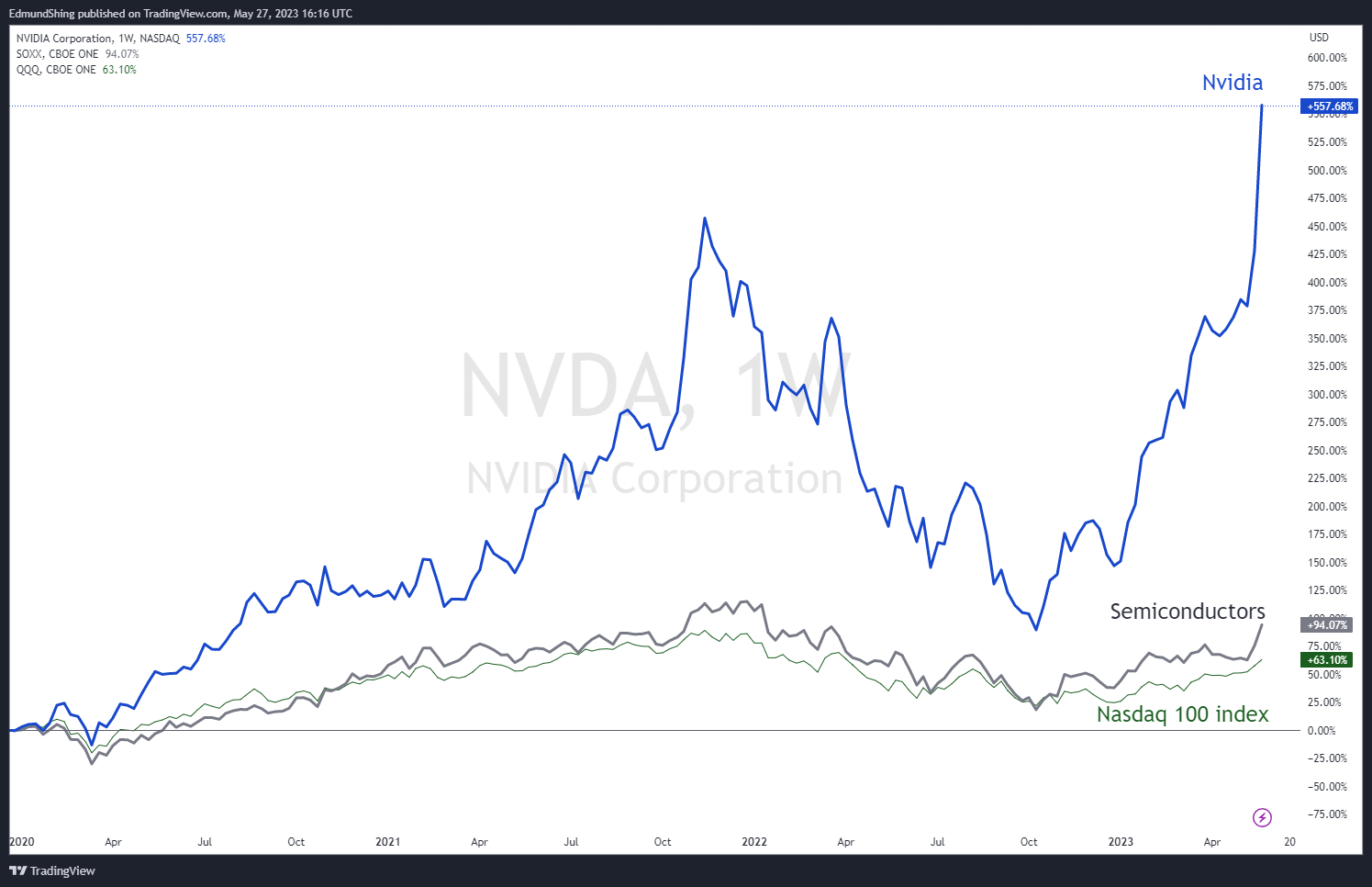
Nvidia is the poster child for the AI mini-bubble
Nividia’s Graphic Processing Units GPUs) are the AI processor of choice
Source: tradingview.com
Nvidia is now richly priced following a 28% post-results surge since Wednesday last week, valued at 35 times sales.
At this point it is also worth remembering that a great company is not necessarily a great investment.
So even if we accept that Nvidia is an exceptional company that is very well-placed to profit from growth in AI investment, we then have to try to figure out how much of this long-term growth is already captured in today’s valuation. Given how high Nvidia’s valuation has risen of late, the temptation is to say “a lot”.
If you want to invest in AI, how else can you invest apart from Nvidia?
I maintain that it is simply too early to be able to reliably identify the long-term winners from any supercharged growth trend in AI. The eventual winner(s) may not even be listed in the public stock markets today…
A slightly more diversified approach might be to invest in funds and ETFs focused on Industrial Automation and Robotics, as this is an area which should benefit from leverage to AI and also from other megatrends such as ageing populations, nearshoring of Asian goods production and the need for companies to reduce their exposure to high wage growth.
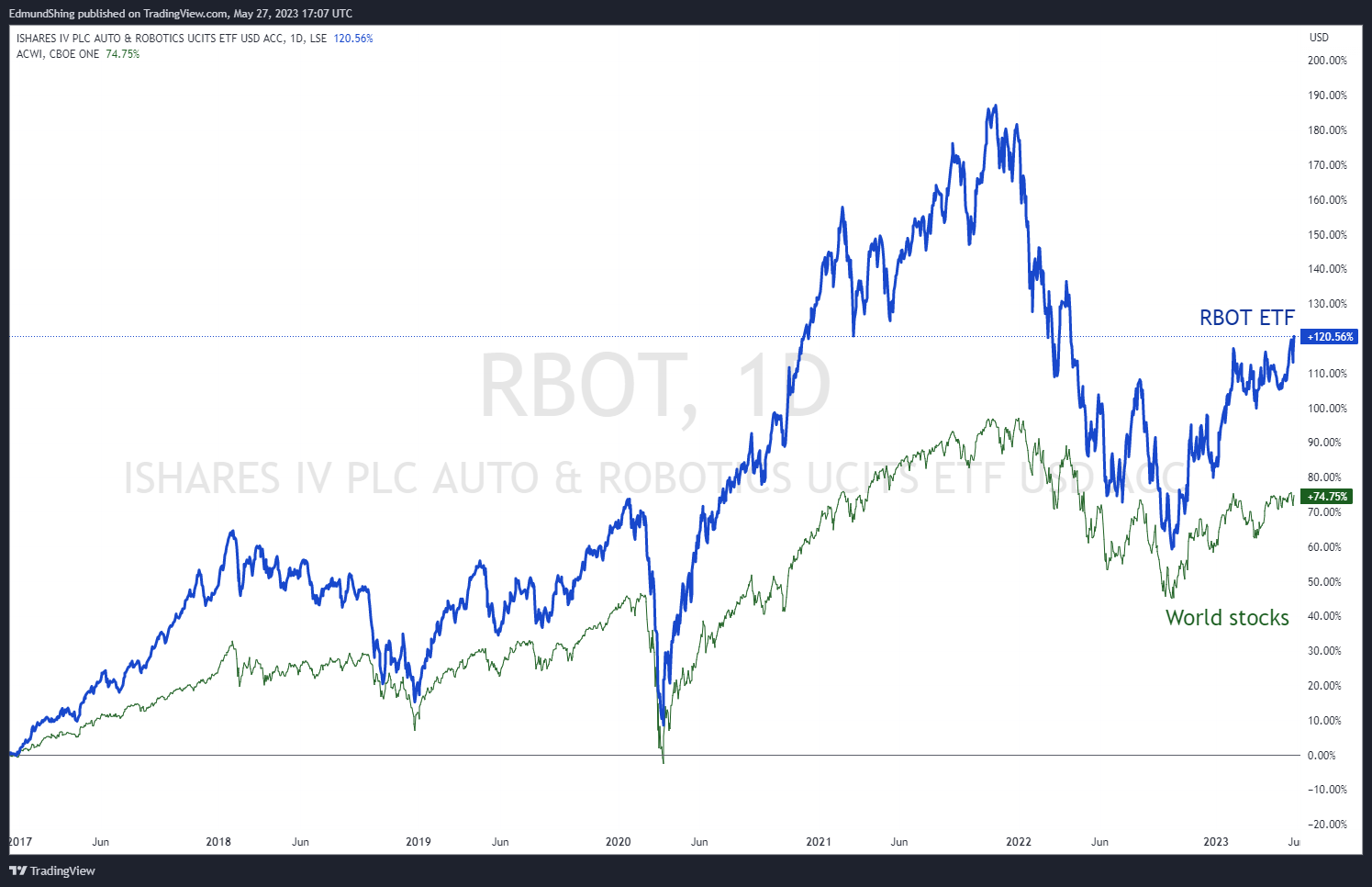
The iShares RBOT Automation & Robotics UCITS ETF is one such investing vehicle, which has performed pretty well since the beginning of 2020.
This contains exposure not only to Nvidia (the largest holding, but only a 2.25% weight) but also to a number of leading industrial automation and robotics companies based in the US (50% fund exposure), Japan (17% exposure) and Germany (6%).
RBOT iShares Auitomation & Robotics ETF (in USD)
RBOT ETF has outstripped global stocks over the last few years
Source: tradingview.com
Finally, what could the macro impact of AI really be?
The most significant impact of AI in the real world may be much more about “creative destruction” than benefit for certain mega-cap technology companies like Nvidia, Google or Microsoft.
Rather, the widespread application of AI and chatbots could mean the devaluation of a whole swathe of white collar office jobs which involve a lot of routine, repetitive tasks. Think of call centres, or junior lawyers drawing up and checking standard business contracts, or junior auditors for instance.
Just as previous waves of industrial innovation have allowed for the mass production of goods and for people to move away from working in agriculture as machinery and fertiliser use massively improved agricultural productivity over the decades, so a similar phenomenon may be seen in a number of service industries. We are already seeing the beginnings of the introduction of this trend in automatic voice recognition in call centres to better direct phone enquiries and even to answer simple queries without human intervention. We also see this in the widespread introduction of automated self check-out tills in supermarkets, which require a minimum of supervisory staff to handle problems and watch for fraud, as opposed to one cashier per manual till.
Ultimately, companies may be forced to adopt these technologies in order to simply remain competitive, if others in their industry are adopting AI and improving productivity and cutting costs are a result. Recall the story of Blockbuster, which did not change its business model quickly enough with the advent of Netflix video streaming, and went out of business as a result. Or the example of Nokia, which in the pre-iPhone era had a global smartphone market share of over 50% in early 2007. Today, it is zero, as in 2007 it decided to retain its proprietary Symbian operating system and did not adapt quickly enough to the rise of the iPhone with its iOS operating system, and the Android operating system.
Today economists worry about the surge in wage growth that we are experiencing in the US and Europe at present, at a time when unemployment rates are at or close to historic lows and when long-term illness and incapacity accounts for more and more of the working-age population. But if both manufacturing and service-sector companies really implement AI and machine learning software in their business models to its fullest potential over the next few years, then we could see the elimination of huge numbers of jobs as they exist today, potentially creating a wave of deflation in wages in these industries.
Of course, this technology will also lead to the creation of new types of jobs which could be based more on human creativity for instance, which AI may struggle to really replicate in the near term.
There is huge potential to improve the effectiveness of new drug discovery and of diagnostics in Healthcare, and also to accelerate the democratisation of affordable higher education and of learning of essential skills via AI-based teaching platforms. These are just two examples of industries that could see a huge acceleration in productivity as a result of AI technologies and techniques.
Have a great week
Edmund
Disclaimer
This is not financial advice. Our content is intended to be used and must be used for information and education purposes only. Please read our disclaimer and terms and conditions to understand our obligations.

18 comments
Here is another good explanation of Alphawave IP (LON:AWE) found on another Stocko thread
https://hakastocks.substack.com/p/alphawave-semi-a-data-center-play
Since return from suspension on May 22nd, I have built up a decent holding. It is the only new stock I have added to my portfolio in the past 4 years (NB excluding additions for sectoral reasons).
Three big advantages
a) There have been significant changes (acquisitions etc) in the past year which may not be reflected in estimates
b) It is hard to understand what exactly the company does
c) So far, it appears to be off the radar of most PIs.
The stock was brought to my attention by another member of the investment group in my area. He knows well both the company and its products.
That is an excellent summary, thank you!
Alphawave IP (LON:AWE) (I hold) is worthy of consideration in this space too…. It occupies an interesting niche in terms of connectivity. I have no wish to try and explain but for those interested there was an excellent link to a summary posted in comments by Stocko reader’ tonybyrne’ here:
https://www.stockopedia.com/co...
Thanks Edmund. Meticulous and insightful as always. I bought Nvidia a few years ago, purely because it had great momentum and looked like it had the potential to be 'disruptive'. To be controversial, I don't think the fundamentals are a key consideration for a company like Nvidia. The chart is a classic cup and handle in the making and I think it could go a lot higher. I do agree AI is in a bit of a bubble at present, but the top US technology stocks (Google, Apple, Microsoft & Nvidia) are likely to be market leaders for the next decade IMHO.
Courtesy FT Alphaville 11/09/19:
We’ll leave you with this, a quote from Sun Microsystem’s founder Scott McNealy. Having watched the stock of his company appreciate nearly 14-fold during the dotcom bubble, and then collapse 95% during the bust, McNealy was bemused that investors ever considered paying what now looks like a rather diminutive 10 times sales for the computer hardware company’s stock at its peak in 2000.
Why? This is what he told Businessweek in 2002:
(https://www.bloomberg.com/news...)
At 10 times revenues, to give you a 10-year payback, I have to pay you 100% of revenues for 10 straight years in dividends. That assumes I can get that by my shareholders. That assumes I have zero cost of goods sold, which is very hard for a computer company. That assumes zero expenses, which is really hard with 39,000 employees. That assumes I pay no taxes, which is very hard. And that assumes you pay no taxes on your dividends, which is kind of illegal. And that assumes with zero R&D for the next 10 years, I can maintain the current revenue run rate. Now, having done that, would any of you like to buy my stock at $64? Do you realise how ridiculous those basic assumptions are? You don’t need any transparency. You don’t need any footnotes. What were you thinking?
10 times sales…
Very good sir.
I must admit that the reason I invested in Nvidia a few years ago had little to do with AI. I invested because the company has an excellent ROCE which may well derive from its strong IP which has made it possible for the company to exploit a range of sectors including gaming and cryptocurrency. The hype over AI may well dissipate with a fall back in Nvidia's share price, but I would expect the company's ability to innovate will enable it to exploit other sectors which are not yet the focus of attention.
With all due respect, any article talking about AI that fails to mention Deepmind in London (owned by Alphabet) and their various AlphaGo Algorithm iterations is missing a key point. The AlphGo Zero is the closest thing we have to artificial general intelligence (AGI).
Super article Edmund.
Whilst I've never invested in Cathie Wood's Ark I do find some of Ark's videos insightful.
The video below is an Ark interview with Cerebras. They have an alternative approach to using Nvidia chips - interesting even if the video may be partly driven by Ark famously selling Nvidia last year. Still it's good to know Nvidia is by no means the only game in town....
I also like how Cathie Wood defines the characteristics of the winners in AI in the interview below...
I like Ms Wood's comment - economic statistics are both lagging and wrong. Look at what companies are reporting and not what the 'experts' are flouting. Maybe we need AI more than ever for the Worlds benefit and get rid of all these taxpayer funded numpties playing with spreadsheets all day long in between home working 'walking the dog'.
Nvidia was a great investment 6 months ago but is a much riskier one today, at least over horizons of a year or two. We may or may not be in a bubble - no one really knows - but the chances are that investors have overestimated the transformational qualities of AI in the short term. I do see remaining opportunities however outside bubbly semiconductors and big tech.
The coming AI world is going to produce ever increasing amounts of data that places ever growing demand on high power computer facilities. Moving the data around requires leading edge switching within data centres. I invest in Arista Networks which already controls 30% of the advanced switching market, worth $500m today but expected to increase 13-fold in the next 4 years.
Arista ran up hard when ChatGPT emerged, only to fall when they revealed an uninspiring recent quarter. However, the huge orders recently placed with Nvidia by the hyperscalers points toward strong momentum for Arista in the near future and the stock has run up to highs again. Even so, the valuation remains unintimidating to a tech investor - not cheap, but below its historical level, and WAY better value than Nvidia. It's a fairly volatile share so it might be worth looking for an entry.
Another opportunity where valuations are actually low is to invest in the providers of digital transformation consultancy. These have all suffered on macro worries but they will become essential partners for corporates to navigate their transition to an AI world. I hold a basket of these across the developed world.
Great common sense thanks. I've avoided ETF's on the basis of my superior stock picking skills, but as that was in my mind and not reality time to consider starting that journey. Mindful of not duplicating i.e. holding Shell etc and SPDR MSCI Europe Energy UCITS ETF (LON:ENGY).
Looking at Global X Telemedicine & Digital Hlth U ETF USD Dis (LON:EDOC) and Global X Robotics and AI UCITS ETF USD Acc (LON:BOTZ). Of course there are iShares, Wisdomtree, L&G etc and will review your older articles.
Have read that ChatGPT free use is not up-to-date, so presume huge upside when Microsoft (NSQ:MSFT) eventually sell the app or packages with their Office 360. Seems to have first mover advantage, but not going to chase higher, although 'ceilings' don't seem to apply in America (expect a boost next week but then what do I know). See China is now making their own airliner - the world is a changing.
Hi Harry. Please can you elaborate on your comment that "ChatGPT free use is not up-to-date, so presume huge upside when Microsoft (NSQ:MSFT) eventually sell the app or packages with their Office 360" I don't see any reason to expect a premium for being behind the curve. Or why anyone would pay to use it at all. Right now Google Bard is collecting data from the internet to give completely up to date information on the questions that are presented to it.
Other than 'nobody does something for nothing' I cannot answer. A simple 'google' search says:
ChatGPT vs Google BARD: What powers them? The key difference between ChatGPT and Google BARD stems from the Large Language Models (LLM) they employ. OpenAI's ChatGPT uses the Generative Pre-trained Transformer 4 (GPT-4), while Google BARD relies on its bespoke Language Model for Dialogue Applications (LaMDA).
Buffett says (or Munger) "if don't understand it don't invest" but who has that ability - you'd only invest in Tesco because you use it often and like it. Hence I'm a chartist - it goes up, it goes down - like the Old Grand Duke of York.
My point poorly worded was that 'data' becomes valuable - and who has the data. The NHS has shed loads but dysfunctional. YouGov (LON:YOU) it and of course the government (but don't seem to use it very well).
But on AI generally the old adage ' garbage in - garbage out'. No insights sorry just saw Edmunds post as no responders so opened the conversation - don't rely on me for investment advice.
I dislike Microsoft (NSQ:MSFT) due to history of PC crashes, resource hungry software, constant updates and authentications etc etc but there are not many CV's or powerpoint financial presentation that are not produced by their software - so suck it up of become irrelevant. The war with Alphabet (NSQ:GOOGL) will be one to watch, but sure they will be masters of the universe one day.
Unusual close correlation between RBOT (iShares) and BOTZ (Global X) ETF's.
Agreed Edmund
Nvidia share trade on 24x EV/sales.
To me, this looks nuts - especially given by 2030 Quantum Computing MAY have disrupted the GPU, CPU & chip market.
Investors don't just own today's profits, but every years.
Edmund, Statista's graph shows ChatGPT at just 5 days old, what the membership will look like in 6 months time? I've just completed re-reading Ed Croft's 'How to Make Money in Dividend Stocks' and now bought Stephen Wolfram's 'What is ChatGPT Doing.....' and am wondering if I could put the two together somehow. Thanks for such an interesting article, Silver
Thanks for the pointer to Wolfram's commentary on ChatGPT.
What I presume is an abridged version of the book you mention is available to read for free on his website, no purchase required. You still need to put aside a couple of hours, but very informative.
Whilst Wolfram has his own commercial interests, I don't think they intruded too much in the piece I was reading.