Marston's versus the coffee shops

According to the Campaign for Real Ale (CAMRA) 29 pubs are currently being closed a week across the UK. To provide support the UK government cut the beer tax for the third time in March. Marston’s strategy is to build new food-led pubs, increase the lodging rooms available and attract a broader demographic.
One of the most successful UK companies over the last 10 years has been Whitbread, which is the UK’s largest hospitality company. This is in no small part due to the growth of Costa Coffee with it now having 1,900 sites in the UK.
The CEO of Whitbread, Andy Harrison, has stated that: “People talk about the pub as a meeting point but pubs were more about males and the evening, coffee shops are [open] all day, more female [orientated] and certainly more family.”
A number of trends have supported coffee shops as social venues with one of these being the increased spending power of women. Increased online shopping has also freed up the weekend for people to meet up more.
Costa
Coffee: the UK’s largest coffee chain

Source: Google images
The British pub, meanwhile, has been in decline with one in five adults in the UK stating that they are teetotal in 2013. In 2004 the average UK person drank 9.51 liters of alcohol per year but in 2014 the figure was 7.76 liters – 18% lower.
British pubs have had to increase their focus on food to survive and also to up their game in coffee. They also need to attract a demographic beyond young males to include families, women and people in their forties and fifties.
This has been the strategy of pub group Marston’s and it appears to be slowly bearing fruit. The group’s average profit per pub has increased by 37% from 2012 to 2015 to reach £100k.
Marston’s sales in the financial year also rose by 7.4% to £846m and earnings per share increased by 10.3% to 12.9p. A sign of the improved business quality is that the return capital increased from 9.6% in 2010 to 10.8% in 2015.

Marston’s 101
Marston’s is a brewer, restaurant and pub group that was founded in 1834 by John Marston. The company is headquartered in Wolverhampton and its flagship beer brand is Marston’s pedigree, which is still brewed in oak casks.
Marston’s three divisions are Destination & Premium pubs, Taverns and Leased pubs. The focus of growth is on Destination & Premium pubs because these have a greater emphasis on food than pubs in the other divisions.
Destination pubs in operation generate 58% of their revenue from food while for the Premium pubs the figure is 28%. This is much higher than in Taverns where only 17% of revenue is generated from food.
Marston’s shifts to food led “restaurant-pubs”
Source: Marston’s investor presentation
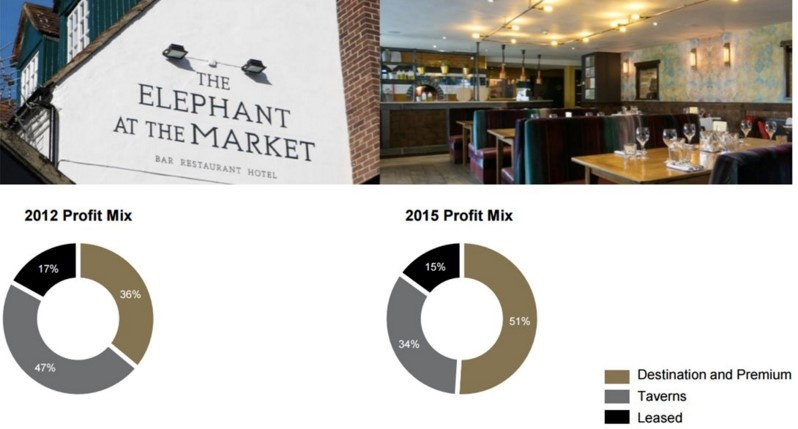
In 2015 the group’s Destination & Premium division generated 51% of operating profit versus only 36% in 2012. This growth has been due to the building of new restaurant-pubs and the disposal of Taverns and Leased pubs.
In 2013 the company had 349 Destination & Premium pubs but in 2015 this had increased to 397 managed pubs. The number of Taverns fell from 1,316 in 2013 to 859 in 2015 while the number of Leased pubs fell from 385 to 341.
Source: Marston’s investor presentation
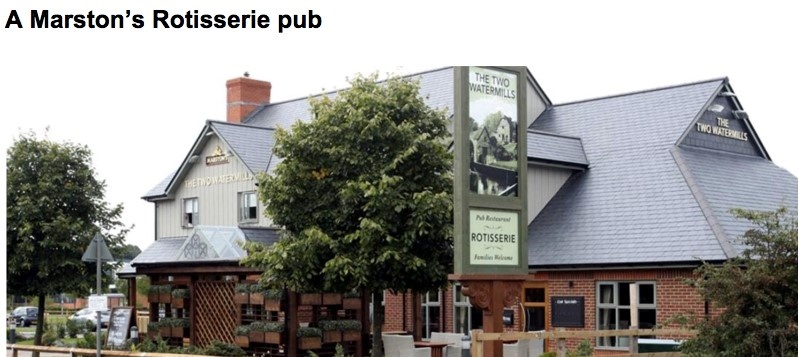
The group’s 360 Destination pubs operate under two Marston’s brands which are “Two for One” and “Rotisserie”. There are 37 Premium pubs with the two brands being Pitcher & Piano and Revere.
Taverns are described as “community pubs” that are “wet-led” and include tenancies, managed pubs and franchised pubs. The focus is to move these pubs towards the franchised model.
Strategy: New build pubs, lodges and beer
Set against the much-reported decline of the British pub it appears surprising, at first glance, that Marston’s is building new pubs. The current rate is 20-25 new build pubs a year along with 5 lodges a year.
However, the new pubs have a freehold return target of 13-15% and so help improve the group’s overall return on capital. They are also restaurant-pubs that target a broader demographic than traditional wet-led pubs.
The lodges (rooms attached to pubs) also provide another string to Marston’s bow. The group currently has 670 rooms sited at Destination pubs and 130 rooms at its Premium Revere pubs.
Marston’s lodges have performed well with occupancy at over 70% and revenue per available room up by over 12% in 2015. The group is hoping to open 40 new rooms per year with the shift taking Marston’s into the hotel market.
Marston’s financial position
Marston’s saw its net debt to EBITDA ratio come in at 5.1X at October 2015 versus 5.4X a year ago. This figure remains high but most of the outstanding debt is securitized against the group’s property.
The latest valuation for the property portfolio also saw a £54m increase in value due mainly to the new-build pubs. The net debt to EBITDA ratio should also fall over time as long-term debt amortizes.
In terms of the pension deficit and Marston’s has been able to reduce its annual cash contributions by £6m to £8m. This follows the 2014 triennial valuation which estimated that the pension deficit at £50m.
Summary and valuation
Marston’s appears to be doing the right things in terms of dragging the British pub into the 21st century. The traditional beer and young male led pub is likely to continue to decline given falling alcohol consumption in the UK.
Marston’s new restaurant-pubs have a more promising future given their broader demographic appeal. This should help withstand the coffee shop competition as Costa Coffee and other chains continue to expand.
The group’s expansion into accommodation also helps to diversify the business into accommodation. Marston’s beer business is another area of differentiation with recently acquired bands including Wainwright and Lancaster Bomber ales.
While Marston’s is not set to be a high growth business the forecast P/E for the current year to September 2016 is modest at 12X. This is expected to fall to 11.2X in the following year and then 10.6X for the year to September 2018.
As a relatively mature business the company offers a forecast yield of 4.4% for the current year. This is expected to increase to nearly 5% in the financial year to September 2018 and is forecast to be 1.9X covered by profits.
Like all businesses that compete for the leisure pound the challenge is to remain relevant to consumers. Marston’s investment in lodges, food-driven pubs and new build sites will help ensure punters continue to come through the door.
This
report was produced by Fat Prophets Senior Analyst, Andrew Latto.
Disclaimer
This is not financial advice. Our content is intended to be used and must be used for information and education purposes only. Please read our disclaimer and terms and conditions to understand our obligations.
4 comments
hmmm ................. so what happens when the minimum wage goes upto £9 ph I wonder?
Not sure, yes wage cost will go up but then these people will have more disposable income which they may spend more in the pub. Problem with beer is the price thanks to Gordon Brown with his tax escalator.
The other brewer to consider is Greene King.
In their recent announcement Marstons say;
"In April 2016, the National Living Wage will increase to £7.20 per hour for employees over 25. Approximately 60% of our people are under the age of 25 and we have previously indicated that the financial impact, compared to our existing plans, will be moderate. Our focus will centre on improving the quality of service to mitigate further the impact of the cost increase."
http://www.marstons.co.uk/docs/financials/mars-preliminary-results-26November2015.pdf
With Marstons the attraction is their improving business quality and scale combined with a hefty growing dividend. I hold and think mgt have a good strategic grip and are worth backing.
I agree that coffee is not good for dogs, fed him coffee beans for a week and he kept waking is up to poop