More AIM woes - investment trust wind-downs and forced selling

Last week, I wrote about the potential for changes in tax legislation to lead to significant outflows from UK small caps and, in particular, from the AIM market. We are likely already seeing those outflows because investors fear an immediate change in capital gains tax rates. What I missed when I wrote in the last article is that rumours over a lower tax-free sum for SIPPs may be driving short-term selling, too. With such investors liquidating 25% of their equity portfolio in short order to get the cash out, this will be generating significant selling pressure.
The impact is particularly high on AIM stocks since there is also a fear that the inheritance tax relief that some AIM shares enjoy may be removed or curtailed. Given that some estimates put the amount of money deployed in the strategy at over 30% of the AIM market capitalisation, this would greatly impact share prices. Ironically, it would hit the higher-quality, normally stable companies much harder than the speculative stocks.
Is AIM broken?
These fears have led some investors to avoid the AIM market altogether, particularly as the long-term performance of the average AIM stock, as measured by the AIM100 Index, is woeful. However, in normal times, I am index-agnostic. I prefer to use my investment experience, plus the Stockopedia tools, to avoid companies where management teams are not aligned with shareholders' interests. While it is rare to see outright untruths published, there is often no one checking the public statements of fully-listed companies. Whereas with AIM companies, a NOMAD will have signed off their announcements. This may not mean much, depending on an investor's view of a particular NOMAD. Still, it undoubtedly adds an extra level of scrutiny that may not be present for smaller main-market-listed companies. There may be plenty of companies listed on AIM that investors will want to avoid, but I see little reason to avoid a company simply because it happens to be listed on AIM.
It isn't just individual investors that have been net sellers of smaller companies recently, either. Many investment managers focused on smaller UK companies and have continued to see net outflows. Take Liontrust Asset Management (LON:LIO) , for example. Last week, they reported further net outflows of £1.1 billion for the three months ended 30 September 2024, of which £904m was redeemed from retail funds. Having looked more positive mid-year, The Investment Association reports that retail fund flows to equity funds slipped into negative territory again in July and August:
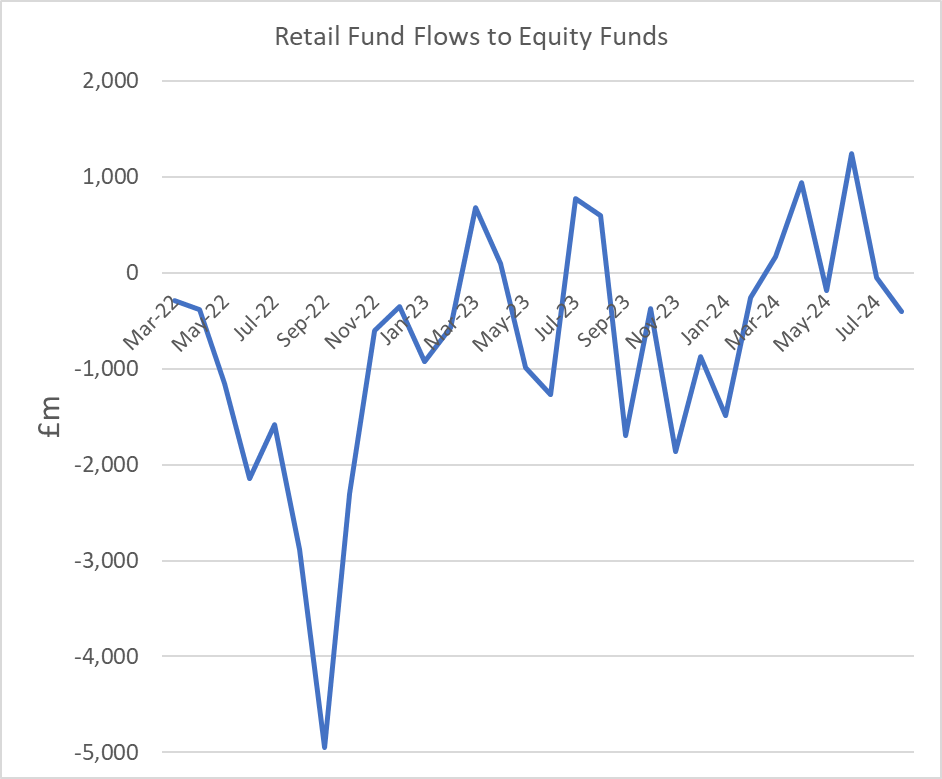
When open-ended funds face redemptions, these have to be met by selling the equities that form the assets of the fund, further adding to the woes.
The advantage of closed-end funds
One type of fund that is usually immune to being a forced seller is closed-end funds. In this case, the assets are held in trust and shares in the trust are listed on the stock exchange. When investors want their money back, they sell their shares in the market to other investors. The shares are free to trade at a discount or a premium to the published value of the holdings, depending on supply and demand. No money enters or leaves the fund in a normal investment transaction. However, the manager often can issue shares to new investors or buy back their shares like any listed company can. It is no coincidence that Warren Buffett's investment vehicle, Berkshire Hathaway, has a similar structure. No one can force Buffett to sell any of the assets held in Berkshire. This means that he is free to invest in the long term and has generated market-beating results for so long partly because the structure enables him to act countercyclically. Although closed-end funds are often started by a specific manager, technically, the trust is separate and appoints the manager. If the performance is poor, the trust can appoint a new manager.
The downsides of closed-end funds
There are some downsides with closed-end funds. Fees can be higher, particularly for smaller funds, and it can be harder for such funds to scale up. Investors are also exposed to the sentiment of other investors. When Mr. Market is optimistic, they can trade at a premium. When pessimistic, they can trade at a discount. One of the ways that closed-end funds can try to minimise the discount they trade on is to give shareholders an option for a period return of some or all of their capital at published NAV. The idea is that, by offering this option, those who wish to exit a fund have the liquidity they need and don't need to sell in the market. However, in poor markets or with a fund whose performance is weak, this can lead to a large number of redemption requests. Far more than the fund can redeem using its available liquidity.
When this happens, the fund is not usually legally required to meet these redemptions, but refusing to do so defeats the whole point of having this option in place. This announcement as part of Downing Strategic Micro-Cap Investment Trust (LON:DSM) 's 2023 Interim Results Statement nicely summarises what usually happens in this case:
Last year the board announced its intention to give shareholders the opportunity in May 2024 to opt for a subsequent return of 50% of their investment in the company. Since then, given the market's continuing undervaluation of both micro-cap stocks and small investment companies - demonstrated in part by the discount of your company's share price to NAV, the board has been considering what would be the best and fairest way to meet that commitment of returning capital to shareholders, realising best value for them equitably. It has concluded that it would advantage all shareholders equally and fairly to commence a managed wind down of the company's investment portfolio in an orderly manner.
In order to meet the mandate of treating all shareholders equally, the fund instead chooses to liquidate the portfolio in an orderly fashion and return the capital to shareholders. Here is the breakdown of the fund's holdings at the time of the announcement:
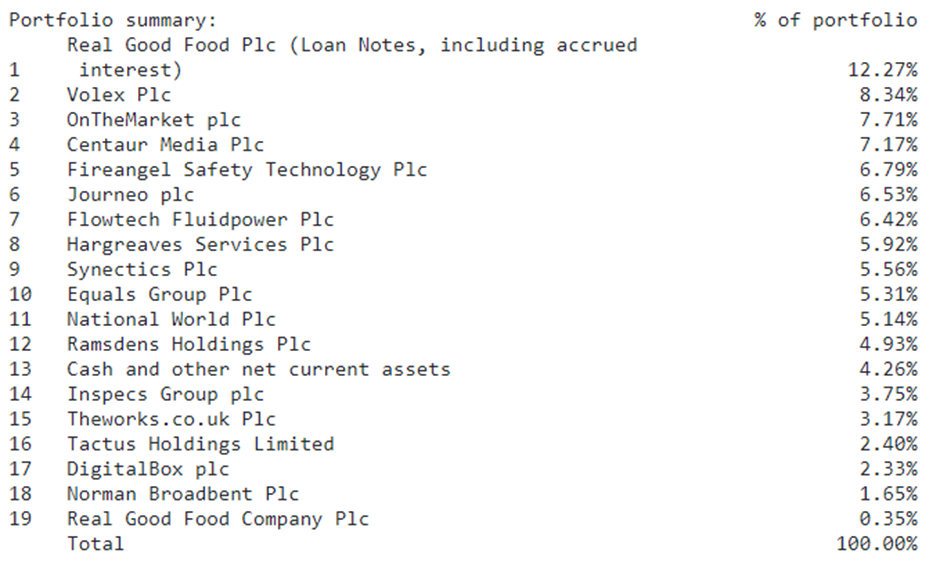
OnTheMarket and FireAngel had recently agreed to takeovers, and Real Good Food was about to appoint administrators. Tactus is unlisted. For the rest, we can roughly work out how much of each company Downing Strategic Micro-Cap Investment Trust (LON:DSM) owned since we can calculate the market cap at the time and the monetary amount of each holding:
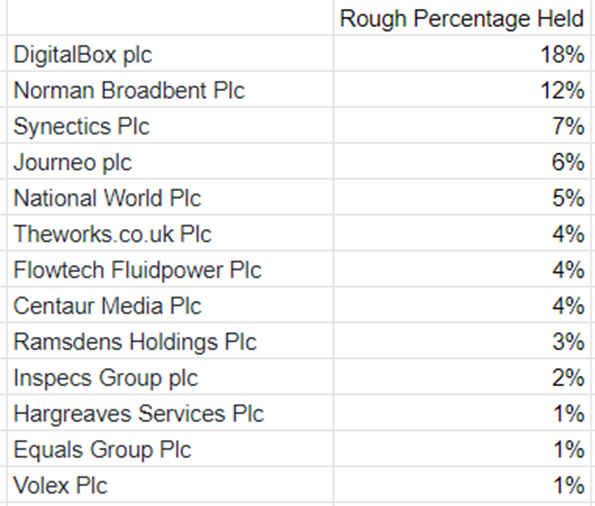
Selling positions such as Volex (LON:VLX) or Equals (LON:EQLS) will have been easy and will not have had a negative impact on the share prices. However, large stakes in illiquid companies are much harder to get rid of, and the market is aware of these overhangs. For example, National World (LON:NWOR) appears to have suffered from the weight of this overhang all year despite trading in line with expectations, which see the company growing earnings and trading on a P/E of less than 5. When the overhang cleared and Downing Strategic Micro-Cap Investment Trust (LON:DSM) sold the vast majority of their stake to Rockwood Strategic (LON:RKW) the shares rose around 20% (only to fall back down again recently, presumably due to budget concerns.)
Unsurprisingly, the remaining holdings are some of the most illiquid stocks. This is what the September factsheet shows:

Centaur Media (LON:CAU) was briefly being considered for acquisition by Private Equity. However, this did not lead to an offer, and their ability to offload this has not been helped by two major profits warnings:
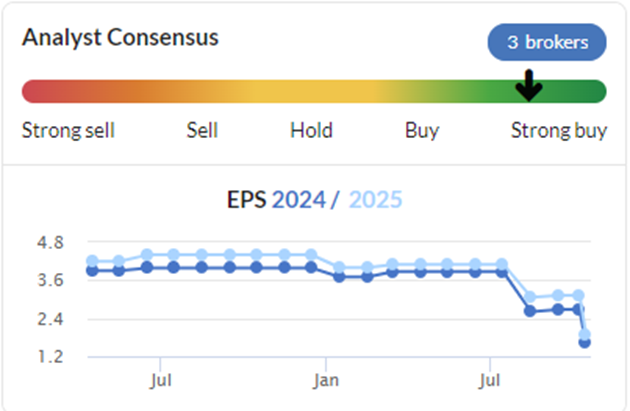
As with National World (LON:NWOR) , it would seem that Rockwood Strategic (LON:RKW) would be a natural buyer here. However, Harwood Capital already own 29%, making this impossible without forcing a mandatory offer:

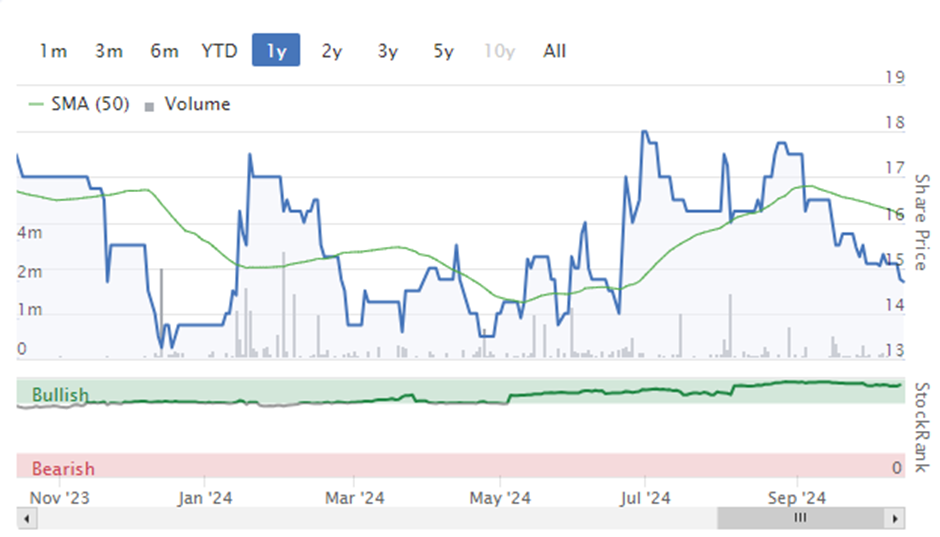
With Digitalbox (LON:DBOX) , I wouldn't be surprised if it is Downing who has forced the company to start a strategic review recently. Not many institutions are interested in investing in a company this size (hence the very cheap rating the company trades on), so the natural buyers are the company itself or connected parties. Presumably, any interested parties have been playing hardball on price, knowing that there is a lack of competition for a stake of this size. Equally, Downing knows this is worth much more than the current price suggests., leading to a stand-off. Whether they will get a significant premium through the strategic review in the current market climate remains to be seen.
Will this situation happen more?
It seems that in the current market climate, investors are likely to see more of these types of situations. Indeed, it appears that this may already be happening with another well-known microcap closed-end fund: Miton UK Microcap Trust (LON:MINI)
On 2 October, they made the following announcement:
Redemption of Ordinary Shares and Shareholder Engagement
The Company has an annual voluntary redemption facility through which shareholders are entitled to request the redemption of all or part of their holding of ordinary shares of 0.1 pence each ("Ordinary Shares"). The operation of the Redemption Facility is entirely at the discretion of the board of directors of the Company (the "Board"). The deadline for the 2024 Redemption Point was 1 October 2024.
The total number of Ordinary Shares in respect of which valid redemption requests were received for the 2024 Redemption Point was 31,083,534 (representing 40.4% of the issued ordinary share capital). A further announcement will be made shortly after the 2024 Redemption Point, being 5 November 2024, setting out the Redemption details.
The Board continues to believe that the Company will be able to generate attractive returns for shareholders in the future. In light of the level of redemption requests received, the Board will engage with shareholders over the coming weeks with regards to the future direction of the Company.
The following chart from their most recent factsheet demonstrates the problem:
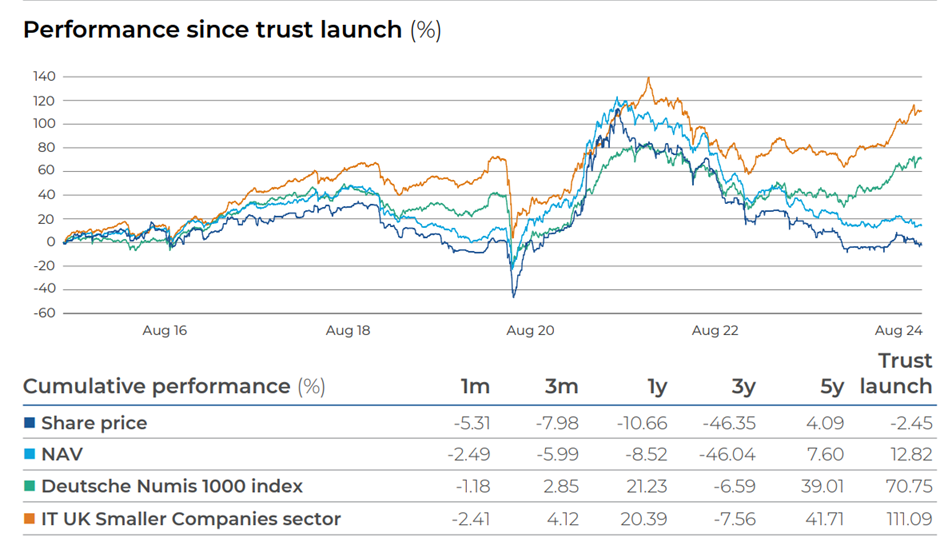
They simply haven't made money for investors since launch in 2015. Even the slight increase in NAV has been eaten by a widening discount. It is perhaps no surprise that some investors may have reached the end of their patience.
In the announcement, the company confirms that this redemption is discretionary, but clearly, it would be unwise to completely ignore a situation where over 40% of shares have requested redemption. It also seems that, in the current market climate, being able to sell 40% of their microcap holdings would not even be possible, let alone happen without moving the market price. The reality is that, at best, this redemption will need to be much smaller than this; at worst, this will lead to the orderly wind-down of the fund in a similar way to Downing Strategic Micro-Cap Investment Trust (LON:DSM) .
Although Miton UK Microcap Trust (LON:MINI) is much more diversified in its holdings than Downing Strategic Micro-Cap Investment Trust (LON:DSM) was, it has a similar challenge, as is highlighted by the following chart:
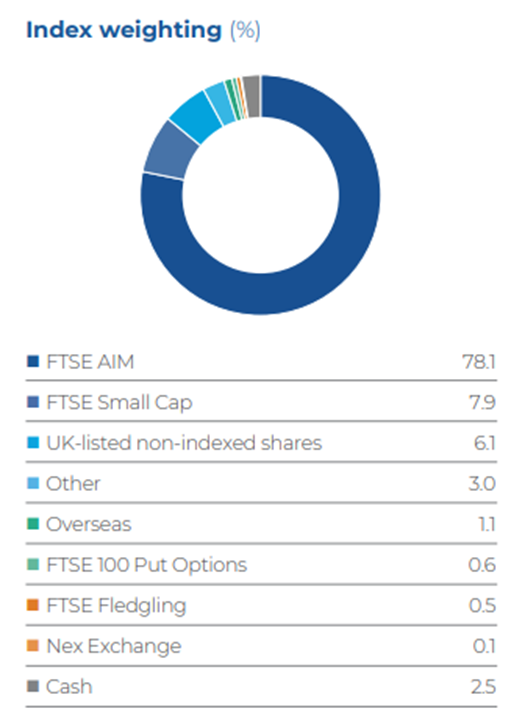
78% of the holdings are in AIM stocks, and we already know that this is where any change in Business Property Relief in the upcoming budget would have its biggest impact. Here are the top 20 holdings as of 31 August:
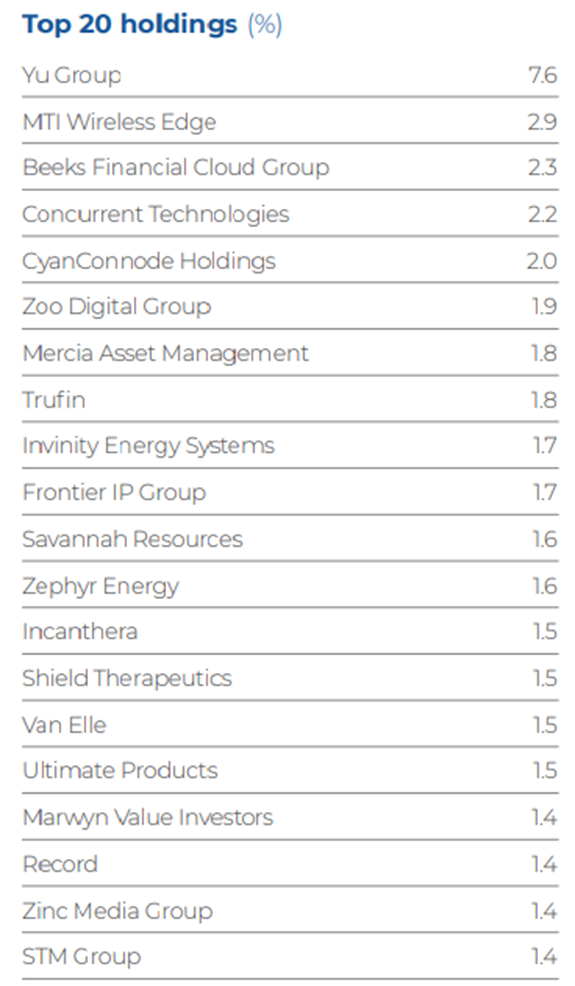
In general, this portfolio is full of small, similar-sized positions. The fact sheet says that it contains 143 holdings. The difference in position size appears to come mainly from running winners rather than an active bet on which stocks will perform best. So this is quite different from the structure of £DSM. In theory, this makes the impact of any selling less. However, the percentage held can vary quite a bit due to the different sizes of the investee company. One of the benefits of this roughly equal weighting is that the top 20 changes quite regularly as share prices change. Then, looking back through the last few fact sheets, I can get a more comprehensive view of the fund's larger positions. Using the same method as for Downing Strategic Micro-Cap Investment Trust (LON:DSM) , I can estimate the percentage of the investee company held by £MINI. This will be approximate due to rounding but gives a good idea of which companies might suffer in a period of extended selling due to wind down or the need to meet redemptions:
Approx % of company held |
|
Zinc Media Group |
3.7% |
MTI Wireless Edge |
3.3% |
Frontier IP Group |
3.3% |
Ingenta |
3.2% |
CyanConnode Holdings |
2.9% |
Incanthera |
1.8% |
Zoo Digital Group |
1.7% |
STM Group |
1.7% |
Trufin |
1.7% |
Serabi Gold |
1.7% |
Shield Therapeutics |
1.5% |
Van Elle |
1.4% |
TPX Impact Holdings |
1.3% |
Yu Group |
1.3% |
Andrada Mining |
1.2% |
CT Automotive |
1.2% |
Marwyn Value Investors |
1.1% |
Zephyr Energy |
1.0% |
Concurrent Technologies |
0.8% |
Invinity Energy Systems |
0.8% |
Savannah Resources |
0.8% |
Braemar |
0.7% |
Beeks Financial Cloud Group |
0.5% |
Ultimate Products |
0.5% |
Mercia Asset Management |
0.5% |
Record |
0.5% |
Capital Limited |
0.4% |
Amaroq Minerals |
0.3% |
Zotefoams |
0.2% |
Anything less than 1% is unlikely to move the market significantly. Still, some of the holdings, approaching 3%, are relatively illiquid, and any forced selling in these names could cause a significant price drop. It is worth noting that this is just 29 out of a possible 143 stocks and that if the company chose an orderly wind-down, £40m+ of selling in largely AIM stocks in an already weak and illiquid market, it could still have a big impact.
The other thing to consider regarding a forced seller is how likely other investors are to want to own the stock. When I looked at the AIM IHT funds, it was surprising to see the number of stocks which were High Flyers or even Falling Stars. The need to hold stocks long-term to get the (current) IHT exemption means that many were high-momentum stocks. Hence, any extended selling will see momentum investors joining the stampede for the door. With a lack of obvious value to support the price, the outcome could be a severe correction in these types of stocks. In the Downing Strategic Micro-Cap Investment Trust (LON:DSM) liquidation, at least the fund benefitted from many of their stocks being very cheap. Successful value-focused funds such as Rockwood Strategic (LON:RKW) were willing to take their stake in companies such as National World (LON:NWOR) as a block rather than selling in the market. With Miton UK Microcap Trust (LON:MINI) , the types of stocks vary significantly:
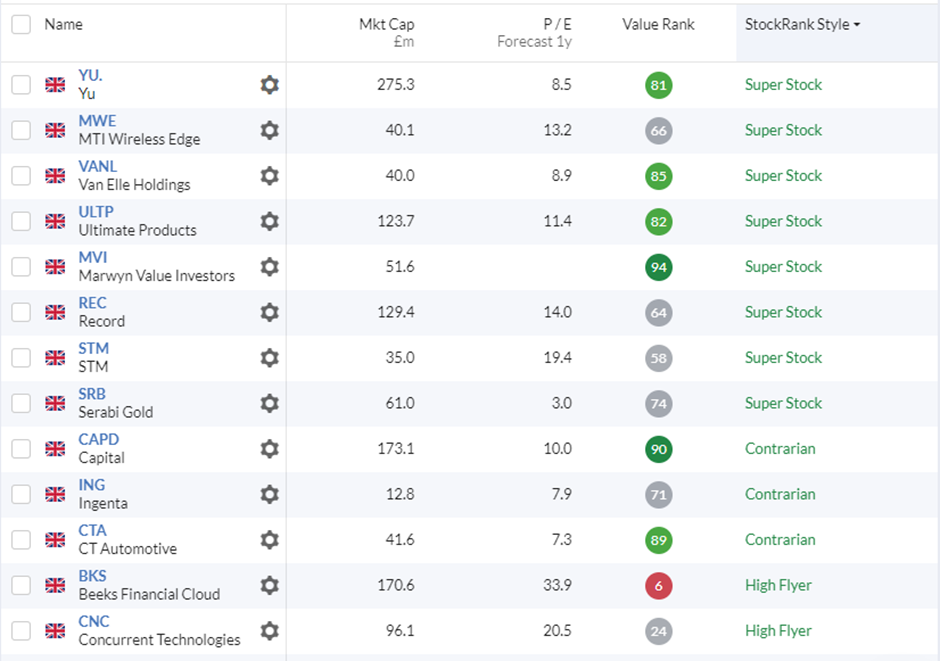
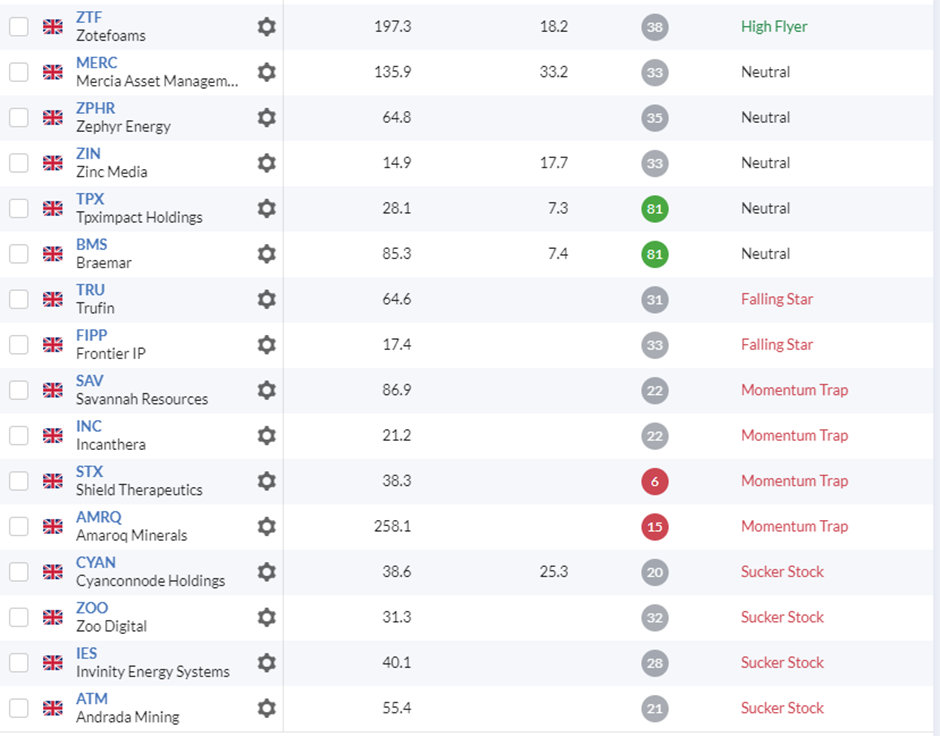
Many of the SuperStocks with decent Value Ranks, such as Ultimate Products (LON:ULTP) and Van Elle Holdings (LON:VANL) , will probably not struggle to attract an institutional buyer. However, the Falling Stars, Momentum Traps and Sucker Stocks could be a struggle to exit or sell down in the current market.
Conclusion
This can feel like another depressing tale of market woe. However, it is worth reminding ourselves that the wind-down of such funds and the (semi-)forced selling it generates has nothing to do with the fundamental value of the underlying businesses. The best investment returns often come from acting countercyclically, buying when there is blood on the streets, as the saying goes. Most of the time, severe market corrections occur in response to unpredictable external events affecting the sales and profits of companies. Those who bought stocks in March 2020, for example, were doing so in an environment where the pandemic was having a massive and unpredictable impact on the trading performance of most businesses. In contrast, apart from a bit of weak UK consumer sentiment, there has been no deterioration in UK companies' results. They are being sold off purely out of fear of future taxation plus any secondary effects of outflows from funds. For those with long-term horizons, the expected return from investing in UK equities has gone up, not down.
Even the long-term investor shouldn't completely ignore fund wind-downs, though. By looking into the details of the holdings, investors can understand which stocks are likely to be weak and why. They can take advantage of the situation when the time is right. For example, I recently purchased Digitalbox (LON:DBOX) National World (LON:NWOR) and Ramsdens Holdings (LON:RFX) at very low multiples of earnings due to the impact of the overhang of the Downing Strategic Micro-Cap Investment Trust (LON:DSM) wind-down. Downing Strategic Micro-Cap Investment Trust (LON:DSM) may have been the first microcap closed-end fund casualty, but it is unlikely to be the last. If Miton UK Microcap Trust (LON:MINI) ends up with a similar fate, I expect the opportunities to be less widespread, but it may still give investors a chance to pick up a bargain.
[Disclosure: Mark owns shares in Capital (LON:CAPD) Digitalbox (LON:DBOX) Ingenta (LON:ING) National World (LON:NWOR) Ramsdens Holdings (LON:RFX) Van Elle Holdings (LON:VANL) ]
Disclaimer
This is not financial advice. Our content is intended to be used and must be used for information and education purposes only. Please read our disclaimer and terms and conditions to understand our obligations.
29 comments
Mark an excellent ,well timed ,article. Thanks for investing so much of your time in fully researching this piece, as of course you do always .
Nice article Mark, as usual.
Contrast with Crystal Amber, also pushed into wind-down. They fought the pre-pack theft of Hurricane by the debt holders, and then refused to wind down until their last quoted holding, De La Rue, had a fair valuation. Which the sale of a division has just achieved.
I thought Judith at Downing had a similar activist approach, but I guess when the tide refuses to turn you just have to get out of the water.
Hi Jon,
Judith & team may yet wait to get a better price on the remaining holdings, but I think that goes with ongoing costs (some of which will be reduced by delisting), and there is the time value of letting investors have their money sooner. So, it will be a balancing act in reality.
Cheers,
Mark
Very interesting article, Mark. I just can’t fathom how a professional fund manager can end up with so much junk in their fund. Or, more importantly, how they can have so little conviction that they need to hold 143 different companies. What are they paid for?
And when you look at their performance it makes you wonder whether they shouldn’t hand back their the fees and wages as part of the redemption process! I know, unlike me, many round these parts consider fund managers like rock stars, but tbh I think Thom Yorke and Jonny Greenwood could do a better job than the vast majority of them. Or in the case of these funds, a monkey throwing darts.
I do wonder what some of these fund managers do - and what they are doing is perhaps responsible for the demise of actively managed collective investments.
A few months back, John Rosier (Investors Chronicle - Private Investors Diary) invested in Herald Investment Trust (LON:HRI) - decided out of interest to have a look.
This trust has over 300 holdings!
If nothing else you are creating a situation where you need more bodies to look after all those holdings and therefore increasing costs to pass on to the investors in your trust. But, equally, have they never heard of Diworsification, which much be a risk.
Bizarre/Strange/Worrying
And yet, they have comfortably outperformed the global smaller companies benchmark over 1, 3, 5 and 10 years Herald Investment Trust (LON:HRI)
It seems to me this commentary underplays the differences between good and bad investments in AIM companies which is part of Stocko’s purpose to highlight. The scare story doesn’t stack up imo, and serves more to point up the folly of putting all your eggs in someone else’s basket ie fund managers. Now if the new Govt put a full stop on share ISAs - equally illogical and disproportionately benefitting millionaires - then that would be different.
"ISAs - equally illogical and disproportionately benefitting millionaires"
How? The only reason there are ISA millionaires is because they were able to take a 20k annual contribution and invest wisely. They can't put there millions in to an ISA.
Maybe QUoz was thinking of SIPS contributions.
Your post reveals almost zero understanding of share ISAs. A lot of investors in share ISAs are small investors and often with limited funds to invest each year. These investors use ISAs to benefit from all capital gains being tax free and also all dividends are also tax free.
Investors can only invest a maximum of £20000 in shar ISAs each year, and there will be many small investors (including this one) who either can’t afford to invest new money each year, or who eventually become wealthy by investing the full ISA allowance every year, along with investing that money successfully. That’s how John Lee became the first ISA millionaire.
Best perhaps to check if your opinions are sensible before posting them?
Best perhaps to check if your opinions are sensible before posting them?
Hi ken
Although you might disagree with their opinions I don't think Quoz Zouq's point is unreasonable. It's important to remember that the government doesn't provide tax breaks on ISAs out of the goodness of their happy little hearts, but to incentivise people to save. Incentivising millionaires to save isn't really the point.
As John Lee himself noted in a recent IC podcast, the £20,000 per year tax break on ISA's is extraordinarily generous and can only really be fully utilised by people who are already wealthy, which is surely not the point of a generalised tax break intended to incentivise saving for the masses?
There's certainly justification for addressing this while trying to find ways of encouraging less wealthy people to invest in stocks and shares at a young age. The ridiculous Cash ISA should be scrapped for a start. I can also see no justification for the UK government incentivising people to buy shares in non-UK companies, I think ISAs should be for UK quoted companies only.
I wouldn't be surprised to see the annual ISA allowance reduced and possibly a lifetime allowance introduced in the upcoming Autumn Statement. At the very least there needs to a significant simplification of the entire ISA structure.
timarr
Hi timarr
Thanks for the (as always) well argued reply. If I was too harsh about Quog Zuog’s post it was because of the apparent suggestion to get rid of all share ISAs. That would be a terrible mistake. Obviously there are rich people who have invested the full allowance every year and combined that with being competent investors who I agree are getting excessive tax free benefits. But there are a lot of ordinary non wealthy investors who deserve their share ISA tax breaks.
I agree with you about those ridiculous cash ISAs and that only UK shares should be allowed in share ISAs as long as Investment Trusts that allow us to invest worldwide and in more obscure areas are still allowed. By limiting ISAs to UK only it would encourage more investment in UK Companies where so many quality shares are ludicrously cheap but have been for so long. E.g like Aviva (LON:AV.) Legal & General (LON:LGEN) M&G (LON:MNG) Phoenix group (LON:PHNX) where the huge up to 10% dividends that they are in some cases increasing every year reflect that share price undervaluation. And why so cheap for so long? Because so many either invest in the booming US markets or in the case of Pension Funds avoid investing in the UK. No wonder UK shares have underperformed.
And I agree again that it’s not unreasonable to reduce that generous £20000 a year annual allowance nor to introduce a lifetime allowance. It’s surprising that this hasn’t already happened and the fact that it hasn’t might be because so many including politicians and their advisers and commentators seem so clueless when it comes to investments. That reflects the lack of any such education. A lot of the rich appear to rely on their financial advisers.
Quite a complex discussion and important to recognise that many people have chosen to use iSAs to save for retirement rather than a conventional pension.
If someone has lumpy earnings, they may not be able to contribute the full amount (20k) to an iSA each year but would welcome the opportunity to contribute 20k in a good year.
I dont have any fixed views on whether foreign shares shuld be included in ISAs - though there is the concern that restricting ISA investment choice might drive up costs on the various investment platforms which have come to rely on this ISA volume.
If the Government wishes to promote interest in the UK stockmarket - thats fine. it should do so in a positive manner rather than reducing the options for investing abroad. Interesting to see what (if anything) is announced in the budget.
Hi Ken, £20000 is only half a new car and this amount has not kept apace of inflation. Though having just my pensions meaning I can't save much these days I am bed & ISA-ing shares from my trading account each April. The time is coming when I won't have anything left in my trading acount but doing this will help me on the way to becoming an ISA Millionaire ;-)
Nothing wrong with the share ISA timarr, it's the games the Banks play with cash ISA's.
ISAS are pretty useless to millionaires. If one only has £1mn in cash / investments £20k is just 2% of that. It takes decades of adding money to get to meaningful amount added. To make a meaningful difference to a millionaire they would have to find consecutive multi-baggers, which is difficult. Long run equity returns are circa 8%/y. On the other hand a person with modest means can shelter a significant proportion of their wealth.
It's cash ISAs that need banning as when one looks at the interest rate offered the delta between those an rates outside tax shelters ends up greater than the tax saving for a standard rate income tax payer.
My ISA is pretty useful . Loaded with much denigrated AIM shares many eligible for IHT relief, amongst others. Sometimes you just have to take a societal view, and in my opinion they should be capped. The chancellor clearly disagrees and I bow to her superior wisdom. Thank you very much.
Reading this today after watching Ed Croft and Megan Boxall's webinar yesterday I can see that Mark was on the same page regarding Stocko Styles; "When I looked at the AIM IHT funds, it was surprising to see the number of stocks which were High Flyers or even Falling Stars". I was convinced by the webinar that I must run through my portfolio, which is on the risky side, to see how many investments should be moved away from thses styles.
Edit: It's Thursday and I have done my Styles Survey. As a result I sold Centamin (LON:CEY) and have picked out two Hi-Flyers in my portfolio to add, BAE Systems (LON:BA.) Rolls-Royce Holdings (LON:RR.) . I have more Contrarians than anything else on the wrong side of Falling Stars but then, an ex-Bonnevlle rider is a risk-taker!
Applause, v. helpful, genius analysis, typical of Mark Simpson.
Sold a chunk of MINI in 2021 at 95p. It spiked then.
Recently bought back a chunk which now under water. Was looking to buy more but better to chase individual shares on the basis of this article. Or maybe play the discount narrowing on run-off. That served me well on DSM with a stonking pay-out this summer, mostly covering the loss on the rump.
Faith in Gervais Williams' abilities but he cannot move the market.
Good article thank you. Just to highlight AIM managers not selling positions has little to do with IHT rules (if you reinvest the proceeds you don't restart the IHT clock) and more to do with the larger players' size which leads to inertia.
Thanks Mark, another good and thought-provoking article.
I'm currently in JNEO, BKS, RFX for the divi and YU.
I have noticed volatility and a sell-off in Beeks Financial Cloud (LON:BKS) . After a good set of final results and a meeting with the team, the shares shot back up and then shortly afterwards back down again and once more it seems to be on the up again. I won't be selling this one either, even though it might be overpriced (for now);
Certainly interesting and challenging times ahead that's for sure
A further worry for those invested in AIM stocks could be the that CGT may be changed so that it is no longer forgiven on death. Though it is not levied solely on AIM stocks , it could affect AIM as a group because many would have bought these stocks for their IHT benefits and holders could be sitting on substantial gains. I would suggest that this could be as big a worry for some holders as the withdrawal of IHT relief. The government could do both ie charge CGT on death and remove Inheritance tax relief, which could result in huge unexpected tax liabilities (he shudders).
Another fabulous piece of analysis, Mark. Thank you.
It'll be worth tracking these shares to see how they perform after the IHT positions are unwound. Like you, I suspect there'll be bargains - specially if the expected IHT clampdown doesn't materialise in the way many have assumed.
Very good piece Mark, thought provoking stuff.
Double whammy potentially to hit shares.
What to do is the question??
Helpful to know what may be affected the most, i hold one or two...
Hi JohnDoe,
It is always tricky to know what to do in these situations, as we don't know the future with budget details or whether Miton UK Microcap Trust (LON:MINI) will wind down, nor do we know how much of these possibilities have already been priced by the market.
Personally, I tend to think in terms of valuation, so if it doesn't change the valuation, I don't tend to react with existing holdings. Although it helps that I own very few high flyers, which are most susceptible to the double-whammy of tax selling and then momentum buyers quickly becoming momentum sellers in response to that price action. However, with new holdings or where I am underweight, I tend to be much slower at topping up when I know a potential overhang may be on its way. Hopefully, this gets the balance right, but we won't know until the future happens!
Cheers,
Mark
Miton UK Microcap Trust (LON:MINI) The Grand ol Duke of York he marched them up to the top of the hill and marched them down again - and when they were up (a bit) and when they were down (a lot) then the only way was down.
Do remember an article on the managers long time ago, and hope they keep the 'chin up' and remember "all that glitters is not gold".
Thanks Mark for an excellent article and thanks to the community for so many interesting comments.
JD2378, you ask what to do. FWIW, I have done two things:
1. Reassessed my portfolio to highlight anything not in the HighFlyer or SuperStock categories for a further rodding
2. Applied the intrinsic value idea outlined by BnB in excellent piece on 12/10/24. Again throws up some holdings needing further reconsideration.
Apart from some actions (not many am pleased to say!) as result of the above, I am content that what I have Is basically sound so am sitting on my hands.
Mark
Excellent piece Mark, thank you.
Surprised how much junk is in the MINI fund, there won't be any buyers for half of the stocks there.
Still you've given us some homework to be getting on with, some cut price MTI Wireless Edge (LON:MWE) is the first one to pop out at me.....hopefully a few others in there as well.