Multi-bag or bust? RTN, MAB, RBG, and OTB

My usual targets are high quality companies that are aligned with shareholders, because these can be compounding investments. This is the best kind of long term portfolio to build but right now I feel like there could be some pretty exceptional investment opportunities out there that justify a widening of the remit...
There is a long way to go in this lockdown, with a great deal of uncertainty remaining even though we are seeing early signs of peaking curves. The stock markets have rallied, but there is still plenty to play for. The Government must balance the length of the lockdown against its economic impact.
Amid the daily news flow of dividend cuts, equity placings, and administrations, it is possible to pick a profitable path. This lockdown isn’t happening in a vacuum. Companies are pulling out all the stops to survive and I feel that the majority of those that were good operators before the lockdown will remain good operators after the lockdown.
The downside risks to investors in this market are clear, however: the really big opportunities right now carry with them the risk of permanent capital loss. So pick wisely and understand your risk exposure. The shares I look at below pretty much all carry the risk of permanent loss of capital… But if they pull through they could be extremely lucrative investments.
Last week Restaurant Group’s shares jumped by more than 40% in a single day. Revolution’s shares are up 20% today. When all is said and done and we look back with the benefit of hindsight, the big winners will have come from the areas most at risk. I think it is worth covering these opportunities.
How long does a lockdown last? And how long is a piece of string?
Wuhan is tentatively coming back to life, with a lockdown period of 76 days. Italy’s lockdown began on 09 March, meaning it has been in effect for a month so far. France’s lockdown began on 17 March. The UK’s started on 23 March.

Bear, base and best cases
Assuming a ten-week lockdown seems like a pretty reasonable base case if we take Wuhan as the precedent.
Given the body language and rhetoric of various experts, I do not think the best case will be significantly better. We will be in lockdown for at least another month or so, on top of the three weeks we have already sat through. Call it seven weeks total as the best case.
The bear case, on the other hand, could be significantly worse. We just don’t know. For now, let’s assume the worst case scenario is six months (c180 days) of this lockdown we have all come to know and love so well.
A couple of weeks ago we talked about the increasing likelihood of significant equity placings at lower share prices. It looks like that is now what is happening. I’ll explore this theme more in another article, but suffice to say companies are wise to raise capital and deepen liquidity buffers - and to do it early, while there is appetite.
If, in three months’ time, we are still in a position where companies must plan for a sustained lockdown, then share prices will most likely be lower than they are now.
Given the lockdown assumptions above, how do some of the hardest-hit companies fare?
Restaurant Group
FY19 share price: 166p
Today’s share price: 58p (-65%)
Market cap: £295m
Monthly costs: c£3m - c£5m
Liquidity headroom: £219m
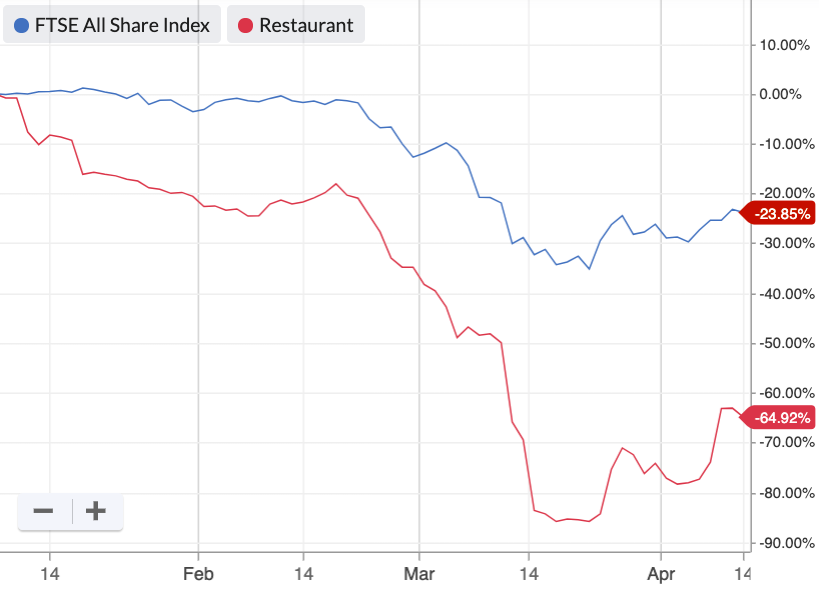
Back on the 19th of March, Restaurant (LON:RTN) said it was “consider[ing] its funding options, both equity and debt, on an ongoing basis.” Last week the group got away a significant placing after market hours. The whole thing must have leaked like a sieve because the group’s share price jumped by some 41% before the RNS. Funny that.
Say what you like about the fundamental quality of Restaurant Group’s dining brands but, placing aside, I have been impressed with the group’s decisive actions and informative communications over the past few weeks.
In fact, this lockdown has sparked RTN into action and has accelerated a number of key long term strategic decisions. RTN has raised £57m of cash and is ditching two struggling brands (Chiquito’s and Food and Fuel), with a third of its bloated 600-strong estate earmarked for closure.
Perhaps the group really can emerge from this period as a better business?
On 08.04.2020 RTN further updated the market post-placing, saying: “In light of the rapidly changing developments regarding Covid-19, we have modelled a pessimistic scenario for the current financial year…”
The assumptions:
- All units closed until end of June (99 day lockdown)
- phased reopening of through July to December 2020
- Around 400 of its 600 restaurants and pubs open by the end of 2020
- An overall decline in Group total sales of c. 50% in FY2020 (assumed down 60% in the first half and c. 45% in the second half (with Q3 down 60% and Q4 down 30%).
The company is also working on preserving cash:
- capital expenditure has been reduced to no more than £30m for FY2020,
- costs have been reduced to a minimum and ongoing cash expenditure is now only c. £3m per month,
- Staff have been furloughed and included the business rates holiday for three quarters of 2020,
- Food and Fuel and Chiquito have been placed into administration, and
- the Group continues to work with landlords.
The group adds:
Under this scenario, we forecast a minimum of £60m of cash liquidity throughout the remainder of the 2020 financial year. The Group believes that in the event that all our restaurants and pubs are shut down for a period in excess of that assumed in this scenario, then the adverse impact on cash would be no more than £5m for each further month of complete closure plus the cost of furloughing employees.
Here’s a stab how this all plays out using RTN’s assumptions:
HY18 | FY18 | HY19 | FY19 | Lockdown assumptions | FY20 | |
Revenue | 686 | 1073 | -50.00% | 537 | ||
COGS | 603 | 944 | Reduced capex, rates, rent | |||
Adjusted gross profit | 83 | 129 | 65 | |||
Adjusted gross margin | 12% | 12% | 12% | |||
EBITDA | 88 | 137 | ||||
D&A | 33 | 46 | ||||
Adjusted operating profit | 55 | 91 | 46 | |||
Adjusted operating margin | 8% | 8% | 8% | |||
Adjusted PBT | 53 | 75 | 37 | |||
Adjusted PBT margin | 8% | 7% | 7% | |||
Cash and equivalents | 7 | 66 | 32 | 32 | +£57m from share placing | 89 |
Borrowings | 29 | 354 | 346 | 346 | 309 |
This very rough take, which essentially consists of halving FY19 revenue and then applying a mix of FY18 and FY19 margins, seems to come out at roughly RTN’s own estimates. It’s probably a bit generous as it doesn’t include the cash costs of the zero-revenue period.
Nevertheless, this does show that a group like RTN can survive the base case assumption of a Wuhan-level lockdown.
What’s more, the RTN of today is looking like a different proposition to the RTN of just a month ago. It has an extra c£50m of cash and the lockdown is sparking a dramatic improvement in the quality of the group’s estate, with 200 of the group’s 600 sites set to be closed.
The remaining 400 units will be led by Wagamama (c145), pubs (c75) and Concessions (c45), with the remainder being Frankie & Benny’s and some leftover Chiquito’s and Food and Fuel. This is a high risk : high reward proposition, but everything has its price. I would want to do quite a lot more digging before I decided to jump in here, though.
Mitchells & Butlers
FY19 share price: 457p
Today’s share price: 205p (-55%)
Market cap: £955m
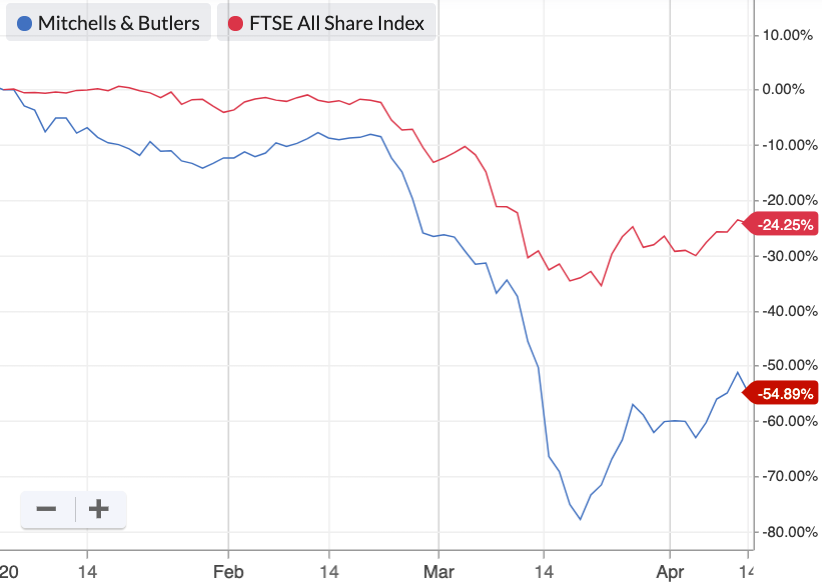
Mitchells & Butlers (LON:MAB) has updated on the covid-19 situation saying ‘all sites have now been closed for over three weeks, and a number of actions have been taken to reduce our cost base.’
Some 99% of its workforce has been put on furlough ‘with basic pay for all employees including the Board reduced to between 60% and 80%, depending on seniority’. Operating costs have been cut and discretionary capital expenditure projects have been stopped.
MAB’s ‘cessation of trade’ covenants - whereby a company (and most companies that have securitisations) will be in technical breach if they do not trade for 30 days or more - are a concern. The group has agreed a temporary waiver until 15th May on this front, though, which sets a precedent for other pub, bar and restaurant companies with similar debt structures.
M&B concludes ‘the group has material cash resources which we believe should be sufficient to fund obligations well into the second half of the year.’
The group has c£4.5bn of freehold property against c£1.7bn of total debt. It has been operating for more than a century. I would back it to pull through, although this is certainly going to be a bumpy ride.
One key point to investigate further is who are this group’s bondholders? In times like these, the latter always trumps equity. Shareholders can quickly realise certain bondholders are absolute sharks - they might not particularly care about looking charitable if they can smell a profit.
Revolution Bars
FY19 share price: 81p
Today’s share price: 18.3p (-77%)
Market cap: £7.7m
Monthly costs: c£1.5m
Liquidity headroom: c£12m
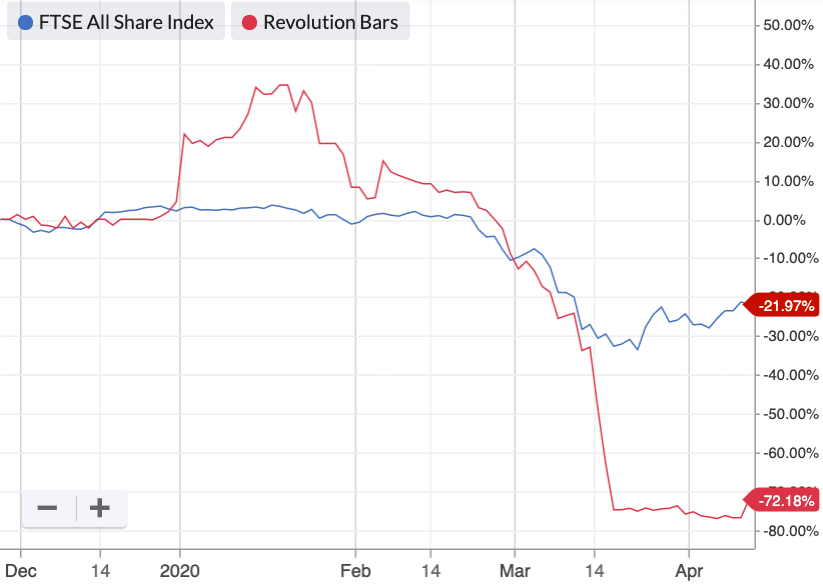
Revolution Bars (LON:RBG) is the highest risk : reward company in this set. It looks like, even accounting for today’s announcement, the group is just about hanging on.
It has updated saying that it has furloughed 98% of its workforce. The company says the board has taken 50% pay cuts and negotiations with landlords regarding rent relief is ongoing. All capital expenditure has been cut.
RBG says ‘these measures have significantly reduced the Group's weekly running costs to approximately £0.4m per week and management continues to seek further cost reduction opportunities.’
Regarding debt, RBG says it is ‘pleased to announce that, subject to final documentation, Natwest has agreed to increase the Facility to £30.0m until 31 August 2020, following which it will step down to £24.0m as the Group begins to benefit from its normal positive working capital cycle following an assumed recommencement of trade in July 2020.’
With about £12m of headroom (RBG has net bank debt of c£18m and a £30m limit) and monthly running costs of c£1.5m, I think it’s possible that more needs to be done at RBG to ensure it has enough liquidity to navigate this lockdown. It might just about have enough, but it will be close.
At today’s extremely depressed prices, it is worth monitoring as there is a chance of this happening. Lenders have already shown goodwill in extending facilities and waiving covenants so far. This is only for those with a very high risk tolerance, though.
On the Beach
FY19 share price: 487p
Today’s share price: 259p (-47%)
Monthly cash costs: £2m
Liquidity headroom: c£50m
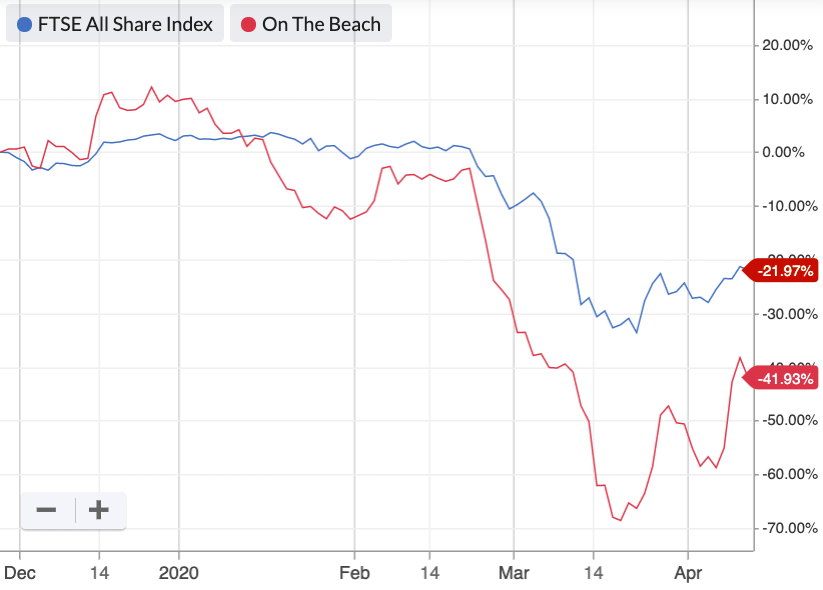
On The Beach is best positioned to survive this lockdown. It has an asset light, flexible, no inventory risk model and has no fixed commitments on hotel rooms or airplane seats. The group elaborates:
A tour operator or airline will generally have an almost immovable committed inventory cost (aircraft and/or hotels) and infrastructure cost of 60-70% of its aspirational total sales (transaction value) with or without any demand. An online travel agent like OTB without any inventory commitment only incurs inventory costs on each sale made and under normal conditions will have an underlying operating cost of approximately 8% of sales of which almost 70% is flexible marketing spend. If demand falls away completely then the fixed cost base will drop to c.3% of aspirational sales (or one twentieth of the costs of a similar sized asset heavy operator).
OTB is also the only listed UK travel business that operates a fully ringfenced customer trust account. Unlike the majority of online travel agents, tour operators and airlines, OTB does not rely on cash received for forward bookings to trade.
Monthly cash costs are now less than £2m across the entire Group and OTB has renewed its bank RCF to provide up to £50m of liquidity. At the last balance sheet date (September 30th 2019), the group had a net cash position of £55m.
Stress Test
OTB runs a helpful theoretical stress tests in its recent COVID update. The assumptions are prudent:
- No bookings until the end of September 2020 across the travel industry for travel on any dates in the future;
- All flight programmes would be cancelled until the end of September 2020;
- All forward bookings until the end of September 2020 would therefore have to be cancelled and all customers refunded;
- Although bookings would return slowly once airspace reopens, bookings would remain at a significantly reduced level YOY until at least the end of March 2021 (H1 FY21).
In this event, OTB would end H1 FY21 “with only a limited drawdown of its facilities and significant headroom” which would “allow the Group to take advantage of the multitude of opportunities that these market conditions would present.”
Given OTB’s asset-light model, clear communication, and prudent modelling assumptions, I am minded to think this is one company well-placed to wait out the storm. With fixed costs of less than £2m per month and ringfenced cash, there is a fair chance of OTB’s share price reverting to historic levels over the next three years.
Conclusion
Spending time trying to figure out how certain Leisure companies might weather this almighty storm is time well spent.
Some will survive, and who knows where their share prices might end up in the coming months? There is certainly an argument for the more risk tolerant among us to be bold in these exceptional conditions.
Of the stocks listed above, OTB strikes me as best placed to survive. Not only that, management appears to have one eye on capitalising on conditions. It also models the longest lockdown (or at least, grounded flights) up until the end of September, which would be some 191 days - longer than my bear case scenario mentioned above.
Restaurant Group is changing quickly as an investment proposition. I have typically been bearish on this company but I am ready to revise my opinion should further research warrant it. It models a 99-day lockdown until the end of June, as does Revolution.
As for Revolution - this strikes me as the highest risk : reward of the bunch. With a market cap of just £7.7m, it is priced at a fraction of historic annual sales. If it can survive and recover, it could tenbag and then some. For now, it remains extremely high risk even with today’s new measures.
For both Mitchells & Butlers and Marston's (not included in this article, but with similar operations and debt structure), further investigation into just how supportive bondholders will be for the inevitable upcoming waivers is a key point.
The option of not going anywhere near this sector for the foreseeable future is, of course, valid. For those with a higher risk tolerance, though, taking a dispassionate and clear-headed look at some of the companies listed above could lead to some promising contrarian recovery opportunities.
Disclaimer
This is not financial advice. Our content is intended to be used and must be used for information and education purposes only. Please read our disclaimer and terms and conditions to understand our obligations.

18 comments
A very good analysis. However, much seems to rest on a return to the status quo in terms of consumer behaviour when the lockdown ends. But this may not be the case. I would suggest that the longer this lockdown continues, the more likely that attitudes and behaviour will change. For example, drinking alcohol at home rather than in bars may become more prevalent. From what I can understand, changing an environment is often a good cue for changing a habit. With people spending more time at home, there could be profound changes in how they spend their money. The most obvious example is the more widespread adoption of digital commerce. Maybe people will opt for food delivery services and choose a type of restaurant experience at home.
There now seems to be a wide selection of “Bargain” stocks available. But their success is largely predicated on a reversion to the mean in terms of consumer/client behaviour. It’s quite possible that there is a huge amount of pent-up demand and it will be business as usual but I would prefer to see that happen before investing. It may mean that I miss some of the upside but it also probably means that I will miss the downside and that could be 100%.
Another great article Jack, again providing an interesting and informative read.
There is of course another aspect to this which is looking from the position of existing holder which needs a subtly different analysis to that of taking a chance on a multi-bagger.
As posted previously I hold Mitchells & Butlers (LON:MAB) and Revolution Bars (LON:RBG) and am wrestling daily with my feelings which swing from "bin them and run" to "hold" to "double / treble up" to find a possible way out. I don't imagine I am the only subscriber here who with the benefit of hindsight would have sold out of everything and then be tactically re-buying - but I didn't, so have to wrestle this one.
I bought into these as part of my portfolio diversification and re-alignment to embrace a post-election and post-Brexit expectation of buoyant consumerism and growth in UK centric leisure businesses. Not too sure what I feel about that any more. Survival is one thing, and bounce-back to prior levels another. I am continuing to hold for now, but am increasingly thinking about selling out of these, and other losing positions in order to rebalance again around more likely growth areas.
It's a tough one.
Without resorting to be a tip sheet, it would be useful to examine less precarious options that are being undervalued by the market.
That would be interesting.
Interesting analysis. But aren't you assuming that after the lockdown punters continue to spend money at these businesses as they did before the lockdown? If so, that is unlikely. These companies' customers tend to be middle and working class punters and students. Apart from students, those punters are likely to be strapped for cash, having had to take pay cuts/furloughs. As for students, those international students who weren't able to leave before lockdown will probably leave as soon as air travel recommences, since most universities have closed down and won't be back to normal till September/ October at the earliest. As for domestic students, will they have the same level of disposable cash, or readiness to spend it? As for workers, whilst there might be an immediate attraction of going to the pub/out for dinner as soon as lockdown is lifted, those punters cash constraints will be under pressure from the pay cuts/furloughs, possible redundancies and general anxiety about the future of the economy. Once the novelty of a Wagamama or night out at one of RBG's bars wears off, they might realise that having coped fairly well on lockdown it makes sense to save money and stay in until their finances are on a surer footing.
RTN have probably put off the curtain call for now with their latest placing. Wagamama which was to be their saviour has cost its shareholders dearly. When there was possibility of big global roll out it looked a bold and creative move, but once that ambition was removed I stopped trading it. Ironically its been an even better trading stock on the edge of bankruptcy, but I would never have guessed they could find more investment again (considering most investors didn't like the Wagamama deal in the first place) for a terminally declining business. Too much old baggage they can't shift and have to write down at some point namely the 'leisure arm' and redundant leases . The new baggage was just too expensive. Was it £2 million per Wagamama site? Multi bagger? You are joking. Survival at best as the management of these situations are very skilful at prolonging their salaries.
This is good analysis, but the point it misses is that even if lockdown is until June, if the virus is still around then many people will not go and socialise. Even if it is say 30% of patrons, this may well mean nothing is made for the best part of 2020 at best.
At worst, it might not be worth reopening, even if formal lockdown is ended.
Personally, I wont be going out until there is a vaccination / everyone else has had it. The virus has a 5-20% hospitalisation rate (which is what should be focused on, not the death rate). To me it isn't worth the risk, when I can wait 12 months and get vaccinated.
I think you underestimate the British public's commitment to drinking. I don't expect people to be flocking to the airports for holidays but I do expect the pubs to be full once they are reopened -especially if that's in the Summer.
Many who frequent pubs and bars owned by listed companies will have more disposable income to spend. However you're right that it may not be worth doing if another breakout of the virus is inevitable without a vaccine
Regarding On The Beach (LON:OTB)
Given that they hold no inventory of their own, whose inventory are they selling particularly in terms of hotel rooms?
Surely it cannot be they deal direct with the hotels because they wouldn’t have the buying power to get attractive prices. So, is it possible these rooms are actually inventory held by other travel companies? The same companies that may be going bust in the crisis? If so where does that leave their business model for after the crisis?
It would be interesting if any industry experts on the board could clarify where OTB get their inventory.
No position myself. The sector seems uninvestable for now to me.
Hi Graham,
Re On The Beach (LON:OTB) & hotel inventory, this is from their annual report, ie 70% direct contracted. This was another reason this was a great business, was.
What if social distancing is mandated, one person for every 3 seats in a plane, bus, train, restaurant, cinema etc. - All these businesses are toast, they might survive with more debt but at some point more debt is just too much.
''Despite the increasing proportion of sales into Eastern Mediterranean and longer haul destinations, the investments we have made into our supply resource and technologies has helped us to deliver more than 70% of total hotel buying through direct contracting in FY19. The increasing proportion of directly contracted product has continued to support the improved customer satisfaction scores as complaint ratios on directly contracted product are significantly lower than third party sourced product. Our continued focus to strengthen our relationships with key overseas suppliers is giving us increased access to exclusive rates, ring-fenced capacity and OTA exclusivity while maintaining our no risk, lightweight business model.
Many thanks. Interesting to know.
Leaves me somewhat confused. It suggests that they have enough buying power to get hotels to agree contracts with them at attractive prices without those contracts including an obligation to take the rooms (perhaps they can just release the rooms 10 weeks before they are due if they are unsold, or something like that). And you then wonder why the main tour operators don’t have a similar deal or at least get a much larger price discount for committing to take the room allocation come what may.
One small anecdotal point regarding Restaurant (LON:RTN) Part of the Wagamama concept involves long bench-style seating. Personally, I was always put off having people sit so close. I imagine this might need a bit of capex to correct, if social distancing is to become the new normal.
Jack, thanks for a really informative article and useful ideas.
Would you be able to help a newbie out? Just joined the platform and new to investing in general so on a steep learning curve....
For Restaurant Group you mention that you'd like to do a 'lot more digging'. Would you be able to advise what you'd be looking to satisfy yourself with what sources you use to help with that?
Cheers Antony
Hey Anthony,
For RTN, given the exceptional conditions, the group faces not just the systematic market risk of the lockdown but also non-systematic, company-specific risk in that it has for a long time underperformed due to putting pretty mediocre brands into hundreds of badly located sites.
I'd want to find some management commentary on average site EBITDA of the 200 units to be disposed of and from there take a stab at what the 400-strong RTN might trade like in more "normal" conditions (if we ever get back to that). This might be found in the latest COVID update but I have not had time to check. If not then they would probably give more detail in a later update to the market.
RTN could double - but it could also easily go bust in this environment. That risk profile will rule it out for a lot of investors and is something we all need to consider. Losing all of your money in an investment is not a good feeling!
If you are starting out it might be better to focus for now on something like 1) high quality-momentum companies with business models unaffected by the lockdown that have 2) strong balance sheets - things like a high Piotroski F-Score and net cash.
This way hopefully you avoid companies that go out of business in this environment - which, sadly, is a risk for a lot of consumer-facing companies. The above are worth covering as the situation is changing all the time, meaning there could be opportunities, but the risks and uncertainties are also material.
The QM Screen linked above might be a good jumping off point for some more stocks to look at.
Thanks for the detailed reply, Jack. I think I'm staying clear of the speculative punts for now!
marstons is way to cheap!!
Another great article Jack - always good to read about your thoughts.
Agree with you on RTN - it's no longer the same company and investment proposation as it was two weeks. I'm not a buyer, but I can see the attraction.
For me RBG is the most attractive IF lockdown ends end of June or not long after. Speculative as you point out.
Thanks Michael,
Speculative seems a good word for it... I think the key takeaway here is: understand the risk exposure and uncertainty involved. For most of these companies, there is no silver bullet. They have to fight to survive. Many investors will ultimately decide that this area is not for them.
Others might take a position but the blunt truth of the matter is we just don't know how it all shakes out right now. If you understand that and want to take a speculative position, then that is one thing.
I think there is plenty of share price movement to come in this lockdown and there is no harm in being patient, having certain price levels in mind, and watching from the sidelines.
I haven't moved to buy any of these companies (perhaps for now they are better suited to trading?) but I do want to keep a watching brief as these risk:reward tradeoffs are evolving all the time.
Thanks for the research. I don’t get how £RTN is only burning just under twice the cash per month of £RBG. 55 sites costs £1.6m p/m against 650 (current) sites costing £3m p/m. Maybe it’s not directly comparable but something doesn’t sound right.