MVF: Growing market share in a growing market

Monash IVF (ASX:MVF) provides assisted reproductive services (ARS) and associated services such as ultrasounds and genetic testing. It has 23 ARS clinics across Australia and four service centres. There are 15 ultrasound clinics and two genetics laboratories. Monash has grown to now account for 21% market share for stimulated cycles in Australia and 20% market share for frozen embryos.
Monash was included in the inaugural NAPS ANZ portfolio which commenced on 1 Jan 2023. When the portfolio was reset on 1 Jan 2024, Monash was retained as it was still one of the top two healthcare stocks. There was however a partial sell down to reweight the portfolio to equal weightings. It has been the third best performer since the portfolio commenced with an annualised return of 49.2%.
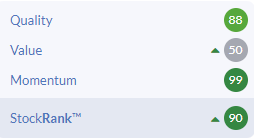
The StockRank has advanced 5 points to 90 since the release of the half year results on 23 February. This is primarily due to the improvement in the Value score. The price has increased 3%, so the change in the Value score is due to improvements in the underlying fundamentals, not a declining price. Earnings per share (EPS) have increased, therefore lowering the PE ratio. Likewise, sales, cashflow, dividends and book value have all improved.
Revenue grew by 21.7% in 1H FY24. The biggest contributor to growth has been the Australian IVF business. Within this, the contributors in order of significance were:
Acquisitions of additional practices
Price increases of 5% - 8% comparing 1H FY24 with 1H FY23
Organic market share growth
Industry growth
The Day Surgery Unit has also made a significant contribution to growth, with the opening of the Day Surgery Unit on the Gold Coast in October 2023. The Ultrasound division made a small contribution to growth, along with the International division.
The two main components of IVF treatments are stimulated cycles and frozen embryo transfers. Of those, stimulated cycles account for 54% of total IVF patient treatments. Stimulated cycles grew by 5.1% across the industry for 1H FY24 as measured by Medicare data. This compares with 15.1% growth for Monash. Over the last four years Monash has increased their share of this market by 3.6% to 20.9%.
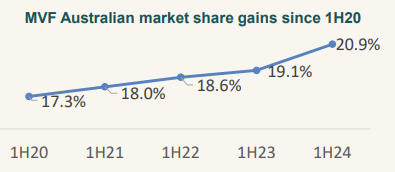
Source: Monash, 1H FY24 Results Presentation, 23/2/24
There are four areas that Monash can focus on in order to increase their market share.
Acquisition of additional practices. The industry consists of many small practices as well as some larger groups of practices. In May 2023 they acquired the PIVET business with a practice in Perth and Cairns. In March 2024 they acquired another practice in the northern suburbs of Perth.
Attracting more fertility specialists. The more doctors they have working in their clinics the more patients they can treat. New doctors are added through the acquisition of new practices as well as recruitment. They place a high priority on creating a compelling value proposition for doctors.
Improving success rates through science and technology. Monash has achieved a clinical pregnancy rate per embryo transferred of 38.9%. This has improved markedly over the last six years as shown in the graph below.

Source: Monash, 1H FY24 Results Presentation, 23/2/24
Marketing - The advantage of being a national business with revenue of $236 million is that they can use their scale to engage in national or regional advertising campaigns to build brand awareness.
These factors combined have been fairly successful leading to a compound annual growth rate in sales of 7.2%.
Underlying NPAT grew 18.7% in the first half. Management had provided earlier guidance of a growth rate between 15% and 19% so the actual result came in near the top of that. Underlying EBITDA increased 20%. The contributions to growth were:
Domestic IVF growth 12.0%
Acquisition 4.1%
Ultrasound 4.6%
Asia -0.7%
Patient price increases were offset by higher wages, higher prices for supplies and higher costs for new clinic infrastructure.
Further growth is anticipated in the second half of the year with contributions from the recent acquisitions, the new fertility specialists, growth in new patients and growth in the genetic carrier screening business. Domestic new patient registrations increased by 11% in the first half and this will flow through to growth in treatments. MVF’s monthly genetic carrier screening volumes have increased by over 160% since the introduction of the Medicare rebate in November 2023.
Management are forecasting underlying NPAT of between $29 million and $30 million which would equate to 13% to 18% growth. The market is forecasting growth of 17%.
EPS has been growing since 2020, however in the period 2015 to 2019 it was well above the current level. This corresponds with a large capital raise in May 2020 (the height of the pandemic crunch) which resulted in shareholder dilution.
When looking at the balance sheet the first note of caution is with the Bankruptcy risk, where the Altman Z score is in the cautious zone at just 1.55. The net gearing is 42% which is not excessive.
There are two reasons for the low Altman Z score:
The large negative Retained Earnings balance
Current liabilities exceed current assets
The negative retained earnings extends from the early years but the business has been profitable for the last 10 years at least.The main contributor to the high current liabilities is borrowings of $42.8m at 31 December that were due to mature soon. By the time the interim results were released on 23 Feb 24, the debt facility term had been extended to Feb 2027. Given the nature of these two factors the Altman Z score is less of a concern than it may initially seem.
Other key risks include the regulatory risk which is often common to health care businesses. In Australia a significant portion of their revenue is indirectly funded by the government via Medicare. Any changes to these funding arrangements would affect their business. Of course regulatory risk can also work in their favour as shown by the recent introduction of a $2000 rebate from the NSW government for ARS at private clinics to help make fertility treatments more affordable.
The NSW government has also expanded the availability of publicly supported lower cost IVF clinics and there are three hospitals in NSW that provide public IVF treatment where out of pocket expenses are capped at $1000. This adds lower cost, competitive pressure to Monash.
Another risk for Monash is customer disappointment. The harsh reality is that the majority of treatments are unsuccessful. Whilst patients are made well aware of that, the pain can still sting and could lead to negative perceptions.
With complex medical procedures there is also the risk of things going wrong, and rightly or wrongly some people may pursue litigation. They are currently defending a case claiming damages regarding a particular genetic screening technology that is no longer in use.
Monash is following a well trodden path in the healthcare sector, where a firm buys up clinics involved in a particular area of medicine and then capitalises on the economies of scale to provide the service more profitably. Often referred to as a roll up strategy. In addition to the acquisitions, Monash is in a growing segment and has been able to increase their market share within that segment. This has enabled them to steadily grow the business.
Important Information: Stockopedia Ltd ABN 39 757 874 670 UK business registration number 0637267 (“Stockopedia”) is an Authorised Representative of Daylight Financial Group Pty Ltd ABN 77 633 984 773 (“DFGPL”) which is the holder of an Australian Financial Services Licence (AFS Licence No. 521404).
Information in this commentary is current as at date prepared unless otherwise stated. However, please bear in mind that investments can go up or down in value, and that past performance is not a reliable indicator of future performance. For more Important Information please refer to the Disclaimer section of this website.
This communication may contain general financial product advice. It has been prepared without taking into account your personal circumstances, and you should therefore consider its appropriateness in light of your objectives, financial circumstances and needs before acting on it.
If our advice relates to the acquisition or possible acquisition of a particular financial product, you should obtain a copy of and consider the Product Disclosure Statement (PDS) before making any decision.
The author holds interests in the following stocks mentioned in this article: MVF. This position can and will change at any time without notice.
Disclaimer
This is not financial advice. Our content is intended to be used and must be used for information and education purposes only. Please read our disclaimer and terms and conditions to understand our obligations.
2 comments
I have looked at MVF in the past and have been deterred by its low margins and lack of earnings growth. Competition from public hospitals is a big risk. Given the high cost and high failure rates a slowing economy might have an adverse impact, that said I have missed out on about 20% stock price gain :(
All very valid points Vince55. Margins and earnings have been improving a bit recently, but they are still relatively low. Competition is high, and governments like NSW are trying to make IVF more accessible via the public system. Management note the risk of high cost of living in their latest presentation, but also point out that they are yet to see any noticeable impact from it.