N Brown Group: big (discount to TBV) is beautiful

Ed recently introduced the Stockopedia Strategy Map, showing that there are many ways to invest successfully using the Stockopedia tools. In this week’s article, he discussed the concept of deep value investing, a strategy close to my heart. So as a follow-up, I’m going to look at a deep value stock from Benjamin Graham’s NCAV Bargain Screen: N Brown (LON:BWNG)
Summary
- N Brown is an online clothing retailer specialising in clothing sales in a wide variety of sizes via the brands JD Williams, Simply Be and Jacamo. They also have a small homeware brand called Home Essentials.
- The company trades at a substantial discount to tangible book value, with a P/TBV of just 0.38, after adjusting for post-balance sheet events.
- The majority of these assets are represented by a £492m customer receivable book. Even after netting off provisions for doubtful debts and the debt secured against these receivables, they exceed the current market cap by some margin.
- These assets are not particularly productive at the moment, though. Despite much earnings over the last few years, earnings are forecast to be just 1.7p for 2023, putting them on a forward P/E of 16. Their most recent ROCE I just 4%.
- A court case with their finance provider over who was responsible for the costs of PPI misselling has hung over the company for some time but is now settled, with the company paying £49.5m to the insurer.
- Frasers, the highly acquisitive retail group led by Mike Ashley, bought a stake recently, leading to speculation that N Brown (LON:BWNG) will be their next target.
- The Alliance family own a controlling shareholding and was buying recently too. Presumably to avoid losing the company to an opportunistic bid.
- The share price has dropped back down since this buying, perhaps due to read-across from poor trading of other online clothes retailers such as Boohoo (LON:BOO) and ASOS (LON:ASC) . So this could provide a good entry point for investors that believe these assets can be made productive again, either by the current management or in the hands of Mr Ashley.
Profile
N Brown (LON:BWNG) is a direct-to-customer clothing retailer. Today this means that the company sells online. However, its oldest brand, JD Williams, was founded in 1859 when James David Williams operated three mobile shops. In 1882 he began to send clothes via the newly introduced national postal service. Thus it became the mail-order catalogue business that it was for so many years. In 1963 the Williams family sold their shares to Alliance Brothers Limited, a holding company the brothers had previously purchased, hence the name. Additional mail-order catalogues were added in 1970, and then the company was listed on the LSE as N Brown Group in 1986.
As well as JD Williams, the company’s other main brands are Simply Be, which sells fashionable clothes in sizes 12 to 32, and Jacamo, selling men’s clothes in a full range of sizes from Small to 5XL. The company operated physical stores until 2018, but these are now closed. They also no longer send out complete catalogues, pointing customers to browse their full range online. However, like many retailers, they do send out some physical promotional literature to their extensive mailing list. In 2020 they also launched an online homewares brand, Home Essentials.
The Alliance family still control the business:
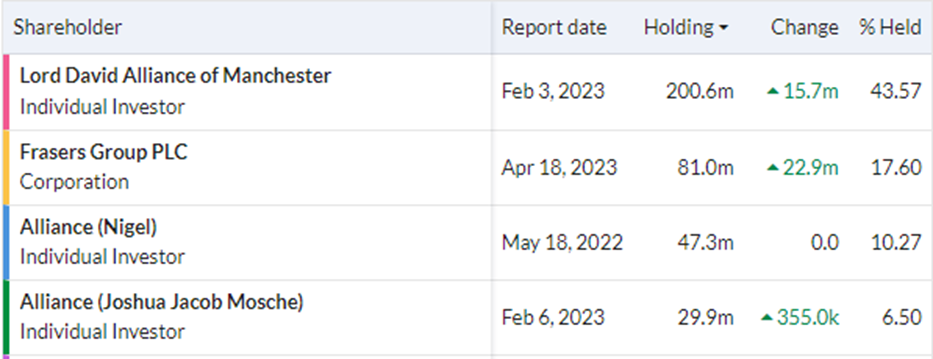
Despite extensive holdings, the family have been adding to their holding, with Joshua Alliance significantly increasing his stake in 2021:

In 2023, the Alliances have also been on a buying spree, paying over 40p at times to increase their stake:
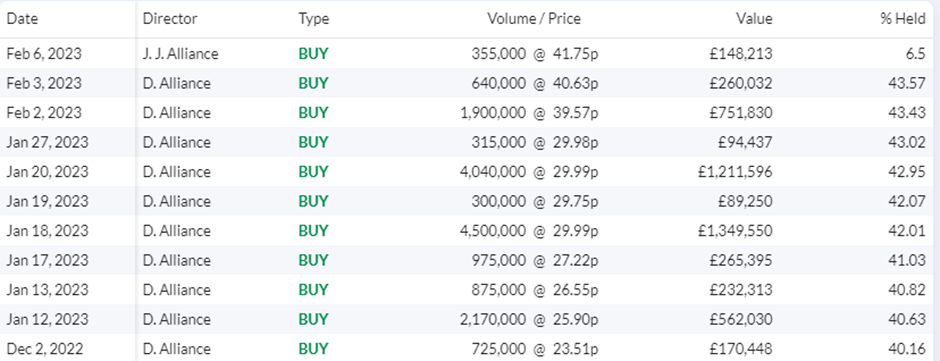
I suspect that the following news has triggered this buying:

Frasers, the highly-acquisitive retail group controlled by Mike Ashley, appear to have started buying just before poor interim results from N Brown in October 2022, which led the share to trade below 20p. Since then, Frasers has built up over a 17% stake in the company. Their largest purchase appears to be at the end of January when presumably they would have paid over 30p/share.
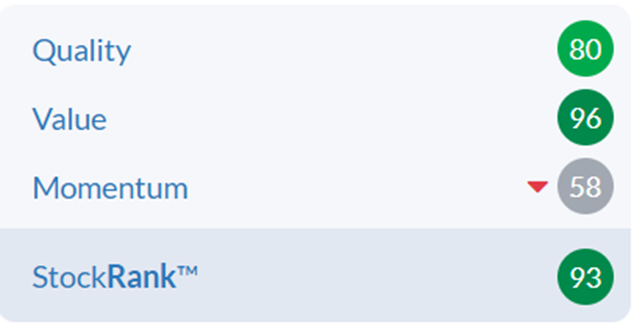
As one might expect from a company featuring on a deep value screen, the Value rank is exceptional. But, interestingly, the Quality rank remains top quintile:
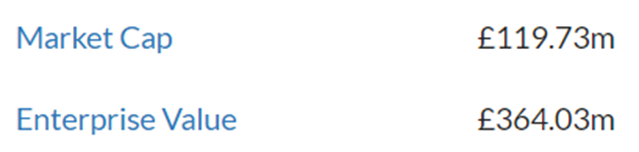
The company is highly geared, with net debt including IFRS16 lease liabilities double the market cap:
However, this debt has arisen because the company own their own creditor book, which is currently valued at £492m, net of provisions. Although a customer loan book sounds like something that is not readily turned into cash, this is a real asset, and such creditor books have been sold to third-party finance providers by other companies.
Competitive Landscape
There is no shortage of online clothes retailers. This is a highly competitive market. It is also a market that has been struggling recently. After a covid-related boom where everyone had to shop online, shoppers have increasingly returned to the high street. On top of this, businesses have struggled with increasing costs and increasing customer returns. Even some of the biggest companies in the sector, such as Boohoo (LON:BOO) and ASOS (LON:ASC) , are forecast to be loss-making this year.
N Brown differentiates itself by offering a more comprehensive range of sizes than other online retailers. Although other retailers can expand their size range, the relatively few people in these size categories mean the market can probably only support a few niche retailers. With their brand history in these markets, N Brown is one of these existing niche players, and as such new entrants may be cautious about expanding their size range. However, online clothes retail itself has very low barriers to entry. So this is, at best, a weak moat.
Historically, their offer of consumer credit was also a competitive advantage. However, almost all clothes retailers now offer consumer credit via third-party providers, such as Klarna. So this is no longer a competitive advantage for the company.
Strategy
In their latest results presentation, the company shared their strategic pillars for the business and activities they had taken to build those pillars:
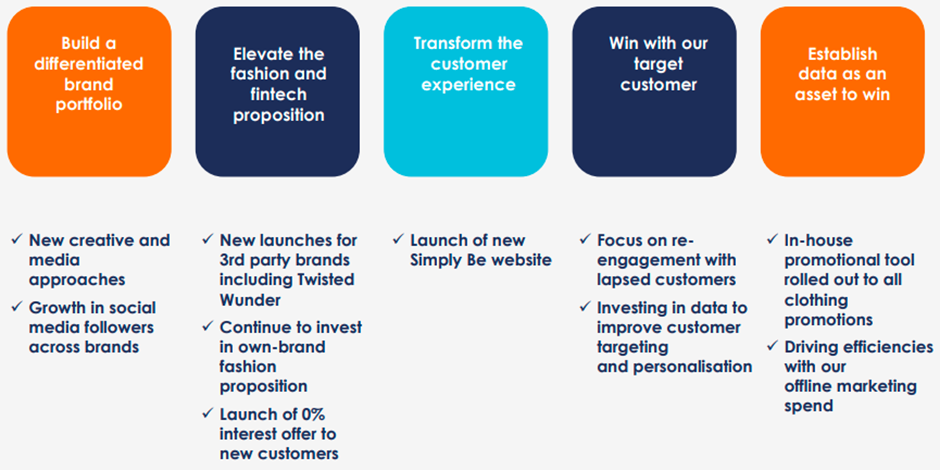
While it is good to see the company is actively addressing their current challenges, I can’t help but think that these are not exactly ground-breaking developments. I would expect that almost all online retailers will be pursuing a similar strategy. Hence there will be little strategic differentiation.
Competitive Advantage
The company has a good Quality Rank:

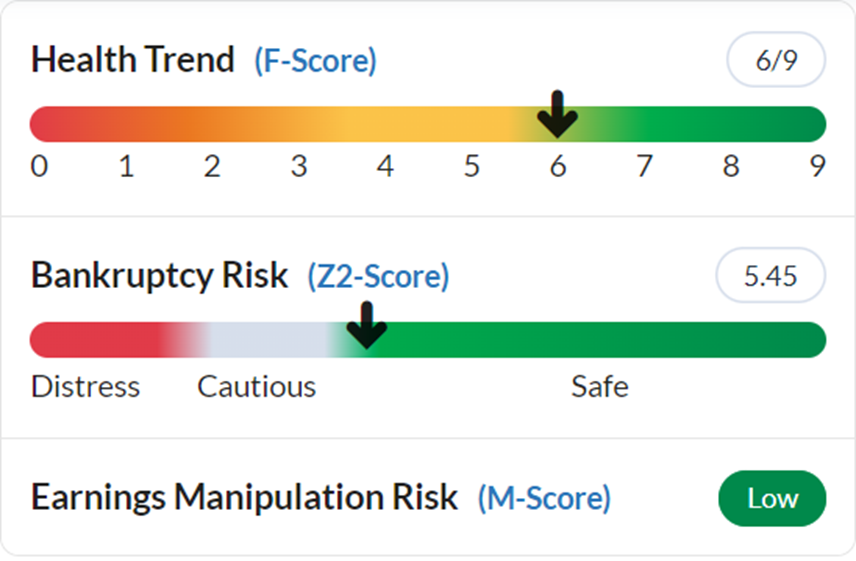
However, this is driven by the F-score of 6 out of 9, and the financial strength of the company:
Their Return on Capital has never been particularly high, even during better times:
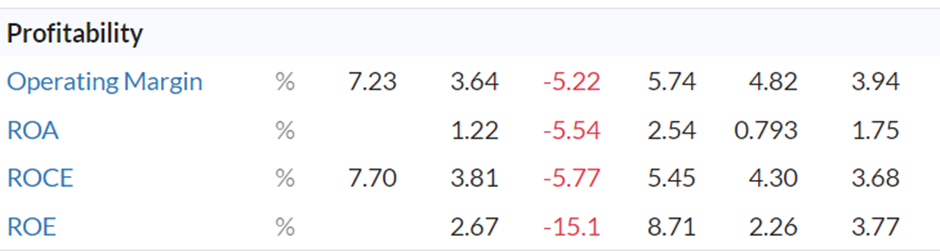
Overall, I’d rate their moat as weak. They undoubtedly have some brand loyalty amongst shoppers that require more uncommon sizes. However, it wouldn’t be hard for a competitor to expand their size range to gain market share. The online retail of general fashion clothing is highly competitive. While in the past, the provision of finance to customers may have been attractive, these days, many retailers have third-party provision of finance, so this no longer represents a unique selling point.
Financials
Growth and Profitability
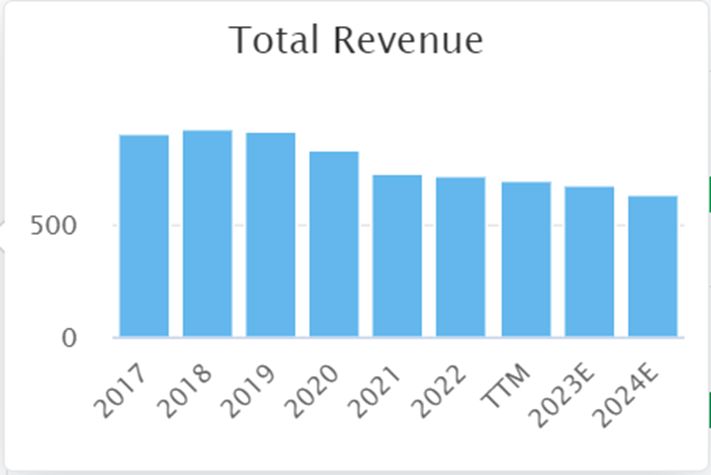
Revenue here does not show an encouraging trend:
Neither does EPS, with little sign of any recovery in the near term:
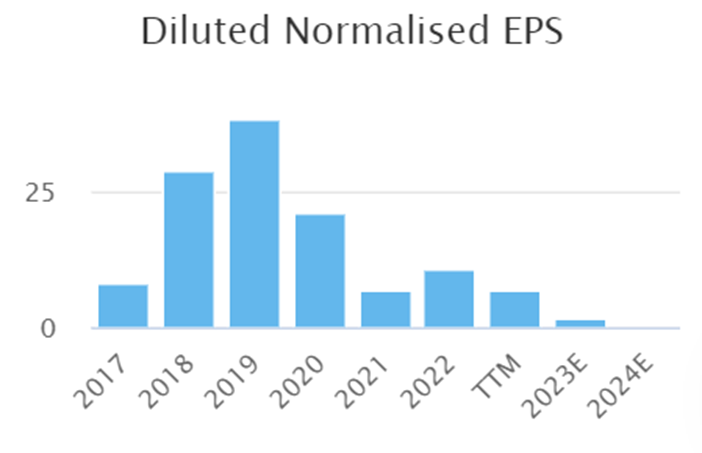
However, it wouldn’t take much of a recovery to see the company very cheaply-rated on earnings again.
Balance Sheet
It is the balance sheet assets that mark out this company as an interesting proposition, with a Price to Tangible Book Value of just 0.36 at the last balance sheet date of 27th August 2022:

This figure needs to be adjusted for the amount the company paid to settle a claim by Allianz related to PPI-related customer payments in January this year. The company paid £49.5m to the insurer, which was in excess of the £25.5m provided on the balance sheet. Making this adjustment sees net assets of £329.6m, and the P/TBV becomes 0.38. Results to 4th March 2023 are due on Tuesday 6th June 2023, so this number may change. However, any TBV change over the last six months is unlikely to alter the investment case here significantly.
The largest asset is a customer loan book, which arises from the company providing credit to their customers:
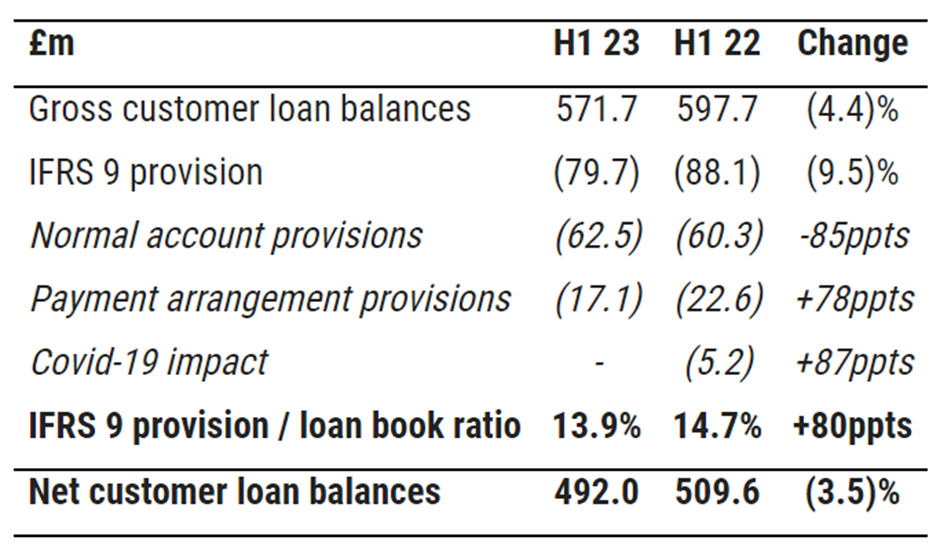
Of course, this is only a valuable asset if customers pay what they owe. The amount in the balance sheet is the net amount of £492.0m, which is net of any provisions. The total provision made for doubtful debts consists of £62.5m for debts unlikely to be paid and £17.1m for amounts subject to payment arrangements, such as debt management plans. A 13.9% provision rate seems high, but this is a relatively high-risk consumer debt. The company says:
The reduction in provision rate on payment arrangements reflects a higher propensity to recover. This is a consequence of customers proactively seeking forbearance via the business’ various support measures.
Given the cost-of-living crisis and entrenched inflationary pressures, there is a risk that these figures prove grossly inadequate to cover the actual level of defaults over the next few years. Nevertheless, the company considers these adequate, even for current market conditions, saying:
The FY22 year-end inflationary post model adjustment of £5.8m is now embedded in the base provision as book performance has declined and modelled economic inflationary expectations are now in line with the market.
Overall provision rates remain higher than the pre Covid-19 level reported in FY20 (10.9%).
However, I wouldn’t be surprised to see this provision rise in the upcoming results.
Against this loan book is secured £290.7m of debt via a securitisation funding facility. This leaves £201.3m net amount. Given that the current market cap is £122.5m, provisions would need to double to mean that net customer receivables do not entirely cover the current equity value of the company. While this is not impossible, this would represent close to a 30% default level, which would be unprecedented.
At the last balance sheet date, the company’s £103m of payables was matched by a similar level of inventories. The company also has around £60m of property plant and equipment.
Cashflow
The impact of the customer loan book and the securitisation of those borrowings complicates the cash flow for N Brown. Large net outflows here saw negative free cash flow at the half year:
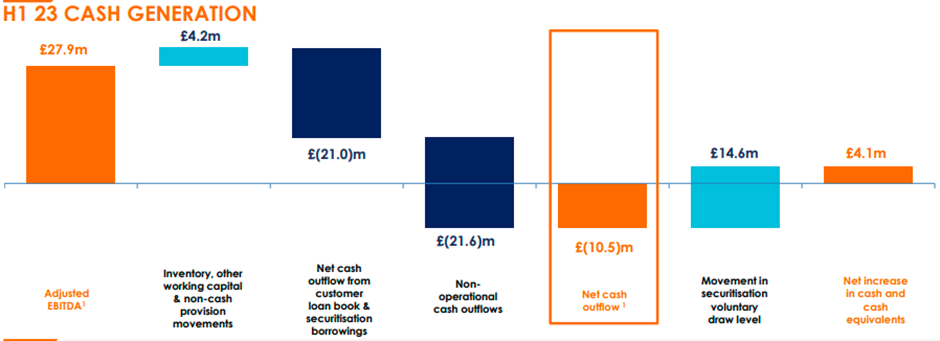
However, the company says this is due to the typical in-year phasing leading to a reduction in securitisation borrowings. In addition, payment arrangements increased by c.£31m, and these are not yet eligible for securitisation drawings, resulting in a timing lag for cash inflows.
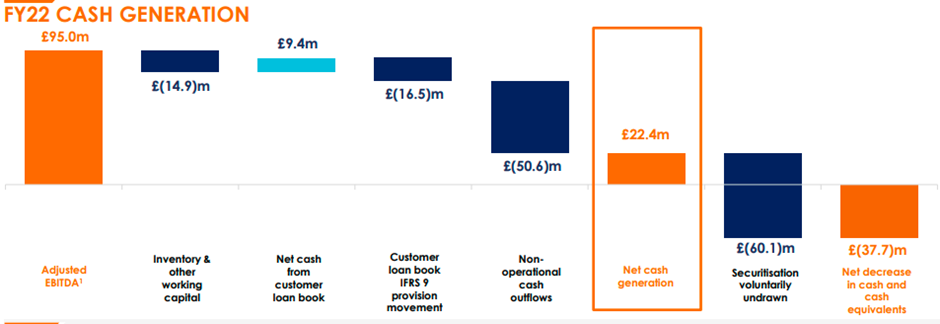
The last full year showed much better free cash flow characteristics, generating £22.4m of cash on a pre-securitisation basis:
Dividends/Buybacks
Given weak trading and outlook, the company is not paying a dividend or buyback. In the past, the company has paid large dividends, but the strength of trading since covid has not been strong enough to support any shareholder returns:
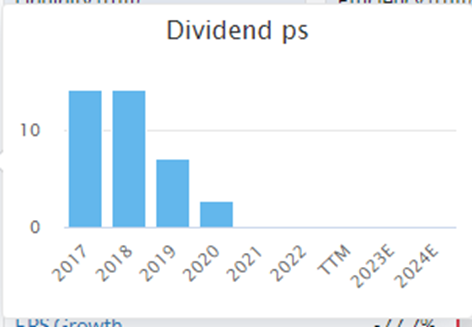
Instead, the company has been an issuer of equity, placing £100m worth of shares at 57p in November 2020:
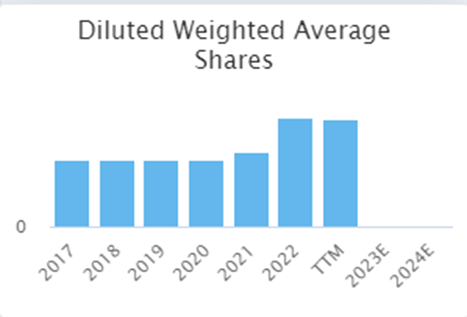
Ownership Structure
Apart from the controlling stake of the Alliance family, Frasers are the largest holder. Monecor (London) is a subsidiary of a CFD provider, so it may well represent the indirect holding of Frasers, which is why the free float appears negative!
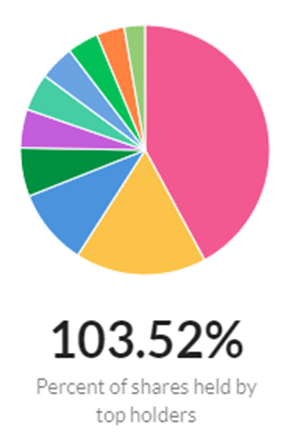
Only two other institutions have over 3%, Schroders and J O Hambro:
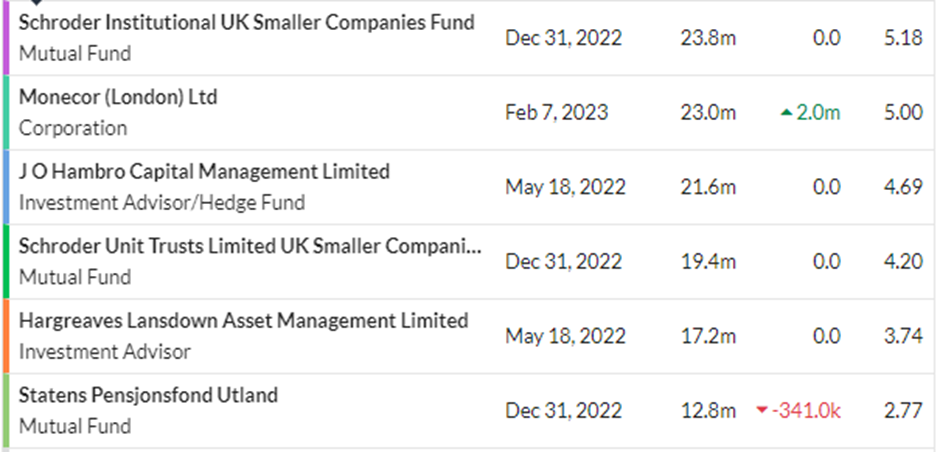
The presence of Hargreaves Landsdown effectively represents retail free-float too. However, this remains a tightly held and, therefore, illiquid stock.
Valuation
The value rank is very high, as you expect from a deep value pick:

The stand-out values are the Price to (Tangible) Book and Price to Sales. However, investors need to be wary of the apparent low P/E and low P/FCF since these will undoubtedly look much worse when results are announced next week and the Stokopedia algorithms crunch the numbers:
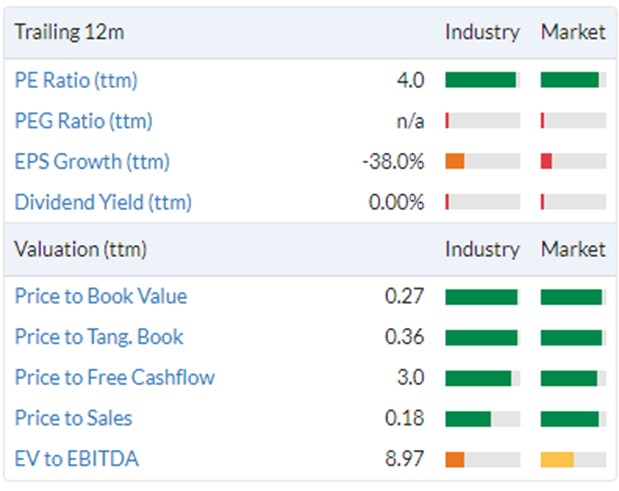
Investors should only invest here because they expect these tangible assets to be turned into cash soon or that they can be made productive by returning to more profitable future trading.
Risks
The short risks to the business are clear. Consumer confidence is weak, and with inflation continuing to trend above monetary policy targets, the consumer will likely be squeezed further. This will particularly impact lower and middle-income earners representing N Brown’s target market. In addition, the cost-of-living crisis may mean that previous consumers are less likely to make payments on previous credit purchases made. This will further impair the value of the customer loan book. Small percentage changes in a large gross receivables amount will have a disproportionate effect on the net amount.
Recent Trading
The latest trading statement is from January when the management confirmed that trading is in line with expectations. However, these expectations have been falling continuously for over 18 months:
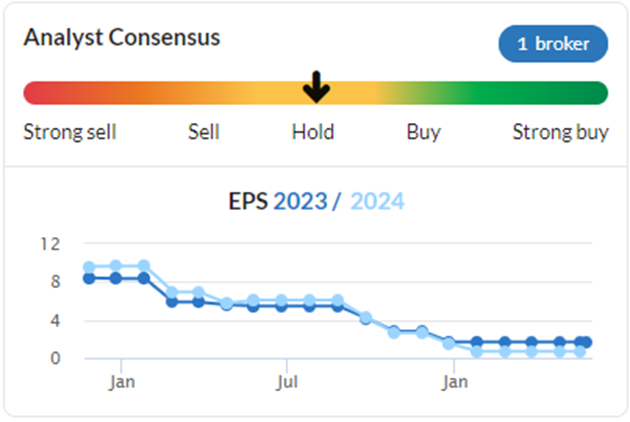
There seems to be little chance of conditions improving in FY24 either:
We expect the market for UK discretionary consumer goods to be soft in calendar year 2023, particularly in the first half. This, together with the difficult trading environment in FY23, means we will commence FY24 with lower active customers year-on-year.
The value of the consumer loan book and the ability to borrow against it means that the company has significant financial resources to trade through to improving consumer sentiment with the company saying:
Although we are cautious about the macro environment over the next 12 months, we remain confident in the resilience of our business and in the strategic investments which we are making for the long term.
However, with little real moat, it is hard to see how those strategic investments will be able to deliver progress above merely the return of consumer spending, which should float all retail boats.
Sentiment
The Momentum Rank is reasonable here but has been falling recently:

This is perhaps helped by some recent share price strength caused by Frasers and the Alliance family buying aggressively:
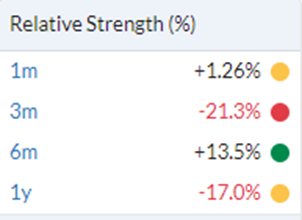
Based on current forecasts, earnings momentum will likely be weak for the foreseeable future, and hence this is not a stock that will not appeal to momentum investors.
Conclusion
The main attraction of N Brown (LON:BWNG) in the short term is the value of its consumer credit book. The market tends to ignore these types of assets, but the reality is that they can often be sold to finance providers for a minor discount if a company chooses to. In 2016, Sainsbury’s acquired Home Retail, owner of Argos, despite a weak consumer outlook for the business. One of the main attractions was Home Retail’s internal consumer credit book, meaning that Sainsbury’s paid a relatively small net amount for the trading businesses.
With N Brown, there is a risk that the current provisions for customer bad debt do not reflect future economic conditions. However, it would require an unprecedented level of non-payment for the net loan book to drop below the current market cap. This is perhaps why highly-acquisitive retail group Frasers has been buying and why the Alliance family have also bought aggressively to protect their interests.
With little chance of improved trading any time soon, this is a stock that will appeal either to the very patient value investor or investors who believe that Frasers will be able to force the company’s hand. This may be in the form of a takeover by Frasers, or the company selling their loan book and returning cash to shareholders. Given that the Alliance family were buying at over 40p, any deal will likely be at a significant premium to the current share price. As would the return of cash from any sale of the loan book.
Compared to last year, the increased possibility of a value-releasing catalyst means this is a much more attractive value investment. However, with a controlling stake, the ball is in the Alliance family’s court. If they want to take the patient view and continue to trade the business based on the current strategy, Frasers may struggle to force through anything else, no matter how vocal they are about the current situation. In this case, investors may face a long wait for the value to out.
Disclaimer
This is not financial advice. Our content is intended to be used and must be used for information and education purposes only. Please read our disclaimer and terms and conditions to understand our obligations.

11 comments
Down 50% since the article. Must be getting close to the point where the Alliances and Frasers want to do a deal to recover some of their losses but there again no reason it will not halve once more.
Poor results and predictable market reaction. I don’t hold this share but it is looking attractive at this level, assuming a long term view. Obviously, a possible takeover target .
Serious comment:
Page 58 - 59 of the annual report 2022:
Various senior changes:
New chair (existing NED moving to Chair) March 2021 - Ron McMillan - given he has been on the board since April 2013 usual practise is to leave after 9 years but in essence, as long as the existing major shareholder assents to it, it will not be an issue
General counsel:
- General counsel / company sec resigned Oct 21 (Theresa Casey)
- Interim General counsel / sec leaving May 22 (Christian Wells)
- new counsel (Michael Mustard) appointed March 22
CFO:
Rachel Izzard joined June 2020
CIO:
Adam Warne resigned Oct 2021
COO:
Nuno Miller appointed Nov 21
- note that he was chief digital and information office at Sonae Fashion
CEO of retail:
Sarah Welsh appointed March 2020
CEO of Financial services:
- appointed Dec 2020
I am still reading through the annual report but the reason I draw attention to all the above is that retail can often be about attention to detail, and to product / design etc. In this case I am a tad concerned re the changes - is it really about focus? And what does the CEO of the company do if there are separate CEOs of the retail and the financial services parts.
And why can I not see a 'product' person or a 'logistics' person on the executive team?
Given the issues with Allianz the change of General Counsel is 'interesting' - would need to dig into that more.
So N Brown is controlled by Lord Alliance - who is on the board but not chairman. It is / was in litigation with Allianz, which though it sounds similar is a totally different business (a German Insurance co). [Joshua Alliance is also on the board].
And the second biggest shareholder is Frasers which was Sports Direct but is not anymore. Frasers was founded by Mike Ashley who no longer runs it because it is run by Michael Murray who is Mike Ashley's son-in-law.
So in summary, a business NOT run by Mike Ashley, and NOT called Sports Direct has a stake in a business NOT run by Lord Alliance which is NO longer in dispute with Allianz which is NOT related to N Brown. (Oh - and N Brown passed away years ago).
Hope that is clear and helpful!
(PS Great writeup Mark).
Thanks for reviving my interest. The rump remaining of my shares is down 61% so adding a few more will make a significant change.
Apart from the accounting argument from Mark and the quality comment from 'ettrader' , investing in the owners is worth something.
The biography of David Alliance 'a Bazar Life' is a fascinating story of persistence and risk taking. Neither the Alliance nor the Ashley family are working for Stockopedians' benefit but they have business acumen that in a bizarre way can benefit stakeholders.
I've bought and sold these shares a few times over the past couple of years I've also tested them out for buying the branded goods mainly not their essentials. I was impressed on the quality of the goods to be honest I wear them and wash them over and over where they're stll looking good. There's something else they do use a value courier called Evri which doesn't have the best reputation but ordering online the service has been outstanding. I'd order say for example Sunday night they'd be on your doorstep by 3pm next day with free delivery. I thought wow this is good so order again and again every time it was next day never a bad order. The other aspect that is good which falls down with other oline retailers are the size guides, this site gets you to choose a premium brand where you type in what size fitted you best, you put in your size measurements and it gives you a pretty accurate profile so any itmes you check it knows your size so selects the right size automatically. My personal opinion is this company is pretty slick at what it does.
Right now I don't own any but if they dip under 25p I'd be tempted in again. The only concern I have is that this company could end up being a management buyout as the Alliance family own over 60% of the shares I believe. I think you'll find Ashley has sold the bulk of his stock as the Alliance's had over 50% when he started buying. The Alliance's will not let this go plus I think the only reason for not selling out to Ashley is that Ashley wants this business on the cheap and the Alliance's won't sell on the cheap. The question I've always asked is why don't the Alliance's do a management buyout? They've been over the 50% for years now, so the only reason I can think is that they're tax efficient because it's a listed AIM stock.
Great piece Mark. The insider/outsider interest plus the Graham bargain angle have been catching my attention for the last few months. I've been thinking of buying N Brown for some time, but not yet pulled the trigger. I would imagine that the continual sideways grind has been shifting stock from weak hands to strong. Given this, the company might not need a catalyst for the share price to start moving higher. Time and the change in ownership structure may be laying the foundations. I'm weighing that off against all the negatives of course - well elucidated here!
Thanks Ed,
I think it is a situation that favours those who can correctly divine the intentions of the Alliances. Assuming they attend the AGM, it could be worth also attending and asking them directly. If they recognise the value of the loan book and have plans to leverage it for shareholders' benefit, then it could well be worth owning the equity. If they give the impression that they will try and trade the business in the same form for the foreseeable future, it may be far less lucrative a hold. This doesn't change the fact that the company trades at a discount to liquid assets, just that there is a big difference between that discount closing in under a year versus over the next decade!
It's interesting to think of N Brown (LON:BWNG) as (give or take) first in and last out of mail order retail. It's certainly a historic business.
As a going concern however it's got little or nothing going for it, (because everything it can do someone else can probably do better or cheaper), unless that is someone can come along and repurpose the business. The credit book is what draws attention but maybe the e-commerce platform is of some interest to Frasers (LON:FRAS). I imagine they would massively cut costs as well and there would be significant operational synergies, but also a customer database to cross sell to.
I agree with you Mark, the strategy is in my view one of managed decline when if the business is to go forward, it needs, frankly, a turnaround plan.
I don't want to trash N Brown (LON:BWNG) though. It's a historic business, but with a moat that's largely dry and no plan as to how to fill it.
Thank you Mark for such as thorough analysis, there may be some special situation attraction for some, but it scares the hell out of me!
Thanks for this, I think you are right its fits with Frasers strategy
Great article, thanks.