National Grid beats the sector hares

The utility sector features low risk monopolies and higher risk power generators and suppliers. The monopolies include water companies and groups owning transmission & distribution infrastructure. National Grid falls into the latter camp and has delivered strong long-term returns for investors.
In the fable of The Tortoise and the Hare a race between the two sees the Tortoise emerge as the winner. While the Hare is the fastest he is also overconfident with his downfall being the nap he takes during the race.
A similar story can be seen in the stock market with investors often overconfident on racy sectors like technology and resources. This means that they tend to underperform the slow and plodding sectors like regulated utilities.
Empirical research has borne this out with low risk stocks (low volatility) outperforming high-risk stocks (high volatility). In theory the opposite should be the case with investors rewarded for taking on higher risk.
The explanation may be that higher risk sectors don’t retain and compound value over time. In the tech sector, for example, rapid change can hit the leading stocks while the resource sector suffers when commodity prices tank.
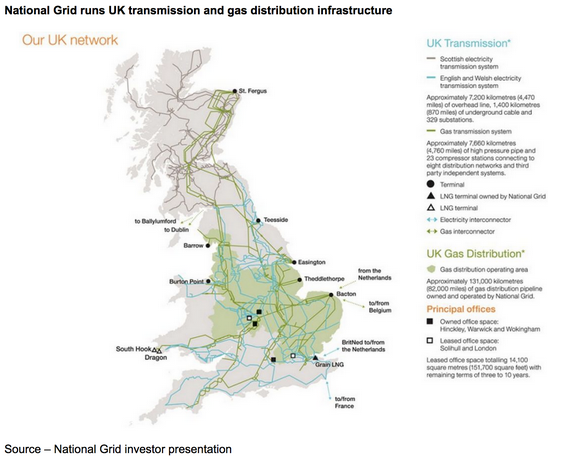
Against this backdrop investing in stock market tortoises may be a sound long-term bet. National Grid is the UK’s largest utility group and has seen its regulated transmission infrastructure make it a reliable investment tortoise.
National Grid plods through the financial crisis

Will UK regulated utilities remain in favour?
The regulated utility sector (water firms and transmission businesses) offers a similar profile to bonds for investors. However, an advantage of listed utilities is that they can increase their dividend payments over time.
Regulated utilities typically retain part of their profits to grow their regulated asset base. The regulator also tends to allow for price increases because utilities need to offset cost pressures and develop new infrastructure.
Secure and growing dividends therefore make regulated utilities attractive core portfolio holdings. The sector has also rallied since the start of the financial crisis due to falling Western government bond yields.
The 10-year yield on UK government debt is currently 2.08% while the 30-year yield stands at 2.79%. As such a regulated utility offering over a 5% yield offers a compelling alternative.
We note that the Bank of England governor, Mark Carney, has recently said in a speech that the first increase could be “at the turn of this year.” He then expects rates to increase gradually over 3 years to half of the historical average of 4.5%.
Mr Carney is therefore forecasting that peak UK of interest rates will not be significantly higher than 2%. This should mean that the high dividend yields on offer from regulated utilities continue to be attractive.
National Grid in focus
The main focus on National Grid is the UK but the company generated 29% of operation profits from its US regulated business last year. This provides some geographic diversification and offers a competing area to invest in.
National Grid profits generation
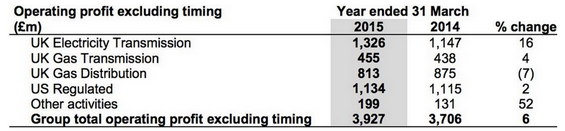
Source: National Grid investor update
In the UK the electricity transmission business generated a third of operating profit last year. UK Gas Transmission and Gas Distribution together provide just under a third of group profits.
The UK generated a 13.7% return on equity while in the US the figure only came in at only 8.4%. For the group as a whole the return on equity for the year to March 2015 came in at 11.8%, which was up 0.4% on the previous year.
In the year to March 2015 the adjusted operating profit for National Grid rose by 5% to £3.86bn (including timing). Adjusted profits before tax rose by 11% to £2.87bn and adjusted earnings per share rose by 9% to 58.1p.
Summary and valuation
The main focus of investors in National Grid is on the dividend payout which last year was up 2% to 42.87p. At the current share price of 858p this represents an historic yield of 5%.
This is an attractive yield given the regulated nature of the group’s activities and the strong long-term track record. With the payout set to increase the shares should continue to be attractive against UK government bonds.
The share price of National Grid has seen some weakness recently with it falling from 960p in late 2014 to as low as 820p. This may offer a good opportunity with plans to reduce UK corporation tax further set to bolster profits.
National Grid is unlikely to ever set investment pulses racing but its ability to compound value over time has generated strong returns. We don’t expect this to change as long as the UK regulatory environment remains favourable.
Warren Buffett once noted that companies with the characteristics of Toll Bridges are good areas to invest. These are firms with monopoly positions that make a small and frequent charge from their customers.
National Grid’s transmission and distribution infrastructure fits this description well. It therefore appears to be a safe bet that National Grid will continue to perform strongly and give the stock market Hares a run for their money.
This report was produced by Fat Prophets Senior Analyst, Andrew Latto
Disclaimer
This is not financial advice. Our content is intended to be used and must be used for information and education purposes only. Please read our disclaimer and terms and conditions to understand our obligations.
2 comments
Correction: I spread betted it at 1072.6 for Sep contract on 18th Feb 2020 with a 10% running stop. It's got a great chart.
I bought it today, actual I spread betted it at 1057.4 and it's still going up, It adds a bit of stability to my portfolio.