National World: Read all about it!

A couple of weeks ago, I looked at one of the companies that appeared on my Free Cash Flow screen, newspaper distributor, Smiths News (LON:SNWS) . I stay with the News theme this week and look at another cash cow: National World (LON:NWOR) .
Summary
National World is a company formed to consolidate companies in the media sector.
Their first significant acquisition was JPI Media, publisher of many iconic local news titles. This has gone well, and the company is generating significant cash.
The company has outperformed listed peers so far in 2023 yet appears to be on a much lower valuation rating.
The Price to Free Cash Flow is just 5.9x, and with £26m net cash, it would be even lower on an enterprise basis.
However, the company is not immune to conditions in the wider advertising market, and revenue is forecast to decline this year and next.
The company has significant cash resources and the ambition to reverse this trend through organic and inorganic growth.
Although he doesn't have a controlling shareholding in the company, National World is very much the vehicle of its Executive Chairman, David Montgomery. Other larger shareholders have backed Montgomery in previous successful media ventures. As a result, shareholders are hitching their ride to this entrepreneur, and external shareholders are likely to have little influence over the company's direction.
Profile
National World is a Main-Market listed news publisher, including an online national newspaper, nationalworld.com. The company was listed in September 2019 as a vehicle for executive Chairman David Montgomery to:
…create a modern platform for news publishing through the implementation of a new operating model across multiple brands and platforms by acquiring a number of media and digital technology assets and leveraging its portfolio to launch new media brands across the UK.
Montgomery has a lot of experience with this type of strategy. In 2012, he led a consolidation of local newspaper titles to form the company Local World, which was sold to Trinity Mirror for £220m in 2015.
National World raised £4.6m on admission but clearly had plans for a significant transaction as their shares were suspended a few months later while they negotiated the acquisition of JPI Media. JPI was formerly known as Johnston Press and was the publisher of seven well-known regional news titles: The Scotsman, The Yorkshire Post, Belfast News Letter, Sheffield Star, Edinburgh Evening News, Portsmouth News and Lancashire Evening Post.
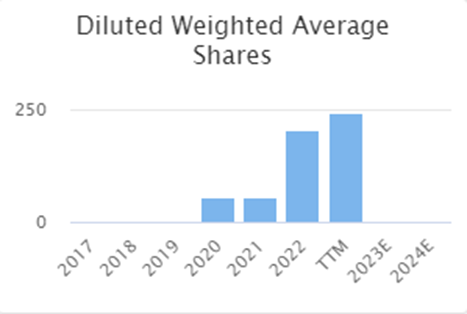
National World paid £10.2m, which they funded from cash and the issue of convertible loan notes. They also provided working capital to the business and drove a significant digital transformation of the titles. The loan notes were converted to shares in May 2021, leaving the company with £18.1m net cash on 3rd July 2021. However, the shares in issue increased significantly with this conversion:
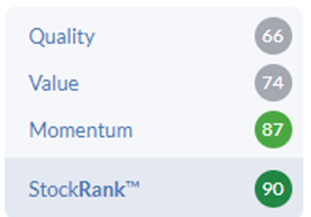
The company has top decile StockRank driven by a good showing in each of the QVM ranks, although no individual rank is exceptional:
The company holds significant amounts of net cash:
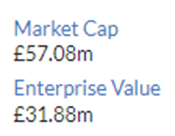
This has arisen due to the conversion of the loan notes and 18 months of cash-generative trading. Results for the year ended 31st December 2022 show net cash of £26m, excluding lease liabilities. This cash is largely retained to enable the company to grow via acquisition, although they have just begun to pay dividends.
Business Model
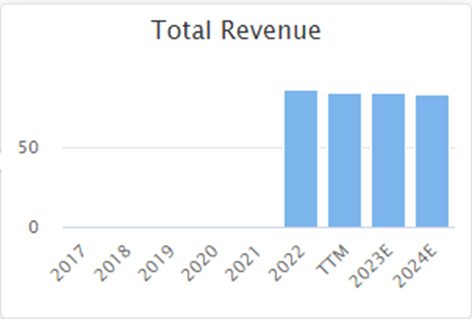
The company's motto is to "localise, energise, digitise and monetise". Although the company has national online publishing assets such as the National World website, most of its revenue comes from local titles. They aim to connect with these local communities better and make their titles the must-read for local news. They are increasingly turning to digital infrastructure to take cost out of the declining print assets while growing online revenue. Although their topline is not increasing, essentially flat revenues still mean outperforming the industry:
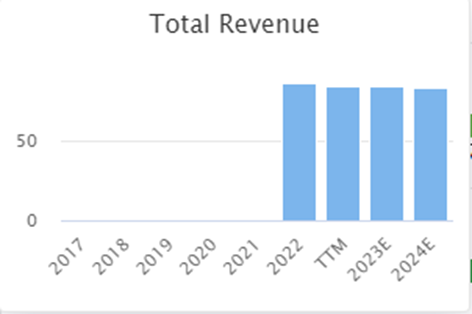
[Note that the year-end, which is always based on a 52-week year, has slightly confused the Stockopedia algorithms. What the StockReport has as 2022, the company call FY2021, which is the 52 weeks ending 1st January 2022. TTM on the StockReport is what the company calls FY2022 and is the 52 weeks ending 31st December 2022.]
For example, the mid-case for Smiths News (LON:SNWS) when I looked at this company recently was a 4% annual decline in revenue even after any price rises. Reach (LON:RCH) appears to have revenue declining at similar rates to Smiths. So while National World can't buck these trends completely, their monetise strategy seems more effective than competitors.
Competitive Landscape
Although there are many newspaper groups, Reach (LON:RCH) remains the only listed competitor after the Daily Mail and General Trust was acquired last year. In many ways, regional titles have monopolistic features. Often a city or county will only end up with one local paper over time. This monopolistic nature has always attracted Buffett and Munger to newspaper stocks. Charlie Munger remains Chairman of Daily Journal Corporation, a publisher specialising in the legal industry in the US. Many features that attracted these billionaires to the newspaper industry are gone; the internet has completely removed the need for classified adverts, for example. However, these can still be highly cash-generative businesses in the right hands.
Strategy
National World's strategy is to acquire media companies and apply their "localise, energise, digitise and monetise" mantra to generate higher returns by taking costs out via centralising administration and advertising sales. Obviously, the most significant acquisition and the cornerstone of the business are the local titles originally owned by Johnston Press.
Since then, they have invested in The News Movement as part of a strategic partnership which aims to create content that will appeal to younger audiences via social media platforms. This year the company acquired independent digital football publisher ScoopDragon and video-first content innovator, NewsChain, focusing on news, celebrity and football. In addition, sports news appears to be an increasing focus for the company as they have also started their football site called 3ADDEDMINUTES.
The scope of the company's ambition is evident as last year it was announced that:
National World confirms that it is at the early stages of exploring a possible offer for the entire issued and to be issued share capital of Reach
Given that, at the time, Reach (LON:RCH) had a market cap of over £300m and National World £50m, this would be the minnow eating the whale. Unsurprisingly, this came to nothing. This may well have been a bit of posturing on behalf of the National World Management; David Montgomery used to lead the predecessor to Reach in the 1990s. However, National World claims to have the finance required agreed upon in principle. In reality, National World shareholders may be breathing a sigh of relief. Reach has several off-balance sheet legacy issues, such as a pension deficit and continued provisions for phone-hacking claims. Not everyone would be keen to expose themselves to these risks.
Competitive Advantage
The company has a middle-of-the-road Quality Rank:
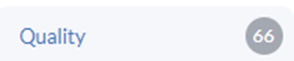
The F-score is only 5 out of 9, mainly due to recent positive trends in business performance. Last year, ending on 1st January 2022, was an exceptionally strong period. However, over 2022, inflation and a weaker consumer environment affecting advertising spending means that the year just reported was weaker.
The Altman Z-score shows that the company is safe. Unsurprisingly given the large cash balance and cash-generative nature of the business. The return on capital isn't great, given the cash balance, but the return on equity that excludes cash looks much better:
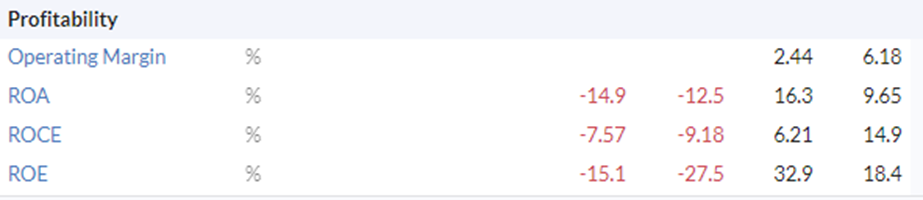
The company has only had significant operations for a short period. However, regional newspapers seem to retain some of their moat, even if it is not as strong as it once was for the industry.
Financials
Growth and Profitability
Revenue is forecast to decline slightly, although this excludes the impact of any further acquisitions they may engage in:
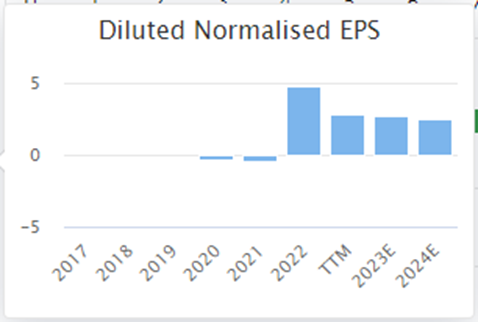
The same picture is there for EPS. After a very strong 2022, brokers are forecasting slight declines:
Balance Sheet
Given the large cash balance, the balance sheet is very strong. However, this does not trade at a discount to book value:
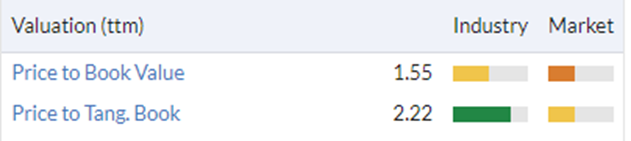
Investors in this company rely on these publishing assets being productive and generating high cash flows to see the value.
Cashflow
Although EPS was lower in FY22 than FY21, cash generated from operations has increased due to better working capital management:
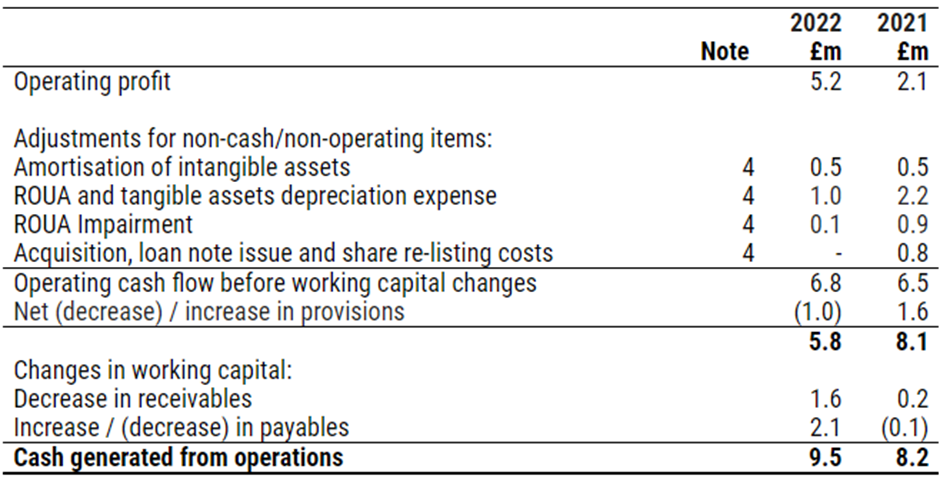
This means that free cash flow per share remains flat despite an increase in the weighted average number of shares due to convertible loan note conversion during FY2021:

The price to free cash flow is just 5.9:

This would be an even lower value on an EV basis. Hence, this company appeared in my EV/FCF screen results.
Dividends/Buybacks
With the FY2022 results, a maiden dividend is declared:

The current yield of around 2.5% isn't anything to write home about. However, this is forecast to rise to 3% next year, and there is scope for more cash to be paid out as a dividend and large acquisitions.
Ownership Structure
The company is tightly held and, with just 27% free-float, can be illiquid at times:
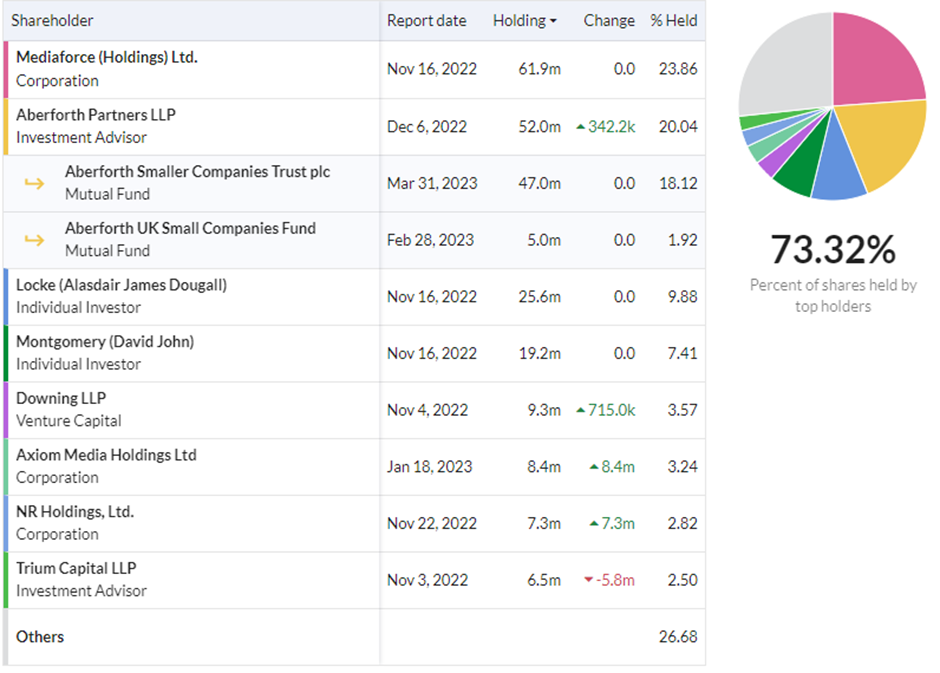
The largest holder is Mediaforce which is owned by media entrepreneur Malcolm Denmark. As is the right of holders of more than 20% of a company, Mediaforce requested the appointment of David Fordham as a Non-executive Director. Chairman David Montgomery owns over 7% of the company. While Scottish Busnessman Alsidair Locke, one of the backers of Montgomery's previous newspaper businesses, Local World, holds just short of 10%. Most of these holdings come from the conversion of the loan notes issued to fund the acquisition of JPI Media.
The only recent transactions in the shares have been the vesting of options from the 2019 listing:

While it is good to see Montgomery and Chief Commercial Officer Mark Hollinshead not selling shares to pay the tax due on this vesting, this isn't necessarily the same as buying with their own money.
The terms of the original loan notes and the size of the vested options look pretty favourable to the directors, so shareholders may be right in questioning if interests are aligned here.
Valuation
Given the amount of green on the StockReport, it is perhaps surprising not to see a higher value rank here:
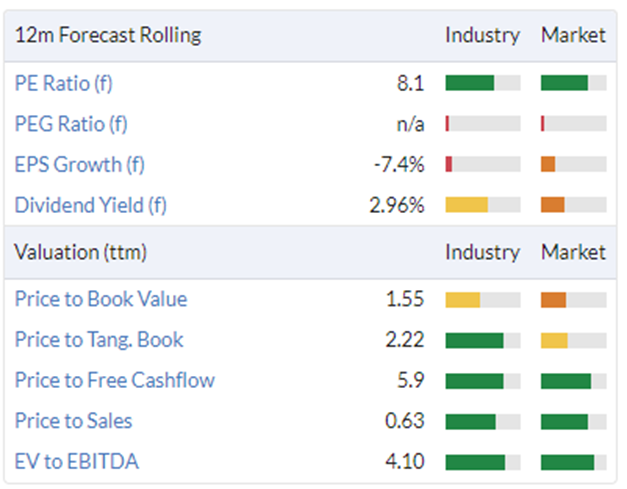

The lack of tangible book value and only just starting to pay a dividend have cost the company a higher Value rating.
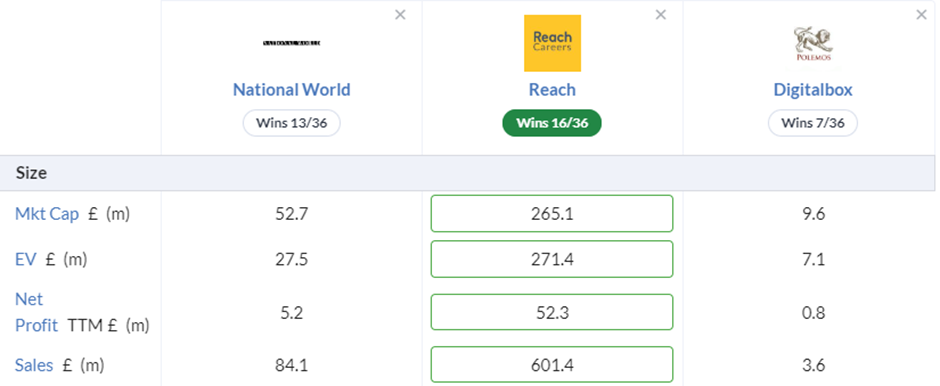
Given the industry, it is worth comparing National World to other news publishers. The most direct competitor is their former acquisition target Reach (LON:RCH) . However, given that National World are increasingly an online-only publisher in areas such s sports, it is worth also comparing them with Digitalbox (LON:DBOX), who publish the Daily Mash. Firstly I'll use the Stockopedia comparison tool.
Here, Reach (LON:RCH) wins, not least because it is a more significant business:
Perhaps the most important comparison for these types of businesses is on an EV/EBITDA basis. And here, on the surface, it appears that Reach (LON:RCH) is on the lowest rating:
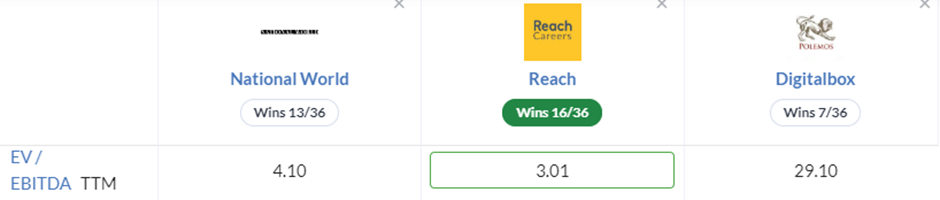
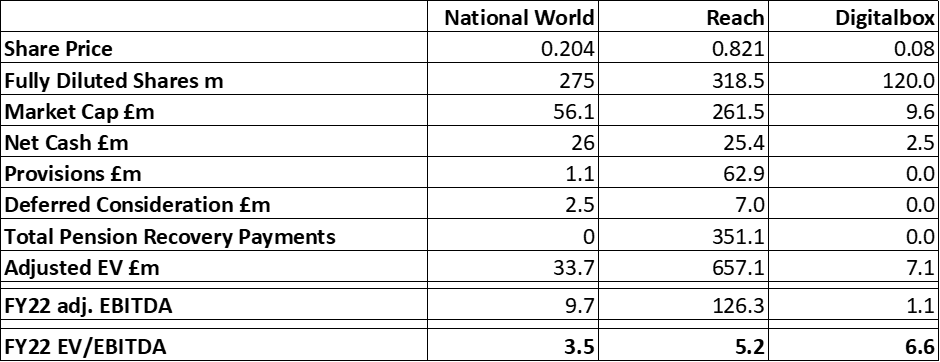
However, in this case, I think the algorithms miss a few key liabilities that Reach (LON:RCH) has that the other businesses don't. The first is a large pension deficit. Pension accounting is a complex issue, which I covered in more detail here. However, the crux of the matter is that the balance sheet amount doesn't have much bearing on the recovery payments a company has to make. So although Reach has a net accounting deficit of just £150.9m on the balance sheet, they have committed to paying over £350m in recovery payments. So investors should adjust their Enterprise Value figures to include the agreed pension recovery payments. The second is that Reach has large provisions relating to historical allegations of phone hacking on its balance sheet. Again, seeing as these will be paid from cash, I believe these should be included in the Enterprise Value.
These adjustments show that National World may be significantly cheaper than Reach and have a better trading outlook. The rating also looks to be significantly lower than digital-only publisher Digitalbox:
Risks
As with Reach, Smiths News and the whole sector, the risk is that physical media declines more rapidly than expected and that National World cannot take cost out of the print publishing division or grow digital revenue fast enough to overcome that decline.
The argument for investing in National World on a low EV/EBITDA is that they can put that cash pile to good use. While the management has ambition, as demonstrated by their attempt to go for the much larger Reach, good value assets may not be available. There is a risk that management wastes the cash on substandard assets because they are available and feel pressured to utilise the money.
Management has paid themselves a significant number of options on listing. The loan notes they issued to management and related parties to fund the JPI acquisition also seemed to have quite generous terms. Although these loan notes are now largely exercised, and my analysis includes a fully-diluted market cap, there is a risk that Montgomery does other deals that favour majority holders at the expense of minority ones.
Recent Trading
In the recent results announcement, David Montgomery said:
Following an encouraging start to 2023 we look ahead to a year of accelerating change combined with sustained profitability.
They continue to show strength in management and execution compared to their peers:
Continuing strong digital revenue bucked the trend compared with some peers in January and February with a 9% year on year increase matched by audience growth of 9%. This is before the benefit of acquired Scoopdragon and Newschain sites which are expected to add over 10% audience improvement.
However, that 9% audience growth does not translate into revenue growth, as advertising is weak. Instead, revenue is down:
Despite total revenue being down 9% year on year, due to economic conditions, we have met our EBITDA target for January and February. Trading is expected to remain challenging for the first half.
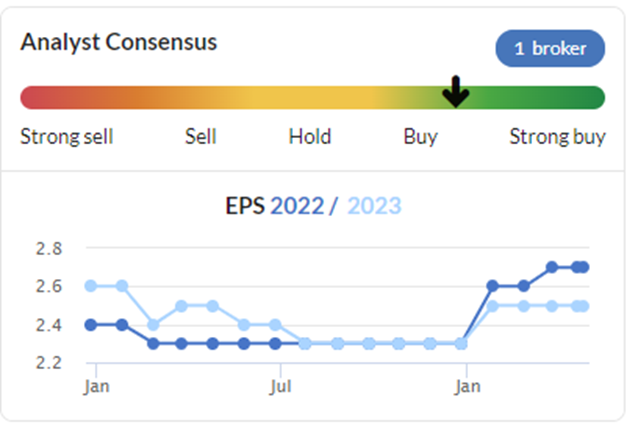
Overall, they say trading is in-line, meaning a slightly lower EPS in 2023 than in 2022. Although both were upgraded following a year-end trading update in January:
Sentiment
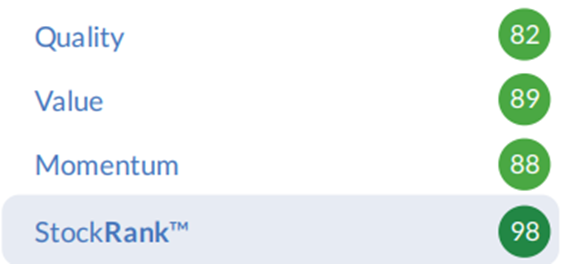
The Momentum Rank is reasonable here but has been falling recently:

In February, the company was a top Superstock with a very high Momentum Rank:
The drop is caused by the recent decline in the share price:
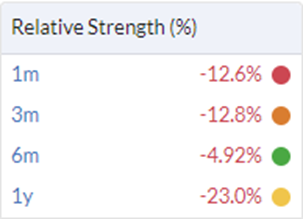
With no forecast change during this period, this is likely to be just weak general market conditions impacting an illiquid stock. However, momentum investors may want to wait to see if a stronger uptrend is established before investing in the company.
Conclusion
National World is a well-run company that looks cheap compared to both the wider market and listed peers. Any investors who own Reach (LON:RCH) should seriously consider National World (LON:NWOR) instead. However, they are not immune to macro conditions, particularly advertising spending. Hence they are unlikely to grow revenue or profits in the short term. Even assuming no growth, they generate significant free cash flow that is starting to be paid out to shareholders as dividends. However, the yield is not particularly high at the moment. Instead, they hold a significant cash balance earmarked for earnings-enhancing acquisitions. The management team is ambitious, as demonstrated by their aborted takeover of a much larger listed peer. However, given the sector and acquisition plans, the stock is not without risk. Despite this, the valuation will undoubtedly appeal to value investors who trust Executive Chairman David Montgomery to deliver similar results to his previous media roll-up, Local World.
[Disclosure: Mark owns shares in National World (LON:NWOR) ]
Disclaimer
This is not financial advice. Our content is intended to be used and must be used for information and education purposes only. Please read our disclaimer and terms and conditions to understand our obligations.

11 comments
Forgive my ignorance but I didn't know that a shareholding above 20% gives an entitlement to insist on the appointment of a director. Is that in this particular company's Articles, or one of the standard sets of Articles, or the Companies Acts?
Thanks,
Michael
hi mark - always great to read your material. couple of questions - this cash pile - what is it doing with it? surely with rates where they are a 25mm (average of year end numbers) cash pile generates cash? a lot of the cashflow generation is WC movements - any sense thats durable?
Hi Jim,
They are almost certainly looking to make earnings-enhancing acquisitions with it. Ones where they can centralise admin functions to take out cost, and drive higher digital adverting sales. Whether they can acquire anything at a price that makes sense is the challenge. They seem pretty cheap, even if you assume they partially waste the cash, tho.
Likewise, for the cash flows from working capital. If you ignore these, they still look reasonable value, especially considering 2022 & 2023 will be weak macro conditions for advertising. They run with negative working capital, so if they can grow they can probably generate further cash flow from working capital but this is unlikely to be as big as 2022. And of course -ve WC has risks associated with it too.
Thanks Mark
AFTER the iEnergizer (LON:IBPO) de-listing (also a share with a low institutional holding) I remain cautious of illiquid stocks.
This is definitely not a cash cow company.
Why are you getting excited for a 2-3% dividend yield , no special dividends and definitely no buybacks?
It is actually the biggest cash cow ever if your name is David Montgomery
Hi yiannos1,
Overall, a single year's dividend payout is a poor proxy for underlying cash generation. In my opinion, a P/FCF of 5.9 and almost half the market cap in cash make this a cash cow. The debate, and I hope I have captured this in the article, is whether they will use that cash wisely, and for the benefit of all shareholders. A lower dividend may indicate a propensity to waste that cash. However, if a company can generate higher incremental ROCE than your average investment return, you are better off with them retaining the capital than paying you a dividend.
A cash cow company is one that uses the cash it generates for the benefit of its shareholders (at least 7% dividend yield and/or special dividend and/or buybacks).
Perhaps a value play but certainly not a cash cow, especially involved in a rather declining sector.
PS. And the announcement supposedly buying a 270m market cap company was daft ( unless they thought Reach plc was going to come after them! ).
I'm afraid that definition doesn't cut it for me. By that definition, if the share price fell significantly they would become a cash cow!
I agree on the Reach (LON:RCH) takeover. Although they claim they had financing in place, and I believe them (remember the board and large shareholders are all very experienced media execs), I reckon it was more about trying to get Reach shareholders to push the board to acquire National World (LON:NWOR) , kick out the underperforming Reach management and appoint Montgomery et al. instead. I suspect the Reach management saw the writing on the wall and refused to engage.
As a National World (LON:NWOR) shareholder, I am pleased they didn't do the deal. I really don't want to be exposed to the cash black holes that are Reach's pension deficit and phone-hacking claims.
At least we agree that they tried unsuccessfully to plot their own takeover, but got to thank them as I did hold Reach at the time.
Much better growth and/or value opportunities elsewhere.
Good luck with National World though; there is a bit of value at the current price but not for me.
Keep up the good and very useful work you are doing here.
Thanks