Nationwide Accident Repair Services (NARS) - Hidden Risk?

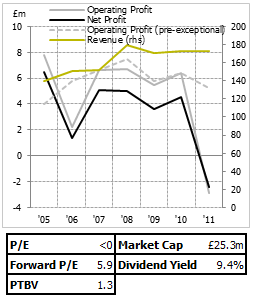 Nationwide Accident Repair Services (LON:NARS) is an interesting stock to me because it sits in such a bizarre spot. It provides pretty specific services - and, in the manner that I love, tells you what it does in the title. They're the largest accident repair network in the UK, fixing over 200,000 cars a year and with the usual sideline bells and whistles (mobile glass repair etc.). Perhaps it's just me and my simplicity, but I like when companies write things like this fact I found on their website: "In a typical year, Nationwide will repair One in every 150 vehicles on the road". That's a helpful statistic. It helps me get an idea of scale.
I started looking at NARS late last week after thinking about what companies could possibly eat up the growing cash pile in my portfolio. I don't like holding cash. It's a non-productive asset. It's not the first time I looked at them, though; that 'honour' came almost 10 months ago, when the price was almost exactly the same as it is now. How time flies and my opinion changes! While I considered that it'd "end up looking pretty cheap" in any case back then, now I can't really find a way to like the shares - despite their huge yield and cheap P/E. There's three main risks, and I reckon they're not particularly rare ones, so I think it's a good case study to list them all here.
Customer concentration
This is something I noted back then, actually, so not too big a slap on the wrist for me in this case. 38% of their revenue comes from their 2 largest customers (insurance companies), though this peters out slightly, as only 75% of their revenue comes from their top 20 customers. The first fact is worrying - the second not so much. The loss of either of their big 2 customers would be a hammer blow to the business, particularly in combination with the points I'll come on to in a minute. However, it's certainly not as bad as it could be. One of the distinct advantages of being the biggest is that customer attrition is lower than in smaller, more competitive industries. I doubt their customers have much incentive to move. Secondly, and while this could be caused by a number of things, there's unlikely to be any huge driving competitive forces cropping up. The company earns unspectacular returns.
The 'hidden' debt
I call operating leases hidden debt because they're like debt in all but name, really. They're stuck down in the footnotes of the financial statements and are rarely talked about by management. Companies are still obliged to pay them, like they are a bank loan, though. Consider the difference between renting £100m of property with long-term leases and getting a £100m loan for property and buying it yourself. Frankly, they're not hugely different situations. The second leaves your balance sheet looking a lot fatter than the first, though, and worsens your debt ratios.
Nationwide's balance sheet balloons significantly when you factor in those leased assets. As an example - if you were to just take a look at the balance sheet on their last annual report, you'd see £11.4m of property, plant and equipment, and £68m of total assets. Equity sits at £26m. This is reasonably small. Depending on how you capitalise those operating leases, though, you're looking at whacking another figure of roughly £80m on both the assets and liabilities sides of that balance sheet. Not so slim now - we've just more than doubled assets and liabilities. The debt to equity ratio, for instance, skyrockets. It might be considered over-conservative or pessimistic, but operating lease commitments are a real problem - it's not hard to find companies (Howden Joinery is a good one) stuck with onerous lease commitments, in their case from the blow-up of MFI.
The reversed debt
As usual, I'll preface any of me talking about pensions with a statement (even more than usual) that I am, essentially, trying best to learn as I go along. Some of the pension accounting is difficult given that I have not formally studied it. The low-down with regard to NARS, though: their balance sheet records a £11.4m surplus on their pension scheme. Fantastic! But rather rare, so it requires some delving. In fact, when we look at the footnotes, we see that the present value of obligations (the liability) is £83.3m. The market value of the assets is £57.2m. This yields a £26m deficit, not a £11.4m surplus. What gives?
Well, as I understand it, companies have essentially two choices when it comes to these 'unrecognised actuarial losses' on their pension scheme - the £37.4m difference between what their balance sheet says and the actual funding status of the plan. They can record the swings in their statement of comprehensive income, which avoids the P&L, but obviously looks volatile as it makes equity look particularly swingy. So it is. Pension schemes are volatile, after all. Alternatively, they can take the approach of amortising these actuarial losses over a long timespan (the corridor approach), thereby presumably trying to avoid the volatility and smoothing out the results. They're basically hoping this difference will correct itself over time, and that (like a lot of economic statistics - business cycles etc.) it's simply deviating around a trendline.
Yes it's dry, but to say it's 'material' to the valuation is an understatement. The difference between those two figures is £37.4m. The market capitalisation of the business is £25.3m! If they were simply to recognise the actual status of the pension plan, they would swing into substantial negative tangible equity. There's other factors in play here; bond rates are exceptionally low at the moment, inflating deficits. On the other hand, the assumptions NARS use include a long-term 8.7% yearly return for equities and property - a figure that seems pretty steep to me. It's just a big slab of non-operational risk, based on a bunch of assumptions I don't know much about. Mortality rates, long-term returns, inflation - I'd rather just analyse companies.
Three's a crowd
It should be obvious from that, then, that I can't invest here. There's too many risk factors. If there's one thing it reminds me, it's that simply looking at P/Es and PTBVs is always going to be insufficient. Fortunately, we live in the digital age, and I can harness the great library of the web - I can dash around bits of the web trying to slowly piece together an understanding of pension funds, and reading the (often extremely insightful) posts of fellow bloggers. As time passes and I read back on my old posts, I see things I've since learned that I didn't know then - sometimes painful, but long may it continue!
Disclaimer
This is not financial advice. Our content is intended to be used and must be used for information and education purposes only. Please read our disclaimer and terms and conditions to understand our obligations.
No comments yet
No one has commented here yet! Why not be the first one?