One up on Gordon Gekko — Four rules to profit from director trading

There’s that stretch over the Christmas holidays when the days all blur together. You can't tell if it's December 27th or 28th. I passed the time with movies, starting with the Christmas classics (I was forced to sit through Muppet's Christmas Carol) before moving on to Oliver Stone's Wall Street. The film stars Michael Douglas, as the ruthless tycoon Gordon Gekko, and Charlie Sheen as Bud Fox, Gekko’s eager apprentice.
There’s that scene where Gekko needs share tips. Bud Fox produces some run-of-the-mill analysis. Gekko shoots back: ‘Come on, pal. Tell me something I don’t know… It’s my birthday!’ A bead of sweat drips down Bud's forehead as he searches the darker recesses of his mind, knowing that this is the point he should not cross.
‘Bluestar…’ Bud forces a response. ‘Bluestar Airlines! They just got a favourable ruling on a law suit. The decision would clear the way for new planes and route contracts.’
‘Well how do you know about it?’
Bud gulps. There is another stretch of silence as more sweat drips down his forehead. He can only muster, ‘I just know…’
Spoiler alert! Towards the end of the movie Bud is arrested. The information Bud passed on to Gekko was non-public, material information — ie. confidential information that would significantly move the share price. Bud and Gekko had engaged in insider trading, violating laws that ban the use of confidential information to gain an unfair advantage. Unfortunately, the movie is not pure fiction. The characters are based on real financiers. The events are based on real scandals.
Oliver Stone’s film was a piece of social commentary, suggesting that investing can be an unfair, corrupt game because some investors have significant informational advantages over others. Regulators work hard to ensure that price sensitive information about stocks is fairly disclosed. Nevertheless, there is an 'inner circle' with intimate knowledge of a company’s future prospects. Do investors need this intimate knowledge? Not necessarily. We don’t need to be part of an ‘inner circle’…
What if Gordon Gekko had to play fair?
Of course, white collar crimes do take place, but the game of investing is perhaps more fair than Oliver Stone's movie made it out to be. It’s true that information asymmetries will always exist. For instance, a CFO will have advanced knowledge of a company's financial performance. It is also legal for company directors to buy shares in the firms they manage. At the same time, various laws aim to level the playing field by requiring companies to disclose director trades — i.e. trades made by CFOs and CEOs and any other director that manages the operations of a company.
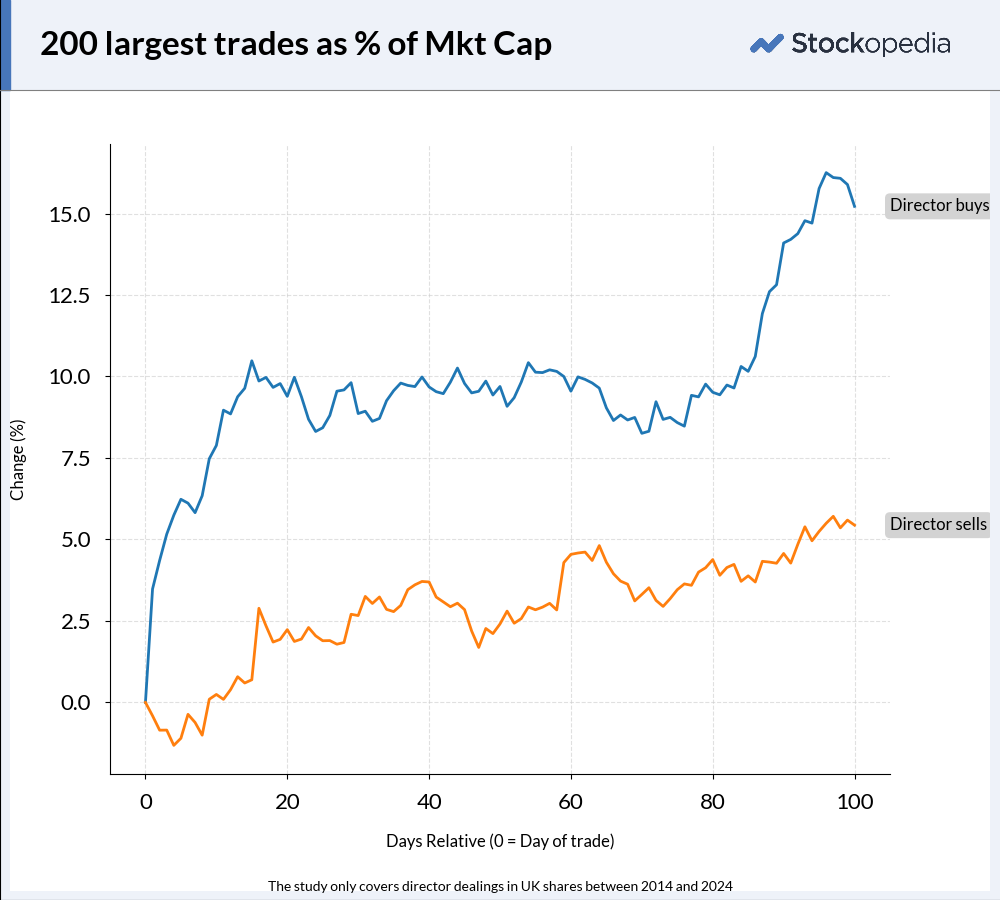
When directors trade, this can create opportunities for investors to piggyback directors’ transactions. This is a legal form of ‘insider dealing’, based on publicly available information. We've crunched the numbers and can pinpoint a series of signals that investors can use to capitalise on director transactions. Four samples were analysed:
- The first sample consists of director trades that make up a large percentage of market cap. We focus on the 200 largest trades.
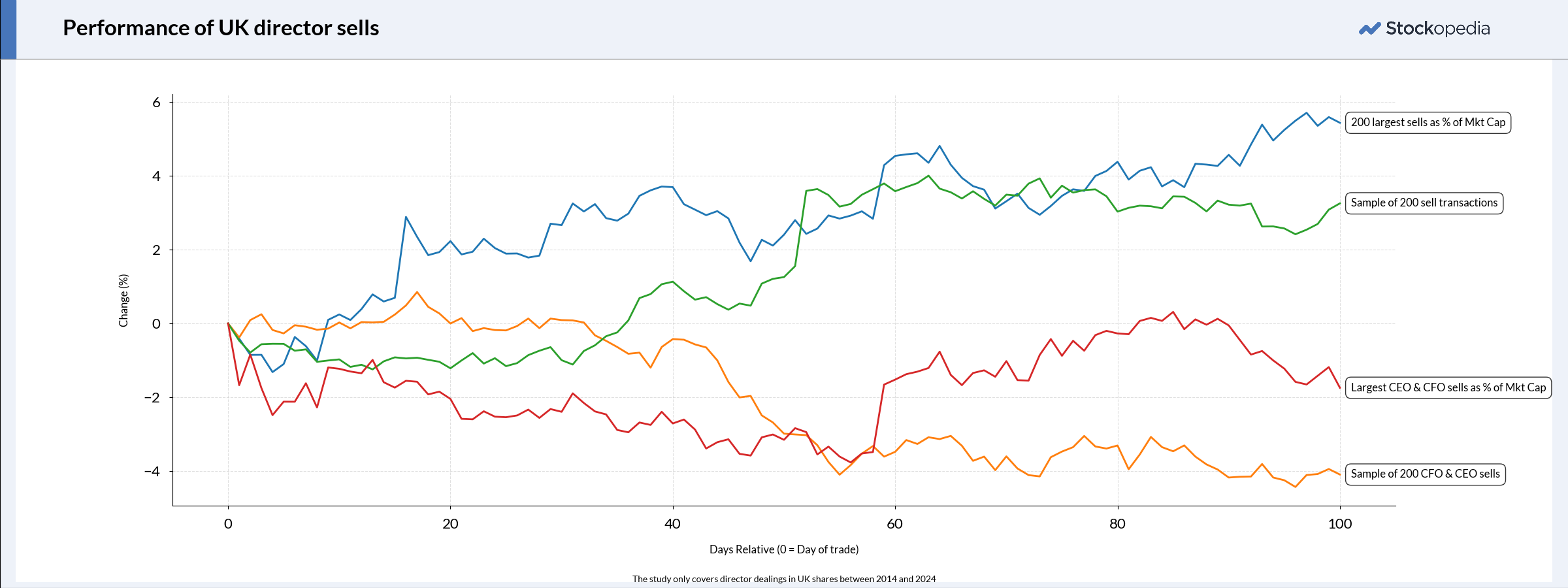
- The second sample is the same as the first, but we filter for CEO and CFO trades which make up a large percentage of market cap. Again, we look at 200 trades.
- The third sample is a randomised selection of 200 CEO and CFO trades, regardless of the percentage of market cap.
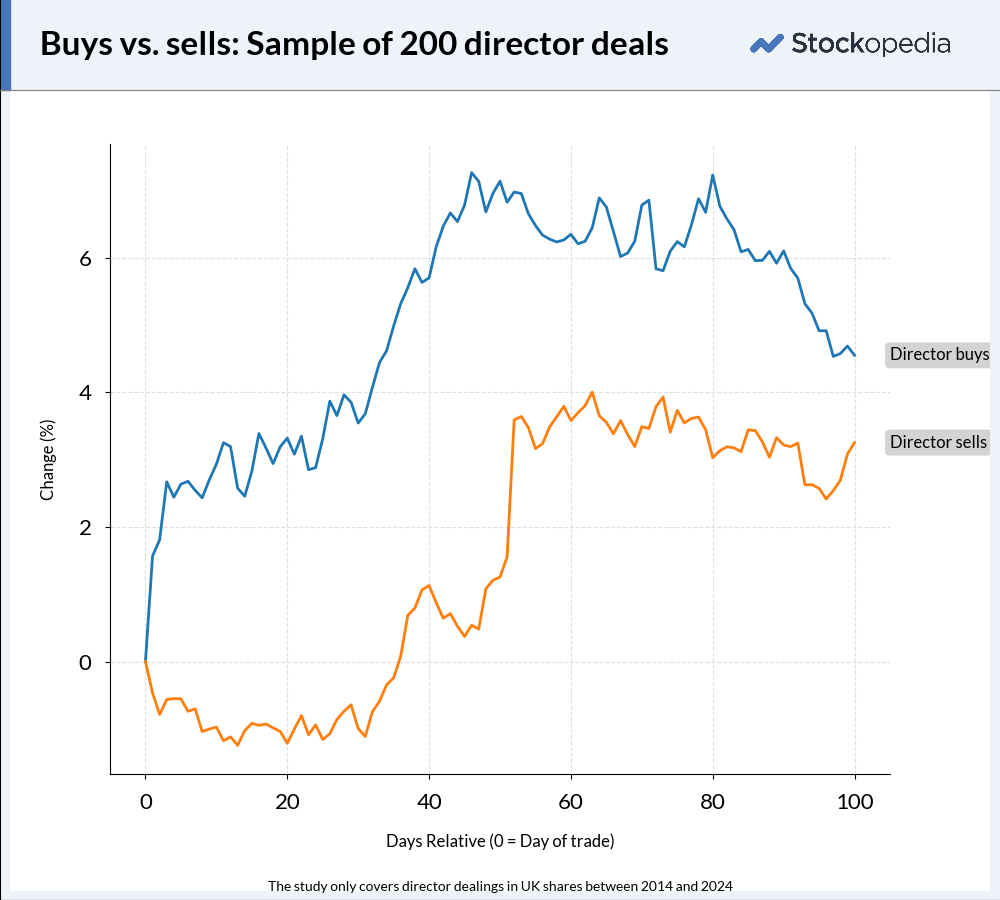
- The fourth sample is another randomised selection of 200 trades, regardless of the job title and regardless of the percentage of market cap.
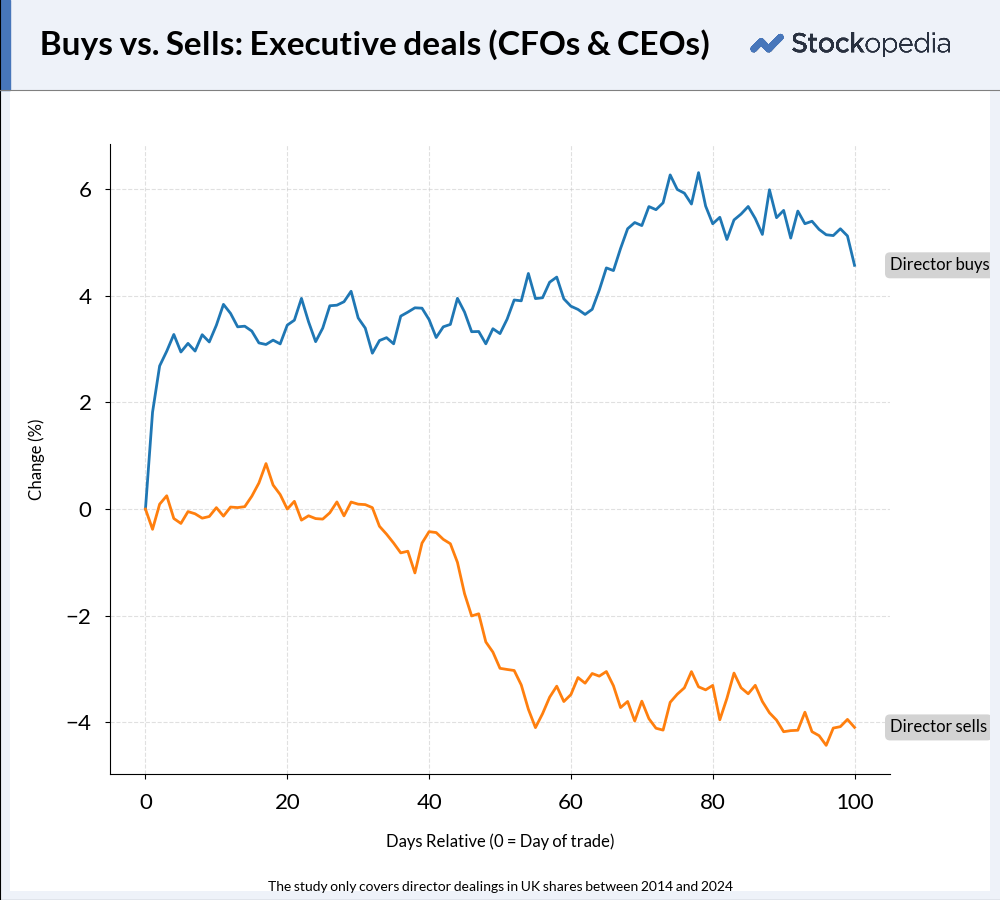
Rule 1: Director buys outperform director sells
It will come as no surprise that director buys have a tendency to outperform director sells. When a director buys shares in their own company, it is often seen as a signal that they have confidence in the company’s future prospects. The same is not necessarily true when a director sells shares, although there is a bit of nuance to unpack. Directors may sell for any number of reasons, such as purchasing a house, diversifying their wealth, or paying taxes. The star-fund manager Peter Lynch put it like this: ‘Insiders might sell their shares for any number of reasons, but they buy them for only one: they think the price will rise.’
There were even cases when director sells were followed by strong share price returns, so we need to explore additional criteria…
Rule 2: Focus on ‘C-suite’ transactions
While the signal from director buys is generally quite strong, the same is not true of director selling. That can be because some positive director sales can muddy the signal. For example, in January 2021, the founder of fleet tracking company Quartix Technologies (LON:QTX) sold shares for the first time since the company had been listed on the market. The reason given at the time was to free up space for institutional demand. Sure enough, a couple of months later, Sandford DeLand’s Buffettology fund had taken a stake in the business, prompting a positive share price reaction.
But we can add clarity to director sells by focussing specifically on trades by CEOs and CFOs. When ‘C-suite’ directors sell, the returns tended to be negative. We can also see that C-suite sells underperformed C-suite buys by a significant margin.
Rule 3: Focus on material buys in smaller companies
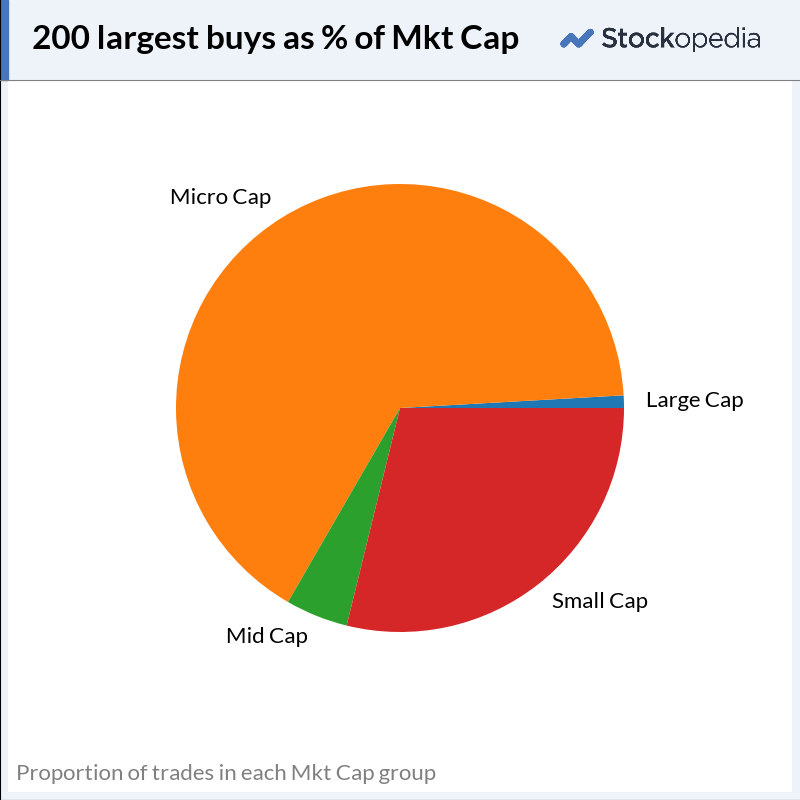
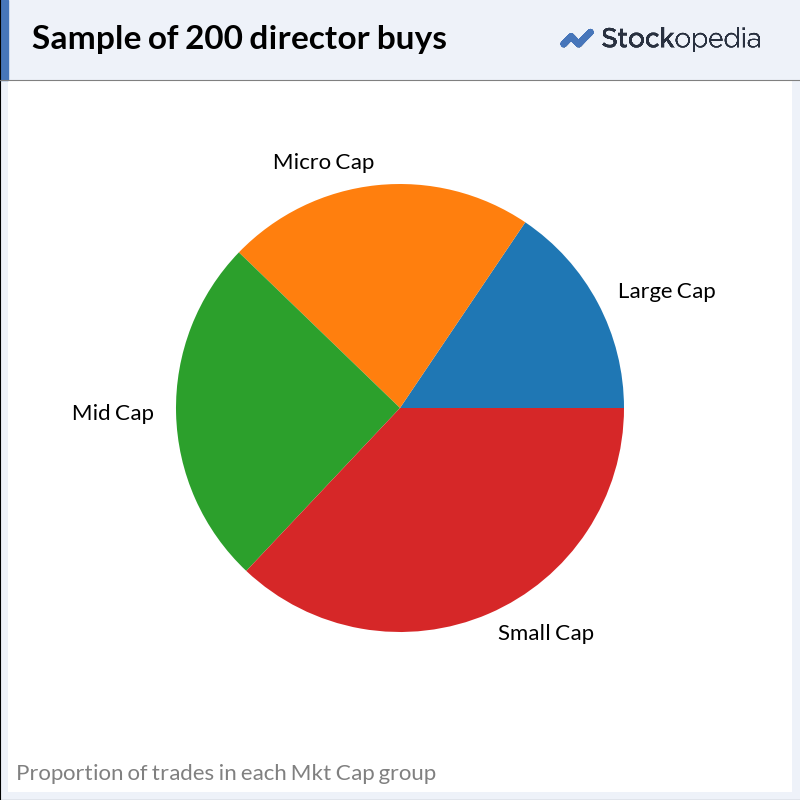
To increase the chances of identifying winning stocks, it can help to focus on a specific type of buy transaction. Research by Lakonishok and Lee revealed that director dealings are a stronger indicator in smaller companies. Analysing one million trades from 1975 to 2005, they discovered that returns were significantly higher when insiders traded substantial amounts of stock. This is broadly consistent with our own research. We found that director buys generated the strongest returns when the transaction represented a larger percentage of market cap. Naturally, these transactions tended to take place in smaller companies, where it is easier to buy a larger share of the company.
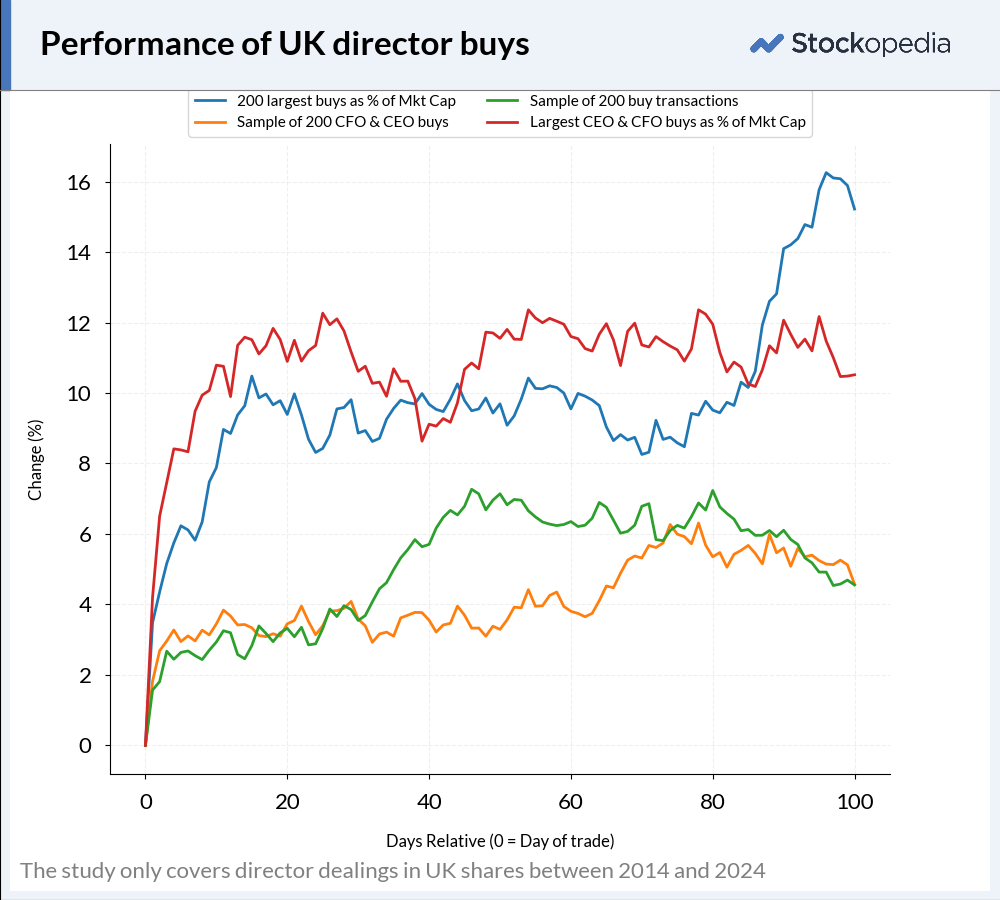
Table 1: Minimum and median amounts for largest buys as % of Mkt Cap
| Plot colour | Trade Type | Director type | Min % of Mkt Cap | Median % of Mkt Cap |
|---|---|---|---|---|
| Blue | 200 largest buys as % of Mkt Cap | All director trades | 0.0207 | 0.04 |
| Red | 200 largest buys as % of Mkt Cap | CFO/CEO trades | 0.0039 | 0.007 |
Rule 4: Don’t worry about missing the bus!
The ‘post-announcement drift’ is a fascinating trend in investing. It refers to the tendency of a company's stock price to continue rising steadily for weeks or even months after the announcement of favourable news. This phenomenon would puzzle someone like Issac Newton, who observed that what goes up must come down. During a ‘post-announcement drift’, shares that have gone up defy gravity and keep going up.
This phenomenon becomes easier to understand when we consider human psychology. For example, imagine yourself in a casino playing roulette. The wheel has just landed on red, and it has landed on red several times in a row. At this point, you might feel hesitant to bet on red again. The Russian novelist, Dostoevesky, described this behaviour in The Gambler:
A thing took place which is actually repeated quite frequently in gambling. Fortune attaches itself to red, for example, and does not abandon it for some ten or even fifteen times in a row. I heard just a couple of days ago that red came up last week twenty-two times in a row. Needless to say, everyone immediately abandons red, and after ten times, for example, almost nobody risks betting on it any more.
Re-read the passage, but this time replace "red" with "stock" and "gambling" with "investing." Dostoevsky observed how, in roulette, people tend to avoid the winning colour. If Dostoevsky had been a Wall Street trader, he might have noticed a similar behaviour among investors. There is often a reluctance to buy stock that have already gone up. Investors believe they have missed the bus and the tides may turn. With this mindset, they deliberate and buy cautiously over time.
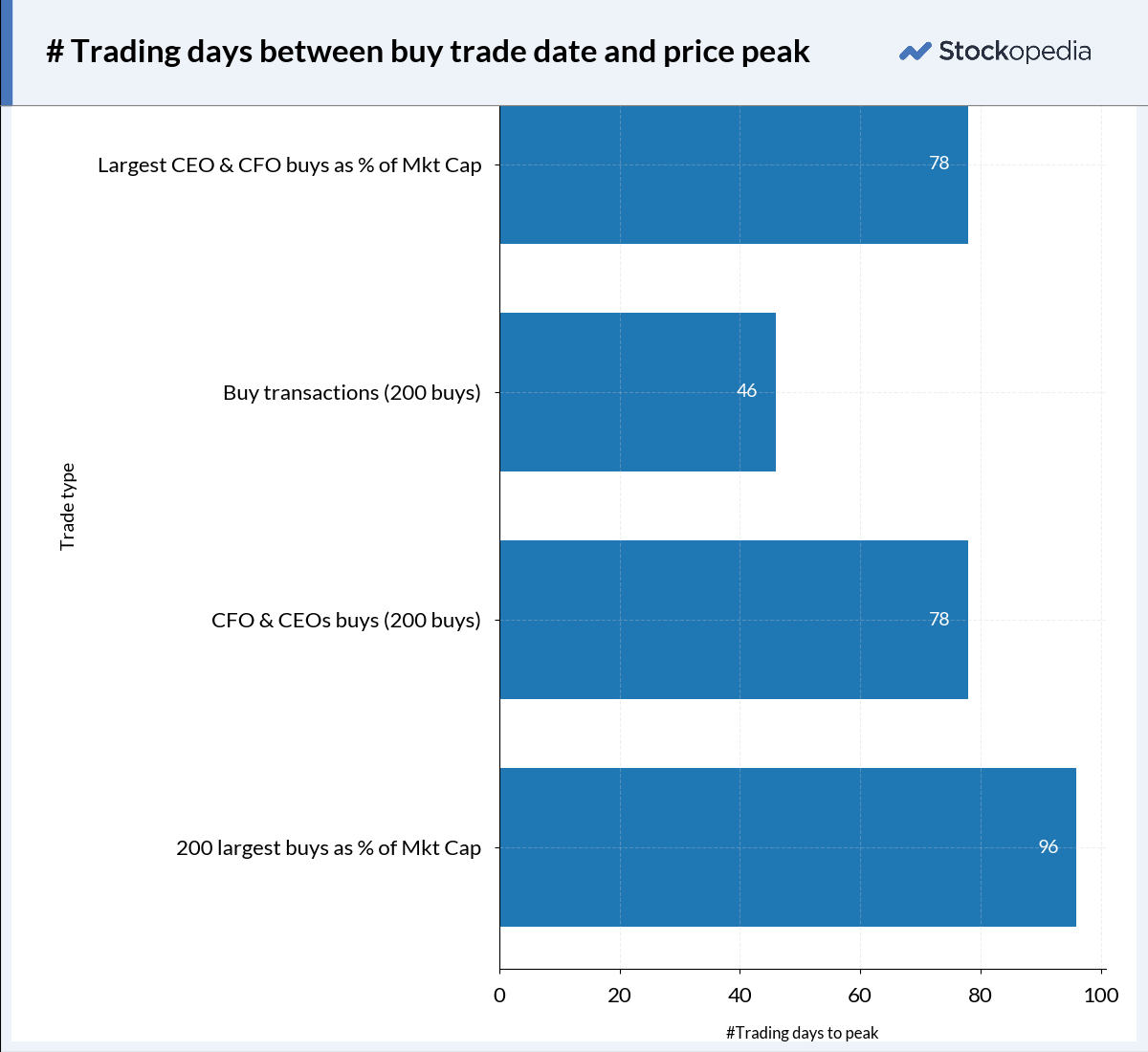
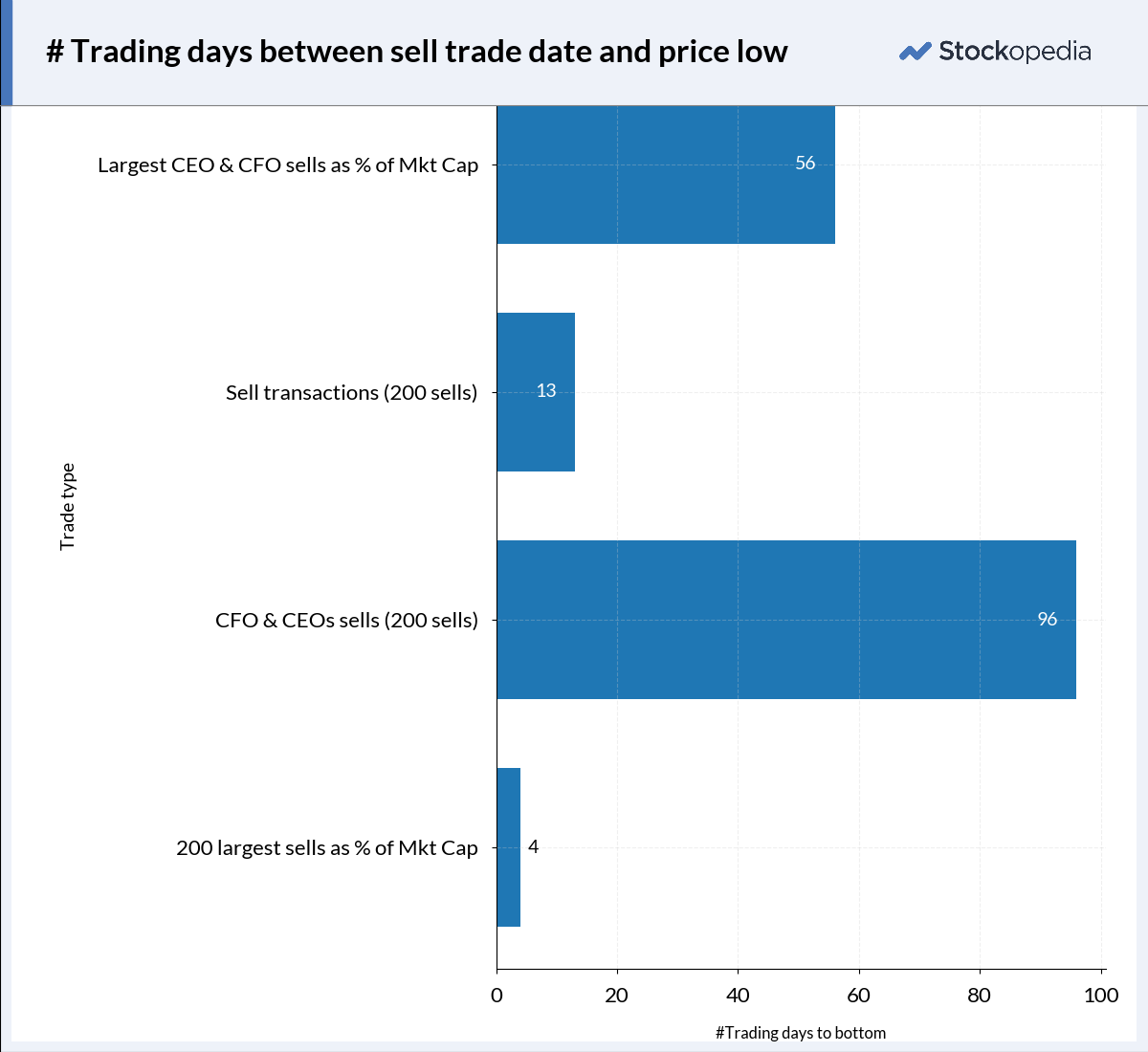
As a result, stocks that announce good news often experience an initial sharp increase, followed by a more gradual upward drift over time. After a director buy, it can take as many as 96 trading days before a stock peaks out. There is a similar trend on the downside if CEO and CFOs are selling.
Next steps
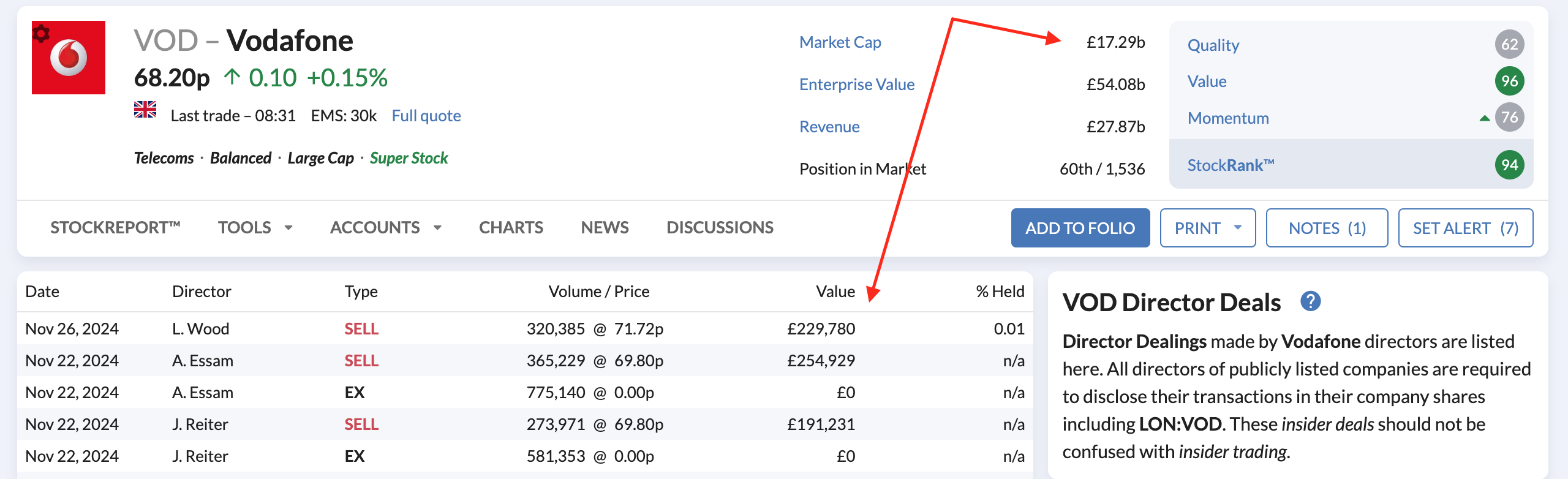
We have the theory. Let’s put theory into practice. Director dealing data can be found on the website (see here). Investors will want to act on a trade that has happened within the last 100 trading days. We display the date of the transaction in the far-left column of the table.
It is also important to identify material trades — i.e. trades that comprise a larger percentage of market cap (e.g. at least 0.02%). The Value column displays the value of the transaction — i.e volume multiplied by price. We also show the market capitalisation towards the top of the StockReport (see here). The two figures can be used to calculate the transaction value as a percentage of market cap. In time, we will calculate this value, so you don’t have to.
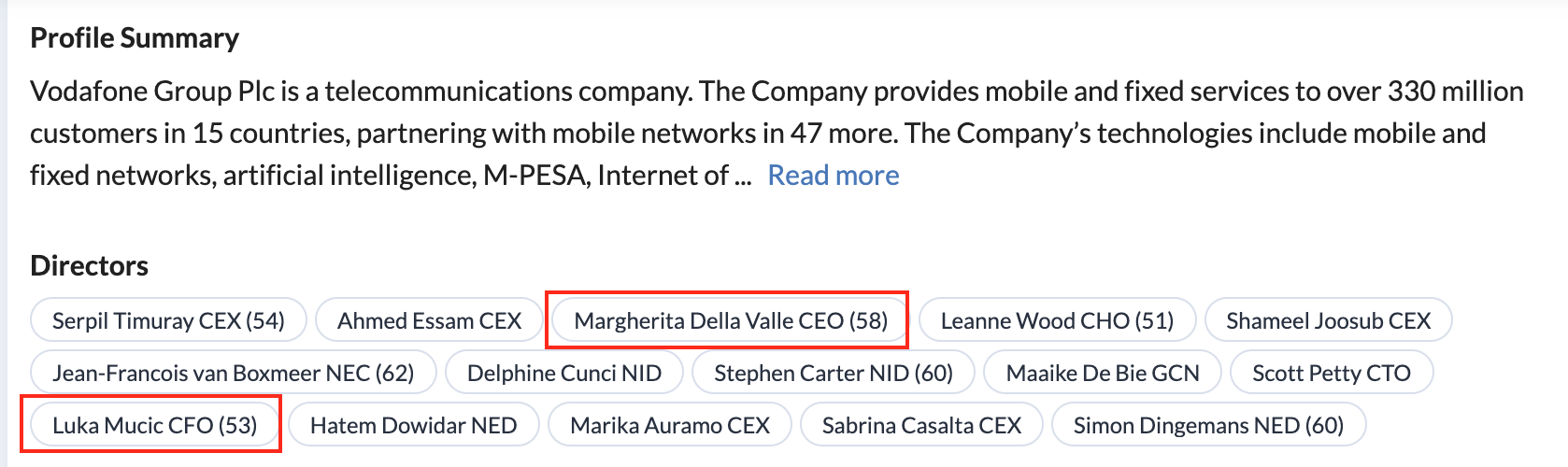
Investors will also want to know who was trading. The names of the CEO and CFO are shown towards the bottom of the StockReport. We show the director deals in the table, so that investors can pay particular attention to ‘C-suite’ transactions.
Going forward, we plan to make it easier to analyse director trades on the site. If anyone has ideas, please do post them in the comments. In terms of the research, I would like to extend the analysis beyond small samples of 200 trades. It is unlikely that the big picture will change, but the analysis would of course be more robust if it encompassed a bigger pool of data. One thing I really want to nail down is the thresholds investors can use to identify a ‘large’ or ‘material’ trade. We can also run some backtests to ascertain exactly how many stocks investors need in their portfolio to profit from a director buy.
Disclaimer
This is not financial advice. Our content is intended to be used and must be used for information and education purposes only. Please read our disclaimer and terms and conditions to understand our obligations.

36 comments
Is it not also important to include the transactions of chairmen, both executive & non-executive?
Some decent director buying at Marshalls (LON:MSLH) recently and chart turning up
Marshalls (LON:MSLH) pretty small amounts though but it does look like momentum has turned. I will put on a watchlist. I have quite a few similar stocks.
It shows Justin Lockwood bought 600k worth of shares on 22nd Jan. Doesnt show on Stocko
I can only see one for 5,000 shares. Where do you get the 600,000 from?
This is from AJ Bell isn't it?
As l said before lots of inaccuracies on that site.
There was a buy of 250,000 shares but it was by the Employee Benefit Trust:
"The Company has been notified by the Trustee of the Marshalls plc Employee Benefit Trust (the "EBT") that, pursuant to an irrevocable instruction given to the Company's broker, Peel Hunt LLP on 21 January 2025, the EBT has purchased 250,000 ordinary shares of 25 pence each in the Company ("Ordinary Shares") at an average price of 239.26 pence per share (the "EBT Share Purchase").
How about setting up a screens feature for this type of information, it would be very useful to track using the four rules and any other variations an investor might want to consider?
One example that proves the point Airtel Africa (LON:AAF) up 10% today and nice trend developing on large director buys
The Sunday Times used to run an article called "The Inside Track" which followed directors dealings in their own companies. Going ahead 6 months looking at directors buys and sells, was clearly a good strategy to follow as there was a correlation between share price movements following director trades, which was quite substantial in some cases. I did raise with Stockopedia a few months ago to see if they could add a screen to track director purchases and holdings so good on Stockopedia for rolling this out.
Thanks Alex, I enjoyed this article. Would it be possible to add something to the 'alerts' feature, say, under the News area in the top right corner: 'Send me an alert when a director trade is announced'. And maybe an option for 'all' or 'C-Suite'.
Hey, we have the 'C-Suite' data internally... so yes, we can in theory use it for product enhancements. Watch this space!
Thanks Alex - is it possible to screen stocks for director buys (view a list of companies with activity) rather than having to go into each individual company’s stock rank page and review if there’s buying or selling activity?
I second this too. Would be excellent if we could get a director buy filter!
And a filter to screen for stocks with RSI below 30 please..
Many thanks indeed
A great read, which adds further weight to the argument for momentum trading.
I'm wondering if there is a way to search for director dealing in the screens, especially where they are significant? The only way I can seem to find them is by trailing through RNS releases, or by looking at the director dealing page on the reports.
I do find - and please put me right if I'm wrong - that Stocko information on this type of data can be hit and miss. Trades don't seem to appear as quickly as they could. It's a real shame as I am more and more convinced that this type of 'trading' activity can be more lucrative that buy and hold quality if you are comfortable with the risk.
AJ Bell have an excellent directors dealing page. It appears to capture everything. I check it around once a week.
https://www.ajbell.co.uk/markets/directorsdeals
Thanks Chris, I’ve been with AJB for 5 years and I never knew that page existed!
I used to use it but stopped, as there were too many errors, maybe it is better now?
This is where I check out the bod trades. Be wary though, sometimes the trade is incorrect, so you need to go check rns to confirm. Best buy I did following a bod buy was with the old Sunlight company, CEO bought £1m, and 2 months after the company was taken over for about a 70% premium if I remember correctly.
https://www.ajbell.co.uk/marke...
I generally just do a quick scan down the pages looking for trades around £100k+ once a week.
Sorry, which pages are they? Thanks
The pages of the director buys. Link above of previous post.
Thanks
Thank you - really useful, as a way of directing us to RNS for confirmation.
Liontrust Asset Management (LON:LIO) : £1M worth of shares bought by CEO/CFO since late November. Ideal situation here to track the value of this article in what is an extremely contrarian trade. Are directors seeing a change in fortune in fund outflows or are they “off their bleedin rocker” as Cockney Rebel so poetically put it. Time will tell.
Great spot. Like Vistry. Terrible CEO buying (so far!).
I don't know, but what is the wealth of the CEO/CFO. How much does the £1m matter to them?
Elon Musk could buy half of BP and make himself CEO and you'd think that had to be a signal but at 10% of his net worth... would it be? (Probably yes in his case)
Think this looks interesting, the share looks too cheap pe, div yield, book value and with directors buying a decent amount in short period of time could be a good one to go in on.
It would be interesting to know (I have some theories) if there is any consistent forward performance to directors trading when:
- the amount is a relatively large/small amount of their holding (e.g. a 40% owner selling 1% is intuitively less of a concern than selling 20%)
- the recent performance of the stock, and the relative amount then too e.g. the recent director buys at Vistry have been - so far - a pretty bad example, but is that always the case, and does it matter vs the directors wealth
- what is the impact when there has been no significant recent news? You might think that should be a strong signal of news coming, or genuinely independent trading for personal reasons (property, divorce etc)
Have you filtered out share sells after directors received vested share awards or exercise options? These are subject to income tax and NIC in the UK, and directors often sell sufficient to pay the tax liability,
Unfortunately the information is not always accurate and there are inconsistencies, such as some share options are shown but some are not.
On US stocks there are not many buys as directors, get so many free shares.
Directors can buy shares to try to move the market, ie try stop the share price falling.
"Regulators work hard to ensure that price sensitive information about stocks is fairly disclosed."
There is a lot of information not being disclosed, look at all the takeover approaches, that have not been disclosed, until months later. A lot of information is not disclosed to private investors. Institutions can often buy shares at a discount which not available to PIs.
How is that fair?
Are you saying CEO and CFO are maybe doing insider dealing?
Hi. Obviously not all information is disclosed, but investors can arguably use buying activity as a proxy for directors "finding out" about good news (and vice versa for sells).
Yes but does not always work, look at the massive share buys at Vistry (LON:VTY), there was over £7m at 931p. I have follow director buys and sells in the past, with mixed results.
Indeed. We do not have 'perfectly efficient' markets, where all relevant information is fully and instantly reflected in asset prices. So we use 'proxies' for relevant information. The research suggests those proxies are generally effective, even if they are not silver bullets. If I find a silver bullet, then I will certainly use it!
Vistry (LON:VTY) Ive also been puzzled by this - Usman Nabi runs (maybe owns) the hedge fund Browning West - listed as largest shareholder. I'm not sure he made the £7m investment in his own name but anyway its certainly big time and the shares are now off their low of mid Jan.
Interesting analysis. Yes it would be useful to flag C suite buying & selling and also institutional changes. I frequently look at the relevant stock report sections but it would be useful to have a flag on the page a bit like 'ex dividend' to highlight a change just in case one misses a RNS.
It would be useful for C-suite directors to be highlighted in the director dealing table, or at least to display information about the company’s directors on the director dealing page.