Plastics Capital & Vertu (PLA, VTU): Played out and playing out

Last time, I looked at Tesco & Dart Group[1] - one company I like the look of but haven't bought, and one company I'm starting to like the look of less but hold having bought it many moons ago. Today, it's another company which has been with the portfolio since inception - the perennially under-the-radar Plastics Capital, and the more recent portfolio addition of Vertu Motors. Both companies released full-year results in my little hiatus, and thus now present me with a great reason to reacquaint myself with what's going on and decide whether I still think they're wise holdings.
Plastics Capital
I really liked Plastics Capital's business model when I 'bought' it way back in June 2011, and I still like it, though with more expressible reasoning now. I like Plastics Capital because they dominate a number of very niche industries, holding large market shares in things like plastic ball bearings, crease matrices (used in the production of cardboard boxes) and hose mandrels. These are ludicrously specific things, and by nature they lend themselves to a small group of small companies producing them. Like investing in the small cap space, I suspect a company investing in a small industry is likely to find more inefficiency and more potential for supernormal returns on capital. In some ways, you might even think of Plastics Capital as an investor itself - they're acquisitive, and their results say they want to continue to be acquisitive, buying more businesses in the same framework they already have.
Results are broadly in line with market expectations, judging by the relatively small price movement, and now place the group on a worst-case P/E of about 20, and a best-case P/E of about 14. The discrepancy arises from the amount of amortisation you feel it's appropriate to exclude from that figure; things like customer relationships, IP rights, trademarks and technology are all being amortised at different schedules, and investors should be cognisant of that before ever placing too much trust in a misleadingly certain headline profit figure.
This might seem quite expensive for such a small company, and I think you'd be right. It's no longer obviously cheap, and in hindsight I didn't buy it at a huge discount to (what I'd now estimate as) its intrinsic value. The calculation of profit does confuse things, particularly with depreciation and amortisation, but I suspect most of the upside from here - if any - will come from growth, not re-rating. If the company's organic expansion story picks up, something I have no real opinion on, we have more value; the company earns decent returns on capital as is and one would expect any further investment to occur (given synergies etc.) at a higher RoIC than they currently enjoy. There's also potential if they identify a good acquisition target. This is something you have to trust management on, and it might be worth trying to get some more detail out of management (or from teasing the figures) on rates of return on their previous acquisitions.
No huge conviction on this, though.
Vertu Motors
Vertu Motors feels like a thesis which is sort of playing out, though perhaps I shouldn't claim any credit - the sector as a whole has risen pretty substantially in the last year, so it's difficult to claim I added a great deal of value beyond thinking that the sector was good. See the chart below, where I've also added my 'recommendations' on them last time:
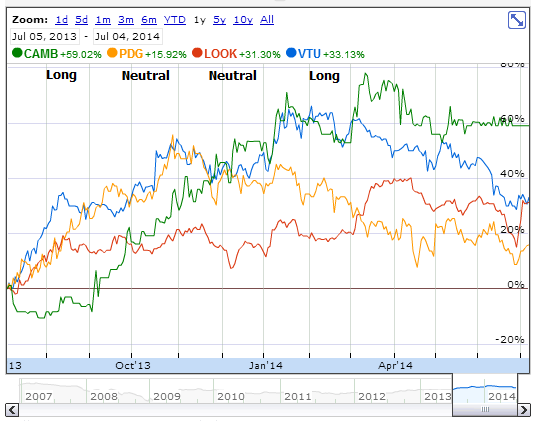
A long/short (as I tentatively floated) would have done you quite well; a long-only would have done you much better. Anyway, why do I think the thesis is playing out? Well, if you want to reacquaint yourself with what I said fully, the four part series and links thereto can be found here[2]. If you don't, most loosely and broadly Vertu appealed to me because it was the one of the bunch which was most underperforming on a return-on-capital standpoint; they had lots of assets, but those assets weren't anywhere near as productive as Lookers or Pendragons. Why is this? Clearly, if that trend is going to continue, they're worth far less - end of story. I didn't think it would, though; the reason they were underperforming was a function of strategy. It was to buy underperforming businesses on the cheap, spend some money and time turning them round, and thus effectively build a dealership empire the 'cheap' way. The cost? A few years of pretty bad looking figures. Why do I say this is playing out?
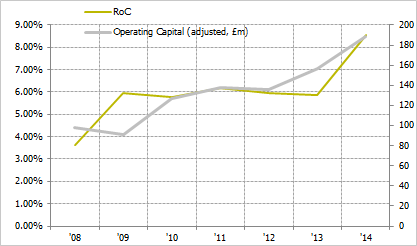
Even as the capital base is continuing to rise, VTU's return on capital figures are being pulled up towards the group average. I expect this trend to continue in coming years, as the ramp up in acquired underperforming dealerships takes a while to filter through and because VTU seem to have changed their strategy a little - I've noticed more acquisitions of premium brands. Maybe the really cheap deals just aren't there any more. Maybe management now has their sights set on a more rounded dealership group.
Vertu is less obviously cheap as it was - it has risen 35% on my buying price. Comparatively, though, I still think it looks pretty good value. The important question for me is whether I'd want to hedge off the sectoral risk by going short on one of the other names, since the sector as a whole feels pretty optimistic.
References
- ^Tesco & Dart Group (TSCO, DTG) (expectingvalue.com)
- ^here (expectingvalue.com)
Disclaimer
This is not financial advice. Our content is intended to be used and must be used for information and education purposes only. Please read our disclaimer and terms and conditions to understand our obligations.
1 comment
Hi EV,
I saw the Plastics Capital management last week and have attached my notes below. It still looks like a good long term story to me but if it could announce some contract wins in the Bearings business I think the shares would respond very positively. In the meantime I don't think the shares are likely to cause much damage to my portfolio.
"Plastics Capital (Market capitalisation; £41.6m, 137p and 2.2% of JIC Portfolio): Following last week’s steady if unspectacular results for the year ended 31st March 2014, I met the Executive Chairman, Faisal Rahmatallah and Finance Director, Nick Ball. To recap, turnover grew by 3.3%, pre-tax profits 8.7%, earnings per share 11.1% and dividend per share by 50.0%. Operating margins increased from 14.3% to 15.1% and year end net debt fell by 14.3% to £7.17m. Growth was driven by Mandrels where sales were up 39% and Industrial films, +5%. Progress was made across the business in securing new accounts and the company invested in significant new capacity, especially in industrial films and mandrels.
Management were excited about its prospects in China following the acquisition of the creasing matrix business Shengli earlier this year. It now has 51 employees in China with £2.5m of sales and has appointed good local management. During the current year we should start to see benefits as Plastics focuses on boosting sales of bearings, mandrels and creasing matrix in the Chinese market.
The one disappointing business, which unfortunately is also the largest, was Bearings. Sales here were down 8% with a slow conversion of new business to production. Margins were maintained as costs were kept under control. Rahmatallah has made significant changes to management, appointing new Operations, Sales, Finance and Legal/Commercial Directors in the last year. Management are clearly both excited and disappointed by the progress at Bearings. The pipeline is strong but converting to actual production contracts is proving difficult and slow. The prize is huge as in most cases the contracts are with automotive companies and have a long life of 5-6 years plus.
The last year was described as a year of progress and the current year has started positively with an improving order book. The pipeline of new business remains very strong and the “conversion to production contracts” is the key focus. With net debt down to £7.2m compared to £19.6m in March 2009 and interest cover at 13.0x, (compared to 2.8x in March 09) takeovers are back on the agenda.
Conclusion: I like Plastics Capital because Faisal Rahmatallah makes sensible investment decisions to boost its medium and longer term growth prospects. With a near 10% stake in the business he acts like a long term owner of the business rather than just being focused on the short term share price. The next year should see further steady growth with analysts forecasting 13.5% earnings growth putting the share on a PE Ratio of 10.8x. The following year forecasts point to a further 18% growth so that the PE ratio falls to 9.2x. The dividend is forecast to grow by a further 33% in the current year leading to a useful prospective dividend yield of 2.9%. I think the share price should make further progress in the next year but what could/should really give it a boost would be contract news in the Bearings Division. This is the division that has the scope to move Plastics from a £32 million annual sales business to a £50m business over a few years. I currently hold 2.2% of the JIC Portfolio in Plastics and have made 18% since buying last November. Happy Holder for now but on evidence that growth was accelerating I would consider adding."
"