Plastics Capital (PLA)/ Creston (CRE): Small pair

As I mentioned last post, while looking over my portfolio I thought it'd probably be prudent - at long last - to take another look at Creston (LON:CRE) and Plastics Capital (LON:PLA) . Both are companies which have been with me since 2011, and their fate is something of a sorry one. They originally had weights of about 5-6% in a portfolio with more stocks than I now particularly like holding, and since the rest of portfolio happily appreciated while both CRE and PLA hovered around the same, they now occupy about 3% each in a portfolio with only 11 shares. They haven't done that badly, to be fair - PLA is up 15% pre-dividends and CRE about 20%, but that's hardly an exciting return for a small cap share over the last couple of years. The last paragraph of my last post most or less sums up my thoughts:
I'm not averse to having such small holdings, but given their size I haven't taken the care I should do with considering them. I'm very much of the opinion that too much diversification simply dampens returns, so I want to either reaffirm that I like the shares - and therefore buy more - or decide that holding them simply because they haven't done much and I haven't given them much thought is a fool's errand, and therefore sell. Expect a post on that soon!
So, without further ado, a short section on each of the offenders, and what I'm planning to do with them.
Plastics Capital
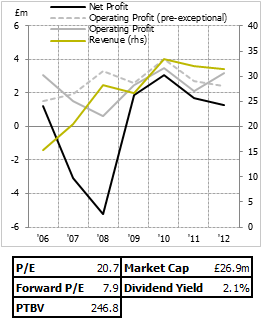 Plastics Capital is a 'consolidator' - they acquire different companies, cut out centralised costs and generally enjoy some of the advantages of scale. They're not huge, mind you, but they are certainly a collection of companies which benefit from being under the same banner. The sort of companies they acquire are achingly niche, too - a producer of 'crease matrices', for instance, which are components used in the production of cardboard boxes and packaging.
I like the business strategy, and given the niche nature of it it's perhaps not that surprising that the company has consistently earnt a strong return on capital - above 20%, for the most part. Its figures as reported under-represent the strength of the business, since the company has about £1m of amortisation chopping down their profits every year - a charge which basically comes about from the reduction of an intangible asset on the balance sheet. Since I mentally chop intangible assets out of the equation anyway, and as amortisation is an entirely non-cash cost, I add this back in when considering a company.
In their most recently released results - the 2013 prelims - the company noted that it had been a difficult year, but posted figures broadly comparable to last year. The outlook was notably more bullish, with apparently 'initial indications that trading conditions would improve'. If you were to normalise their figures, something I don't do for the metrics to the right, I reckon the company's on a P/E of about 8 or 9. Certainly not expensive. The group does have a reasonable amount of debt - net debt stood at £8.4m at year end, and a reasonable amount of effective debt in operating lease obligations.
You're on board with the directors here, who hold about 27% of the outstanding shares (worth about £7m at today's prices) and who seem capable given the acquisitions they've made so far. They do note they're interested in further acquisitive growth, which is a positive if they can continue to find companies of the quality and at the price they have done in the past, which may be getting less likely!
Creston
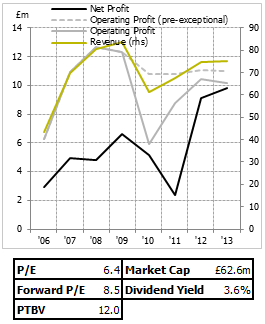 Creston is a slightly less ideologically appealing company for me; they're a marketing group, with all the trappings that usually come with that field. I have a good number of hang-ups about service companies like this, perhaps irrationally, which might explain why Creston occupied such a small position in the first place - and why I never really got involved in any others (except Morson - but look how that turned out!). My biggest problem with them is where the value is created - it is, predominantly, by the people employed in the organisations, and not by any proprietary process, by big factories with expensive equipment or by financial wizardry. I guess it's a testament to inefficiency of the market that more of the returns don't flow to the real value creators.
Ideological questions aside, none of this changes the fact that Creston - along with other marketing companies - can churn out impressive results with consistency. Take a look at something like WPP if you want proof of that. Perhaps the fairest way to value an advertising company is simply to look at what it's done in the past, then, and assume - since the business is fundamentally the same, with most of the same people, processes and customer relationships, a reasonable continuation thereof. Creston, for their part, have done a pretty good job of bringing profits up over the last 7 years.
Judging by their interim statement, this year might not be quite as good as last year, though there are some reasons for positivity. Call me a cynic, but given these are people paid to persuade, I ward myself more than usual against management bullishness! There seems to be potential for growth, though, and management do talk a good talk about cross-selling and up-selling and selling generally in directions which don't mean a great deal to me but probably mean more profit for the agencies.
Conclusion
I actually quite like both companies - more than I thought I would having ignored them for so long. They both have a decent amount going for them, and while not exactly grabbing me by the throat and urging me to invest more, I think they're likely to do better than the market over the next few years. When looking at whether to buy or sell, I was reminded of a rather good reason to sit on your hands with small caps - trading costs. It costs a lot to trade small cap shares because of the wide difference between the ask (the price you pay) and the bid (the price you sell at). In PLA's case, it's 5% - by no means a decisive factor, but it at least gives me a little more reason to like the status quo. As it stands, I have no cash left in the portfolio, but I don't particularly want to sell any of my other shares. If PLA or CRE fall, or if another of my stocks shoots up and leaves me with a glut of cash, I might consider reallocating more towards them. For now I take the easy option, and keep them as they are.
Disclaimer
This is not financial advice. Our content is intended to be used and must be used for information and education purposes only. Please read our disclaimer and terms and conditions to understand our obligations.
4 comments
Plastics Capital (121.5p and 2.1% of JIC Portfolio) On Tuesday I had a meeting with Faisal Rahmatallah, Executive Chairman and Nick Ball, Finance Director following its interim results announcement on Monday.
The main highlights of the results was a resumption in sales growth driven in main by the mandrel business, where sales were up 56% year on year. The dividend was increased by 52% and the business continued to be very cash generative so that despite the increased capital expenditure of some £1.03m, (compared to £184,000 the year before) and a higher dividend, it still managed to reduce debt, which fell to £8.067m compared to £8.369m at 31st March.
The Company seemed confident about future growth in its businesses. The mandrel business is clearly performing well and it won a key account with caterpillar Europe. If it can prove the superior capabilities of its mandrels there is huge potential to grow that contract from the current 10% of Caterpillar’s mandrel business. It has also started to supply its own mandrel lubricants which could grow into a significant profit generator. The bearings business is making steady progress signing up new customers but there is a long lead time and the Company described sales in the first half as disappointing. It has invested to enhance its capabilities such as reducing the speed of manufacture of tooling from 26 weeks to 12 weeks. The creasing matrix business saw steady sales but the outlook for the second half looks more encouraging with Europe recovering and the USA strong. It has had success targeting specific end users and has won major accounts with DS Smith and Smurfit. Sales at its industrial films business was described as “reasonable” but again it was seeing signs of improvement in the second half. Profitability was squeezed in the first half through raw material price increases but they are now benefiting from a falling input prices. It installed a new line producing higher strength film at lower prices and expects to make a full return on the investment within two years. It says there are lots of opportunities to grow profits and as an example it is targeting the high strength sack market in Q1 2014.
Conclusion; this was the third time I have met management and there is a re-assuring consistency to the story. True, I could find plenty of other investments opportunities that are more exciting to write about and would get the pulse racing, (I have got one for later on!). I think however, that this is what everyone should be looking for in an investment. The management act like owners of the business, probably because they own substantial chunks of equity, (in Rahmatallah’s case 8.7%) and manage it sensibly for the long term. It generates substantial cash, (net debt has fallen from £19.6m in March 2009 to £8.1m today), it uses its capital wisely investing where it sees opportunities to boost sales and enhance its market position and it has made sensible long term strategic decisions such as its entry into the fast growing Chinese market. Its recent acquisition Shanghai based creasing matrix business, Shengli, which is close to completion, will I think, prove to have been a very good move. With growth resuming in the first half and with an air of confidence about the second half I think the shares on 10.2x consensus forecasts for March 2014 for 18% growth, falling to 8.8X March 2005 (17% growth) and 7.9x March 2016 (12% growth) and with a dividend forecast to grow 50% this year to 3.0p (2.5% yield) followed by 4.0p in 2015 and 5.0p in March 2016 look attractive. I am pleased I bought the holding last month. Very happy Holder!
Plastics Capital (110p and 2.0% of JIC) I have bought a 2% holding this morning. I have rather dithered with this one having first met the company last July.
The following is what I wrote following that meeting:
I met the Executive Chairman and Finance Director of an interesting little company on Wednesday which I think could be a reasonable investment. At the current share price it feels about 25% too cheap but if top line growth starts to pick up could be worth more.
It manufactures plastic components at four factories in the UK and one in Thailand and has sales offices in USA, Japan, China and India. It exports roughly 60% of its sales to 80 countries. Its principal operations are Bell Plastics (Google "hose mandrel" to understand what it makes or see the Report & Accounts!), C&T Matrix (creasing matrix used in making corrugated boxes), BNL (plastic ball bearings) and Palagan (bespoke polythene films mainly for the food packaging industry).
In the year to March 2013m, of total turnover of 31.4m, Bell Plastics had revenue of £3.1m, C&T £5.6m, BNL £11.2m and Palagan £11.5m.
Palagan has performed well, trading some 5-10% above pre-crisis levels. With £0.75m cap-ex in the last year, focused on increasing capacity and reducing costs, it has "the potential for a strong year" to March 2014.
The prospects for Bell are exciting as it has evolved its business model so that it works closely with prospective customers, customising “mandrels" to individual requirements. This leads to greater efficiencies for the customer and already seems to be paying off in terms of market share gains; £3m turnover last year but already annualising at £5m. Plastics believes the addressable market is between £25 and £50m.
BNL also has good growth prospects with the major focus is on converting the project pipeline, which was described as "very good". In many cases it can take up to three years from the start of talks with prospective customers until full production. It has strengthened the management in this area over the last year.
The start to the year at C&T Matrix is described as promising with the pickup in Q4 continuing into Q1 of the current year.
Results for the year ended 31st March 2013, published yesterday were in line with market expectations. Sales were down 2% but this was wholly due to a 4.5% drop in Europe (60% of the business) compared to Asia up 4.5% and USA up 2.0%. Pre-tax profits fell 12% from £3.8m to £3.3m but currency accounted for £0.2m of the fall and "investments in business development" cost a further £0.1m. EPS fell by 1% and the dividend was doubled to 2p reflecting management's "confidence in the cash generation within the business" which helped net debt fall by 18% (£1.78m) to £8.4m.
Conclusion: After a difficult year given the headwinds from the €zone, Plastics looks well placed to return to growth during the current year.
For some reason, probably lack of cash, I did not follow up the conclusion to my notes by buying some stock!
Since then it has issued a trading update on the 12th September. The highlights were a strong first half for mandrels with sales up 50%, the winning of a substantial contract in plastic bearings which should add £200,000 sales per annum and six other smaller projects amounting to annualised sales value of £600,000 per annum. The chairman’s outlook statement was confident.
On the 31st October it announced the acquisition of Chinese plastic creasing matrix company, Beijing Higher Shengli Printing Science and Technology Co., Ltd. At the same time it raised £2.7m through the placing of 2.7m shares at 100p to cover the expected final cost of the acquisition of approximately £2.2m and fees of £0.5m. The background and rationale for the acquisition are summarised below:
Plastics Capital has 7 staff in China and has been building up its activities so that in the last financial year it achieved sales of approximately £0.5m. China is one of the largest markets for creasing matrix with annual sales estimated at £5m and growing at between 15 – 20% per annum. Shengli, established in 1998, is a profitable, privately owned manufacturer of plastic creasing matrix located in the Tongzhou District of Beijing. It employs approximately 50 personnel and is estimated to have a 30 per cent share of the domestic Chinese market. The acquisition of Shengli would increase Plastics presence in China and would enable C&T Matrix and Shengli to realise significant synergies and improve the profitability of Shengli once within the Group. The Directors' believe that C&T Matrix currently retains approximately 8 per cent of the plastic creasing matrix market in China which would increase to approximately 40 per cent following the acquisition.
Having talked through the acquisition with the management I feel as reassured as one can be that proper due diligence has been carried out and that it represents a good opportunity to accelerate the growth of Plastics’ business in China and for which they are paying a sensible price.
Conclusion; I have now met the management twice: I like both Finance Director Nick Ball and Executive Chairman, Faisal Rahmatallah, who is a founding shareholder of the Company which he helped set up in 2002 before floating it on AIM in 2007. Mr Rahmatallah has an 8.7% stake in the company and is clearly driven to create long term shareholder value. The shares are currently valued at 10.3x its broker’s forecasts for the year ending March 2014 and 9.2x the following year for 12% earnings growth. Its forecast dividend for the current year of 3.0p puts the shares on a prospective yield of 2.5% with forecast for 33% growth in the dividend the following year. It also looks cheap on price to free cash flow relative to the market. Interim results for the six month ending 30th September are due next Tuesday the 2nd December. I have decided to take the plunge and have bought a 2% holding. (See transactions)
Hi Cisk,
As I've (rightly or wrongly!) become more confident, I've come to think it makes more sense to invest bigger chunks of your money in your really high conviction picks. I have something like 18% of the portfolio in Northgate, for instance, but that is the biggest by quite some margin.
If I was starting again and aiming for a figure, I'd go for 5-7 stocks; enough to diversify away some of the risk but small enough so that I can focus a lot of attention on each stock and pick only those I think are the cheapest.
I would also say I think the amount of diversification you need depends a lot on what you're buying. If wouldn't hold 5 companies if 2 were financials and one was a miner, for instance; then you're just enjoying one enormous bet on the global economy. Since my portfolio includes the UK's largest van rental company, a pawnbroker, a producer of plastic ball bearings and the company that publishes the Mirror newspaper, I'm a little less concerned!
EV, would you care to share your thoughts on portfolio allocation - you mentioned that you started to slim down the number of stocks in your portfolio - what works well for you?
Regards
Cisk