Premier Foods and PZ Cussons - two consumer defensive turnarounds

Some of the best companies in the world can be found in the Consumer Defensives sector. They make things people need like food, drink, and soap. It’s a solid place to look for long term opportunities.
In fact, head over to the Browse section and you’ll see that the Consumer Defensives sector has one of the highest average StockRanks of all the sectors:
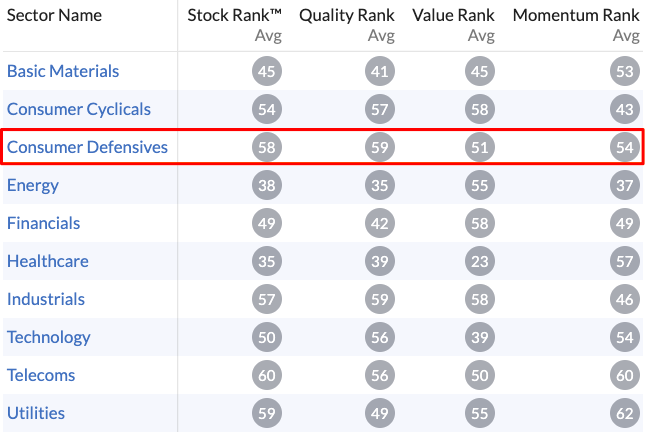
Two interesting candidates aren’t so much high flyers giants as unloved contrarian turnarounds, though. Premier Foods (LON:PFD) and Pz Cussons (LON:PZC) : two companies with long operating histories and strong brands that have fallen from grace. The question is can they bounce back?
Judging from its share price chart, the Premier Foods recovery is already under way. PZ Cussons, on the other hand, continues to languish at its lowest share price in a decade but the community has been buying:
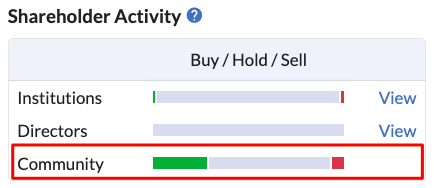
Clearly some people are betting on PZC reviving its fortunes. With operations dating back more than a century and supported by strong consumer goods brands, I can see why.
Let’s take a closer look - first at Premier Foods with its gravity-defying share price, and then at PZC to see if there is any readacross.
Premier Foods (LON:PFD)
- Share price: 77p
- Market cap: £662.45m
- 1y relative strength: +148%
- StockRank: 97
(I hold)
For a long time, Premier Foods was just too risky for many investors. Companies change though. Sometimes perceptions take a while to adjust to those operational and financial improvements - I think that might be happening here.
After years of being dead in the water at between 30p and 40p, the shares are finally turning. Look at the chart and you can see something’s happening - the shares have nearly trebled in about three months on historically high volumes of buying activity:
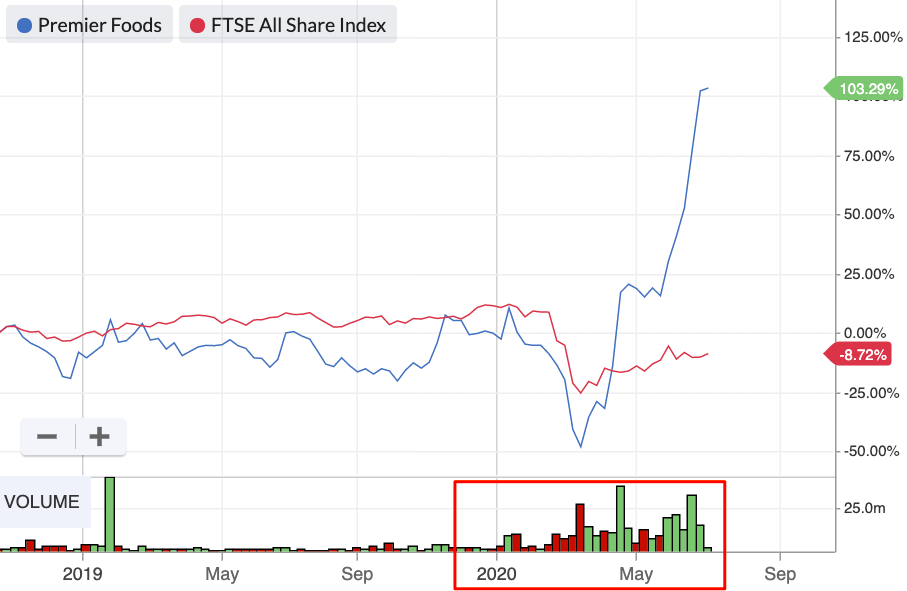
Premier Foods is materially de-risking itself and there is a clearly identifiable share price catalyst. This clear and transformational catalyst is a ‘landmark’ pensions agreement that should make its shares far more investable for many participants...
Unlocking value at PFD step 1: debt reduction
There are two big weights holding PFD down: the group’s debts and its pension funds. Prospects are improving though. The company has strung together 11 consecutive quarters of UK sales growth and net debt to EBITDA is now 2.7x.
This is a far cry from the high levels seen just a couple of years ago. The company is driving down net debt while steadily growing revenue at the same time:
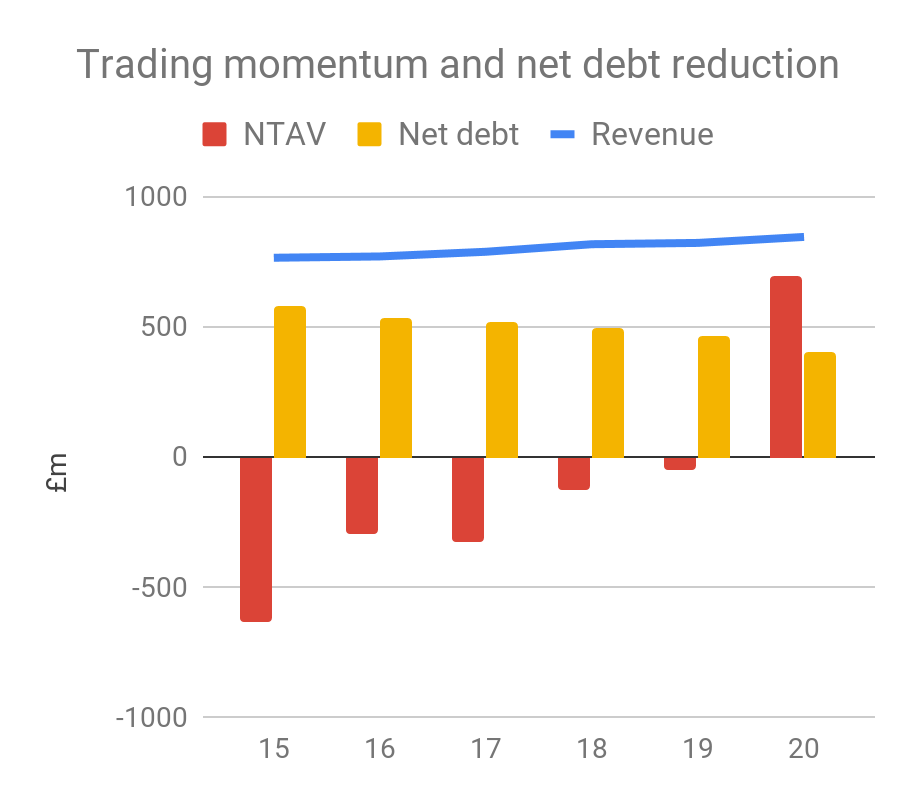
Revenue steadily rising, net debt falling at an accelerating rate, and note the swing in NTAV this year - that’s in large part down to the group’s pension funds transforming into a combined surplus. It is this swing that has paved the way for PFD’s pension announcement (more below).
To recap recent newsflow:
- Strong trading momentum - PFD expects revenue and trading profit to exceed current estimates this year, and has seen a c20% sales jump in Q1 of the new financial year,
- Debt reduction - net debt fell by £61.8m to £408.1m, and it’s expected to reduce further this year. See this recent update,
- A “landmark” pensions agreement has been made that nearly halves the net present value of deficit contributions from £300-320m to £175-185m, and
- There are rumours of a £100m-£150 sale of Hovis. PFD retains a 49% stake in this bread maker but has long since written it off in the accounts. In its results for 2018, Hovis recorded revenue of £460.9m with EBITDA up 80% to £14.6m.
Continued earnings growth and the possible disposal of Hovis give PFD ample scope to pay down debt. And as debt falls, the value of the equity should increase.
Unlocking value at PFD step 2: offload pension funds
So back to that ‘landmark’ agreement.
Premier Foods’ combined pensions surplus stands at some £1,230m - but in a sense this is a part of the problem: these funds dwarf PFD. What happens to them is much more important than how many Cadbury’s mini-rolls the company shifts.
It’s been a tale of two schemes for a long time - on the one hand a resurgent RHM scheme, and on the other a struggling PFD fund.
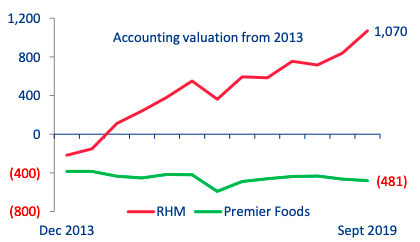
But then we get the transformational pension fund agreement.
To recap:
- The group’s pension trusts are merging.
- The RHM scheme is being bought out by a specialist insurance provider.
- On buyout, a prospective RHM surplus would be expected to transfer to remaining deficit pension schemes
- This leaves a smaller pension scheme with greater funding certainty that is £4m a year cheaper to run.
This agreement paves the way for significantly lower pension contributions from FY23/24 onwards (subject to future valuation discussions). The group provides this range of estimates:
- Low case: £8m lower p.a. at £30m
- Medium case: £16m lower p.a. at £22m
- High case: £21m lower p.a. at £17m
In all, these changes are expected to enhance free cash flow and reduce the NPV of contributions from £300-320m to £175-£185m. Anything saved presumably drops more or less through to free cash flow. This free cash flow can then be spent on advertising or debt reduction. Either option should improve the value of equity.
Conclusion and valuation
Up until recently Premier Foods’ pension fund situation made it a ‘bargepole’ stock for many.
But what happens when that changes? Perhaps a substantial rerating that takes a while to play out because the market is anchored to an extremely low valuation.
Even after recent gains, PFD is priced at 0.78x sales. I think the group would still be attractively valued with compelling upside potential at 1x sales, or c100p. That would be a c34% gain from here, and even then I’m not sure I’d sell. A 1x multiple is still low for a growing, potentially high margin branded goods company.
Let’s imagine in two years’ time PFD has concluded its pension agreement and has continued to pay down debt, while growing revenue and profits. It is now a much more “normal” company with a stable of popular, well-invested brands, a well funded pension scheme, and modest levels of debt. On that basis, it would be much more comparable to its peers.
To keep things short I have left out the extended table, but using a peer group of industry leaders (Nestle, Mondelez, Danone, Kraft Heinz, and McCormick) gives the following trailing twelve month average multiples:
- Price/book - 4x
- Price/free cash flow - 22x
- Price/sales - 3x
- EV/EBITDA - 18x
- P/E - 21x
Applying some of these multiples to a “normal” PFD gives the following share prices:
Premier Foods | Industry multiple | Implied share price | Potential upside | |
Free cash flow per share | 7.93 | 22 | 174.46 | 126.57% |
Sales per share | 99 | 3 | 297 | 285.71% |
Earnings per share | 5.95 | 21 | 124.95 | 62.27% |
Average | 198.80 | 158.19% |
Clearly this is optimistic. Premier Foods is not in the same class as any of these companies. But all Premier Foods needs to do is continue executing as it has done over the past two years, and could continue to close over the next couple of years.
It’s a slightly complex turnaround though, so DYOR.
PZ Cussons (LON:PZC)
- Share price: 187p
- Market cap: £797.43m
- 1y relative strength: +3.04%
- StockRank: 94
PZ Cussons manufactures and distributes various consumer goods including soaps, detergents, and beauty products. Given the current climate, there are worse products to specialise in.
The company began life in Sierra Leone in Africa, where founders George Zochonis and George Paterson began trading commodities way back in 1884. That’s over 135 years of heritage, which provides some reassurance - but the recent track record is bad and brokers are decidedly lukewarm about short-term prospects:
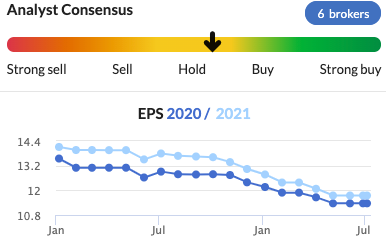
What gives? The company has top tier branded consumer hygiene goods in attractive and growing markets such as Nigeria. But it is precisely this market that is causing problems. Nigeria is seeing high levels of inflation and this is expected to increase as a result of COVID and the slumping oil price.
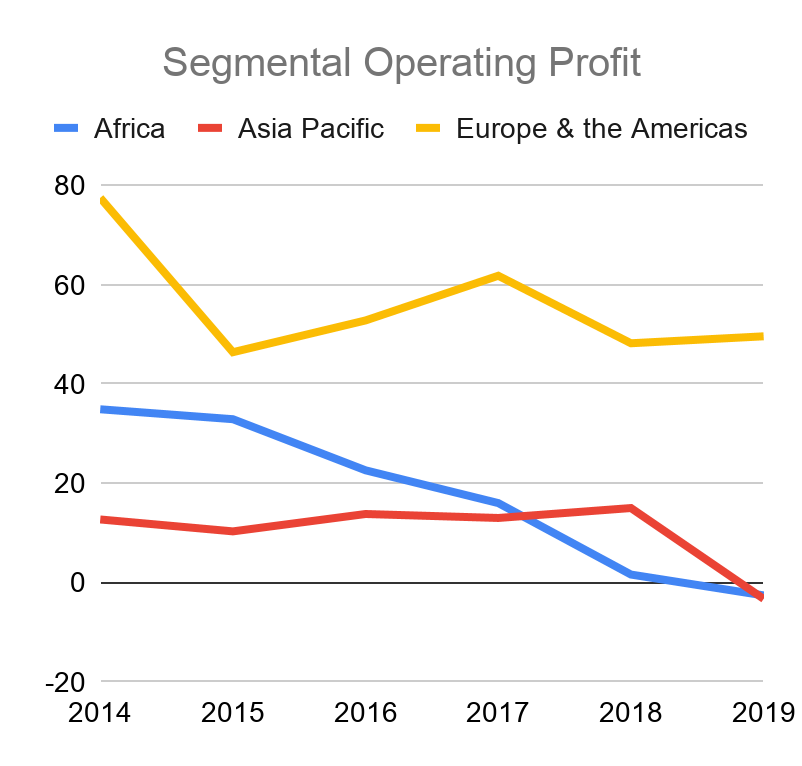
Digging deeper into the segments confirms that PZC’s misfortune is driven by an alarming collapse in profitability in its Africa operations.
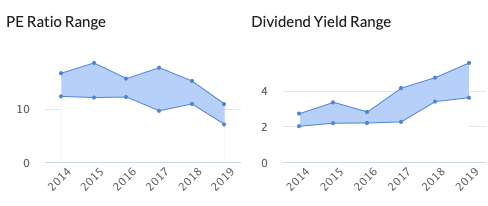
One important point though: with its shares bumbling along at more than ten-year lows, PZC’s valuation has rarely been cheaper. The turnaround has yet to happen - but at these prices longer term quality contrarian investors could be tempted.
Recent trading
Unfortunately, for all the talk of strategic progress operating trends were persisting at the half year mark.
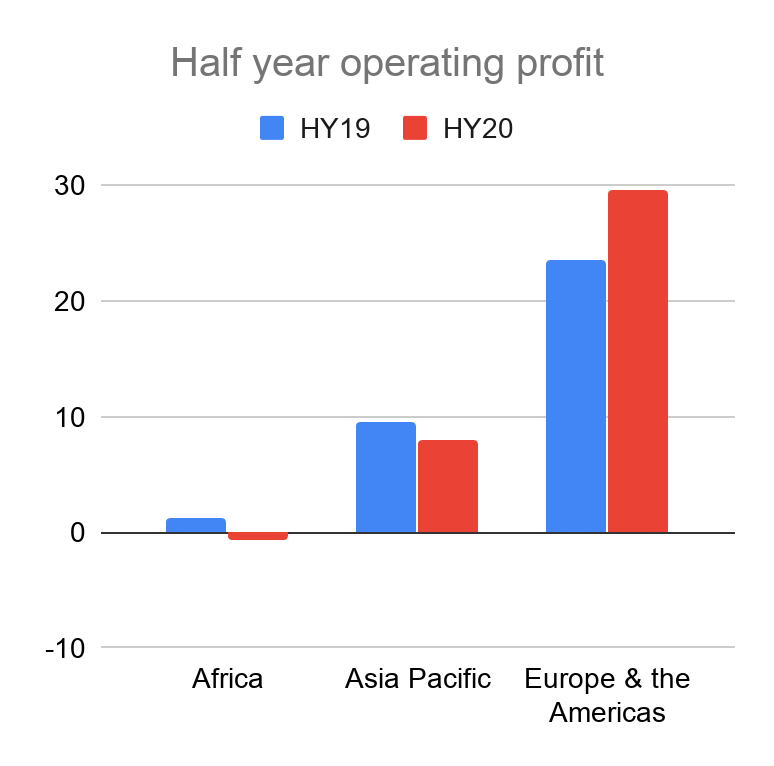
The Q3 update is also mixed. Overall revenue in the quarter declined against last year, albeit at a reduced rate. The impact of COVID continues to be “significant” and full year profit guidance remains within consensus range, albeit at the lower end.
In terms of its regions:
- Africa continued to see revenue declines,
- Asia Pacific was mixed, with trading good in Indonesia but competitive pressures in Australia,
- Europe & the Americas was mixed to negative, with an overall decline in revenue.
Conclusion and valuation
I’m not yet convinced that PZ Cussons is turning around, but its shares are cheaper than they’ve been in a decade and there are signs of real quality here. It’s one for the watchlist.
With its long operating history, resilient brands, product expertise, and strong balance sheet, there is a chance PZC could be a great long term contrarian hold. Through all its troubles, the group has remained cash generative and dividend paying. That counts for something.
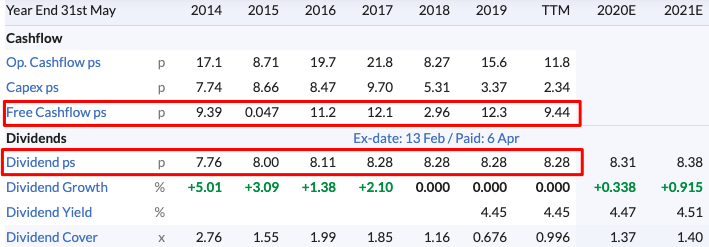
The jury appears to be out on post-COVID dividend payments. PZC wouldn’t be alone in cutting, but it does have that multi-decade track record. I haven’t seen anything in its statements one way or the other.
It looks likely that headwinds will persist for a while yet but perhaps the real opportunity is very long term. Some of the very best companies in the world are in this part of the market. Could PZC one day join that elite tier of Household Products & Services giants?
Constructing a peer group for PZC of Procter & Gamble, L’Oreal, Unilever, Estee Lauder, and Reckitt Benckiser givers the following multiples:
- Price/book - 5.66x
- Price/free cash flow - 33x
- Price/sales - 4.13x
- EV/EBITDA - 26.46x
- P/E - 26.68x
Applying those peer group benchmark valuations to PZC’s trailing twelve month figures gives the following potential prices:
PZ Cussons | Industry multiple | Implied share price | Potential upside | |
Free cash flow per share | 9.44 | 32.72 | 308.8768 | 65.53% |
Sales per share | 148 | 4.13 | 611.24 | 227.57% |
Earnings per share | 21 | 26.68 | 560.28 | 200.26% |
Average | 493.47 | 164.45% |
OK, so equating PZC to established world leaders is aspirational. But what else would PZC be aiming for in the long term?
I don’t know much about the ins and outs of what’s gone wrong at PZC. It’s something I’d like to read up on, because I believe this company might have strong, defensive brands in attractive long term markets.
The above suggests to me that if the company can bounce back and rerate, a doubling of the share price is not unreasonable in the medium term. Then beyond that there is hopefully good long term growth potential.
Plenty more work to be done though, and DYOR. This RNS, for example, raises some corporate governance questions. It looks like the PZC’s previous CEO had his hand in the tills, as it were. If anybody is more up to date with developments here it would be great to hear some views.
Disclaimer
This is not financial advice. Our content is intended to be used and must be used for information and education purposes only. Please read our disclaimer and terms and conditions to understand our obligations.

8 comments
thanks Jack for good analysis and comparatives and highlighting the attraction of Premier Foods (LON:PFD) post the pension deal. I not that the company is very keen to highlight that the debt to ebitda is now comfortably below 3 - technically this is true but i think is a favourable intrepretation. even with the pension deal it is 2 years before the 40m a year obligation to the pension funds reduces to the mid scenario of 22m. EBITDA is a proxy for free CASH flow but in my analysis i deduct agreed pension payments to get a comparable debt to ebitda ratio. doing this the ratio for Premier Foods (LON:PFD) is currently 3.4 times and reducing to 3.2 times if we assume the 22m is more appropriate.
I am a holder and big fan of what the mgt has done at PFD and think now with the benefit of the covid sale surge will have a little extra CASH to invest in new machinery and more marketing / product innovation. however the other side of this is that debt reduction will (relatively) slow down compared to the past 2 years.
I agree that the sale of Hovis (or another brand) could provide another fillip to the price and i suggest also that, post pension deal, it is an ideal candidate for a PE take-over b/c it has steady sales and cash flow and the debt could be refinanced by a larger group.
the ship has defo turned and i although i think the current price is a little ahead of itself in the short term - over 24 mths timescale you allude to i think it will be much higher than today even after the big rise.
the only other company i know of with a material pension surplus is Marks And Spencer (LON:MKS) but i dont think the surplus there is large enough to be as transformation. other opinions very welcome though.
I used to work for PZC in Nigeria (10 years ago) and their issues there are deep-seated and not really related to the current problems in Nigeria.
They have failed to invest (esp in brands) or be modern like the multi-nationals or be agile and aggressive like some of the new entrants to the market focused on the mass market end, especially in respect of updating their distribution systems (which are absolutely key in Nigeria). So whilst they used to have many regionally market leading brands in both Home Care and Health & Beauty, they are living off past glories. For example, they have almost completely lost their footing in Soaps & Detergents with only Morning Fresh Dishwash still strong in Homecare (albeit under pressure) in HomeCare. Similarly in H&B, great old brands like Imperial Leather have lost presteige and face issues as packaging formats change. Canoe was a leading unwrapped bar soap until the late 90s but is now struggling.
In Electricals it survives as the local distribution arm of (Chinese) Haier; it does not control its destiny. Its Food business has been loss making and regularly restructured.
Ultimately, IMHO this has reflected poor strategic management and a trading approach - especially in the Nigerian leadership team that remained 'Greek' in its thinking and key personnel.
The new central leadership team may well choose to focus elsewhere where the company has perhaps more opportunities in more attractive markets; however, it is known for its Nigeria operations which will make it hard for them to give up. I wish the business well but think comparisons to the true MNC is optimistic.
Back in the 1980's Paterson Zochonis was a tightly held private client stock for people in the know who lived near Manchester . The company was once booted out of the FTSE All-Share Index under the lack of turnover rules , it was always a cheaply rated stock ( circa 5x PER ) because of the large percentage of earnings from Nigeria . This was a cornerstone holding for John (now Lord ) Lee along with Nichols Vimto ......... both were 10 baggers for him . It was viewed and rated for a while as a mini Unilever , and their oldest soap brand Cussons Imperial Leather is a classic and still going . I can see why Nick Train is buying as he Takes a 10-20 year view , but it could be dead money for a while .
Thanks - I wrote something about the "voluntary disclosure" at PZC and how voluntary disclosure changed over the years. To be honest, I found that they had been very open about challenges they have faced, for instance:
Good analysis Jack. I hold PZC. Carex seems to be at the end of most aisles in Waitrose and the obsession with hand-washing will not be temporary so I think that bodes well. Additionally if Nigeria (ever) manages to sort itself out PZC is very well positioned - but that is more a wish and hope.
Lindsell Train invested heavily in PZC in March. I hold through them.
Hi Jack, thanks for the article.
I've also looked at PZ Cussons, but only briefly.
Strikes me that the incoming management team will have opportunities.
For example, one of the Nigerian businesses seems to make household appliances. Does that fit within the portfolio? Maybe not
I see potential for the business to be broken up in a way to benefit shareholders.
As you have pointed out, the main issue is Nigeria and the tough environment there for consumers.
That's outside the company's control and is a good example of the risks of doing business in less economically stable markets. However, should things improve, Nigeria should be an excellent place to provide growth.
Like you say, one for the very long term. And I would suggest only if you have a high risk tolerance
It's one I intend on examining further
Good point, speaking of breaking up parts of the business I did see PZC has recently offloaded some Polish operations
"The proposed sale of Nutricima and the sale of Luksja are further steps forward under our 'Focus, Scale and Accelerate' strategy, as we continue to streamline the Group to focus investment on core Personal Care and Beauty brands. This will enable us to deliver higher margin earnings, in geographies which can scale, and support the return of the Group to sustainable, profitable growth."
It feels like there is plenty more to be done in order to arrest the decline. Maybe more disposals are in order. I know from PFD though that this kind of thing can take a long time to execute successfully but I'm interested to see how it goes.
The brands look like they have potential but I've got plenty to catch up on if I am either to prove or disprove that impression...