PSQ: Set to smile again?

This article was written by our regular contributor Anton Crabbe. You can read his bio here
It has been amended from original publication to include a recent update from the business. All changes are in the Outlook section below.
Pacific Smiles (ASX:PSQ) is the largest branded Dentist Service Organisation in Australia. With 130 dental centres across Australia and plans for more to come. They own and operate 11 NIB Dental Care centres and in July 2020 signed a 10-year Managed Services Agreement with health fund HBF. Under this agreement PSQ operates dental centres in Western Australia, on behalf of HBF, for a fee. Their business model is a mix of a franchise model and a service-provider model offering a range of dental services such as general, cosmetic, and restorative dentistry to various segments of the market, including adults, children, and seniors.

PSQ doesn't directly employ dentists, rather it collaborates with independent dentists, operating as a support organisation. The model is designed to attract high-quality dentists by offering them modern facilities, administrative support, marketing, and an existing customer base. This allows the dentists to focus on providing dental services while PSQ manages the business aspects of the clinics.
It comes as no surprise that according to PSQ’s FY22 annual report the bulk of their $139.0m in revenue come from contracts and customers ($138.0m). COVID negatively impacted PSQ’s business as patient deferred dental visits and as a result revenue, earnings and profits all declined, but with COVID behind them, PSQ believes they are in the box seat to grow their business by capitalising on industry tail winds and helping to consolidate the industry.

StockRank:
Given PSQ’s poor performance in FY22 where revenue declined from $153m to $139m, and reported negative operating profit, it’s not surprising to see their current StockRank down at 60. The poor fiscal performance has affected their quality (68), value (36) and momentum (66) too.
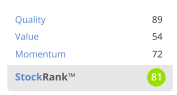
When we look back at their StockRank pre-COVID on the 30th June 2019, it’s a very different story. PSQ were flying high with an overall StockRank of 81 with quality (89), value (54), and momentum (72), all higher on the back of stronger and more consistent financial performance. With FY23 forecast to be a much improved on FY22 it stands to reason that there should be an improvement in their StockRank.
FY19 30th June
Current

Financials:
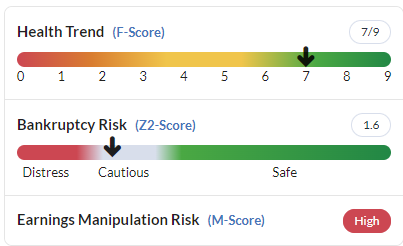
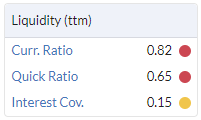
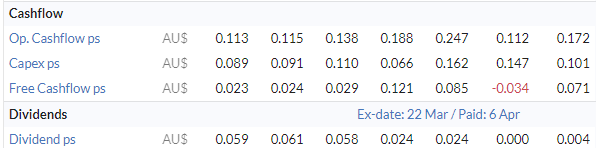
PSQ are in relatively good financial health with an F-Score of 7 and Z2-Score of 1.59. But I am concerned that for a company with a market cap of $217m and $139m turnover, that they have a net gearing ratio of 154%. This is reflected in their F-Score as their long-term debt has not been stable or reducing. The high debt levels can also be seen in PSQ’s liquidity ratios where the quick ratio and interest coverage ratios are low at 0.65 and 0.15 respectively. The fall in revenue, high debt level, and low liquidity ratios have resulted in a fall in operating cash flow and negative free cash flow in FY22.
It is important to note that such a structure can be typical of a capital little (almost franchised like model) business, and given PSQ’s forecast for things to start improving again, I would like to see them focus on paying down debt or maintaining debt levels from here. The company has also resumed paying dividends, though I would they focus the growing cash generation on paying debt rather than increasing dividend payments in the short term..
FY17-TTM(FY23)
Liquidity and Ownership:
PSQ have used debt rather than equity to fund their business operations. This is not only reflected in the high debt levels and poor ratios, but also that since FY17, average shares on issue have remained relatively flat increasing modestly from 152m to 160m in FY22.
Of the 160m share on issue, 58% is classified as free float. Of interest though, is that 68% of the company is held by major shareholders leaving only 32% of shares on issue held by smaller shareholders. For most small DIY investors there should be no issue getting in and out of the stock, but there could be significant price movements if some of the major shareholders decide to flex their muscle and buy or sell.

Outlook:
In their last trading update on 12 July, the company reaffirmed FY23 of underlying EBITDA of $24m. Estimates are for revenue to increase to $170m and $197m in FY23 and FY24 respectively.

As you can see above, consensus has PSQ returning to profit in FY23 and FY24 with EPS starting to increase. Brokers are starting to feel more bullish with 2 out of 4 having a buy recommendation with the other 2 holding firm, which is an improvement on 3 months ago.

In an update to market released one hour after the original version of this article was published, the company said that for the FY23, patient fee increase YOY were 19.5%; and
and same centre patient fee were up YOY by 14.7%
The company said the result for the full year is very pleasing, especially the improved performance in the second half. Patient fees and operating costs have both improved half on half, and they are seeing the evidence of scale benefits and operating leverage materialise in a more settled operating environment.
Conclusion:
In short, PSQ are returning to a grow phase after a tough few years. They believe they can capture and benefit from industry tail winds and grow revenue and profits for shareholders.
A belief that the worst is behind them and profits are just around the corner are one thing, but as always with this type of growth stock you’re paying for some of it upfront and it is up to management to execute the strategy successfully. But for the true believers there does look like there is a bit of upside here with the potential for investors to smile again.
Important Information: Stockopedia Ltd ABN 39 757 874 670 UK business registration number 0637267 (“Stockopedia”) is an Authorised Representative of Daylight Financial Group Pty Ltd ABN 77 633 984 773 (“DFGPL”) which is the holder of an Australian Financial Services Licence (AFS Licence No. 521404).
Information in this commentary is current as at date prepared unless otherwise stated. However, please bear in mind that investments can go up or down in value, and that past performance is not a reliable indicator of future performance. For more Important Information please refer to the Disclaimer section of this website.
This communication may contain general financial product advice. It has been prepared without taking into account your personal circumstances, and you should therefore consider its appropriateness in light of your objectives, financial circumstances and needs before acting on it.
If our advice relates to the acquisition or possible acquisition of a particular financial product, you should obtain a copy of and consider the Product Disclosure Statement (PDS) before making any decision.
Disclaimer
This is not financial advice. Our content is intended to be used and must be used for information and education purposes only. Please read our disclaimer and terms and conditions to understand our obligations.
1 comment
Good read Anton, thanks. I like the way you and also Elio and Chris lay out the articles using the ''Stocko çlips' to support your thesis. What I have found is that when you go to the trouble of documenting the company story and your investment thesis, it really does clear the fog.
Stocko is information rich, that's for sure, but the first page can be confronting - where to start. What i have found is that when you have an orderly system to examine each in their individual segments, it makes the job easier.
I start by examining the business model itself to see whether it is a sustainable model and then I progress to examine why Stocko thinks this is a QUALITY company, and why do they think is it VALUE and why do they rate it on MOMENTUM.
As to the business model, I begin by assessing the company information and then try and find the comparable companies on the ASX (right at the end of the Stocko report).
Take PSA, it really is a 'roll up' company where entrepreneurs have gone to a fragmented artisan/professional group with the spiel that they have technology and systems which will make the indiviual more productive whilst turbo charging the back end for greater profits - a la McDonalds. Healius (HLS) has done exactly this to the quasi medical professions like chiropodists, physiotherapists etc. Roll ups also exist with accounting & legal firms, investment advisors, insurance agents and finance brokers, even surveyors and vets - and there have been some stunning successes like Kelly Partners in accounting & quite a number of failures. Why? Because the business model doesn't work. Wih McDonalds, people fall in love with the burger, not the person who made it. With professions, it is the exact reverse. We go to a dentist because we trust the person and we really don't give a tinkers cuss about the firm. When roll ups change the person to person dynamic and/or take the incentive out of the equation, the roll up model will not work. Period. So many examples. So that would be a starting point for me with PSC - how do they encourage the person to person dynamic and if they are replacing the odl staff with a company owned business with no skin in the game, i am simply not imterested.
Anyhow, hopefully this might be a different perspective on how we can use Stocko better.