Quercus Publishing (QUPP): Variations on a theme

 Last week I looked at the mainly non-fiction and illustrated publisher, Quarto (see also here). This week, Quercus Publishing (OFEX:QUPP) caught my eye in a screener mostly based around looking for companies which exhibit both high medium-run returns on capital with a low price to tangible book value. Both of those screening metrics are blunt instruments for a delicate craft, but the list often throws up a few companies worthy of interest, and Quercus was one of them. Quercus is a publisher too, but not exactly in the same vein as Quarto - Quercus do the more blockbuster stuff mostly, with their healthy dose of fiction. Apologies in advance if I get my Qs confused.
Anyway, in this particular case the way I went about my screening is extremely relevant, because it quickly becomes apparent why Quercus meet those two (apparently contradictory) characteristics. Why would a company that has shown it can earn supernormal returns on its capital trade at less than the value of that capital, or a proxy thereof? There's one obvious answer - something has materially changed. In Quercus's case this became clear to me rather amusingly. From their preliminary results:
• Revenues from non-Larsson titles increased 18% on a like-for-like basis • Q1 2013 non-Larsson sales in the UK (based on Nielsen Bookscan top 5000 titles) increased 134% over Q1 2012
'Non-Larsson' sales as a metric! Not very often you come across companies that have to come up with a phrase like that, but it's crucial for Quercus. They were the publishers of Stieg Larsson's 'Millennium' series of books, which included The Girl with the Dragon Tattoo, later made into a film. There's a nice article about that particular story here, which is well worth a read - particularly because of the way it deals with the issues involved. It is, as journalism will always be, a people focused piece. People make stories interesting. I'm sceptical to give too much weight to a company having one big bestseller, though; while the more optimistic might suggest that this means the company has particularly great people onboard (it might have) or has a new and winning business strategy (again, a possibility), the whims of fate are, by nature, random. Much like the music industry, you can throw a lot of great material at the wall and what'll stick is difficult, if not impossible, to predict. I treat the Larsson years for Quercus as a lovely big cash inflow with which to invest, then, and not as a sign this is a growth company that's set for the stars with bestseller after bestseller.
Luckily for potential investors, the market doesn't seem to see it with doting eyes either. While there might have been a Larsson effect in 2010 - when the shareprice stood at double what it now does - the shareprice has fallen with the company's profits. The difficulty for us, then, is trying to figure out what the company will be capable of post all the Larsson figures - what sort of profits will Quercus make in the hypothetical median scenario, where they churn out lots of books, some of which do well, some of which flop, but on average eke out a little profit for their publisher?
That question is easier asked than answered. I can only gesticulate in the direction of potential guidance, some of which occurred to me when I was looking at Quarto. The way publishers work, from a investment to realisation standpoint, is quite simple. They invest money, in pre-publication costs and in author's advances and the like, and they then recoup those upfront costs of the economic life of the book. Money out, money in. A quality publisher - and a publisher with scale and experience - should be able to do this reasonably mechanically. That's to say we should expect the average book to make a profit, and since they're doing it in scale, we can rely on the laws of averages - barring the occasional Larsson. Quercus published 179 new titles in 2011 (I can't find the figures for 2012), so there's some clear scale there. They also have 55% more employees now.
Anyway, their accounts give us a sort of proxy for the amount of upfront costs that are currently tied up in books in production - the money out side of the equation. If we think, as I've said above, that those investments should all be realised similarly, we can tie revenues to those pre-publication costs. I've graphed Quercus's prepayment balance sheet item below, but note that I've had to make some adjustments from the published figures because of accounting differences.
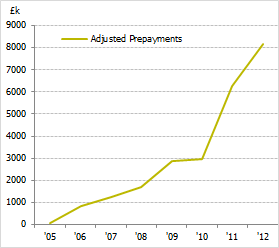
Now, what I'd really like to do is graph my adjusted pre-payments against non-Larsson revenues - probably two year lagged, which looks like a book's average lifecycle - and look at if there's much of a relationship. If it does; as I expect it to; we have a bullish case for the company, since Quercus have evidently been investing a lot in the last couple of years. We're essentially waiting for the lag to finish now, and for the company's previous investments to start paying off and bringing in cash. I should note at this point one very interesting statistic - in their annual report, Quercus note that "Nielsen Bookscan top 5000 title figures for the first three months of 2013 indicate that our non-Larsson book sales in the UK have increased by 134% over the first three months of 2012.". I didn't know anything about Bookscan before writing this, but from what I can read on their website the statistics appear fairly reliable - their statistics are gathered from electronic point of sale at bookshops and other outlets, apparently accounting for ~£26m of book sales a week.
Anyway - what I meant to say before that diversion was that, while the company does give us some statistics on figures without the Larsson books, they're a hodgepodge. They appear to me to be, at least in some points, downright contradictory. I can't reconcile the figures with all the bits and pieces they've said over the last few years ('non-Larsson revenues are up x%', 'Larsson revenues account for x% of total revenues'), so I simply scrap the idea entirely. It's a shame, since that'd give us some confirmation in our hypothesis, but our hypothesis seems reasonably sound anyway.
Out of curiosity, I checked how much Bloomsbury Publishing (LON:BMY) - another well known, FTSE listed publishing group - carried as prepayments and accrued income on their balance sheet. Their figure sits at about £30m, or roughly 4 times Quercus's for the last couple of years. I need to look at their relationship between investment and revenue to see if there's any read-across for Quercus.
As a conclusion - I'm not done here! Quercus is a company which has, over the last couple of years, dramatically ramped up investment to try and get past those post-Larsson blues. While there's still some further declines in that juicy revenue source to be expected, I wonder to what extent we can take those exceedingly positive Nielsen figures - and the potential relationship between pre-publication costs and revenue - and map them to future growth. It's basically trading at book value, with a decent cash pile on balance sheet, so it's by no means expensive. But is it cheap?
Disclaimer
This is not financial advice. Our content is intended to be used and must be used for information and education purposes only. Please read our disclaimer and terms and conditions to understand our obligations.
No comments yet
No one has commented here yet! Why not be the first one?