SABMiller shares are close to my estimate of fair value

Beer and soft drink manufacturer SABMiller PLC has had a fantastic run over the past few years. The shares have leapt from less than 1,000p in the financial crisis to around 3,250p today.
But does that mean the best gains are in the past rather than the future?
In order to find out (or at least develop a sensible opinion), I’ll run the company and its shares through a checklist of 24 questions ending with a calculation of a “fair value” and “good value” share price.
Overview
SABMiller is one of the world’s largest beverage companies and has been brewing beer for over a century. Its global beer brands include Miller and Grolsch and it is also one of the world’s largest bottlers of Coca-Cola products.
It operates in the defensive Beverages sector and has a significant footprint in emerging markets, making it a favourite of many relatively defensive investment funds.
Investment checklist
1. Does the company have an above average track record of growth?
YES – The chart below shows how SABMiller’s financial results have progressed over the last few years:
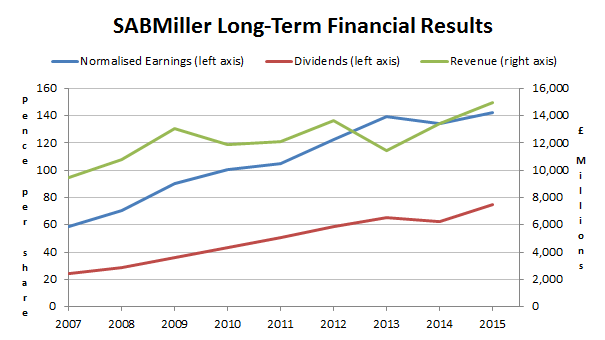
As a defensive and income-focused investor those results are exactly what I like to see; steady, progressive dividend growth supported by growing revenues and earnings (the dip in dividends between 2013 and 2014 was due to exchange rate movements as SABMiller sets its dividend in US Dollars).
Here’s how the company’s growth record stacks up against the market average (in this case the FTSE 100) in numerical terms:
- 10-year Growth Rate: 9.6% compared to 1.0% for the FTSE 100
- 10-year Growth Quality (i.e. consistency): 83% compared to 54% for the FTSE 100
So as the chart suggests, on the growth front SABMiller is clearly above average.
2. Is the company more profitable than average?
NO – I measure profitability using post-tax return on capital employed (Net ROCE), taking the median value over 10 years.
For SABMiller this profitability ratio is:
- 10-year median post-tax ROCE: 7.4% compared to 10.0% for the FTSE 100
Somewhat surprisingly (to me at least), SABMiller’s post-tax profitability is below average.
I have a rule of thumb which says don’t invest in companies where Net ROCE is below 7%. SABMiller is above that, so its profitability isn’t so low as to be a problem, but it will affect my estimate of what the company is worth.
3. Does the company have conservative financial obligations?
YES – By “financial obligations” I mean total borrowings (interest-bearing debts) and defined benefit pension obligations.
I compare each of those to 5-year average post-tax profits to produce a Debt Ratio and Pension Ratio.
SABMiller has total borrowings of £8.5bn, pension obligations of £0.6bn and 5-year average post-tax profits of £2bn, giving the company the following ratios:
- Debt Ratio: 4.1 (my maximum for defensive companies is 5)
- Pension Ratio: 0.3 (my maximum is 10)
- Debt plus Pension Ratio: 4.4 (my maximum is 10)
The Debt Ratio is fairly high, but not too high according to my rules on leverage.
Relatively high debts are one of the reasons SABMiller’s post-tax profitability is quite low. Post-tax profitability is also measured post-interest payments, and interest payments are obviously higher when debts are higher.
Although its current debt levels are quite high the company has a history of using even larger amounts of debt.
For example, in 2012 its borrowings exceeded HSBC Bank (LON:12BN), giving it a Debt Ratio at the time of 8, which is far too much as far as I’m concerned. That may indicate a willingness to take on large amounts of debt in the future too.
Although large debts have not been a problem for the company so far, it’s still a risky game to play as you never know what’s around the corner.
4. At the current share price, are the valuation ratios better than average?
NO – Here are my key valuation metrics for SABMiller at 3,250p compared to the FTSE 100 at 6,550:
- Price to 10-year average earnings (PE10): 30.4 compared to 13.6 for the FTSE 100
- Price to 10-year average dividend (PD10): 65.8 compared to 32.0 for the FTSE 100
- Dividend yield: 2.3% compared to 3.7% for the FTSE 100
SABMiller fails to beat the FTSE 100 on any of my valuation metrics, which is a good indicator that the shares are not obviously “cheap”.
However, it is entirely reasonable to pay a higher price relative to past earnings and dividends for high growth companies, as long as the company can continue to grow faster than the FTSE 100.
5. Does the company have an obvious core business?
YES – SABMiller is a manufacturer and supplier of beer and soft drinks.
6. Does the company have a clear and consistent goal and strategy?
YES – The company’s current goals are:
- To be the most admired beverage company in the world
- To bring refreshment and sociability, improve livelihoods and help build communities
That has more or less been its goal for many years.
Its basic strategic objectives are:
- Focus on emerging markets
- Expand and “premiumise” the beer markets in which it operates
- Reduce costs
This strategy has also been in place, with small variations, for a number of years.
7. Does the company have profitability, leverage, liquidity or investment as Key Performance Indicators (KPIs)?
YES – Improvements in margin (profitability) are measured, as is free cash flow, which is related to liquidity (i.e. ability to pay short-term liabilities).
8. Is the company in the leading group in terms of market share within its chosen markets?
YES – SABMiller is the world’s second largest brewer by revenue.
9. Has the company had the same core business for many years?
YES – SABMiller was formed in 2002 after SAB acquired Miller. SAB was founded in 1895 as South African Breweries while the Miller Brewing Company was founded in 1855.
10. Is the company free of “bold” projects which, if they failed, could push it into a major crisis?
YES – I can’t see any obvious signs of major “bet the company” projects currently underway.
11. Is the company free of the need for large capital expenditures (capex)?
YES – SABMiller spends about 60% of post-tax profit on capex, which is a fairly normal amount for most companies.
12. Are revenues generated through the sale of a large number of small-ticket items rather than through major one-off contracts?
YES – Sales are effectively generated one bottle at a time.
13. Has the company avoided mergers or large acquisitions in the last few years (i.e. cost more than a year’s profit)?
NO – in 2012 SABMiller spent £7bn on acquisitions which was more than 3-times that year’s post-tax profits.
The large acquisition expense in 2012 was primarily down to the purchase of Foster’s, the Australian beer business. The integration of Foster’s does not appear to have destabilised or held back the business.
The acquisition also took the company’s total borrowings to more than HSBC Bank (LON:12BN), which was almost 8 times its 5-year average post-tax profits. That’s far more than I would want to see a company take on, even a defensive company like this.
Excluding 2012, SABMiller spends about 20% each year on acquisitions, which is still substantial but not necessarily a problem, as long as the money is well spent.
14. Has the company avoided acquisitions that have little to do with its core capability?
YES – The largest acquisitions have been directly related to the beverage business.
15. Does the company operate in defensive markets?
YES – Beverages is a defensive sector and the amount of beer and soft drinks consumed does not change significantly through the economic cycle. If you look at SABMiller’s results through the financial crisis in the chart above, they were barely affected.
16. Does the company operate in markets where the pattern of demand (whether cyclical or defensive) is expected to stay the same?
YES – I think it’s reasonable to assume that how people purchase and drink beer and soft drinks will not change significantly in the foreseeable future.
17. Does the company operate in markets where demand is expected to grow?
YES – The majority of SABMiller’s profits come from emerging markets, which are expected to grow faster than the global average for many years and possibly decades.
18. Does the company generate most of its profits from products or contracts that do not need to be replaced in the next 10 years?
YES – Profits come from selling strongly branded beer and soft drinks. These drinks and their brands do not need to be replaced in the same way that patents or large contracts do (for example, Grolsch was founded as a brewery in 1615).
19. Does the company sell differentiated products that do not compete purely on price?
YES – The answer here is somewhat mixed, with some of the company’s products competing primarily on price while others compete on the strength of their brand.
SABMiller’s preference though is to compete primarily on brand. One of its major focuses has been the “premiumisation” of its brands and markets in order to achieve the wider profit margins available to premium brands.
20. Is the company relatively immune to commodity price movements?
YES – Although commodities are used as raw material inputs, and therefore do have an impact on the company’s results, the impact is relatively small and often gets lost in the “noise” of other volatile factors such as currency exchange rates.
21. Does the company have an expected rate of return on investment (ROCE or similar) of more than 10%?
NO – There is no explicit ROCE target (or similar) in the annual reports. Post-tax ROCE is weak at 7.4%, which is just above my minimum investible level of 7% and significantly below the post-tax ROCE of other Beverages sector companies in the FTSE 350.
22. Having asked all these questions, do you still think the company’s debts are sufficiently low?
YES – Just about. The company has a history of using a lot of debt. Through most of the last 5-years it has had a Debt Ratio above 5, which is too much for me.
However, it is a very defensive company and perhaps in reality these debt levels were not excessive, but I would still prefer it to use less debt when making acquisitions.
For now though, I think its debts are just about low enough.
23. Are the odds of this company running into a major (rather than minor) crisis acceptably low?
YES – There are no obvious problems on the horizon and that is reflected in the share price. The dividend yield is 2.3%, far below the market average, and so investors are expecting the strong growth of the past to continue.
24. What share price would represent “fair value” and “good value”?
Having run through those questions I would be happy to buy SABMiller. It is a global defensive dividend growth stock, which is just the sort of thing I like to own.
However, in terms of what return an investor might get from SABMiller, the purchase price is still probably the single most important factor.
What represents “fair value” and “good value” for a company can only ever be estimated. For me that estimate should take account of factors such as the company’s growth rate, its profitability, how much debt it’s carrying and how consistently it has performed over many years.
My approach to estimating “fair value” and “good value” is to adjust the company’s share price on my stock screen, which already takes account of all those factors.
The price that results in a middling rank on my screen (i.e. a rank of 115 out of 230 stocks) is “fair value”, while the price that results in a top 50 rank is “good value”. The “good value” price is the maximum I would consider paying for the company during its current financial year.
After adjusting SABMiller’s share price I get the following results:
- Estimated fair value for SABMiller: 3,000p
- Estimate good value for SABMiller: 1,800p
With the shares currently trading at around 3,250p, SABMiller is just slightly above that fair value estimate.
You might think I’m crazy to say “good value” is some 45% below the current share price and that SABMiller will never get back down to 1,800p, and perhaps you’d be right. But look at Rolls-Royce.
At the start of 2014 Rolls-Royce’s shares were trading at 1,270p and almost everyone thought it was the perfect dividend growth stock. And yet today its shares are about 40% lower at 760p, slightly below the 800p “good value” estimate I made in July 2014.
My point is not that I was “right” about Rolls-Royce, but that the future is an uncertain place, and that uncertainty should be reflected in the price you’re willing to pay for a company, even when that company is as defensive as SABMiller or Rolls-Royce.
Disclaimer
This is not financial advice. Our content is intended to be used and must be used for information and education purposes only. Please read our disclaimer and terms and conditions to understand our obligations.
1 comment
I don't know much about SABMiller shares apart from the brands but the sp has not really gone up in the last 2 years, so all the growth was in the 5 years before that? To be honest I'm not keen on Fosters it s a tired old brand thats not quality, will need a lot of advertising and/or price cutting to maintain market share. Why is SR showing a yield of 7.7%