Screening for Value: Adjusting the Earnings Yield

In my last article, I used the Stockopedia screening tools to generate value investing ideas based on their earnings. I chose to use EV/EBIT, also known as Earnings Yield, since an exhaustive study by Wes Gray and Toby Carlisle showed that this was the best-performing value metric on a quantitative basis. This screen generated 29 initial ideas that I hadn't looked at in previous Screening for Value articles. As usual, I have created a Stockopedia portfolio to allow me to scroll through the Stockreports rapidly:

Before drilling down into the details of these companies, I wanted to take time to consider some of the factors that may not be captured by a simple analysis of EV/EBIT: pension deficits, working capital, provisions, deferred consideration, and lease liabilities.
Pension Deficits
In my previous articles, I mentioned that investors would be wise to adjust their valuations for the presence of any Pension Deficits. After all, most pension deficits require the company to make recovery payments, which are real cash that leaves the business that isn't available for dividends, buybacks or re-investment into future growth. The simplest way is to exclude any companies with significant deficits. However, this may miss companies that are cheap despite this extra consideration.
Another way would be to consider the deficit as debt and add it to the EV. However, there are many valuations investors could choose: the IAS19 accounting deficit, the actuarial deficit or even the net present value of the agreed recovery payments. Making the correct choice here is difficult and then may not be straightforward to calculate. Therefore, when a deficit is likely to remain for some time, the easiest way is to adjust the EBIT, not the EV. Comparing this adjusted Earnings Yield to other companies will give a fairer comparison.
One of the companies from my screen results, Renold (LON:RNO) , is a company with long-term agreed recovery payments and provides the ideal example for this adjustment. Our screen gives a TTM Earnings Yield of 19.8%. This comes from a TTM EBIT of £16.2m, which can be seen on the Accounts tab on the Stockreport, as Operating Profit. The company has an EV of £81.7m, consisting of a market cap of £55.9m and net debt of £25.8m.
To get a good view of the pension situation, I turn to the latest Annual Report. This reveals that the company has agreed "guaranteed future cash contributions to the scheme for a fixed period of 25 years commencing in 2013" – long enough for an earnings-based adjustment to be considered. The cash flow statement reveals the size of the recovery payments:
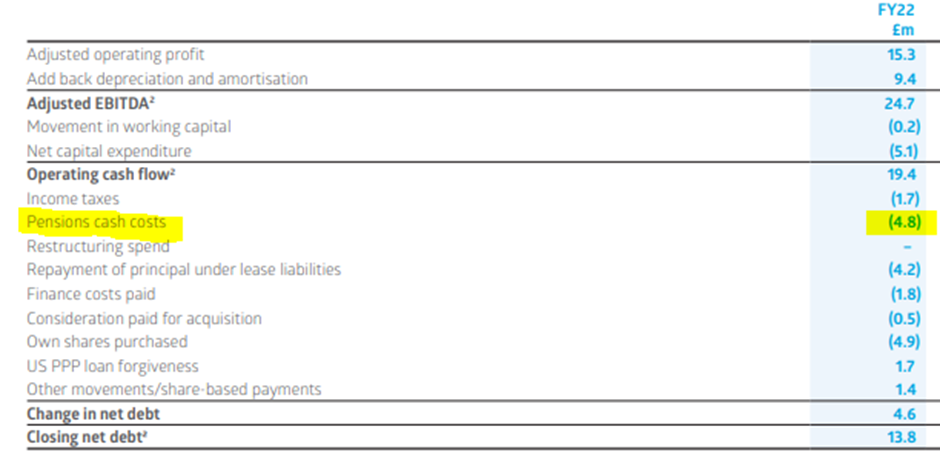
Taking this figure from the EBIT of £16.2m gives an adjusted EBIT of £11.4m, which is an Earnings Yield of 14.0%.
The annual report also reveals that the payments on the UK Pension Scheme will increase from £3.4m to £4.1m from now on, making total recovery payments around £5.5m. Forecasts are for net profit to be similar in FY23, so it makes sense to assume the unadjusted operating profits will be around the £16.2m historical figure. This makes the forward Earnings Yield around 13%, adjusted for pension contributions. This may still be good value for a business that is managing to grow, albeit slowly in the current market conditions. However, when compared to companies that are not required to make pension recovery payments, the figure to use is the adjusted Earnings Yield of 13-14%, not the almost 20% initially reported.
Negative Working Capital
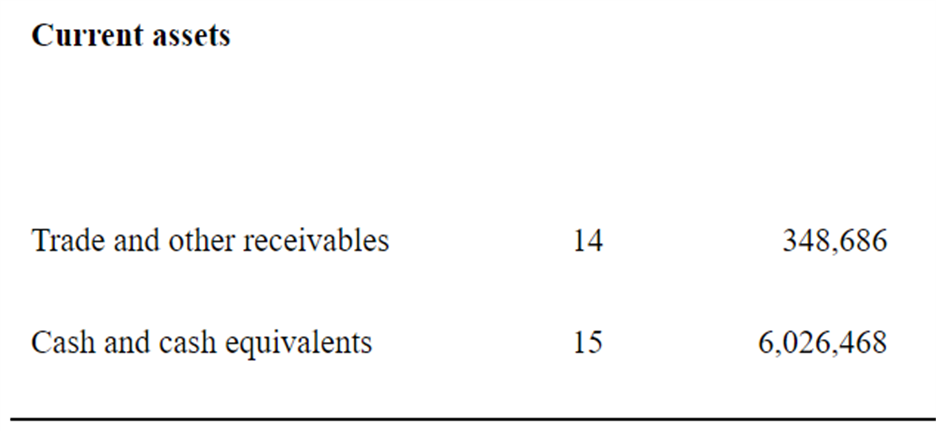
The Earnings-based screen included the requirement to have a current ratio above 1.2. So, unless a company holds significant cash reserves, it will not have negative working capital (where current liabilities exceed current assets excluding cash). The definition of working capital in the Stockreport includes cash, so investors need to know what to look for to assess this appropriately. For example, this is the Balance Sheet section of one of the screen results, Arcontech (LON:ARC) :

A look at the results shows current liabilities exceeding current assets when cash is excluded:
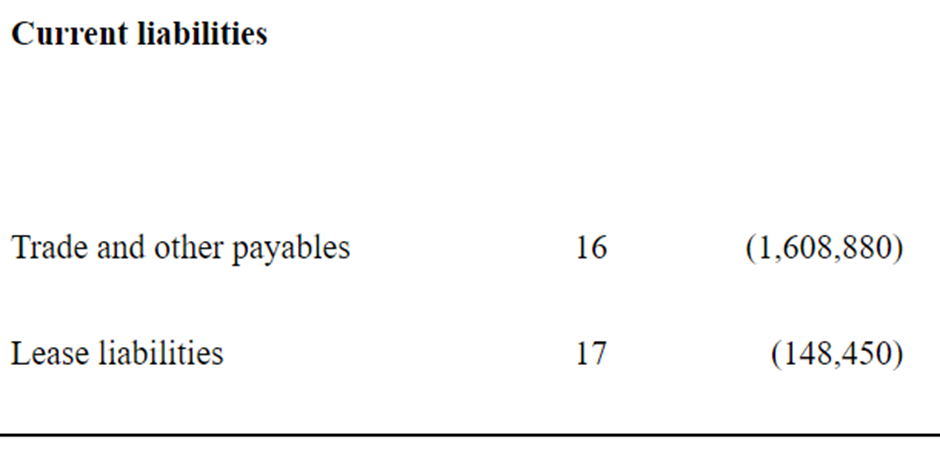
Although negative working capital may signify a company in financial distress, many companies, such as retailers or software companies, can run successfully with negative working capital ad infinitum. This is because the nature of their business means that they get paid by customers before paying their suppliers or employees. However, problems can arise if their revenue declines since this will lead to cash outflows.
There is also the issue of "window dressing". Companies often choose their year-end carefully, at a point in the year where their working capital is most favourable. This means that a reported net cash figure may not actually represent cash that can be paid out to shareholders or invested in growth. The most helpful companies also report their average net cash or debt. If the average figure is known, it would be wise to take this when calculating the EV, even if a company doesn't have negative working capital.
The most conservative way would be to treat negative working capital as an additional debt and add it to the EV. Using Arcontech (LON:ARC) as the example, this would mean adding the £1.26m difference between payables and receivables to the EV. In this case, the final results have been published, but the annual report is not yet available, which means that the Stockopedia Stockreport doesn't yet reflect the latest figures. So I will use the results statement to calculate these:
Adjusted EV = Market Cap - Cash - Net Working Capital - Lease Liabilities
Adjusted EV = £11.03m - £6.03m + £1.26m - £0.20m = £6.46m
With an operating profit of £0.76m, this gives an earning yield of 11.8%. Not expensive, but not as good as the 17% figure before adjustment.
Arcontech (LON:ARC) is a software company and has a history of being able to operate with negative working capital, so this adjustment is likely to be unduly harsh. Unfortunately, there is no substitute for an investor's personal judgement when making these adjustments.
Provisions and Deferred Consideration
Provisions are where a company has identified a future liability, which has been accounted for in the income statement but not yet settled in cash. Provisions can occur as part of the normal operations of a business. For example, a resources company may have an obligation to remediate the land they operate from when operations cease. This known liability will occur at some point in the future. Or a company may provide for taxes incurred on trading profits that are not yet paid. But often, provisions are taken when something goes wrong; a contract proves onerous, warranty claims occur, or a company has to make staff redundant. Although some judgement is required over long-term provisions, in my opinion, short-term provisions should always be treated as debt and the EV adjusted accordingly.
Likewise, the deferred consideration from a company making acquisitions should be treated the same way. Although there may be some doubt as to the timing or size of long-term deferred consideration, short-term values should always be treated as debt, in my opinion. If they are sufficiently close and well defined to be in the current liabilities, these will need to be paid in cash relatively soon. The most conservative assessment would treat both provisions and deferred consideration, current and non-current, as debt when calculating an earnings yield.
IFRS16
IFRS16 is an accounting standard introduced a few years ago to level the playing field between companies that owned long-term assets (mainly property) and those that rented them. Under IFRS16, leased assets would appear as non-current assets in the same way as property and the amount due under the whole length of the lease agreement as lease liabilities, either current or non-current depending on when the lease payments were due. This means that companies could no longer move assets off the balance sheet via agreements such as sale and leaseback deals. Such arrangements also often come with favourable initial rental terms, such as rent-free periods. Under the old accounting standard, such deals would, therefore, flatter the near-term profits and return on assets. Under IFRS16, there is a depreciation and a finance charge instead of a rental payment, reflecting the economics of the whole arrangement.
There are a couple of problems with this change from an investor's point of view. The first is complexity and the reliance on models to define aspects such as the value of lease assets. The second is that it can make comparisons of EBITDA (increasingly!) meaningless. The so-called "Payment of capital element of leases" can be a large part of the cash flow statement, and this appears as an investing cash flow.
Perhaps the biggest issue is that the new accounting definition treats lease liabilities as debt. Stockopedia follows this convention when calculating the EV. Again, on some level, this makes sense. Why should a company that mortgages a free-hold property they own have that treated as debt, whereas a company that leases the same space is considered debt free? However, it tends to overly punish companies with significant lease liabilities, even if these lease costs will be incurred over many years as part of profitable trading.
For some companies, such as Arcontech (LON:ARC) , the £200k difference due to their lease liabilities is negligible. However, for many companies, the treatment of lease liabilities can have a big impact. For example, private investor favourite SCS (LON:SCS) has net debt and EV of £75m on its stock report, despite having £87.9m in cash. This is due to its even larger lease liabilities. Although it is not perfect, my preference is to take the net lease liabilities. If liabilities exceed assets, this suggests that some of the leases are onerous based on current trading, and it makes sense to reflect that in the EV, just not the gross amount.
"Shareholders' Cash"
Converesly, concluding that SCS (LON:SCS) has a negative EV due to its large cash balance would also be wrong, in my opinion, because of the factors I've described above. Putting all of these together, I have come up with my own definition of the cash that may not be required by the business to operate in its current form and should be available for payout, investment or distribution. I call it "Shareholders' Cash" (or "Shareholders' Debt" if it is negative).
Shareholders' Cash = Cash – Debt – Provisions – Deferred Consideration + Net Working Capital - Net Lease Liabilities
(Net Working Capital is only included when negative, and Net Lease Liabilities when Lease Liabilities exceed Lease Assets.)
For SCS (LON:SCS), Shareholders Cash = £87.9m - £1.7m - £61.8m - £10.0m = £14.4m
With a current market cap of £52.2m, this makes the EV adjusted by my measure of Shareholders' Cash £37.8m. With a TTM Operating Profit of £5.26m, this would give ScS an TTM Earnings Yield of 14%. This is perhaps a better measure of the underlying perfromance of the business versus an Earnings Yield that simply includes or excludes total lease liabilities.
Some Quick Exclusions
Renold (LON:RNO) and Arcontech (LON:ARC) retain high Earnings Yields even after making adjustments for pension deficits and negative working capital, and I will look at them in subsequent articles. However, since I first created this screen, some companies have released results that meant their TTM Earnings Yield fell significantly. I have picked 10% as a lower limit for cut-off which means that I will no longer look at Sourcebio International (LON:SBI) and ECO Animal Health (LON:EAH) . I am also excluding Softline Holding (LON:SFTL) due to its connection with Russia. They have announced a demerger of the Russian assets, but this also makes it too hard to analyse the remaining part.
Next week I will start to look at the remaining 26 companies in detail.
Disclaimer
This is not financial advice. Our content is intended to be used and must be used for information and education purposes only. Please read our disclaimer and terms and conditions to understand our obligations.

3 comments
thanks Mark,helpfull
excellent article. Very helpful
Great series of articles, much appreciated. David