Screening for Value: Ideas which hit the sweet spot for price to book value

In last week's article, I looked into the first set of seven stocks highlighted by my discount to Tangible Book Value screen that also passed my initial filter. This week, I will go through the remaining eight stocks:
Northamber (LON:NAR)
Northamber is a distributor of IT and Audio Visual equipment. The revenue trend here is uninspiring:

But then I am looking for the most unloved of stocks. The consistent losses for many years give greater cause for concern. The 2020 number shows an adjusted EPS of 5.98p, but this looks to be an anomaly due to the adjustments made:

The accounts for 2020 show an adjusted operating loss of £736k, not that different to the adjusted operating loss of £870k in 2019.
The company has been relatively active, though. The exceptional profit in 2020 came from the sale of their distribution centre in Weybridge for £16.4m. They reinvested £3.4m of the cash into a distribution centre in Swindon and £2.1m acquiring AVM, an audio-visual distributor. Sadly, very little of this excess capital was returned to shareholders, and the dividend payment was just £80k for 2020.
2021 was a better year with increasing organic revenues, a full contribution from AVM and higher gross margins. However, this only led to an operating profit of £380k. Net cash had declined to £7.45m as they had to invest in greater stock levels.
The 2022 half-year results see a continuation of these revenue trends but also much-increased distribution costs putting them back into an operating loss. Further stock level increases mean that net cash declined to £4.7m. The dividend remains a paltry £80k, and it appears that almost all the windfall gain from the sale of the property has been invested back into currently unproductive assets. There are no forecasts in the market, but the outlook suggests that these assets are likely to remain unproductive in the near term.
Another factor to consider is that, in an inflationary environment, First-In-First-Out accounting rules flatter the revenue and profits of distributors in a way that is not reflected in the cash flow. This can be seen with companies such as Wynnstay (LON:WYN) that have generated exceptional profits this year but little extra cash. So for Northamber to have weak profitability in this environment is particularly concerning.
The latest accounts show £7m of non-current assets, the majority of which are freehold property, plus £11.9m of net working capital and £4.7m of cash. However, these assets are unproductive and have remained so for many years. The company requires a significant shake-up if the return on capital is to be raised to anywhere close to a reasonable level.
Often, a change of management can act as the impetus for a turnaround in value stocks, so I read the following announcement with interest. But unfortunately, it appears to be an internal promotion of a manager who has been with the business since 2018. This is unlikely to presage the drastic action needed to make Northamber's assets productive again. Indeed, Managing Director Alex Philipps owns 63% of the shares and doesn't seem keen to rationalise assets or return capital.
I'd love to be able to conclude that Northamber was an excellent opportunity since this has precisely the sort of assets that a value investor looks for; cash, freehold property and inventories are often easily monetised. However, in this case, there seems to be zero appetite to make these productive from a controlling shareholder. As such, this is not an attractive opportunity.
Petra Diamonds (LON:PDL)
Petra Diamonds is a diamond producer in South Africa and Tanzania.
I looked at diamond producer Gem Diamonds in a previous article when my 52-week lows screen flagged it. One of the attractions was that diamond prices remained elevated from historical levels, despite weakness this year:

Ultimately, Gem Diamonds was too complicated to analyse in detail due to their reliance on finding large diamonds, the presence of carried minority interests, and their decision to capitalise and amortise waste-stripping at the mine. This obscured the true cash flow and did not make it an attractive value Investment. Since then, Gem diamonds issued a profit warning due to costs being 15-20% higher than previously planned.
Cost inflation is a risk for all companies at the moment. However, Petra doesn't seem to be suffering to the same extent as Gem. In their latest Q4 results, they say:
“We reaffirm our production and cost guidance through to FY 2025. An increase in the lead-time for some capital items will shift some FY 2022 capex to FY 2023 with no expected impact on the anticipated project timing or overall capex spend. We are monitoring cost increases in our operations very closely, but our relatively low fuel consumption, disciplined cost management, three-year labour agreements to June 2024 and exposure to a weaker South African Rand will assist us in better absorbing these cost pressures.”
Investors need to be careful in valuing this company based on its assets. The vast majority of the assets are mine equipment in African countries. There is no guarantee that these could be sold for book value or the proceeds returned to shareholders if they wanted to. They have a large cash balance, but net debt is still around $40m despite significant cash flow being directed to paying down debt. Presumably, this is why there is no dividend being declared.
Despite doubts over the true value of the assets, Petra may make sense as an earnings play since the P/E for the year just gone is around two, having undergone a successful turnaround program. Caution is required, though, since brokers are also expecting the 2021 & 2022 results to be exceptional in nature, and 2023 is forecast to be much lower:

The most up-to-date broker views are from Barclays and Berenberg, which means that, unfortunately, individual investors will not be able to see these. However, I note that the broker price targets have been reduced, and ratings are not exactly enthusiastic:

Given that brokers usually put forward the bull case for a stock, this is worrying. Petra themselves are guiding the following years to be similar to 2022, just finished:

This suggests that the brokers' caution is due to diamond pricing concerns which makes sense since many people are facing cost-of-living challenges, reducing demand for luxury goods. The forecast economic slowdown may negatively impact industrial diamond uses.
Although Petra appears more attractive than Gem Diamonds in the short term, the sensitivity to diamond pricing assumptions means this is too hard for me to value.
Panther Securities (LON:PNS)
Panther Securities is a property investment company. The Chairman here is the always-entertaining Andrew Perloff. The P/TBV of just 0.5 means this trades at a discount to many property funds as well as their assets. The gearing here is higher than average, though. In their last results, they comment:
The £66,000,000 was fully drawn but with the net proceeds from disposals we repaid our revolving facility.
The new loan is a more conservative facility agreement than we are used to with a headline loan-to-value covenant of 55%, when historically it had been around 65% (which used to be considered conservative!). The extra cautious nature shown by the lenders is also reflected by the smaller loan facility arranged (previously, we borrowed £75,000,000, which is now £66,000,000).
So, they feel comfortable with the gearing levels. High gearing increases the risk but also increases the potential returns to equity holders. However, the book value per share has been largely static for the last few years, suggesting that the c.4% dividend yield is the only real return that shareholders have been getting:
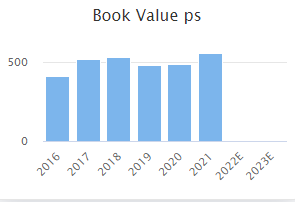
The accounting here is also complicated by the purchase of interest rate swaps. I find it hard to see where significant returns are going to come from, despite the large discount to tangible book value.
SDX Energy (LON:SDX)
SDX Energy is an oil and gas company with production in Egypt and Morocco. Earlier this year, the company received a merger proposal from Tenaz Energy with a cash alternative at 11p per share. However, the offer was rejected by shareholders, which makes the current share price at 9.5p look potentially interesting (although the oil price is around 20% lower today than when the offer was made.)
Again this is a company where the fixed assets represent sunk capex in far-flung lands and should not be expected to be realisable by investors in a downside scenario. However, the company has around £18m of cash plus net working capital, versus a market cap of about £20m. Therefore, it does take much cash flow for this to appear undervalued.
Although EPS is still negative, the company is forecast to be profitable in the future. Unfortunately, these forecasts look a little odd, and I wouldn't place much weight on them:

Instead, I turn to the latest results, which in this case are the half-year results to 30 June. The income statement shows a loss. However, they generate strong operational cash flow, although below last year and below current capex. In mitigation, they say:
H1 2022 operating cash flow (before capex) of US$10.4 million, was lower than the same period in 2021 of US$14.9 million, primarily due to prepayments made in June 2022 and income taxes paid during Q2 2022.
The capex seems reasonable and broadly expansionary. SDX also have a new large shareholder working with the company to increase production and shareholder returns. This may be the catalyst that is needed to turn things around. However, the following is not a good sign:
As a result of various geopolitical factors, US dollar transfers by the Central Bank of Egypt have been delayed resulting in the need to draw the EBRD facility to pay head office G&A and certain US$ dominated operational expenses. Under the existing facility with the EBRD, US$3.2 million of additional undrawn lines remain available to the Company.
Not being able to get cash out of the country and relying on debt to fund external payments is a big risk factor and potentially negates all the rest of the positive factors. If they can resolve these issues, it may be worth another look. Until then, I can't get over this risk factor.
J Smart & Co (Contractors) (LON:SMJ)
J Smart & Co are on a P/TBV of 0.56 and a TTM P/E of 4.4. Although the dividend yield is only around 2%, they have a buyback in place. This clearly deserves further investigation. This is a company that does building contracting but also owns and trades properties. By looking at the income statement, I can straight away see that this low P/E figure includes earnings from a one-off property sale. On underlying earnings, the company says:
Construction costs continue to rise. This, coupled with inflation, rising utility prices and the general cost of living increases, may have an impact on the demand in the property sectors we trade in.
At this stage, it is difficult to make an accurate forecast for the year end figures. It is unlikely that the headline profit will increase this financial year, and it remains to be seen what the underlying profit will be.
Therefore, I put aside any earnings analysis and will focus purely on the assets. The company has net cash of £27.6m, net working capital of around £8m and investment properties of £76.2m. This compares favourably to a £66m market cap. There are also some JV's and a pension surplus they are unlikely to be able to access. Even without these, the discount to book value is significant, and the property portfolio seems conservatively valued, from what I can tell.
Trades are few and far between, but this is more liquid than Sutton Harbour (below), with a much tighter spread. Management owns over 50% of the shares, pays themselves very modestly and seems happy to pay a small dividend and channel as much cash into buying back shares as the market will allow. With their name on the door, the directors' ages suggest that they won't be in a rush to sell up, however:

Without aggressive action on the horizon, the price here is likely to move slowly. But with a record of gradually increasing book value and decreasing the share count, the share price gets dragged up slowly by the increasing Book Value per share:

I don't see why it won't continue to do so in the future.
Sutton Harbour (LON:SUH)
As its name suggests, Sutton Harbour owns Sutton Harbour in Plymouth. Geographic assets can make good value investments since they are often local monopolies, meaning they can charge high prices. In this case, although they have marina facilities and charge for car parking, the revenue is small compared to the market cap, and the main assets seem to be the property development portfolio. Here the price to tangible book value of 0.49 looks attractive given the geographical location and development opportunities. Although the Book Value as been increasing, so has the share count meaning the growth in Book Value per Share is unimpressive:

Unfortunately, the shares are incredibly illiquid, and despite having a £27m market cap, the last trade was almost two weeks ago with an 11% spread! FB Investors LLP have 72.91% of the shares, and smaller Sutton Harbour investors' future is largely in their hands. With such illiquidity and no dividend, this is unlikely to be attractive to all but the most long-term of investors.
Thinksmart (LON:TSL)
Thinksmart is effectively a special situation. It owns shares in NYSE-listed Block Inc. They intend to sell these shares and return the cash to shareholders. This is being structured as a Scheme of Arrangement by the Chairman, who also holds 29.4% of the share capital. In terms of the price achieved, the company says:
The cash consideration to be paid under the Scheme will be determined shortly following implementation of the Scheme when the relevant number of Block shares owned by ThinkSmart are sold on the NYSE.
They provide an example calculation:
By way of example, the Block closing share price on the NYSE on 21 July 2022 was US$74.76. If the Block shares were sold for US$74.76 per share and the sale fees equated to 0.5% of the proceeds, ThinkSmart shareholders who receive the Scheme consideration in Pounds Sterling (being holders of depositary interests and holders of ThinkSmart shares who elect to receive Pounds Sterling) would receive approximately 36.01 pence per ThinkSmart share (assuming 1.1992 USD: 1 GBP).
The average volume on Block is 14.6m shares, so the sale of 618,750 shares should not require a significant discount. The Block share price, as I write, is $71.74, and the exchange rate is 1.1863, meaning shareholders would get 34.93p in cash. The shares can be bought for 30.5p, making a 14.5% discount. This represents a decent profit on a low-risk investment but nowhere near the 58% discount the P/TBV in the StockReport initially suggested based on the last accounting figures.
The problem is that the Block shares are not being sold until November 2022, so investors are taking the equity risk on Block in the meantime. Block isn't exactly cheap on traditional metrics either, so value investors will not want to take a long-only position in Thinksmart, despite the discount available. Arbitrageurs may be attracted to this if they have the ability to hedge their exposure to Block via options or similar instruments. Being a US large cap, suitable options are likely to be available. However, the option premium will eat into the profits, plus the opportunity cost of having capital tied up in the trade may be significant. In reality, this strategy will be too complex for the average small cap investor.
Wynnstay Properties (LON:WSP)
Wynnstay Properties is another property company that tends to focus more on industrial trade units. Although at 0.63 P/TBV, the discount is smaller than the other property companies I have looked at, Wynnstay marks itself out by a dividend record unbroken by COVID-19 (although the yield is not exceptional) and by giving a positive trading update recently:
Rent collection: Of the rents due at 24 June 2022, for all practical purposes 100% of rents due to Wynnstay have been collected, with just under £2,000 outstanding in total.
Occupancy: The portfolio is fully let and income producing. Thus at present Wynnstay has no unforeseen property costs, such as empty business rates, insurance, security or other costs.
Demand and market conditions: Despite all the economic and political uncertainties, there continues to be strong occupational demand for industrial, including trade counter, units which comprise the majority of Wynnstay's portfolio, and this has undoubtedly contributed to the portfolio being fully let as well as to a number of good rent reviews negotiated over the past four months. The demand reflects, in part, shortage of supply of good quality units in the right locations to meet tenants' requirements.
Checking the latest accounts, it's obvious that the P/E of around 3 includes property revaluation and should not be counted on as an ongoing operational profit. However, Wynnstay Properties are active in seeking to improve their properties, and this is reflected in the faster growth of their Book Value per Share compared to Sutton Harbour and Panther Securities :

The assets are mostly the investment properties, and gearing is around 30% which is relativity modest for a property company. The Chairman holds over 30% of the shares, with directors holding another 14% between them, making this quite illiquid. The company does trade, however, and the spread is large but not ridiculous. They have recently proposed a share buyback which should help close the discount to the asset value.
Another interesting thing here is that the directors are approaching the age where they may choose to sell the company rather than find new managers:

So this may provide a faster discount narrowing than a buyback alone, making this an attractive prospect.
Over the last few weeks, I started with a Discount-to-Tangible-Book-Value screen and have drilled down to find investment ideas that warrant further research. Firstly, I used the Stockopedia Stockreports to filter out companies that were either too hard to analyse or had other undesirable features - mainly doubt over the value of their assets or excessive cash burn. Then I looked into the details of the remaining companies. Unfortunately, I only found J Smart & Co (Contractors) (LON:SMJ) and Wynnstay Properties (LON:WSP) to be of investable quality, and even then, they will only appeal to value investors wanting property exposure. This is to be expected. If value investing was easy, and everyone found many undervalued companies with little effort, they would cease to be undervalued! However, it was not a complete bust. Last week, I found two non-property companies that made it onto my watchlist: N Brown (LON:BWNG) £HTG. In addition, Helical (LON:HLCL) looked like an interesting property investment.
Now that I am starting to build a watchlist of interesting ideas, in my next article, I will describe how I manage that watchlist and when ideas end up as positions in my portfolio.
[Disclosure: Mark holds shares in £HTG]
Disclaimer
This is not financial advice. Our content is intended to be used and must be used for information and education purposes only. Please read our disclaimer and terms and conditions to understand our obligations.

8 comments
Hi Mark, thanks for the article. Myself and a few other crazy people went to a few Northamber AGMs to see if value could or would ever be realised. The answer is no.
Slightly off topic but since we are looking a TBV here, I have seen it suggested elsewhere that a good way to find value is to look at TBV growth (added to dividend yield). If this is consistently around 10% (say) over 5+ years, it demonstrates a good return to shareholders. I'd be interested in your opinion of this approach.
Interesting comment. Thanks Bronstein.
I think TBV growth is a good thing and avoids one of the challenges with TBV investing - which is that you buy at a discount to TBV, and the TBV drops to your buy price rather than the other way round. It's why I am particularly sensitive to high cash burn when looking at these sorts of companies.
In terms of simply investing in high TBV growth stocks, I'd express a couple of words of caution:
1. I'd like to see some academic evidence that it works. It may be similar to dividend growth investing, where the theory sounds great, but the academic evidence suggests it underperforms a simple high dividend strategy. Likewise, it may be better to just use maximum discount to TBV rather than include growth factors.
2. Research into the deepest of deep value stocks: net nets, shows that adding extra "safety" (e.g. only profitable companies or dividend payers) reduces returns, rather than enhances them. The cheapest price might be in the most-hated stocks, and TBV growth might reduce the hate!
(here's a video I made about the net net strategy if you are unfamiliar):
Thanks Mark - I don't see the link to the video above - interested to take a look at that
I stopped screening, instead use VectorVest, having much better results than before - highly recommended, and you can take a trial. It gives me a lot more confidence in the trade execution
Interesting feedback Glen. However, every time I've seen VectorVest present, I have come away underwhelmed. As a value investor, this isn't the kind of service I would be paying for, personally. Confidence is exactly the sort of thing I would not be looking for either. Most people are overconfident, and it leads to many investment mistakes. But glad it works for you, there are many ways to skin an investing cat.
I find it works on the short term, but as you say, you need to be alert / nimble - it gave me HBR this week - okay, that was a small risk with the results, but like SQZ, these can quickly fade if oil and gas price drop. I have tried following value plays on here, my worst follows being SAGA and SCS - hence I am not such a fan of value investing as often you end up holding the bags for a long time. I find stockopedia good, but have invested in several super stocks, only to find myself in the red and choking on large losses over short time frames - IMO we are not in a buy and hold, more a buy and sell in short order as profit targets are met
As I described in one of my introductory articles, Value Investing takes a certain mindset and isn't for everyone. As for trading vs LTBH - I think value investing does take a certain amount of patience, waiting for the value to out. That said, and while I certainly wouldn't describe it as trading, this is very much about buying companies that are likely to be worth more than their current market cap. When the market cottons on to these anomalies the re-rating is often rapid.
I hope to cover selling, top-slicing etc. in more detail in a future article. However, selling when value outs is very much the value investing way. Certainly, with these first screens, I am looking for valuation anomalies that close quickly rather than excellent companies that compound over a long time. But I am not trading on market signals (most of which have little objective evidence that they work), I am buying cheap and selling when things look fully valued. This tends to work in all market conditions to some extent.