Screening for Value: Picks from the retail and media sectors

In my last article, I started to look at some of the companies highlighted by the 52-week low screen. Although very few companies will appear on a 52-week low screen when everything about their trading and outlook is rosy, more severe issues led me to exclude some companies from further analysis. I excluded two companies due to excessive debt or pension liabilities. I also excluded two companies because their StockReport highlighted a high risk of earnings manipulation, and their area of operations meant I could not get comfortable with these risks. Finally, three other companies were flagged as at risk of earnings manipulation: Gear4music Holdings (LON:G4M), Capital (LON:CAPD) and £SLP. However, looking at the results announcements directly, they didn’t seem unusual for such companies. So I choose to include these in my further analysis. However, investors may want to conduct their own investigation into these issues.
This left 22 companies that warranted further investigation. In this article, I am going to look at nine of them – the ones that fall roughly into the categories of Retail, Media, and Investment Companies:
Retail
Angling Direct (LON:ANG)
Angling Direct is a specialist retailer that, unsurprisingly, sells fishing tackle, both online and through a network of 42 stores. Revenue growth here is impressive:
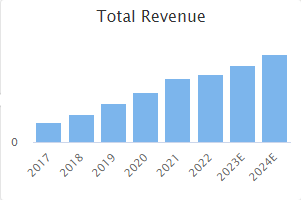
Although EPS is much more patchy:

The latest trading update, as part of their full-year results in May, says that, although they are not immune to inflationary headwinds, they expect to trade in line with current market expectations this year. This puts them on a forward P/E of 14.5, so not exactly cheap in the current market.
However, the business has been highly cash-generative and has built up £16.3m of cash at the last balance sheet date. And this is not achieved by stretching their working capital either, with net working capital standing at +£8.1m. I would expect that there may be some working capital movements during the year - retailers don’t pick 31st January as their year-end for nothing - but this still represents over half the market cap. Unfortunately, there is no dividend paid by the company with them choosing to re-invest in growth. However, they spent money on four new stores, a European distribution centre and their IT platforms last year, yet still generated free cash flow.
Cash adjusting the rating here makes this look pretty cheap for a company that retains the possibility of good medium-term growth. Ideally, I’d like to see a commitment from the management for when or under which conditions they would return that cash to shareholders.
Gear4music Holdings (LON:G4M)
Gear4music is one of the companies where the market got carried away with its rating in mid-2021, extrapolating the covid-related demand far too far. Since then, the analysts' 2023 consensus has dropped around 60%.

The share price reaction has been even more savage, with a 1-year RSI of -81%.
In their 2022 full-year results statement in June, the company confirmed that they are trading in line with 2023 expectations. This puts them on a forward P/E of 10.9. This hardly seems great value given that net debt has also been ramping up and now stands at £24.2m, or around 65% of their market cap. The debt has been used to build inventories to ensure product availability during periods of supply chain disruption, plus to make an acquisition. Revenue growth is expected to continue but perhaps not at the rate it had been over the past few years, and looking at the EPS forecasts, there doesn’t appear to be any operational gearing in the short term.
Still, this is a well-run company and is perhaps one for a watchlist even if the current rating is not particularly compelling.
Media
National World (LON:NWOR)
National World was listed in September 2019 with the intention of being a roll-up in the news publishing business. Its aim is to acquire new publishing assets and apply a digital transformation strategy. So far, they have acquired JPIMedia, which was formed out of the assets of Johnston Press. They have lots of regional titles, the best known of which are The Scotsman and The Yorkshire Post.
The metrics here look outstanding, despite an EPS figure that is forecast to decline significantly. Particularly since the company has £23m of cash on the balance sheet and, as far as I can see, no legacy pension issues:

The company reported a good start to the year but is cautious about the cost environment, as many businesses are at the moment. At the end of the day, this is a declining legacy print business with a digital growth business attached (although they clearly cannot be separated since they both require the same journalists to generate content). It would be foolish not to compare them with £RCH. Adjusting for cash, pension deficits etc. I make National World on an adjusted forward P/E of 4 vs around 7 for Reach. I think this discount is potentially unwarranted.
STV (LON:STVG)
STV started off as the broadcasting company Scottish Television. Various attempts over the years to diversify into other areas never really took hold and were sold off. Today it remains a TV broadcaster and production company for both terrestrial TV and streaming services. A quick glance at the StockReport makes the company look highly attractive. It has a low rating:

It reported positive trading in June and has had increasing brokers’ forecasts over the last year:

They had a small net cash balance at the end of the year. However, in my initial trawl, I missed something: a large pension deficit. It shows how easy it is to overlook such things.
In this case, the pension deficit is £79.4m on an IAS19 basis and £116m from the Last Triennial valuation. They are making £9.6m of cash contributions and have agreed to continue this level for the foreseeable future.

This represents around half their profit after tax and makes their “adjusted” price-earnings ratio more like 12. This isn’t that great value in the current market, but it is much better than Carclo (LON:CAR) and De La Rue (LON:DLAR) , which we excluded in last week’s article for similar reasons. This goes onto my watchlist. If the share price drops further or growth accelerates, then this would look more interesting. (Since the pension contributions are fixed, if profits were to double, the contributions would represent a quarter, not a half of profits.)
Investment Companies
We excluded collective investments from our screen, but several of the results have fund-like qualities. This is because they are either listed Closed-End Funds, or tradable assets make up a significant proportion of their value. With such companies, we can largely ignore any earnings numbers since this will primarily be due to profits or losses on the sale of assets. By nature, the earnings of such companies are lumpy and non-recurring, so they are not helpful for making investment decisions. Instead, the most relevant metric here will always be the discount to tangible book value for these companies. Value investors will want to look for a sizable discount to tangible book value to be interested in investing in these.
Rockwood Strategic (LON:RKW)
Some investors may know Rockwood Strategic by its old name. It used to be called Gresham House Strategic prior to the change of investment manager to Harwood Capital. Their Q2 Factsheet shows a net tangible asset value of 1513p per share, which means the current quoted buy price of 1400p represents a discount of around 7%. This discount doesn’t seem high enough to warrant further investigation, given that both the stock itself and its holdings are quite illiquid, despite a well-regarded manager.
Given that most of its holdings are listed small cap companies, it may be worth considering Rockwood further if marking these to market shows that the current discount has widened significantly. However, a quick check shows that, if anything, the net asset value will have declined since the Q2 Factsheet was published:

Volvere (LON:VLE)
Volvere is a turnaround specialist; it buys struggling companies and injects capital or management expertise to improve their fortunes. It has a strong track record of successfully conducting such turnarounds. However, their inability to find companies to purchase at a reasonable price over the last few years means that the majority of their assets are currently cash. The current discount to Tangible Book Value of around 28%, according to their StockReport, reflects the concerns that they will not be able to utilise this cash. However, if investors believe that business conditions will be weak going forward and access to capital will be tight, then Volvere could find itself in a great position again. Perhaps the only downside with holding Volvere at today’s price is the opportunity cost; there are ongoing management costs, and the company has never paid a dividend, preferring to retain and re-invest capital. Waiting to see if they can deliver a suitable acquisition may be the best strategy here.
Logistics Development (LON:LDG)
Logistics Development Group became a cash shell following the sale of its stake in the Eddie Stobart businesses. Initially, the intention was for them to make acquisitions in the logistics field. However, a lack of opportunities in the space has seen them expand their mandate to other trading businesses. Given that they are managed by DBAY Advisors, it is not surprising that they took a position in Caretech, a company that DBAY made an offer for. Ultimately that offer was outbid, leaving Logistics Development Group with a £1.7m profit on their investment. Adding this to the £131.9m cash balance on 30th November and taking off c.£21m spent on share buybacks and around £1m annual admin costs means that they should have about £111.6m of cash and investments or 19.87p per share. The current ask of 13.7p implies that this currently trades at a 31% discount. Despite the obvious concerns with almost all of these assets being cash, this looks too low given the quality of the investment manager. DBAY are likely to be more active than the Volvere management at putting this cash to good use.
Inland Homes (LON:INL)
Inland Homes is a rather strange mix. Part of it is a land banking company specialising in purchasing brownfield sites in the South East and getting planning permission for housing. The other part is a house builder. The house-building side was intended to capture more of the value chain for Inland. However, increasing costs meant this side of the business made a loss in H1. The company is quite geared and hence hasn’t returned to paying dividends post-covid. However, several recent land sales have reduced the gearing here. In the past, there has been criticism over management pay. And the geared nature of land values to property prices won’t appeal to investors who believe a large property crash is on the way. However, the current 0.43x Tangible Book Value gives a large margin of safety against even severe adverse economic outcomes.
Frontier IP (LON:FIPP)
Frontier IP is a specialist in commercialising intellectual property. Reading their H1 results, they seem to be trading well and have realised cash profits through selling some of their holding in NASDAQ-listed Exscientia. However, a portfolio of largely pre-profit holdings is notoriously hard to value, and their remaining holding in Exscientia has halved in value since their sales. So a 14% discount to Tangible Book Value doesn’t appear to cover the valuation risk here.
That covers the nine companies that loosely fell into the Retail, Media, and Investment Company categories. I found four value companies that warrant further investigation: Angling Direct (LON:ANG) National World (LON:NWOR) Logistics Development (LON:LDG) and Inland Homes (LON:INL) , and three companies that are worth watching for further share price weakness or changes in fortunes: Gear4music Holdings (LON:G4M) STV (LON:STVG) Volvere (LON:VLE)
Later in the week I will complete the set by looking at Resources Companies and anything else that the screen highlighted.
Disclaimer
This is not financial advice. Our content is intended to be used and must be used for information and education purposes only. Please read our disclaimer and terms and conditions to understand our obligations.

No comments yet
No one has commented here yet! Why not be the first one?