Secrets of investing success: creating an effective watchlist

In last week’s article, I explained how investors would be much better served by generating their own ideas for further research rather than following tips. The benefit is that these will align more closely with an investor’s unique temperament and strategy.
Unless an investor is purely a quant, using a strategy similar to Ed’s NAPS, a company appearing on a particular screen doesn’t immediately make it a buy. Most stock-pickers, including myself, have a process similar to a funnel. Many ideas go into the funnel at the top, but relatively few make it into one’s portfolio:

Initial checks are likely to be around the financial strength of the company and if there is any risk of earnings manipulation or other underhand behaviour going on. A checklist can often be a useful tool to make sure all bases are covered here. The next level of analysis may vary between investors, but something like the framework we use for Stock Pitches on Stockopedia would be a good start for many investors. This may find that a company meets all of an investor’s investment criteria immediately. However, it is far more typical for a company to meet most but not all investment criteria. This is where a watchlist comes in. The point of a watchlist is to avoid having to screen for companies all the time. An investor can’t keep all potential investments in mind at once. A watchlist removes this mental load of tracking multiple investment ideas. While Stockopedia doesn’t differentiate between portfolios and watchlists, few investors will have ten separate portfolios, so it is easy to use one or more of the portfolios as a watchlist:

The ADD TO FOLIO button on the StockReport allows any company to be added to the watchlist:

Decide what are the most important factors
The best watchlists don’t just track a list of companies. They allow investors to make quick decisions by distilling down the critical information for an investment case. Different investors will be interested in different metrics, so it is worth spending time ensuring the most important financial information is visible in any watchlist. Some aspects to consider are:
Financial Strength
2023 has shown the peril of investing in financially weak companies, where many have been forced into highly dilutive fundraises or even worse. Therefore, the ability to exclude financially weak companies is a vital part of an investment process. Typically, this will involve the Current Ratio, Quick ratio, Gearing figures, or maybe all three. I wrote about these in more detail here.
Of course, it is possible to filter financially weak companies out at the screening stage. However, the exact ratio representing financial distress may vary between companies in different industries or with different characteristics. And these numbers change; a company may improve its financial position, or its balance sheet may weaken over time, affecting the investment case. For these reasons, an investor may want to use wider screening thresholds. However, financial strength should never be forgotten, given the importance of avoiding large losses to long-term investment returns. Including the most important ratios in a watch list will keep this focus.
Value
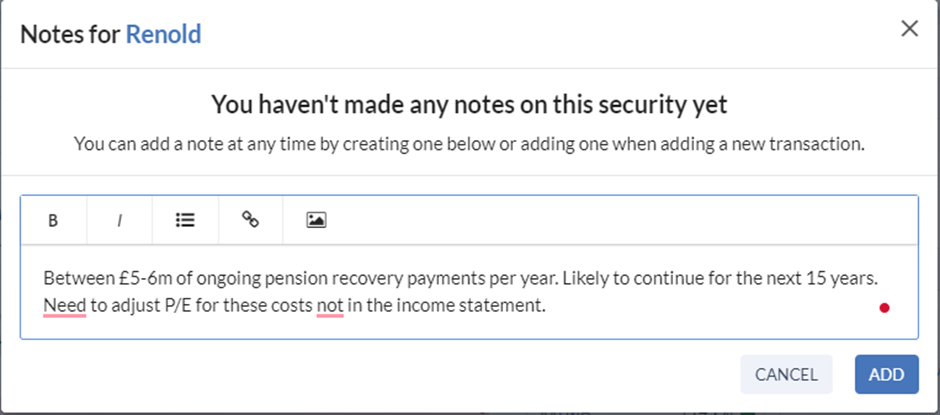
Most investors are not entirely agnostic to the price they pay for a business, even those willing to pay up to own an exceptional business. All things being equal, the lower the price paid, the higher the expected returns. Although investors are likely to be most familiar with the Price Earnings Ratio, it is worth including at least one ratio that includes the whole capital structure by using the Enterprise Value (EV), such as EV/EBITDA or Earnings Yield. One challenge is that the EV won’t include any pension deficit, nor do the StockRanks adjust for it (since there is no consistent way to do this.) So it is worth adding notes as a reminder of things like this:
As well as earnings, the value investor may want to consider price to tangible book value or, in extreme cases, price to net-net. The idea is that earnings growth tends to be mean-reverting, so buying a stock with high earnings may make it look cheap at the moment, but it may be a temporary state of affairs. Buying a stock with significant assets means reversion may instead work in an investor’s favour. However, it is worth remembering that companies that are cheap on assets rarely have high quality metrics. It is a trade-off that investors need to be aware of.
Some investors only invest in companies that pay dividends or have high yields. For them, it will be important to track income measures such as yield, dividend cover, and forecast changes in dividend payout.
Quality
What constitutes a quality share is open to debate, but some common ratios that may indicate a competitive advantage are high gross margin, High Gross Profit to Assets, and High 5-Year Average ROE or ROCE. Even for investors who don’t place these metrics above everything else, they tell a lot about a business and are often worth including.
Momentum
It is one of the quirks of the market that buying stocks at both 52-week lows or 52-week highs is a winning strategy. However, this will appeal to different types of investors. I am much more comfortable buying the unloved, even though I recognise the sense in buying stocks that are previous winners. Of course, those who are primarily momentum investors will want to include many more measures of price and earnings trends in their watchlist.
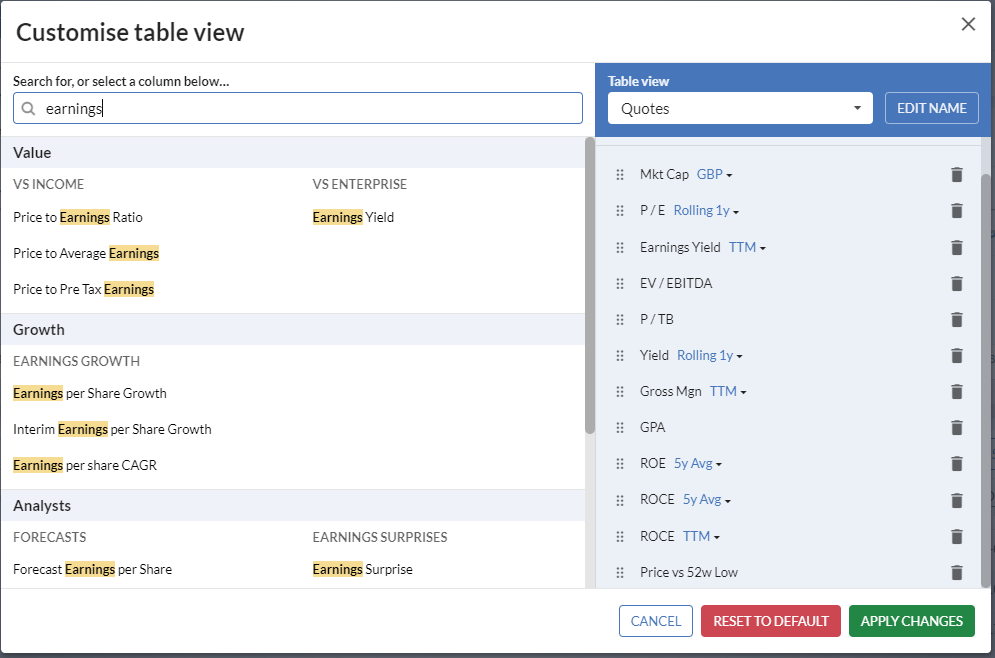
When investors know what is important to them, they can use the Customise button to make their watchlist show the most important factors for them:

Decide what triggers a buy
Once an investor has decided to place a company on their watchlist, then there must be an event that triggers an investor to buy the stock. Otherwise, why have a stock on the watchlist? These are the main aspects that may move a stock into the buy category:
Further research
Sometimes investors need more time to get comfortable with an investment. For consumer-facing businesses this may be trying out the product. Some investors will only consider investing when they have created a detailed financial model that tracks the drivers of profitability and cash flow within a business. Investors must be careful because excessive stock research is more likely to make an investor biased towards a company than improve their decision-making. However, in general, some extra time on research isn’t wasted.
Change in price
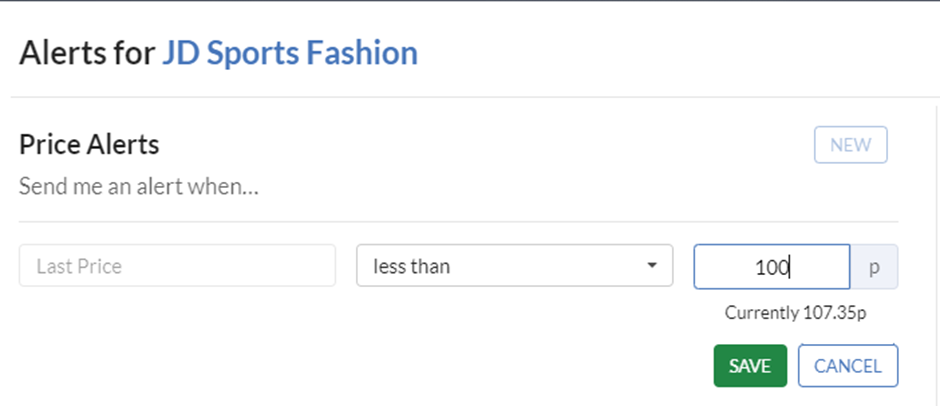
The most common call to action in investing is a change in the stock price. In The Intelligent Investor, Benjamin Graham came up with the concept of Mr Market: a business partner who was manic-depressive. One day, he was bullish and would offer way over the odds for an enterprise. At other times, he was so negative he’d offer to sell his stake for far less than its worth. This allegory is a good description of how the markets act from time to time. I like to set price targets for my watchlist constituents. Typically, this is a low level where I think that the price could drop to on a bad day. Although I am often quite aggressive in my price targets, I am surprised how often they are achieved due to a forced seller or a market panic. Patience and discipline in this area often mean I get a bargain.
Other investors only like to buy when a stock enters a defined uptrend. In this case, a price rise would trigger a buy. Again, it doesn’t matter what an investor’s strategy is in this regard as long as they have defined it well and are consistent.
Stockopedia Price Alerts allow investors to set those price targets and be informed when these are reached:
Change in circumstances
For me, two changes of circumstances tend to cause me to purchase a watchlist constituent. The first is the strengthening of a previously weak balance sheet. The second is a significant improvement in profitability or other news that I don’t believe is fully reflected in the price.
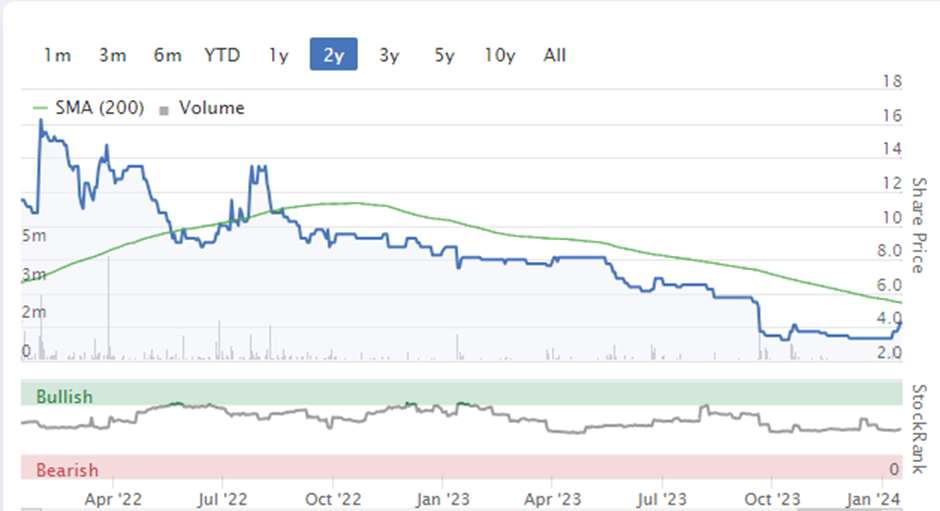
A recent example would be Digitalbox (LON:DBOX) . This company has struggled recently with changes to Google and Facebook algorithms that are reducing visitors to their main sites. Combined with a difficult online advertising market, this has meant that the company’s 2023 EPS has reduced to just 0.1p, from over 1p the year before. However, their recent trading statement indicated that the issues they have been having have been resolved. If the advertising market improves, the company should be back to generating over 1p of EPS again, making it look very cheap. Although the price rose in response to this trading statement, the rise is not significant compared to the level the company previously traded at:
This is obviously more subjective than balance sheet changes. However, the change from a company that has been missing expectations to reporting in line or even beating them can act as a good buy trigger to buy a stock.
Consider existing holdings
It is often worth keeping one’s portfolio constituents on the watchlist, too. Often, the best buy is to top up stocks that an investor already knows and understands (as long as it doesn’t take them over their portfolio limits for an individual stock). However, if two stocks have an identical level of attractiveness, the investor should always prefer the one they don’t own. The reason is that this gives a higher level of diversification. Perhaps the only exception is when an investor owns so many stocks that they struggle to keep up with the news flow for their portfolio. In this case, they may want to aim to be more concentrated. In general, diversification is a free lunch, as they say.
When does a stock leave a watchlist?
Unless there is a process for culling ideas from a watchlist, it will become an unruly mix of previous ideas that have long since gone stale. One way would be to set a time limit, note when a company was added to the watchlist, and remove it if no investment has been made within a set time period. The problem is that the best opportunities often present themselves after a long waiting period, and the investor may miss those. Instead, I like to target a maximum number of watchlist ideas, having a periodic cull to bring down the number to a more manageable figure.
The idea is to remove the worst ideas. For me, these typically will be one of two types of stocks. The first is where the company has become very poor, financially or operationally. It is often tempting to keep these around due to a voyeuristic tendency to want to watch them fail. As fun as this can be, this does little to improve my future returns, so they are gone. The second is companies currently trading at two or more times my fair value estimate. Yes, Mr. Market may bring them back down to earth again, but if something drops 75% or more on no news, I am likely to notice and be able to re-add the company to my watchlist. Other types of investors may have different criteria, less closely related to valuation. However, periodically culling their worst ideas will almost always add value to their process.
Systemise
Finally, I firmly believe that if something can be systemised, it tends to lead to better decision-making. If I am struggling to lose weight, having a rule of no chocolate or crisps in the house is better than trying to resist them when I am tired and hungry. Likewise, with a watchlist, I can make quicker and better decisions if I can build in rules that take away some of the mental load. This makes me more responsive when more fleeting opportunities present themselves.
I use Google Sheets for my watchlist in order to add in these extra factors. The first one filters out companies where the balance sheet is too weak for me to invest. This means I only spend time looking at companies that are financially strong enough that I would consider investing in today. I then calculate a desirability metric. The precise formula doesn’t matter, but the principles are that a company is more desirable:
- The closer it is to my target price. As described earlier, this is often set at a very low but achievable level.
- The greater the potential upside. Estimating this sort of thing is often more of an art than a science, but I still feel it adds value to consider where a stock might trade when Mr Market is at his most bullish.
- The cheaper the company is on forecast EV/EBIT, Free Cash Flow and Dividend Yield. This forecast may be brokers’ numbers (if I believe them) or my own estimates. I adjust my EV for pension deficits and a few other nuances.
- The cheaper the company is on tangible assets.
- When I don’t already have a significant position in the stock.
This allows me to sort by the most interesting ideas for me at the moment. This doesn’t mean I automatically buy the most “desirable” stock. However, it allows me to focus on the most likely candidates meeting my investment criteria. Modern investing is not so much about access to data but distilling down the firehouse of information to the key points. My watchlist is not foolproof, but it certainly helps in this endeavour. A well-crafted watchlist can do the same for every investor.
[Disclosure: Mark owns shares in Digitalbox (LON:DBOX) ]
Disclaimer
This is not financial advice. Our content is intended to be used and must be used for information and education purposes only. Please read our disclaimer and terms and conditions to understand our obligations.

10 comments
Hi Mark
This is uncanny.
Apart from 1 or 2 items you've just described my methodology for finding new attractive stocks. Items I would add
1. Quality - includes a low level or no gearing. This excludes lease liabilities because until recently these ( thinking rent or equipment rentals) were profit & loss items. You can see these on a company's balance sheet (not stock accounts tab).
2. Quality - operating margin eg I have liked Kitwave (LON:KITW) but as a wholesaler the margins are wafer this so it's a NO.
3. I use one of stocko folios as a watchlist but it's never longer than half a dozen which come and go
4. Using a stocko folio for my portfolio separated into differing categories like inv trusts, overseas stocks etc.
Excellent articles BTW - wish it had been around earlier. Its taken 10 years to develop my method. Oh and I Don't do momentum - instead I use Value
Excellent work Mark.
None of it rocket science but all of it easy to overlook. Well done!
This article is a valuable read for investors. In my experience, simplifying investment decisions to focus primarily on a company's profitability and growth potential, alongside its ability to consistently generate dividends, has proven effective. While tools like Stockopedia offer comprehensive analysis, they complement rather than replace the crucial step of evaluating a company's fundamental health and potential for sustained growth. In essence, to me a successful investment strategy hinges on discerning not just current earnings but also the future prospects and intrinsic value of a business. But hey, if anyone of us had the perfect method we would not be here right now.
As a newcomer lots of tips for me here. I'm not sure what the Stock Pitches framework referred to is though - appreciate clarification on this?
On the left menu if you go to
Discuss and then under UK Blogs it should have a Stock Pitches
This is an old article I think it might be refering to re template..
https://www.stockopedia.com/co...
Yes, thanks AlexwUK for digging it out. When we create Stockpitch articles, we are asked to (roughly) follow that format for consistency.
Wheeler1, if you look at any of the StockPitch articles, then you will see the headlines we follow and treat them as "worked examples". I don't think they are the only way of doing it, and different types of companies require some more nuance. e.g. you can't really consider mining/oil & gas without thinking about life of mine/reserves. But for the majority of trading companies it is a good template and makes sure all the major investing headlines are considered.
Thanks Mark (& Alex wUK). I hadn't picked up on the stock pitches information at all, & also ResearchTree. Creating my own template now using what i'm learning.
My personal watchlist also addresses what the company does, how well it does it and the extent to which it has a sustainable moat. I don’t have any company on my watchlist if I can’t realistically understand what it does. This rules out, for me, various sectors including pharmaceuticals and banking (ex purely retail banking).
Well done Mark. This piece of work is crammed with ideas on how to create or improve a share selection process. My main three folios are 1) Current Holdings 2) Waiting to Buy 3) Work in progress. For the waiting to buy folio I have a spreadsheet which shows what event I am waiting for. This tends to be things like a) A good recent trading update B) An earnings upgrade C) Share price is no longer falling and has started to rise. As you can probably tell, I like to follow positive momentum.
Sounds a great way of doing it!