Shifting Tides: Geopolitical Events and the Shipping Industry

A number of volatile geopolitical events, marked by the Houthi rebels' attacks on commercial ships in the Red Sea, and simultaneous crises in major shipping canals, have triggered a ripple effect across the global shipping industry.
The attacks by Houthi rebels in Yemen have forced major shipping companies to alter their routes, avoiding the Red Sea and opting for longer, costlier journeys around the Cape of Good Hope.
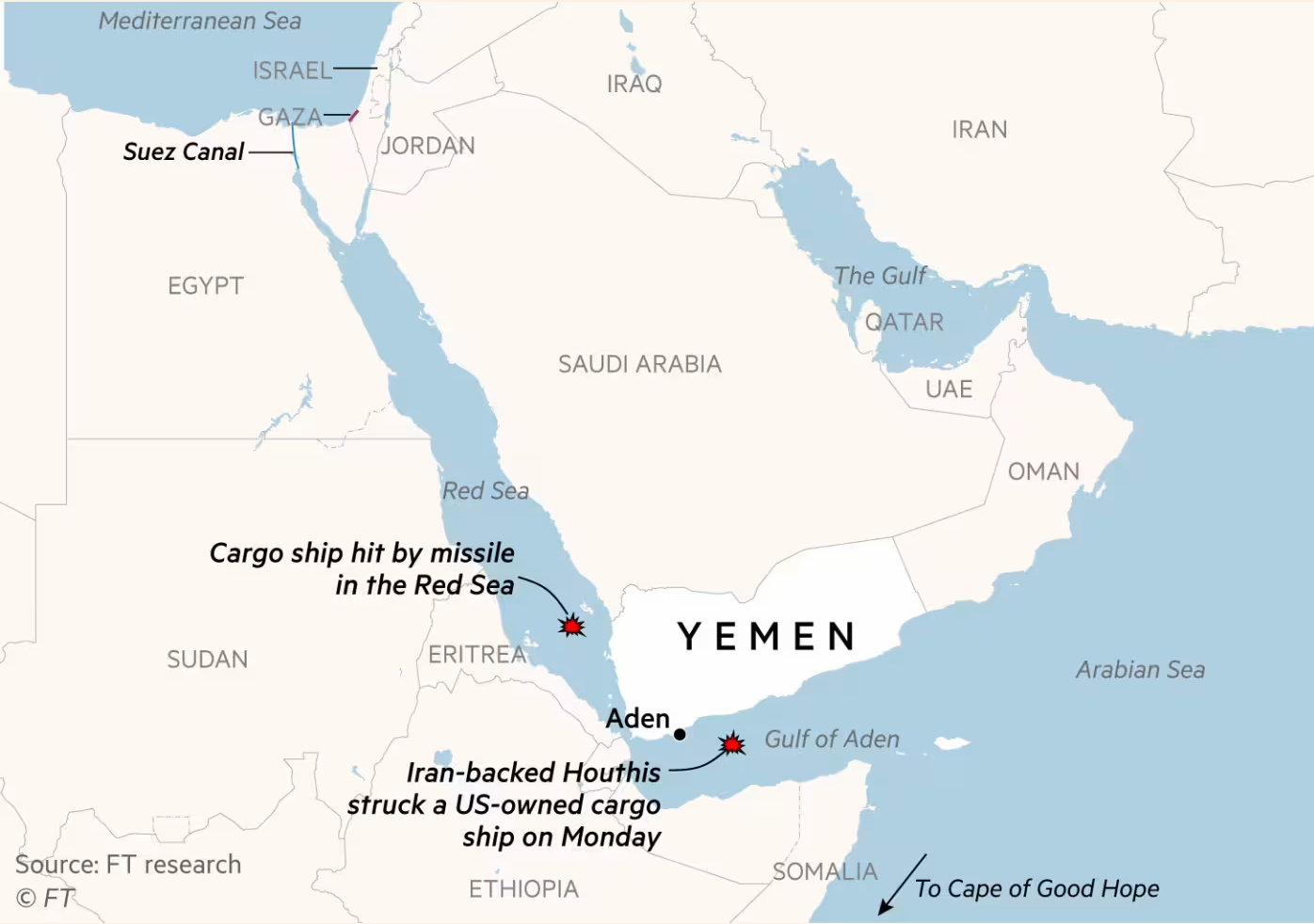
Source: Financial Times
This redirection away from the Suez Canal, which is responsible for around 15% of global trade, has led to a spike in freight rates. Container shipping rates on key global routes have, on average, doubled over the past month. The disruptions have also prompted a number of companies such as BP and Shell to pause shipping via the affected routes, underscoring a broader impact on global commerce.
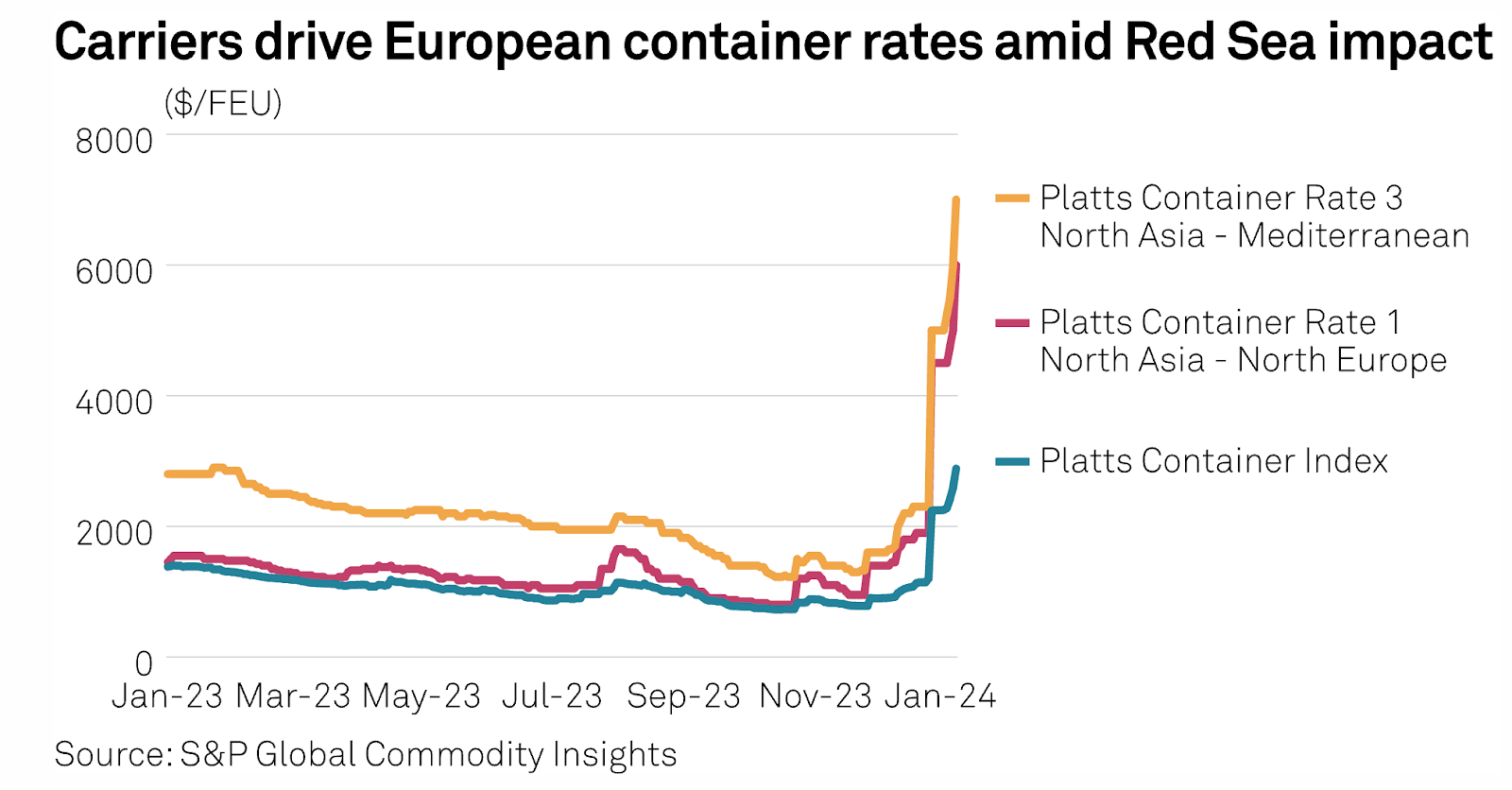
The escalating situation has led to serious concerns about the safety of maritime routes, with traffic along the Suez Canal down by 28% in early January, according to the IMF PortWatch. At the same time, climate-related issues, such as drought affecting the Panama Canal, have further contributed to the complexities faced by the shipping sector.
A silver lining for the shipping industry?
While the global shipping industry experienced a slump in 2023 due to high inventories and reduced consumer spending, recent geopolitical events have presented a potential reversal in fortunes. Shipping experts, such as Alan Baer, CEO of logistics company OL USA, anticipate that the higher rates resulting from the current disruptions could significantly boost the profitability of Vessel-Operating Common Carriers (VOCCs). If the situation persists for an extended period, profits may approach levels seen in 2022, offering a silver lining for an industry recovering from recent challenges.
Investors are now once again eyeing opportunities in shipping company stocks. Jefferies research note indicates that the turmoil in the Red Sea region is likely to disrupt shipping routes for the foreseeable future, keeping shipping rates high. The brokerage has raised earnings forecasts for shipping giants like Maersk, Hapag Lloyd, and ZIM, reflecting the positive outlook for the industry.
Navigating challenges and uncertainties
Despite the potential for increased profits, the shipping industry has faced several challenges and uncertainties over the past year. An oversupply of containers, a legacy of the post-pandemic shipping boom, remains a key issue. Container lines' vessel-buying spree in 2023 led to overcapacity, making it challenging for the industry to manage the excess supply. Additionally, the duration of the geopolitical tensions and the effectiveness of measures taken by multinational navies, such as ‘Operation Prosperity Guardian’, will determine the long-term impact on shipping routes and rates.
The shipping industry is inherently cyclical, marked by alternating periods of prosperity and downturns. These cycles are influenced by factors such as global economic conditions, trade volumes, and vessel supply and demand dynamics. Navigating these cycles requires industry participants to adapt strategies, manage risks effectively, and capitalise on opportunities during more favorable market conditions.
The intersection of geopolitical unrest, climate-induced disruptions, and the global shipping industry creates a dynamic landscape for investors. While the immediate challenges are evident, the ongoing crises present opportunities for those monitoring the sector closely.
With this in mind, let’s take a closer look at a few of the top-ranked stocks in the shipping container industry…
AP Moeller - Maersk A/S (CPH:MAERSK A)
Established in Svendborg, Denmark, in 1904, A.P. Moller - Maersk has emerged as a worldwide pioneer in integrated transport and logistics. Now the largest shipping company globally, it boasts a workforce exceeding 100,000 employees, a fleet of over 700 container vessels, and a footprint in 130 countries.
A beneficiary of the post-pandemic spending boom, the company has steadily grown its revenues and earnings in recent years, reaching an impressive 27.98% and 278.68% respectively, on a 3-year compound annual growth rate basis.

Despite the ongoing challenges faced by the shipping industry in 2023, Maersk recently reported Q3 2023 group revenues of $12.1 billion and profits after tax of $0.6 billion, demonstrating its resilience.
It was the Ocean division that struggled in particular, facing headwinds from declining freight rates despite increased volumes. As a result, Maersk was forced to implement cost-cutting measures, laying off some of its workforce and intensifying its restructuring efforts, successfully reducing operating costs by 19% in the process. The ongoing restructuring programme is forecast to deliver savings of $600 million in 2024, positioning Maersk as a leaner entity amid geopolitical uncertainties and rising freight prices.
The Logistics & Services division saw a recovery in volumes in Q3 2023 but also dealt with lower rates, whilst Terminals maintained good returns with strong EBITDA margins. Maersk anticipates meeting its full-year 2023 guidelines, but it expects these results to be towards the lower end of its guidance.
It is, however, worth noting that freight rates have shot up since this statement, and during a comparable spike in freight rates in 2022, Maersk recorded profits exceeding $30 billion. Not bad for a company currently valued at just over $30 billion.
Hapag Lloyd AG (ETR:HLAG)
Hapag-Lloyd, a prominent German large-cap company, operates a fleet of 264 modern ships with an annual transport volume of 11.8 million TEU (Twenty-foot Equivalent Unit). The company, founded in 1847, boasts a rich history, having successfully navigated significant changes in the shipping landscape and played a pivotal role in the consolidation of the industry, successfully integrating CSAV, UASC, and NileDutch.
Nevertheless, Hapag-Lloyd also faced challenges in the first nine months of 2023 due to the unfavourable market dynamics in the shipping industry. Group EBITDA and EBIT amounted to USD 4.5 billion and USD 3.0 billion, respectively, a notable decrease from the previous year.
Lower average freight rates, impacted by weakened demand and increased capacity, contributed to this decline. Despite stable transport volumes, a decrease in the average freight rate from $3,106/TEU in 2022 to $1,312/TEU in Q3 2023 has posed challenges. However, this picture has drastically improved in recent weeks, with container shipping costs through Red Sea from Europe to the Gulf having already shot up by $1,000 a TEU.
Improving freight rates, combined with Hapag-Lloyd's expansion into terminal activities and the establishment of the Norcoast joint venture in Brazil signifies efforts to tap into growing coastal shipping markets, and positions the company well for the future. It aims to grow its operations profitably and maintain a global market share of over 10%.
Notably, Hapag-Lloyd exhibits excellent financial prudence, which can be seen by its robust returns on capital. With a return on capital employed of 24.7% and a return on equity of 27.3%, the company has proven its ability to effectively manage costs and generate returns for its shareholders even in more challenging times.

The outlook for 2023 acknowledges the complexities of geopolitical conflicts, persistent inflation, and high customer inventories. However, Hapag-Lloyd still forecasts an EBITDA range of $4.5 to $5.5 billion and EBIT in the range of $2.4 to $3.4 billion, acknowledging these uncertainties. These figures could be on the more conservative side, should freight rates continue their upward surge in Q4.
Clarkson (LON:CKN)
FTSE 250-listed, Clarkson, has enjoyed a much stronger 2023 than many of its peers. The integrated shipping services company reported outstanding interim results for H1 2023. Underlying profit before taxation surged to £53.1 million, a 25.8% increase, with earnings per share rising by 35%.
The Ship Broking segment delivered an impressive performance, contributing to a strong balance sheet with £128.2 million in free cash resources. As a result, the company felt confident enough to increase the interim dividend to 30p per share, continuing its track record of 20 years of consecutive dividend growth.
Andi Case, the CEO, highlighted the success of Clarksons' strategic execution, leveraging global mega-trends such as the green transition, digitalisation, and strategic advisory. The company, which operates in 24 countries, now offers everything from shipbroking to sector research, logistical support, and full investment banking capabilities. It’s well positioned to capitalise on emerging trends in the industry, and analysts are starting to recognise this, consistently upping their forecasts over the past year.

The company’s shares ended 2023 on a particularly strong note, climbing over 40% since late October. It also seems that the company could be set to continue this momentum after its most recent trading update in January 2024 confirmed that results would be ahead of market expectations for the year ending December 2023.
Mpc Container Ships ASA (OSL:MPCC)
MPC Container Ships, which has been listed on the Oslo Stock Exchange since 2018, has experienced rapid growth in recent years. The company has positioned itself as a key player in intra-regional trade lanes, boasting one of the largest feeder fleets globally, owning 65 vessels.
The company's vessels operate on fixed-rate charters, supporting intra-regional trade by connecting major ports on intercontinental shipping lanes to smaller ports. MPC Container Ships has showcased strong execution capabilities, managing a fleet with a utilisation rate of 98.7%.
MPC Container Ships’ Q3 2023 financial results point to a company in good health, marked by continued dividend distributions and increased revenue guidance. Q3 2023 highlighted the positive impact of strategic measures, such as the sale of older vessels, acquisitions of eco-design vessels, and ongoing fleet optimisation. The company's proactive approach to fleet optimisation positions it favourably in the face of market softening and uncertainty.
Despite challenges in the market, MPC Container Ships maintains a very rewarding dividend policy with an intention to redistribute 75% of net profits after capex. In the good years, this dividend can be worth a quarter of the company’s market capitalisation.

Looking ahead, the company seems well placed to weather any storms with a revenue backlog of $1 billion, offering high earnings visibility despite market fluctuations. To add to this, the shares are now trading on a forward price-to-earnings ratio of 3 and a price-to-free cash flow of just 2.6.
Conclusion
Amidst geopolitical turmoil and industry challenges, the global shipping sector could now present some unique opportunities for investors in what is an often overlooked market segment.
Recent events, such as Houthi rebel attacks and canal crises, have led to route shifts, boosting freight rates and potentially enhancing profitability for shipping companies.

Companies like Maersk, Hapag-Lloyd, Clarkson, and MPC Container Ships, despite facing challenges over the last 12 months, have showcased their resilience. As strategic initiatives materialise and freight rates stabilise at higher prices, the outlook could significantly improve for these companies, making the landscape a much more fertile hunting ground for prospective investors.
Disclaimer
This is not financial advice. Our content is intended to be used and must be used for information and education purposes only. Please read our disclaimer and terms and conditions to understand our obligations.

19 comments
Supply and demand is the simple answer. I didn’t hear too many people sympathizing with container ship operators during the many years they were making marginal profits while investing tens of billions of dollars to build, and charter in, more efficient ships…. On average, shipping is a highly capital intensive but low return business.
Exactly.
Also, the big, massive in fact, elephant in the room here is that order books for new ship builds are a disaster area with various shipyards having gone out of business.
Ship builders are building container ships. However tanker, liner ships LNG carriers, dry bulk ships are deemed too risky and are not being built [mainly due to myopic ESG/net zero reasons].
As such, the favorable opportunity for patient investors arises from the unavoidable disparity between the demand and an industry that can solely generate supply with substantial capital...
A really nice article Keelan - one of the reasons that I'm a fan of Stocko.
MPCC looks interesting.
Great article Keelan, thanks for covering some of the areas rarely discussed on the SCVR. I enjoyed your review of the mining sector as well. Going to keep tabs on Clarkson (LON:CKN), but looking at the run up in the SP maybe I've missed the boat on this one (pun intended) so will see if a little pull back happens in the next few weeks.
One small point on MPCC that I think is worth mentioning is that for the 18 months or so that I've had their shares, they have indeed paid fantastic dividends, but also lumps of cash paid as return of capital which doesn't seem to suffer the Norwegian tax take. I've always assumed that it represents the proceeds of ship sales but never checked that.
One more comment .
You really have to ask yourself this
Why should a Suez Canal / Houthi rebel issue actually lead to extra profits - that’s called profiteering .
Similarly it is arguably morally questionable that excessive and off profits were generated for shipping lines as a result of a global pandemic .
Baroness Michelle Mone got hammered for profiteering yet the shipping magnates get away without any criticism or comment .
Anyway making extra profits at someone’s expense due to external issues. By all means pass on the extra costs that is fair and equitable .
But to make increased profits in these situations is just not right unless of course you own shares in a shipping company .
'Why should a Suez Canal / Houthi rebel issue actually lead to extra profits - that’s called profiteering'
Well many ships are diverting via the Cape of Good Hope, which adds 6000 miles and three weeks to the journey. There are fuel costs and also other costs involved in the running of the ship for three weeks. Moreover, insurance for those ships continuing to use the Suez Canal has skyrocketed, for good reason.
That’s no problem to pass on those extra incurred costs, these are added as standard practice , eg “fuel surcharge “ etc
So pass the costs on absolutely no problem
This is not additional profit
Profiteering is the adding of the xtra profit to the actual increase .
I did 30 years import export that’s how it works .
If the additional costs are passed across that’s all fair and agreeable, but not an increase margin
Freight industry is a nightmare to deal with closest thing to racketeering I ever dealt with .
UK importers have zero bargaining power when freight rates are set and shippers just get away with what they can and make excessive profits.
So yes profitable and a pretty non competitive market run by as cartel of price fixing gangsters .
Good investment yes.
But the kicker will be on the reverse with increased cost on landed goods, inflation, and reduced profits by importers exposed .
Still can’t argue with the investment case on shipping companies .
But importers hate them due to the master servant relationship .
Take a look at Tufton Oceanic Assets Epic: SHIP. Yield increasing to just under 10%, paid quarterly. Big discount to nav. Check out recent RNS on possible special dividend and break up. I hold.
Hi Keelan,
"Maersk recorded profits exceeding $30 billion. Not bad for a company currently valued at just over $30 billion."
Can I please check if the above figure of $30 billion is correct?
Hi Logical David,
I've attached some links to highlight the company's 2022 results below.
https://www.ship-technology.co...
https://www.seatrade-maritime....
https://investor.maersk.com/fi...
Keep in mind that this is the EBIT figure, but it is still a remarkable achievement nonetheless.
Best,
Keelan
I've been running my own shipping portfolio for about 2 years (as there isn't an off the shelf ETF) . I don't own any of the shipping companies that you mention however. Instead I own the Dry Bulk and Tankers. Why? Because civilizations require oil, gas, coal, metals, fertalizer, et al in order to function. Whereas cheap tat from China isn't so important:-) Aside from that, the Dry Bulk and Tankers were completely out of favour for the last decade if you look at their charts(they still are) . Super high dividends too, over 20% pa in some cases eg Diana Shipping (NYQ:DSX) and so on...
Hi Alphaflight,
That's a great point regarding dry bulk and tankers. Diana Shipping (NYQ:DSX) looks interesting, Genco Shipping & Trading (NYQ:GNK) is another one on my radar at the moment. The dividends in the good times can be extraordinary, lots of value out there.
Best,
Keelan
Hi Keelan,
Yes lots of value out there. I own Genco Shipping & Trading (NYQ:GNK). Also look at Star Bulk Carriers (NSQ:SBLK) (Note: Michael burry still holds this I believe). DHT Holdings (NYQ:DHT) Teekay Tankers (NYQ:TNK) Frontline (NYQ:FRO) are the blue chips companies of these two shipping sectors I mention. Most of these have >5X upside in my opinion, you just have to hold them for long enough while receiving the dividends. A lot of these companies have already gone bankrup in the past and the shareholders were wiped out, debt holders were converted to equity etc.
Thanks for this - I'm just surprised that Suez Canal traffic is apparently only 15% - would have thought its a fair bit more - but are they going by number of vessels transiting or should they be more concerned with actual value of goods transported? Either way Egypt must be suffering.
Hi bohenie,
In terms of the value of goods transported, you're looking at around $1 trillion worth of goods annually. So the figure refers to the value of the goods transported rather than the number of vessels.
Around 30% of all container ships cross through the Suez, so yes, this is a big hit for Egypt! I've just seen a Reuters article confirming that revenues from the Suez are down 40% in Jan 2024 compared to Jan 2023.
Best,
Keelan
Great article Keelan. Thanks
Hi DavidMcCabe,
Thanks for the comment. Glad you enjoyed it!
Best,
Keelan