Should AI Companies Be More Expensive Than Dow 30 Stocks... Really?

To understand how stocks will be impacted by AI, we should stop looking to the future. Look backwards instead, to the 1920s — another era when, in the words of John Kenneth Galbraith, 'men sought not to be persuaded of the reality of things, but to find excuses for escaping into the new world of fantasy.’
The parallels between the 1920s and the 2020s are uncanny. Commentators today blur the lines between sci-fi and reality. Where does it all end? Will optimism produce a great crash, as it did in 1929? Or will we arrive at what Ray Kurzweil calls the ‘Singularity,’ the point where AI surpasses human intelligence and technological change becomes exponential?
This week, I will present the bear case against AI, with a particular focus on LLMs (Large Language Models) and two companies leading this space, namely OpenAI and Anthropic.
In a subsequent article, Graham will offer a more bullish rebuttal.
Writing On The Cocktail Party Wall?
Before diving into financials, we should analyse the zeitgeist of our time.
There are two telltale signs of a bubble.
- Skeptics who warn of danger are shunned;
- Shares become the main topic of conversation at dinner parties.
Tell someone that AI is an overhyped fad, and watch their reaction. Many will dismiss you as a naysayer. Keep your ears open on the Tube, or in the supermarket. How often do you hear someone say ‘AI’ or ‘ChatGPT’? When everyone is talking about the same thing, herd mentality may be taking hold, the very psychology that fuels market bubbles.
Another telltale sign of a market bubble is people saying: ‘It’s different this time’. Just before the 1929 crash, one economist said that markets had reached ‘a permanently high plateau’, as if the laws of finance had changed and stocks would go up forever. Today, people say that AI will change everything. Maybe it will, but we’ve heard it all before.
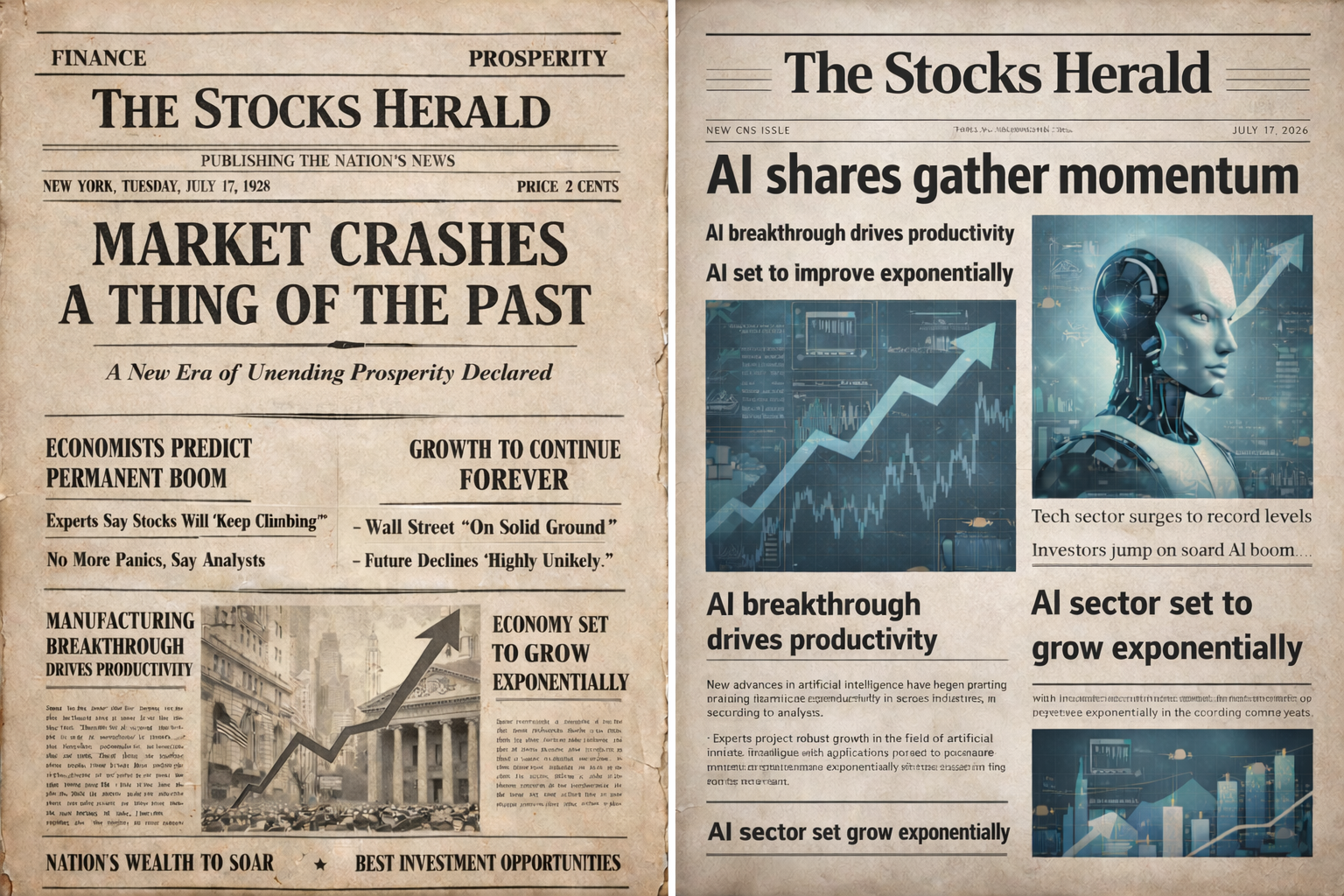
The following illustrations are fictional, generated using DALL·E 3 (OpenAI). Nevertheless, they are plausible caricatures of the times. They highlight plausible parallels between the 1920s (left) and 2020s (right).
Do The Valuations Make Sense?
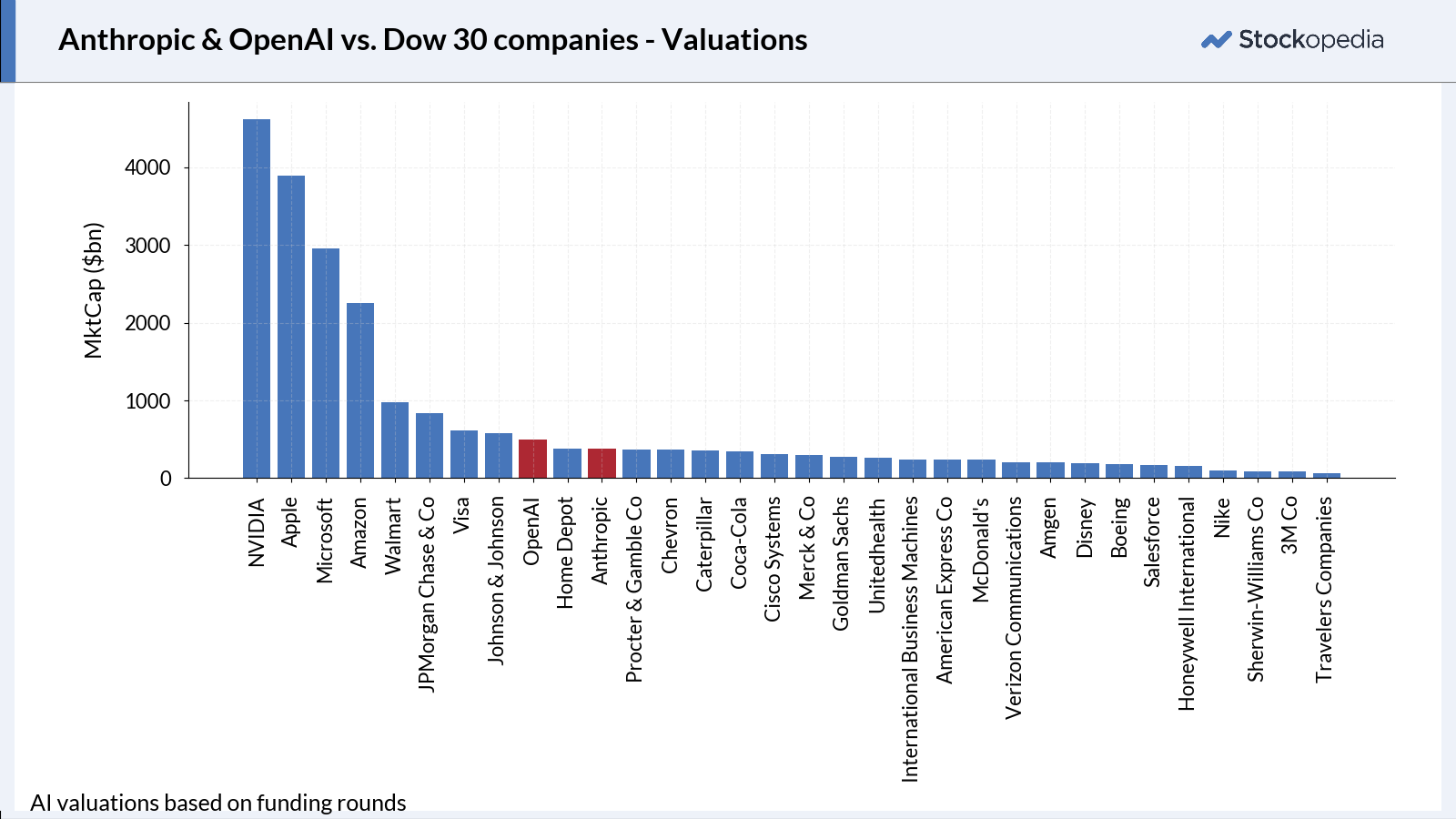
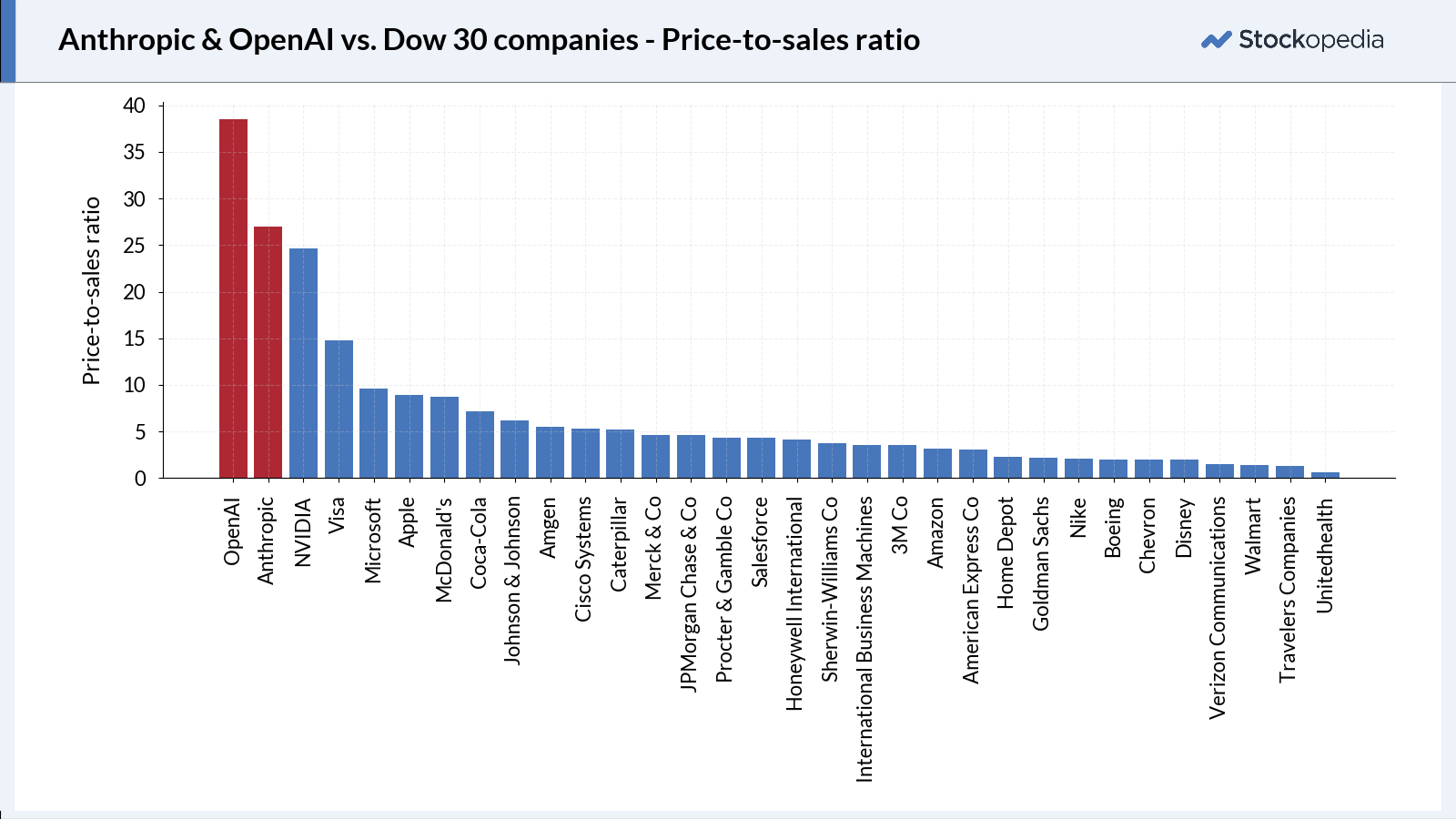
The clearest sign of a bubble is the high valuations that OpenAI and Anthropic have secured in recent funding rounds. Investors need to answer a simple question: does it make sense for these companies to command higher valuations than Coca Cola and Chevron?
The missing ingredient is —you guessed it— a profitable business model.
- Microsoft’s financial statements suggest that OpenAI made a $12bn loss in Q3 2025.
- Sam Altman (OpenAI’s CEO) has warned losses will persist.
- Similarly, Anthropic’s gross margins were negative -94% in 2024.
Profits could be limited, due to the high cost of building AI. OpenAI plans to spend $1.4tn on compute capacity over the next few years — that’s equivalent to the GDP of Spain! It would only pay off if LLMs improved when we trained them with more data.
In reality, returns may diminish...
LLMs are ultimately statistical models. Words are represented as numbers. Predictions are based on probabilities. LLMs don’t think. They assemble words which statistically make sense. At a basic level, they predict sentences like: ‘The [ ] sat on the [ ]’ — like auto-complete on your phone. LLMs are auto-complete ‘on steroids’, trained with more data.
More data improves predictions, up to a point... and then it doesn’t. Think of a coin toss. After 100 flips, you’ll generally see a 50/50 split between heads and tails. Another 200 flips won’t change the ratio.
Language works the same. After enough Christmas cards, the pattern becomes obvious: 'Dear so and so'… insert seasonal greeting… then sign-off with, ‘Best wishes.’ You won't improve the AI by showing it more Christmas cards.
Now consider the investment case. Companies pour money into data infrastructure. They hope to produce better models, but what if performance plateaus… while data costs keep rising? You see the problem.
Don’t take it from me. Yann LeCun, the Chief AI Scientist at Meta, said:
If you think that we're going to get to human level AI by just training on more data and scaling up LLMs, you're making a mistake.
In a similar vein, AI-critic, Gary Marcus, has said:
There is an old saying, that the definition of insanity is doing the same thing over and over again and expecting different results. Basically, that's been the field of AI for the last few years… The scientific hypothesis is you pour more data, you'll eventually get AGI. And the thing is people keep trying that experiment. It doesn't really work.
Betting on Breakthroughs
The risk for investors is that inflated market valuations reflect a breakthrough that has not yet happened. It is as if investors were being asked to invest in the Wright brothers in 1903, on the basis that jet propulsion was ‘just around the corner.’
Sustained, economically viable innovation will require breakthroughs beyond the current LLM paradigm, potentially integrating LLMs with other approaches, like World Models.
- LLMs predict the next token or word in a body of text.
- World Models predict the next state in a given environment.
The idea is that World Models could facilitate progress in autonomous driving, robotics and other areas, especially if we create a sort of LLM-World Model hybrid. However, progress is by no means guaranteed, for several reasons.
- Data availability: We train LLMs by ‘simply’ feeding them a corpus of digitized text. World Models train on richer and messier datasets, encompassing sensor data and video footage. This is more expensive to source.
- Closed-world vs open-world learning: LLMs improve by training in the relatively ‘closed’ world of text and language, where rules are more defined. Conversely, World Models operate in more dynamic, unpredictable environments, where it is unclear that learning scales.
- Resource intensity: Training World Models is computationally expensive. In order to generate a return on investment, we need to scale models over a long and uncertain road, towards products that people willingly pay for because they solve complex problems reliably (e.g. ironing your shirt without burning the house).
While the above challenges are being addressed, investors risk missing opportunities in other areas. So unless we want to speculate about the future, our investment thesis should be grounded in the technology that exists today. This brings us back to LLMs.
How Good Is the End Product, Really?
AI companies should only be worth as much as Coca-Cola or Disney if their products are going to be used by everyone, everywhere. Towards this end, LLMs are marketed as general-purpose ‘silver bullets’ — tools that can be used by everyone, everywhere… and for anything.
In reality, we still need specialists in the loop to ensure quality, safety, and correctness. You can’t fully remove experts without consequences. This potentially limits mass adoption.
- Companies are already reversing course: A UK study found 55% of firms that replaced employees with AI later rehired, possibly because of the following quality and safety concerns.
- Security failures are real: Moltbook —a social platform built with 'vibe coding'— was hacked and 35,000 email addresses were stolen. These breaches can potentially hit corporations hard. Think about the possible lawsuits, reputational damage and regulatory fines.
- Quality is inconsistent: A study by the Center for AI Safety tested whether AI could complete freelance software tasks, e.g. on Fiverr. The jobs were simple. The results were not impressive. In only around 2% of cases did the AI complete the job successfully.
- There is also a theory around productivity gains: AI in theory makes workers faster. But is this an illusion? Model Evaluation & Threat Research (METR) tried to find out. In early 2025, they ran an experiment with two groups of software engineers: One used AI. One didn’t. The non-AI group finished a set of tasks faster than the AI group.
Gary Marcus sums up the problem:
The quality that's been promised isn't really there. It doesn't really make sense.
The bottom line is that LLMs are powerful tools, but not magic. Over time, users will become more discerning about when, where, and how AI can be used.
One Final Question: Where is the Durable Moat?
Even if LLMs do become commonplace tools, it is not clear that OpenAI and/or Anthropic would be the long-term winners. It’s worth running Warren Buffett’s thought experiment: ‘If I had a tonne of money, could I compete with the business?’

Admittedly, Anthropic may have an edge over OpenAI, in terms of specialisation and switching costs. Anthropic has started to embed itself into daily workflows, by positioning itself specifically as a developer 'side-kick', rather than a generic LLM tool. This could make it harder for software developers to migrate away once habits are formed.
At the same time, both companies could see their moats pressured if LLM learning plateaus. In this scenario, competitors could catch up with today’s ‘good enough’ performance which, in turn, becomes a commodity.
- On the theoretical side, AI products are built on algorithms, but much of the theory is public, for instance, in academic papers. Even patented breakthroughs expire. At the end of the day, information wants to be free!
- On the practical side, data infrastructure helps create a moat, but there’s a ceiling. If the model no longer improves when we add 'more data', then scale isn’t protection. Any firm with enough money, infrastructure, and elite engineers can spend billions and compete.
Some analysts already warn that models like DeepSeek could trigger a price war. In this context, the real advantage would be ownership of proprietary domain data. In finance, firms like Bloomberg could outcompete general AI labs. Imagine a world where LLMs are 'commoditised' and Bloomberg decides to integrate financial insights with LLMs. Bloomberg would have an edge. More generally, it may indeed make sense for industry incumbents to absorb emerging AI firms.
On the flip side, if data infrastructure does create a moat, then we may be entering a new, less profitable software paradigm. Historically, software has been capital-light relative to hardware-heavy industries. But AI may change that: building and training advanced models requires enormous capital for compute, chips, and data centers. On this point, it’s also worth mentioning that data infrastructure carries a depreciation risk, because AI chips advance fast. Older systems must be upgraded or they lose value.
If the AI boom slows, there is the potential for contagion risk across the financial system, because various pension funds and banks have started to invest in AI. All of these factors lead me to believe that OpenAI and Anthropic most probably should not be priced above giants like Boeing or Chevron. The profits aren’t there. The math doesn’t work. The growth story is speculative. They may survive, but are they blue chips? Unlikely.
AI companies are selling a powerful story - i.e. we must adapt now or be left behind. Whether their claim is true is beyond scope. The key issue is that AI companies are incentivised to sell a compelling vision. And they’re entitled to promote that vision, but as investors, we have zero incentive to follow the herd…
Disclaimer
This is not financial advice. Our content is intended to be used and must be used for information and education purposes only. Please read our disclaimer and terms and conditions to understand our obligations.

19 comments
There was quite an interesting segment in a TV program last night - it was in one of those forensic/murder programs which seem to be quite popular nowadays.
A young boy had been stabbed and ultimately killed in some parkland where there was no cctv. The Police were forced to collect all cctv evidence from the school where he left to the entry point of the Parkland, to determine the sequence of events.
It was a huge amount of cctc footage, however, the Police took a photograph of his face and asked AI to trawl through the data, and within a few minutes, AI correctly identifed the boy, his route and timings. The detective implied that it would have taken him days to do this manually.
Even more impressive, the Police fed the details of the murder suspect (another young boy on a bike) into AI through the same cameras and it came back with some still photos for confirmation. The Police confirmed the correct photo, fed this back into AI and the AI generated all the route information for the suspect.
Clearly AI is going to do two things.. reduce human involvement to near zero in some tasks and to bring impossible labour intensive tasks into the scope of reality.
My thoughts. Valuations may be top heavy. They may not be. But i challenege anyone who has used AI tools in their daily duties or work to claim they are not here to stay. It is not hyperbolic to say that for some roles they are ALREADY 10x'ing the output of a single employee. For the first time recently, with the latest model updates and use of 'agents' plus 'skills' i am feeling somewhat terrified at the pace this is moving. Large swatches of office workers will be losing their jobs in the next few years. Jack Dorsey laying off 40% of Blocks workforce recently is a harbinger. I say all this as someone using these tools near the leading edge. The average person has no idea whats coming.
The vodka is good, but the meat is rotten.
What AI boils down to is predictive text. That's basically all it is. There is no thinking or conceptual understanding by the tools.
What all this about vodka and meat? This was an early attempt at AI to translate "The spirit is strong, but the flesh is weak" into Russian and back again.
As regards competitive advantage, as Prof Damodaran said, "If everyone's got it, then no-one's got it."
There's an enormous land-grab right now which I think boils down to FOMO. Meta spends billions, so Google has to spend billions. Amazon, Microsoft, etc..
No doubt efficiency gains in terms of computing processes or algorithms will be made where you can achieve a lot more with a lot less.
I've tried Grok, and I quite like it, actually. I've seen vids of ChatGPT and I'm sure I'd want to hit my monitor if I used it. It seems to just wing most stuff and get it wrong. When you call it out, it says "Good catch", then comes back with another wrong answer. All in an annoying upbeat American voice.
Damodaran pointed out that it is worth looking at AI spending in the aggregate. Looked at collectively, rather than on an individual company-by-company basis, is the expenditure likely to matched by revenues? He said "No".
My mate Dave said that the AI expenditure was like the fibre-laying of the late 90's. About 10X the fibre was laid than necessary. He suggested that all those GPUs will likely find a use other than their current purpose, although it is impossible to predict what that something is at this point, as it hasn't been invented yet. That's not an endorsement to buy NVDA, you understand, but that there will be so much spare capacity that it will be used for some hitherto unknown purpose.
Thank you for writing want I am thinking.
All 3 of the most popular AI chat tools: Chatgpt, Gemini and Claude (I don't use Grok, a producer of CSAM owned by a white supremacist) are customisable in the settings - so you can select the voice, including non American options (and using voice mode is optional of course) you can also select the 'tone'. I am sure many of the options are annoying/ cringe, but they are easily avoided..
As for getting it wrong - while that's true, the extent also depends on settings/ mode / prompt etc. The basic chatbot versions are optimised for speed and conversation, rather than accuracy.
https://www.oneusefulthing.org/p/using-ai-right-now-a-quick-guide
They are also becoming much more than just chatbots.
I'm sorry Mark but what you're saying is simply not correct. AI is not simply predictive text writ large.
Do you think driverless cars are controlled by predictive text? Do you think that medical diagnostic systems are just predictive text? Do you think that predicting the shape of protein molecules is predictive text? What about automatic trading systems? Interpretation of medical images? Navigation? Robotics? Warehouse automation? Speech recognitions and synthesis? Anomaly detection? Those are just top of my head, no doubt I've missed more than I've included.
Underlying predictive text is just an algorithm searching huge databases as fast as possible to suggest what comes next or what you are trying to type based on statistics. All the other AI stuff is just a flavour of that: automatic trading is just searching for what statistically comes next, medical images are compared to whatever is already in existence to determine the probability of various diagnosis, etc. The fact AI can look at larger amounts of data faster than a human makes it appear like magic or dare I say 'intelligent', hence the name Artificial Intelligence.
But we don't have to agree. That is what makes us human after all.
I wouldn't want to come down on either side of the argument particularly, but when Artificial General Intelligence arrives, it will be the game changer ... that definitively won't be predictive text....
Interesting article available on Fortune about Demis Hassabis and IsoMorphic a company spun out of DeepMind and mostly owned by Google.
IsoMorphic's stated ambition is to "Cure All Disease". Think about that.
Before you draw the conclusion that it's just over-blown hype, DYOR about Alphafold - the AI tool which led to Hassabis being awarded the Nobel Prize in connection with protein folding. That solved problems in minutes that had previously taken years for large teams and is already accelerating medical research by a very substantial amount.
Sounds to me like it has the potential to be pretty valuable.
Fortune article is at https://fortune.com/article/de...
Thanks for sharing that example.
I suspect the winners in this space will be the companies that clearly match:
i) a well-defined business problem;
ii) to an AI-driven solution.
Your example shows new technology being applied to a clearly defined problem. 'Cure All Disease' may be a marketing phrase, but the intent is clear.
By contrast, some AI companies risk becoming solutions in search of a problem. This may be why 'generalist' LLMs are often positioned as cost-saving and productivity tools, as if expenses and productivity themselves are the core business problems to be solved.
Sure - we have to keep an eye on the bottom line, but expenses and productivity are just one part of the bigger picture.
I suspect the winners will be the well funded big boys who can scoop up any interesting competitors before they grow too big for their boots - thats one huge advantage of premium ratings (aka insane) - i wouldnt be betting against any of the first movers in the field thats for sure.
Perhaps they might start scooping up traditional companies to accelrate their growth and provide som semblance of profits - for example one buy adobe and $7 bill of annual profits fdor like $150 bill - and set the ai lose on eliminating as many ovehead costs as possible
so perhaps the answer here is they all merge into one all powerful being
Thank you for an article I tend to agree with: to me AI mania is similar to the search for a rarer tulip bulb.
Greatly interesting article Alex and a timely check on anybody tempted to join the rush or "herd" mentality of investing in AI that the principal players all seem to be engaged in a race to be the best in the field by advertising their intention to spend eye watering amounts of capital developing what is yet to be regarded as a physical product with an asset value. Rather it is a model which can be copied or improved upon, quickly rendering the companies falling short of perfect with a worthless product.
At best well developed AI, if adopted by most scientific and health research companies can surely only improve their business efficiency and profitability and would therefore never be able to recoup the huge sums of money being touted by the magnificent 7 players, but reliant on yet to be built data centres?
For myself I should prefer to wait out the development stage, until there is a clear demonstration of marketing strategy and real need for developed AI models, before investing in those companies most likely to benefit from including it within their manufacturing process.
Excellent article and a good corrective against the hype.
My two pennies for what they are worth:
No one knows how this is going to pan out, so how do you know which firms to select? But if you feel AI will raise company profits in general then it is a good idea to be in the market via an index ETF.
Thank you, Alex, for an interesting article on a subject that is bound to keep us all engaged for a while to come. Just one observation that I’d like to make. You specifically refer to two companies, Open AI and Anthropic, both of which are currently private companies. You then go on to talk about “herd mentality” and how it can “fuel market bubbles.” Neither of the two companies that you’ve mentioned are available to the “herd.” If there is an AI bubble brewing, you’d expect that it would be reflected in the public companies that are financing the majority of the capex in AI, i.e. the Mag 7. Well, here are the latest forward P/E ratios: -
Meta 21.5 – 23.0
Microsoft 24.0 – 25.3
Nvidia 23.2 – 39.0
Alphabet 27.8 – 29.0
Amazon 28.4 – 32.0
Apple 29.0 – 32.7
Tesla 195 – 215
Tesla is the stand-out exception, and their valuation is clearly based on a ‘story’ of outsized future profits. Ignoring this, the rest are on a fwd. p/e of around 25 or 30. This is pretty high, but they are serious growth companies. The broader S&P 500 is averaging around 22. I’m not sure if this is indicative of an AI bubble.
Hi,
Thanks for this.
The point about public versus private markets is an important one.
The fact that private AI companies are commanding stellar valuations suggests that there may be a bubble forming within the subset of the investment community that has access to those funding rounds. That could reflect several things, including:
a) A genuine belief that LLMs are on a path toward becoming something close to “God-like” AI. This feels like a blurring of fantasy and reality — precisely the kind of narrative excess that tends to underpin bubbles.
b) A more cynical agenda on the part of some investors. It’s possible that certain participants are simply aiming to ride the momentum while it lasts. Private investors may believe they can buy in early and exit at higher valuations, effectively selling to those who buy into the hype.
Your point about Microsoft and the broader tech complex is also interesting, but I see two nuances here. First, large-cap tech stocks have been a major driver of the US bull market more generally. Second, this may be something of a red herring: even companies with significant AI exposure derive the majority of their revenues from other business lines. That makes it difficult to attribute share price movements directly — or exclusively — to AI sentiment.
Who knows which organisations will be the winners in the software and apps space. The thing we do know is the spades and shovels brigade are winners already.
One area I'd like to see covered is the major storage providers eg Western Digital, Micron, Seagate and NetApp. All this development and testing must be generating massive amounts of data. Is this being 'properly' priced in to SVs over the next couple of years?
Thanks Alex for a thought provoking article. I would say that LLMs are pretty much already commoditised - indeed they are widely available for nothing. I suppose the real fear for investors is the extent to which agile companies, who harness the extra compute and cheaply available AI models, will disintermediate the business models and juicy margins of incumbent businesses in a wide array of service heavy industries in areas such as insurance, software, finance, gaming and others. At the very least, AI could lower the bar to compete in many spaces and drive increased competition threatening many businesses. Even if the hype is ahead of the potential, as I suspect may the case, the fear is enough to reduce valuations across many service businesses due to terminal value reductions as business models start to look assailable.
Yes – this is a valid point. There are a few things to consider.
AI makes it easier to write good code... when used well. There are only so many ways to structure a function, class, or SQL query (most start with ‘SELECT’) so LLMs have a decent probabilistic shot at being right. That lowers barriers to entry and increases competition.
But when used badly, AI creates disasters (e.g. see Moltbook). AI empowers novices to write a lot of business critical software both quickly and badly. So expertise still matters, and I guess I don’t buy the idea that non-developers will be able to do away with software services entirely.
Will we need fewer developers? It is unclear. It is hard to define an industry-wide rule. Some companies will cut staff and run their existing operations with smaller teams. Others may decide to keep everyone and boost overall output. It will vary from case to case. Also consider that many new services and products will crop up in this space, creating jobs.
Some argue that companies will use AI to replace paid-for software tools with ‘in-house’ alternatives. I’m skeptical. These efforts may start with, “Just ask Claude to build it.” Teams might reach a decent POC, then stall under teething problems and resource drain — pushing them back to external solutions.
That said, I can see a world where motivated teams of developers take a serious run at building their own start-up products. Those groups would be far better placed to compete — and yes, incumbents could be threatened.