SIC Performance Review: a 52.6% gain and some hard lessons from the first year

Somehow, more than a year has passed since the Stockopedia Investment Club's inception, and a lot has happened in that time. So we've decided to write up a review of the SIC's performance so far. If there's demand for it, we'll look to turn this into a more regular update.
For those that are newer to the site, a quick recap: at the start of 2020 the Stockopedia team set up its own investment club because there's no substitute for 'skin in the game'.
And let's face it, the first steps into the world of investing can be quite intimidating. We hear it from newer subscribers all the time and it's why we support an environment in which newbies can find their feet just as much as old pros can swap war stories.
So we set up the Club in February of 2020, in that strange period after the Covid cat was out of the bag but before the stark reality of lockdowns had fully hit home.
And our stock pitch template was hammered out in the wild months of March and April as retail investors rode out one of the most savage equity market drawdowns in history. Even seasoned investors had moments of doubt in those remarkable weeks, when the streets emptied and all the toilet roll disappeared.
But iron, as they say, is forged in a furnace. And it was in this incredible environment that many of the Club's members experienced their first real taste of the markets. Along the way there have been some great calls and a couple of 'facepalm' moments - including our biggest loss... Not a stock we bought that went down, but one we sold too soon and that soared to new heights.
You can read all about that below (hint: Slater Investments has just joined the party there, buying in at more than twice the price we sold out for).
So far we've found this to be a highly educational, enjoyable, and profitable endeavour. We hope you agree. You can find all of our write-ups so far in The Investment Club blog.
Portfolio performance
Unless stated otherwise, we will be discussing results for the period from fund inception on the 6th of February 2020 through to the 31st of March 2021.
Here is the time-weighted return (which removes the impact of deposits and withdrawals) of the SIC portfolio over that period, courtesy of Oli Cooper.
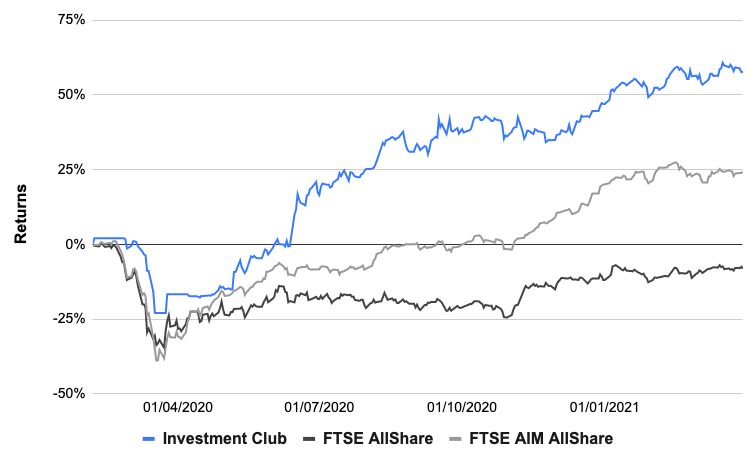
It's been a volatile ride but we are pleased to see the Club outperformed in the crash, with a smaller drawdown (of 23% versus 38.8% for the FTSE AIM All Share) and drawdown duration (110 calendar days compared to 231 calendar days for the FTSE AIM All Share). This resilience was in part thanks to our cash weighting at the time.
But, significantly, the Folio also managed to capture more upside during the recovery despite this cash weighting as we steadily added holdings to the Folio.
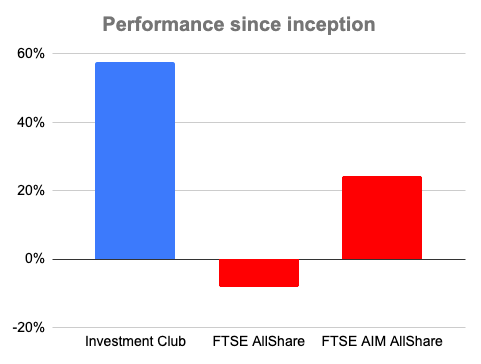
So all in all we are off to a good start with the SIC portfolio up 52.63% in its first year and up 57.76% over the total reporting period compared to -8.15% for the FTSE All Share and 24.26% for the FTSE AIM All Share.
Performance drivers
Let's go a little deeper and look at the winners and losers so far.
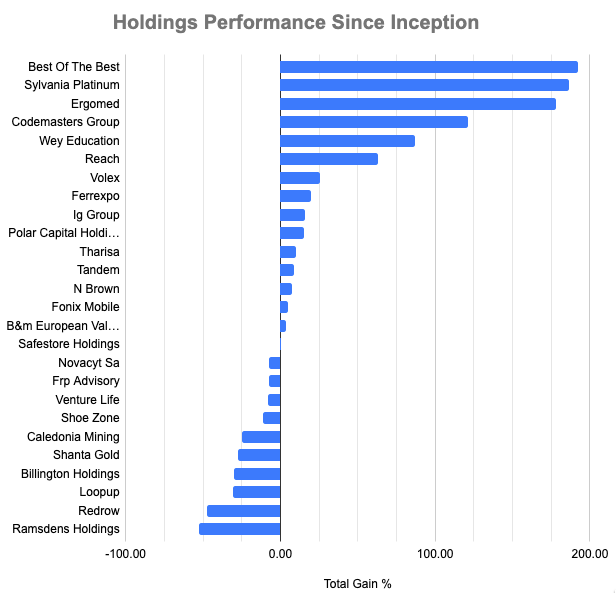
Thankfully the frequency of the winners exceeded that of the losers and we currently have a win:loss ratio of 1.5x.
Perhaps equally important is that the scale of losses was, on average, less than the scale of our wins. This is in part down to our stop-loss policy - it's not been all good but, on average, it has helped more than it has harmed.
Here's a brief review of some of the Club's biggest winners and losers so far.
Winners
Best Of The Best (LON:BOTB) - Pitch
- 08/04/2020 to 15/12/2020
- Bought at 400p; sold at 1,315p and 1,165p
- Total gain: 192%
BOTB is both the Club's biggest winner and its biggest regret. Debate still rumbles around the (virtual) office on this one.
The group started in 1999 as a business that displayed luxury cars as competition prizes in retail space within airport terminals and shopping centres.
This all changed with management's evolution into an online pureplay, which transformed the group's addressable market, cost base, and marketing efficiency. It also paves the way for international expansion in future.
It was one of the Club's first buys back in April 2020 at 400p. The Club voted to sell 30% of the shares in November at 1,315p to reduce the weight in the portfolio due to its strong performance, and to recoup the initial investment cost.
With earnings upgrades blocked by the group's Formal Sale Process (FSP), BOTB's StockRank drifted in the second half of 2020. It ultimately fell foul of our fundamental stop loss rule towards the end of the year and the remainder was sold in December at 1,165p for a total gain of 192%.
Needless to say, performance since then has been stellar and the share price is currently nearly treble our final sell price. If the Club continued to hold, we would be looking at a 700% gain from one of our very first picks!
But is there anything we should have done differently? Most investors have these stories and action bias is very real. One suboptimal result does not necessarily invalidate the process...
Maybe selling BOTB was just a Bad Break?

(Disclosure - I hold BOTB shares)
Sylvania Platinum (LON:SLP) - Pitch
- 23/04/2020 - ongoing
- Bought at 38.7p
- Total gain: 186.7%
Another April 2020 purchase, Sylvania Platinum produces and sells Platinum Group Metals (PGMs), which are platinum, palladium and rhodium. The Club bought Sylvania Platinum (LON:SLP) shares at 38.7p and continues to hold at 117.4p.
Back then, this PGM producer appeared anomalously cheap. It has rerated aggressively since, but, with forecasts of sustained Rhodium deficits and increasing industrial demand across PGMs, the future continues to look bright.
These metals play an important role in reducing car emissions and legislation trends are favourable here. So on the one hand we have demand drivers, with prices rocketing on catalytic converter demand, but on the other hand, we also have some supply disruption further contributing to deficits.
Of course, commodity prices can and do go down as well as up. While the Club has so far surfed a wave of rising prices, we have to be mindful of the risks and downside potential that come with holding commodity-related stocks.
(Disclosure - I hold SLP shares)
- 07/05/2020 - ongoing
- Bought at 418p
- Total gain: 178.1%
Ergomed is a service provider to the pharmaceutical industry. It does three main things (although the main business is in 1 and 2):
Ergomed's outperformance has been driven by a change in strategy. It used to be heavily focused on co-developing new treatments, but this is costly. It has since pivoted towards the higher margin "services" side.
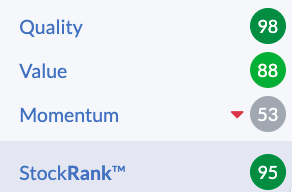
The shares are now expensive on the face of it and momentum has weakened in recent weeks, but Ergomed's performance and returns on capital in recent years mean we are sticking with it.
Losers
As the Club runs stop losses, there was less variability here and downside was broadly capped at 20%.
That said, exceptionally high levels of volatility in March meant that our more notable percentage losses exceeded this limit. In fact, the majority of the negative performance came from getting stopped out of various positions in the March/April 2020 market crash.
We cut 4 positions in this period: Billington Holdings (LON:BILN) , Caledonia Mining (LON:CMCL) , Redrow (LON:RDW) , and Ramsdens Holdings (LON:RFX) .
Ramsdens Holdings (LON:RFX)
- 11/03/2020 - 17/03/2020
- Bought at 189p; sold at 90.5p
- Total loss: -52.8%
Ramsdens appears to offer quality and growth at a reasonable price - but it was sold from the Folio in March 2020, a victim of the stock market volatility.
The underlying investment case remains intact and RFX still qualifies for the SIC Screen - so perhaps we will see it re-pitched at some point...
Redrow (LON:RDW)
- 27/02/2020 - 17/03/2020
- Bought at 757.89p; sold at 404.11p
- Total loss: -47.6%
Another short-lived Covid holding was Redrow and, again, it still qualifies for the SIC's rules so it's entirely possible that it gets pitched again in future. Housebuilders and the property market have been surprisingly resilient and, after a strong first half, Redrow has reinstated dividends.
- 12/10/2020 - 20/11/2020
- Bought at 221p; sold at 155.8p
- Total loss: -30.6%
LoopUp is the Club's biggest loser that was not a part of the March madness (we got this one wrong all by ourselves.)
It looked like LoopUp was perfectly positioned for the work-from-home boom but the company managed to snatch defeat from the jaws of victory with a profit warning that surprised even its own house broker. In this instance, the stop loss saved us from 50%+ losses.
Corporate activity
Codemasters Group (LON:CDM) - Pitch
- 08/04/2020 - 13/01/2021
- Bought at 270.40p; sold at 601.38p
- Total gain: 121%
Attractively valued Tech stocks are hard to come by on the UK markets and this has been a problem area for the Club ever since Codemasters became the centre of a bidding war between two video games giants.
This remains an attractive and IP-backed area for investors and acquirers alike, although valuations tend to be sky high for listed alternatives like Sumo (LON:SUMO) and Team17 (LON:TM17) .
Wey Education (LON:WEY) - Pitch
- 19/08/2020 - 07/04/2021
- Bought at 24.45p; sold at 46p
- Total gain: 87.1%
Online teaching group Wey Education is the Club's most recent takeover candidate after agreeing to be taken over by Inspired Education Online for 47.5p a share. The deal values Wey at more than £70m.
Current holdings analysis
And so that quick tour takes us through to the SIC Folio today.
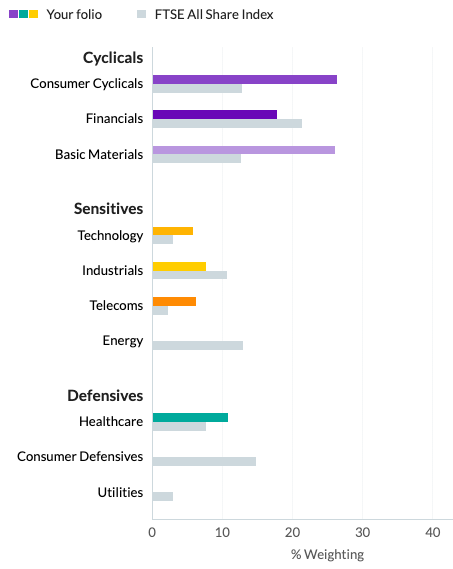
Currently we're overweight Cyclicals, which is either a good place to be as economies unlock, or means one day SIC could be in for a nasty correction. Are we banking too heavily on the reflation trade?
This is something we need to carefully consider in the months ahead and it could be that a 70% weighting here might be too punchy. It would be great to get some more Defensives in there, so let's hear some suggestions.
From a "Style" perspective, Super Stocks currently dominate and represent 43.8% of the Folio, with 25.4% in the Style Neutral category and the remaining 30.8% classed as High Flyers.
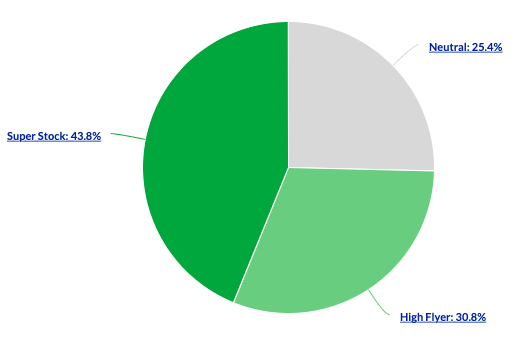
Here are the current holdings grouped by Style.
Super Stocks: Sylvania Platinum (LON:SLP) , Computacenter (LON:CCC) , Tandem (LON:TND) , Ferrexpo (LON:FXPO) , Tharisa (LON:THS) , Ig Group (LON:IGG) .
Neutrals: Reach (LON:RCH) , N Brown (LON:BWNG) , B&m European Value Retail Sa (LON:BME) , Safestore Holdings (LON:SAFE) .
High Flyers: Polar Capital Holdings (LON:POLR) , Fonix Mobile (LON:FNX) , Ergomed (LON:ERGO) , Volex (LON:VLX) .
Conclusion
It's been quite the introduction to the stock markets for the Club and we'd love to open this up as a wider community discussion.
Here are a few of the main points:
Stop Losses
Should we or shouldn't we use them?
At the moment we use two stop losses:
- Technical stop loss - we use a price based (non trailing) stop loss weighted by RiskRating.
- Fundamental stop loss - any stock whose StockRank falls below 50 is sold.
Let's look back at those Covid stop loss stocks. Most of them have recovered more slowly than the wider market (the FTSE All Share is the dark green line below).
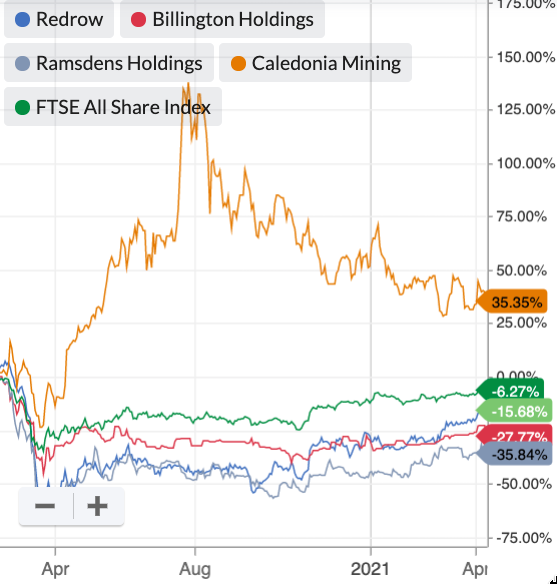
True, we lost out on BOTB. But stop losses have saved the Club from a couple of steep drops (LoopUp comes to mind, although that one is slowly picking back up again).
Running your winners
On a related note, does the fundamental stop loss compromise the Club's ability to run its winners? I am, of course, talking about BOTB in this instance. In order for stocks to compound, they sometimes need to be held through tougher periods. BOTB has always had a Quality Rank of 99 or 100.
Perhaps our fundamental stop loss rule is too blunt an instrument. We could consider building some sort of Quality-related consideration into it. But do we really need to change or is this just action bias kicking in again?
Final thoughts
With restaurants and pubs opening back up and the sun starting to shine again, we're all hoping to get our lives back on track. Subscribers deserve credit for navigating these crazy markets.
As for the Investment Club - with a tricky first year under our belts we're cautiously optimistic. It might not always be plain sailing, and nobody knows what the future holds, but we look forward to sharing our journey with you.
Best of luck in the months ahead.
Disclaimer
This is not financial advice. Our content is intended to be used and must be used for information and education purposes only. Please read our disclaimer and terms and conditions to understand our obligations.
33 comments
well done on your first year youve done brilliantly ! A suggestion to you all is as we are now looking to infrastructure in the coming years perhaps we should look to companies like Ashtead and keir as well as more steel producers like Evraz ? All are doi g very well and with Evraz over this year ive acheived 125% profit margin and im sure these companies will continue to do well ? What do you think ? Best of luck everyone !
Stop losses stop top gains
Jack - really interesting article, thank you - would definitely like to see this continue. I took my inspiration for portfolio construction from the NAPS portfolio article in January, although I don't run it as 'no admin' and have also had a tricky time deciding on my stop-loss/sell criteria so your thoughts on that make interesting reading although they appear to be very similar to yours. Keep up the good work, and good luck with it!
Thanks for this update - very useful.
I have backtested the use of stop losses extensively on a stockranks type portfolio and found that stop-losses decrease overall returns for the kind of portfolio that SIC is running; however, they work at reducing drawdowns, and more importantly, providing a "max loss" scenario i.e. what is the worst case scenario. In other words, it improves your Sharpe Ratio. So having a stop loss/not having a stop loss both work (as an ancillary point, if you are short term trading, you absolutely would deploy stop losses).
Notwithstanding the above, I'm a firm believer in "less is more": I do see the intrinsic value of not adding complexity by adding stop losses etc. as it leads you to tinker with your portfolio, which more often than not, is best avoided - i.e. negates discipline.
Why use stop losses if they lower return? of course, we all want the highest return with the lowest drawdown but the reality of equity markets is that, once in a while, you could have a 75% drawdown across your portfolio (which will cripple you psychologically) and no amount of diversification across stocks/globally will protect you from this.
A stop loss will prevent this. Also, if you tell people, the risk is a 75% loss, most people will run a mile; a defined max loss may encourage participation into equity.
As a position trader/investor, I used to simply diversify amongst 20/30 stocks and NOT have a stop loss but have now started applying stop losses (I'm always open to experimenting):
a) to protect capital and allow me to deploy more capital (as I know my worst case, so I would be less averse to put savings I may need); and
b) to be able to deploy size into any one stock (i.e. if I know my worst case for a particular is a 1% loss on my portfolio, I can invest more heavily in a particular stock, rather than diversify equally between many 2% positions).
However, I am a trend folllower for the most part and my stop losses are structural and loosely defined - I would like to see how the stock is acting at key points - it is not an order resting with the broker; I may give it weeks before I cut it. Sometimes the stock goes back up after I cut it, sometimes it falls below and it feels like you've sold at a time when a stock was at a buy point: a key to dealing with that is anticipating and visualizing how you will react in such circumstances and perhaps having different approaches with different stocks, albeit that adds complexity and cognitive overload. I can always get back in and there are hundreds of other opportunities.
As for fundamental stop losses, for me price is the most important signal - I don't really care if fundamentally it appears well if price is signalling the opposite. I invest/trade price because on average, I expect I will be better off making money from price movement, not my fundamental assessment of the company. I don't have any burning desire to be proven right by anchoring to my analysis. Also, I sometimes buy fundamentally crap companies (i.e. low stockranks stocks), which are rising on sector momentum or sentiment. In that case, you'd be holding on to a narrative as the stock collapses, so need to avoid that.
Another tool that may be useful is selling chunks of a stock when its going very well - that may be helpful in allowing you to keep some stocks when they're not doing so well as you've already banked some profit, but again, that adds complexity.
Buffett, "We sell when the fundamentals have changed".
Excellent article Jack, thought provoking. Markets are an unsolveable riddle aren't they? For stop losses, I always end up coming back to Buffett and his policy for holding. In my experience, the StockRanks have worked really well and I've only sold once the numbers turn south. So, you're already thinking along the same lines. Don't sell on price action alone, but only sell if the quality deteriorates. You just need to decide on the Quality levels at which you sell. Most of my major losses have been due to holding losses too long and hoping for a turnaround. It worked out only a couple of times, Somero Enterprises Inc (LON:SOM) and Games Workshop (LON:GAW), but mostly it doesn't and there is a huge opportunity loss that comes with holding losers.
I think selling rules are a great idea and brings discipline into the investment process, rather than acting on psychological biases. Then sticking to the rules is the next hurdle, though with an investment club, that issue is removed!
I agee with John2 below, setting a stop loss with a broker can be an over reaction. I am currently trying to develop a stop loss approach based on whether the price drops below the moving average. Picking a 60 day, 90 day or 200 day moving average is then really just a matter of risk tolerance.
Very interesting, sadly I got in on Volex, Tharisa and Ergomed somewhat late, but very pleased with Sylvania Platinum.
Jack - May I say a fantastic analysis of your clubs trades and mindset of the investment decisions and trades
2020 for me was a HUGE mindset issue of the whole decision process
Do I HOLD or do I SELL? - I too have several runners that I let loose FAR, FAR too early
What have I (possibly) learned? - Let the post sale runners go, BUT re evaluate the SELL decision
No bragging but I also have some quality winners that also ask questions
Why did I decide to HOLD? - Was it valid? Is it still valid?
More importantly have I learned anything?
WHO KNOWS? - The only conclusion I have is? - I LOVE being in the market
Regarding stop losses, I am a great believer in them because they protect from capital loss. However, I do not think that stop losses lodged with one's share broker are a good idea. There are often wild swings in a share price at market opening which can trigger a stop loss, but settle out in a short period of time.
I think it is best to apply a manual stop loss based on monitoring share prices on a daily basis, which also allows one to consider if a share price reduction is an overreaction which will soon correct itself.
Some years ago, I had a substantial holding in Compass (LON:CPG) (hardly a small cap), which hit the stop loss level I had lodged with my broker at market opening. 15 minutes later, the price had recovered and I repurchased at a total loss of 5% or so.
This is a great initiative and it is highly appreciated that you share it with the subscribers here. Its like a 'model' portfolio. Please keep sharing and keep us updated. Well done!
Monthly/Quarterly reviews would be useful to read please
I started investing for the first time mid november and find this really interesting to read and would very much like further updates. Thank you
Consumer Defensives: I recently bought Bakkavor Bakkavor (LON:BAKK)
Would be interested in your thoughts.
Consumer Defensives: Like Indie I've recently bought into Bakkavor.
I also hold Wynnstay and am giving Carr's a whirl.
1. Trailing stop loss from 15% through to 30% based on risk rating
2. Stock rank falls below 80.
3. Relative performance vs. index on which stock listed of minus 10%
Apart from this strategy (?) which hasn’t resulted in any sales yet. (!)I do top slice strong performers @ 50% gain and 100% gain. After I have extracted my initial investment then I will let the balance run and apply the above rules. This won’t give me any 100 baggers but it does mean I can avoid losing to much money & sleep!!
I do something similar with strong performers... primarily to maintain diversification (if all of my picks had a 50% gain I would do nothing. A situation that has not yet occurred, sadly).
I did a bit of analysis of the use of StockRanks as a sell indicator here https://www.stockopedia.com/co.... One of the key insights was that Stockrank performance by decile doesn't follow a consistent pattern. You can't safely assume that a stock with a rank below 80 will perform better than a stock with a StockRank above 80. In some cases, its the other way round.
I've adapted my own sell rules as a result, so that
- I use Stockrank to identify what large caps not to buy. They predict poor performance (Stockranks <30 have a negative performance), but have negligible predictive power for high performance (there is no material difference between Stockrank 40 and Stockrank 80 performance)
- I stick, very rigidly, to Stockranks for mid-caps. In this segment there is a very consistent relationship between Stockrank and performance
- I entirely ignore Stockrank with micro and small caps. In this segment there is a bell curve effect: both very high and very low stockrank companies dramatically outperform the ones in the middle.
How do you calculate the time weighted return? I have looked at the definition on Wikipedia and once it got into extended formulae my eyes started to glaze over. Is there a simple method - perhaps hidden in Excel?
Very interesting article. Even more so because you started before the Covid crash. I'm in 2 minds about stop losses:
If you are investing passively based on rules then a stop loss will be be the right decision some of the time.
However a technical stop loss simply based on price ignores all the information on this web site and some wise words from the best investors of the past. If the fundamental reasons for your investment haven't changed then don't sell. Better to buy more and average down.
From what I can see this would have worked well with Loopup (LON:LOOP) and Best Of The Best (LON:BOTB) . Loopup's fundamentals changed and so it was a sell. However BOTB did not and so the dip was a buying opportunity. Easy with hindsight....
An observation (from bitter experience) of the need to monitor share price and for that matter traded volume is that this is arguably the most immediate and potent signal of a possible variance between what we think we know as individual investors based on data such as Stocko reports etc., and what the wider market knows (or at least thinks it knows) based upon all available information/gossip/inside track/ relevant related news etc..
Several times I’ve blithely ignored a sudden price jump or fall only to discover after the fact that big movements in share price backed up by heavy trading volume is often a lead indicator of something material coming down the pipe that is not yet in the public domain. At the very least, even if you don’t trade positions based on stop losses they should trigger a bit of enquiry to find out what the wider market thinks it has found out.
Gus.
Really interesting; thank you.
Overall, very interesting. Confirmation that the SIC concept is a valid client service. I hope all the members have put their money where theiranalytical prowess leads them. I'd like to add comments concerning a holding that the folks at Stockopedia think quite highly of - FXPO. I've just completed a review of new investment possibilties. Ferrexpo was at the top of the list. I'm a dividend investor, and always looking for companies with 'moats'. Ferrexpo meets both criteria quite well. It also has a solid balance sheet. But as I went further, I ran up against three problems which, together, led to other choices (curiously, Post NL, not at all the same, but a good return and a safer environment). Ferrexo is Ukranian, not the country best known for transparency. The best example is the over 50 percent owner whose reputation is less than stellar. Ferrexo is incorporated in Switzerland and thus witholds 35 percent as a tax on dividends. My preference is for British companies with no withholding tax (I am a German resident). Finally, and this is really the no-brainer reason, the fabulous mine at the heart of Ferrexo's operations is literally on the border with Russia. Just on the other side of that border is a significant buildup of Russian troops, and there is real fear of intervention. In the event, the effect on Ferrexo would be dramatic. Perhaps somewhere in its terrific rating system (which I prize) Stockopedia should include, as lenders do, ratings for country risk while signaling witholding tax requirements?
Nice to read this comment. I had been staying away from Ferrexo for this reason. I do note however that my Glencore shares which are about to go ex dividend next week will get hit with the Swiss dividend tax.
On Ferrexpo (LON:FXPO) I definitely agree with the country-specific risk, and also the presence of a less than desirable majority shareholder.
With regards to mine location, I’ve seen comments previously that they’re approx 400miles away from the build-up at the Russian border. Do you have specific information/coordinates on the location of their mines? That could change my investment position entirely.
Try this for Ferrexpo (LON:FXPO) mining locations, (or do your own Wiki for Ferrexpo):
https://en.wikipedia.org/wiki/...
The Ruskies will have to march most of the way across Ukraine from East to West to reach Ferrexpo, or maybe they'll just use Crimea as a springboard, then there's always the Black Sea for an amphibious landing, the latter two being closer to Ferrexpo's back yard - it depends how much the Russian's want some quality iron ore pellets.
All said, just one pair of boots on Ukrainian soil will take it's toll on Ferrexpo's share price and no doubt the markets in general.
Tein did his homework which I should have done. The mines are around 300 km (200 miles) from the nearest Russian frontier. The Crimea is further. the closest frontier about 400km away, but that's not where the Russian's have concentrated their troops. Rather they are just on the other side of the frontier from the dissident Ukrainian region. But we agree that the growing threat of Russian intervention, carried out or not, makes Ferrexo a politically risky investment. It seems to me that there are other possibilities of high return placements with considerably fewer geopolitical risks. If you like mining, check out Rio Tinto with an even better yield, a solid balance sheet, a substantially lower political risk (though China is not the most reassuring region in the world), and there is no withholding tax!
To provide a rather lengthy commentary on the situation, here is an interesting article from a German research institute. https://www.swp-berlin.org/en/... Russian intervention or simply visible threats are not the most encouraging investment environment.
Really interesting article. You mention you hold Computacenter (LON:CCC) in your style section but it is not listed in your portfolio holdings? Would this have made a difference to your return?
Hi Rhodie - Computacenter (LON:CCC) was bought after the reporting period, so it had no bearing on the data presented. Hoping to get that stock pitch out towards the end of next week, so I'm afraid this is a bit of a spoiler... It's done well since the Covid crash, so if we had bought it after April and during the reporting period, I'm sure it would have contributed positively.
Thanks for sharing this Jack, really helpful
Thank s Jack, very interesting. I disagree about the stop losses, Redrow (LON:RDW) is up about 66% and Ramsdens Holdings (LON:RFX) is up 87%, since you sold, so have recovered more than the market?
The way I work out if they are working, is to calculate the value of the fund, if you had not sold them, is it higher or lower than it is now?
Apart from LoopUp (LON:LOOP) they all seem to have recovered since you sold?
52% is a good start, although I think you were fortunate with the timing.
'although I think you were fortunate with the timing.' - it didn't feel that way back in March/April! Funny how things turn out though. But we have outperformed so we're happy with that.
And to your point on stop losses, the extreme volatility during those weeks saw some pretty unfavourable rules-based trades. I've never known market conditions like that and I'm not sure they will prove representative going forwards (at least I hope not!) And, while the prices we sold at were negatively affected by the volatility, selling those stocks when we did also made an important contribution to the Club's notably smaller drawdown in the crash.
I would tentatively focus on Loopup (LON:LOOP) as the case study going forwards (still early days for the Club so not much to go on just yet - I'm sure the sample will grow in time and we'll continue to evaluate.)
Taking LoopUp for now, the stock price remains about 50% below our sell price and c65% below our buy price. We also have the opportunity cost and the psychological impact of holding onto an underwater position to consider as well.
It could result in further bad decisions, emotional & psychological biases etc. A lot of us are loss averse, and loss aversion can make people prone to taking more risk in order to recoup losses. It can be hard to spot when biases are clouding your judgement, and that's where some rules like this can really help out.
It's certainly not a cut-and-dry case though with these stop losses, so always happy to hear some contrary opinions on the subject.
Jack, I take your points about stop losses, however you don't need a stop loss to sell shares, I don't use stop losses anymore but I review shares regularly. I understand this would be more difficult with a club investment but maybe you could have a rule about selling if there is a profit warning or certainly a review?
As for market conditions, yes 2020 was an unusual year, but there have been many bear markets, 2007-9, 2000-3, 1987, 1972-4 etc.
2020 was notable by how brief it was.
You touch on a good point in that a club environment, while fun, can make the process of regularly reviewing shares quite a lot more time consuming - particularly if we hope to keep pitching new stocks as well.
But a post-profit warning review process is an interesting idea and it's something I can raise for the rest of the club to discuss at an upcoming meeting.
I'm sure you know about the Profit Warning Survival Guide we wrote a few years ago, that will be a useful resource for the Club in future when we do have to deal with one.
For anybody not familiar with the PW guide, you can find it here - it's well worth a read.