SIF Folio: Why oil major Total could provide the balanced returns I seek

Fireworks are exploding outside my office window as I write, but the stock market seems to have calmed down so far this month. My portfolios are now showing a mix of green and red price movements. That’s a pleasant change from the sea of red seen for much of October.
As Stockopedia writer Jack Brumby commented this week, October’s correction means that a number of good companies are now cheaper than they were a month ago. I share this view and hope to be able to add some new stocks to my SIF Fantasy Fund at attractive valuations this month.
Here’s how my Stock in Focus (SIF) screen results look at the time of writing. I’ve used the following colour code:
Green: already in the portfolio
Orange: potential new stocks
Red: Operates in the same business as an existing SIF folio stock. Doesn’t satisfy my diversification rules.
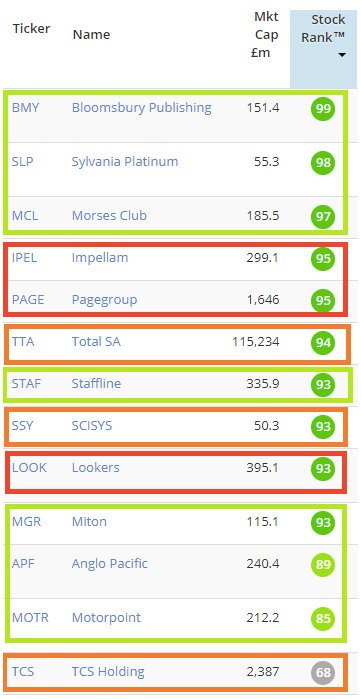
As you can see, there are only three stocks I can consider adding to the fund. Excluding Russian dual-listed bank TCS Holdings (a previous star performer), I’m left with:
My rules specify that I should consider the stock with the highest StockRank first. That means Total falls under the microscope this week.
Regular readers will note that SIF already holds heating oil distributor NWF. Would Total duplicate the oil market exposure provided by this business? I don’t think so.
As Paul Scott explained here, the cost of heating oil is passed on directly to customers. Profit comes from a fixed gross margin (c.1p) added to the price of each litre sold. So higher oil prices don’t boost profits for NWF. Indeed, the firm said recently that higher prices tend to stimulate price competition.
In road transport, the rising price of crude oil has pushed up diesel prices. My understanding is that diesel often accounts for about one-third of the cost of running a lorry. I’d expect NWF’s logistics business, Boughey Distribution, to include fuel price surcharges in its customer contracts. But these can do no more than pass through extra costs, leaving profits unchanged.
A market beater?
Although Total’s primary stock market listing is in Paris, I don’t see this as a major concern. Its business is global and the firm’s dual listing in London provides us with English-language accounts. In contrast to Russian and Chinese peers, we don’t need to worry about the risk of political interference or differing accounting conventions.
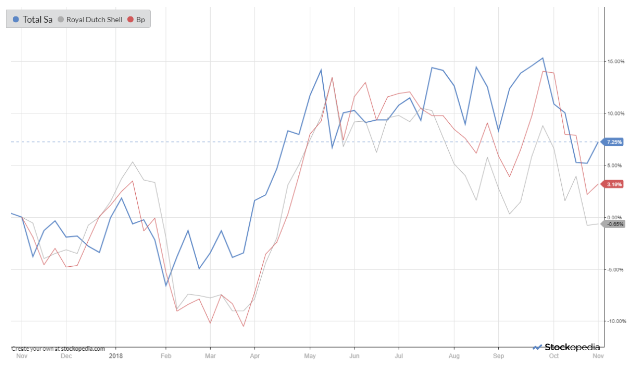
As it happens, Total has outperformed UK-based rivals BP and Royal Dutch Shell over the last year:
The share price of most big oil producers has softened recently, due to a sharp drop in the price of oil:
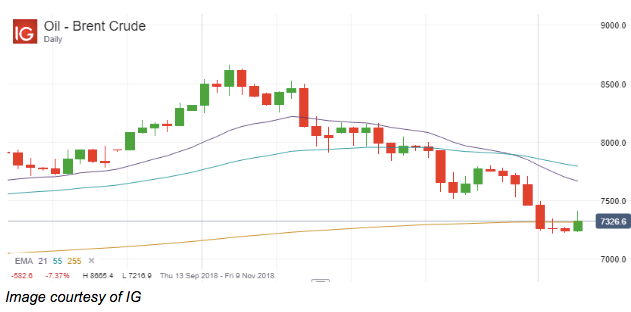
Fears of a supply crunch sent prices surging up to $85 per barrel in September. But this hasn’t materialised, despite the revival of US sanctions on Iran. A pullback was to be expected, in my view, but I think the medium-term outlook remains positive:
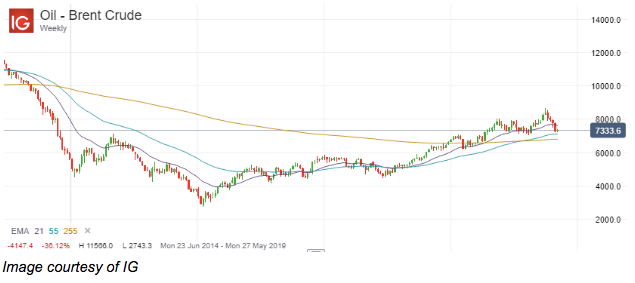
At this time, I’m fairly comfortable buying shares in oil producers with sound balance sheets and modest valuations. Does Total satisfy these criteria? Let’s take a look.
Fair value
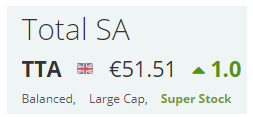
Stockopedia classifies this £115bn oil and gas firm as a Super Stock. A Balanced RiskRating indicates that the shares have been less volatile than 65% of the wider market.
A StockRank of 94 is unlikely to be possible without a decent value score:
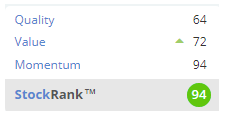
Indeed, Total’s ValueRank has risen by 11 points to 72 over the last 30 days. This is probably due to the stock’s falling price and the impact of its recent third-quarter results.
These figures showed that adjusted net income rose by 48% to $4bn during the quarter, compared to the same period last year. This increase in paper profits was backed by cash flow from operations, which rose by 31% to $5.7bn.
Looking at value in more detail, the shares look reasonably priced to me, if not massively cheap:
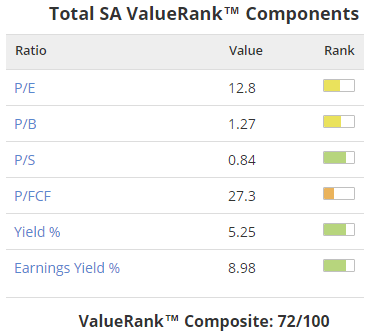
The only potential concern I can see here is that Stockopedia’s data suggest Total has only converted around 50% of its earnings to free cash flow over the last 12 months. To find out more, I’ve taken a look at the relevant cash flow statements.
On a statutory basis, my sums match up with Stocko’s trailing free cash flow figure of about $5.5bn. However, the company’s own measure of “free cash flow after organic investments, without net asset sales” shows free cash flow of $10.9bn for the first nine months of 2018. Net earnings over the same period were $10.3bn, suggesting that underlying free generation is quite good.
I’m prepared to accept these underlying figures. The company has been trying to position itself for the next market cycle and has made a number of acquisitions, disposals and capex decisions over the last year.
Despite this, gearing remains significantly lower than at BP or Shell. Overall, I’m comfortable with the value on offer here.
Surprisingly good quality
We don’t generally expect consistently high quality scores from resources stocks. The returns generated by these capital-intensive businesses are directly correlated to commodity prices and are heavily prone to boom and bust cycles.
However, the ratios behind Total’s QualityRank of 64 aren’t too bad:
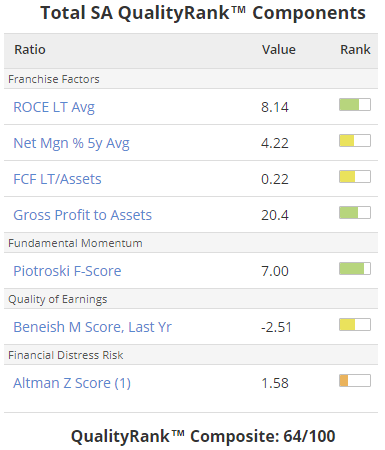
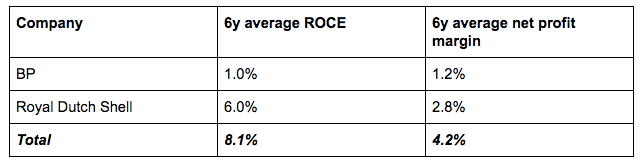
These figures compare favourably with rivals BP and Shell:
One reason for this is that unlike both rivals, Total’s ROCE remained positive during the 2014-16 oil market downturn:
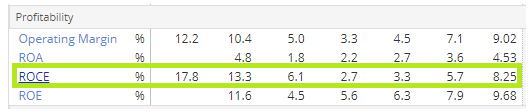
At first inspection, Total appears to be a superior quality business to some of its rivals.
Should I trust strong momentum?
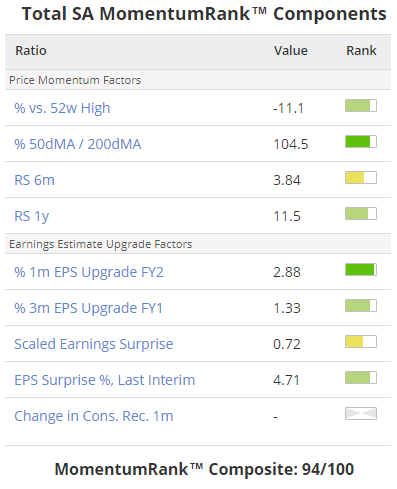
Total’s highest factor score is its MomentumRank of 94. The stock benefits from strong price momentum and a track record of earnings upgrades:
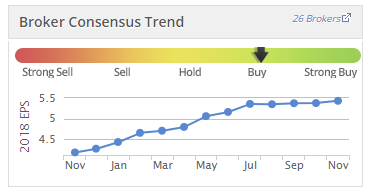
One of the graphics I use most on the StockReport screen is the broker consensus trend. This provides an instant snapshot of whether a company has been beating expectations, a key driver of shareholder returns.
Here we can see that analysts have repeatedly upgraded their forecasts over the last year. The consensus figure for earnings per share is now 30% higher than it was in November 2017:
The recent decline in the share price means that the stock doesn’t look expensive to me. Stockopedia shows a rolling 12-month forecast P/E of 9.4, with a dividend yield of 5.3%. The stock’s price/book ratio of 1.3x also seems reasonable.
My decision
As I discussed last week, I’m becoming wary about relying on momentum.
Despite this, earnings and cash generation are rising rapidly across the oil and gas sector. Brutal rounds of cost cutting during the downturn are now lifting margins and overall returns.
Recent investment decisions by the majors are being based on $40-$50 per barrel breakeven levels. That’s significantly lower than before the market crash.
Meanwhile, reports from the oil services sector suggest that capex levels remain fairly subdued. At this stage, the focus is still on repairing shareholder returns.
I think that Total could offer a decent income-growth opportunity at current levels. I’ll be adding the shares to the SIF fund and to my own portfolio this week, after this article has been published.
Disclosure: Roland owns shares of NWF.
Disclaimer
This is not financial advice. Our content is intended to be used and must be used for information and education purposes only. Please read our disclaimer and terms and conditions to understand our obligations.

6 comments
Hi Roland, all things considered I think I'll be sticking with BP and Royal Dutch Shell, three oils would be a crowd in my portfolio.
Hey Roland,
I have a bit of Shell but have never looked at Total so it was nice to see a couple of comparisons! I see Miton is in your PF - did you see it was Ed Shing's stockpick at the recent slam? It was a v. good presentation and he wrote a follow-up article that's worth checking out it you haven't seen it yet.
Hi Jack,
I hadn't noticed Ed's piece, thanks for pointing it out. Miton (LON:MGR) is one of my favourite plays in this sector.
Cheers,
Roland
Disclosure: I own shares of Miton.
Hello Roland,
How much note do you take of the Altman Z score and how important is it to your approach ?
You have just said that you are going buy Total for the SIF and you personal portfolio but the Altman Z score is 1.59 almost approaching the distress zone.
How do you justify this approach ?
Regrds
Melvyn
Hello Melvyn,
The Altman Z-Score is not a metric I use very heavily. I do sometimes investigate the figures behind the score, but I wouldn't rule out a stock on this basis unless I had other concerns.
In the case of Total SA (LON:TTA), I don't see any serious risk of financial distress in the foreseeable future, so I'm not too concerned by the low Z-Score.
Regards,
Roland
Hi Roland.
Thanks for the piece on Total. I have looked at this company in the past but never quite added it to my oil majors holdings. My main concern has been their aspirations for closer links with Iran. It’s not so much an issue with the rights and wrongs of the politics in the Middle East as the effect that US sanctions and the threat of retaliatory action will have on disrupting their strategic plans. The South Pars gas field development was announced last year as a major investment initiative but was subsequently shelved in August under US pressure.
https://www.total.com/en/media/news/press-releases/iran-total-and-nioc-sign-contract-development-phase-11-giant-south-pars-gas-field
Forward planning tends to have long lead times in the O&G business and this plank in their strategy has been taken away. Longer term, if the politics change, they are presumably well placed to get back in with a major producing country but that seems like a bit of a punt in the current environment.
Gus.