SIF Portfolio: Morses Club could lend the portfolio a profit

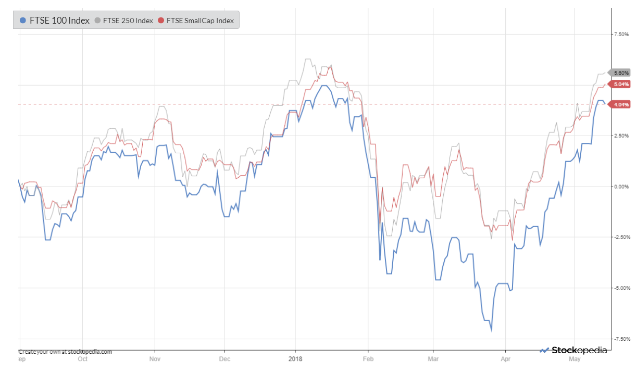
The main UK stock market indices are all trading close to all-time highs. The minor blip seen earlier this year is has passed, and stocks have surged ahead over the last month.
One consequence of this is that fewer and fewer shares are qualifying for my Stock in Focus screen. A month ago, 18 stocks qualified for the screen. On Monday, this number was down to 10.
This is by design. As I’ve discussed before, my hope is that by combining valuation and momentum measures, my screening rules will leave me on the sidelines with a pile of cash when markets overheat or start falling.
There’s only one stock I can consider for the portfolio this week, so let’s take a look.
Jim Slater might like this
The late Jim Slater might be tempted by this week’s stock. AIM-listed Morses Club qualifies for the Jim Slater ZULU Principle Screen, and has qualified for my screen since issuing full-year results at the end of April.
This £195m firm is a doorstep lender with a 130-year history, in the mould of Provident Financial. Indeed, Morses is thought to have recruited ex-Provident collection agents and expanded into new territories as a result of the larger firm’s botched restructuring of its home credit business last year.
Morses’ net loan book rose by 19% to £72.8m during the 52 weeks to 24 February, while customer numbers rose by 6% to 229,000. Impairments rose from 24.4% to 26.1%, but this was still within the firm’s guidance range of 22%-27%. Adjusted profit before tax rose by 8.5% to £19.2m, and shareholders received a 10% dividend increase.
Overall it was a good year for the firm, in my opinion. And although it carries some regulatory risk, I rate this business quite highly. I’m also encouraged by the shareholder list, which includes small-cap specialist fund manager Miton, with a 7% stake. CFO Andy Thomson also has skin in the game, with a 2.35% stake worth about £4.7m.
Can I really buy this?
Regular readers will probably have noticed that the SIF portfolio already contains a sub-prime lender, pawnbroker H&T Group. Although I estimate that personal loans accounted for less than 10% of H&T’s gross profit last year, pawnbroking generated almost half the group’s 2017 gross profit of £63.3m.
I believe there must be a sizeable demographic overlap between Morses’ customer base and that of H&T. So I may not add the shares to the portfolio this week. Despite this I think it deserves a closer look. Is Morses Club worth buying for investors who like this sector?
The firm is ranked third in the Banking Services sub-sector, with a StockRank of 82.
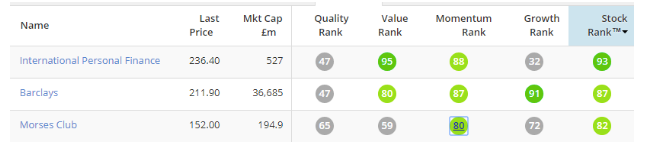
Stockopedia classes Morses as a Super Stock with an Adventurous RiskRating. That’s a combination that has historically performed quite well, albeit with some volatility. However, the StockRank breakdown suggests to me that Morses ranking is being buoyed by strong momentum rather than quality or value.
Valued for growth
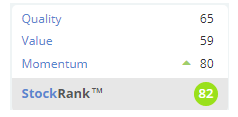
The home credit lender’s ValueRank of 59 doesn’t seem especially good to me. Looking at the components of this score, we can see why:
(You can view these components by clicking on the ranks on sector pages)
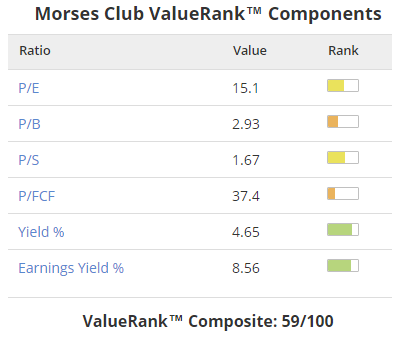
As you’d expect from a growth stock, the trailing P/E is quite high, at 15.1. In keeping with this growth stance, a high price/free cash flow ratio suggests cash inflows are being recycled into new loans.
The price/book ratio is also high, and it’s worth considering why this might be. With a lender, the price/book ratio broadly reflects the expected level of profitability of its loan book, less funding costs.
Morses’ return on equity was a creditable 26.5% last year, broadly in line with the prior year. The stock’s current valuation suggests that the market expects these profits to be sustainable.
By way of comparison, many of the big high street banks are still only managing a low single-digit percentage return on equity. This is one of the main reasons why they still trade at big discounts to their book value.
The stock’s other value metrics look okay to me. A trailing dividend yield of 4.65% seems attractive and the group’s earnings yield (EBIT/EV) of 8.56% is above my 8% minimum.
Quality is good, but not this good
The picture looks brighter here, with a rank of 65. But it’s worth being aware that the franchise factors listed in the top section of this graphic are five-year averages. Because Morses only floated in 2016, these averages are derived from pre-IPO pro forma figures as well as recent results.
The use of such pro forma figures can sometimes distort the picture. In this case, the firm’s 2015 figures seem to include an exceptional gain:
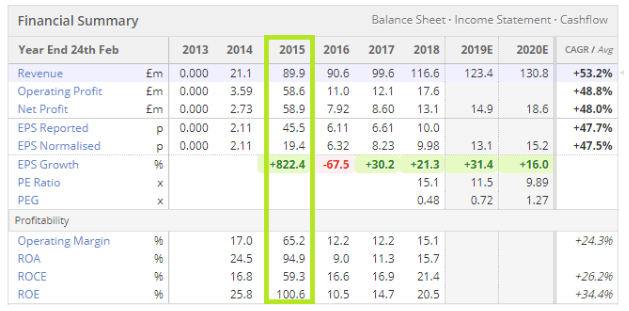
I don’t know the story behind the 2015 numbers, but a repeat seems unlikely. Excluding 2015 gives a 2014-2018 average ROCE of 17.9%, and an average net margin of about 10%. These are still excellent figures, but they are somewhat lower than those used to calculate the QualityRank:
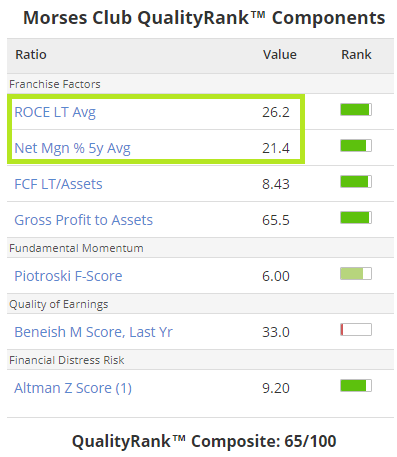
One heavily-weighted component of the QualityRank is the Piotroski F-Score. This is a nine-point checklist that measures profitability, growth and financial health.
Morses scores 6/9. This is mainly because borrowing rose last year to fund new lending, and gross margins fell slightly. I don’t think either of these factors are a concern at the moment, but they’re worth monitoring.
Overall, my view is that this is quite a high quality business. But can this rate of growth be maintained?
Technical momentum
Morses Club MomentumRank of 80 is the star of the show. So what lies behind this top-quintile score?
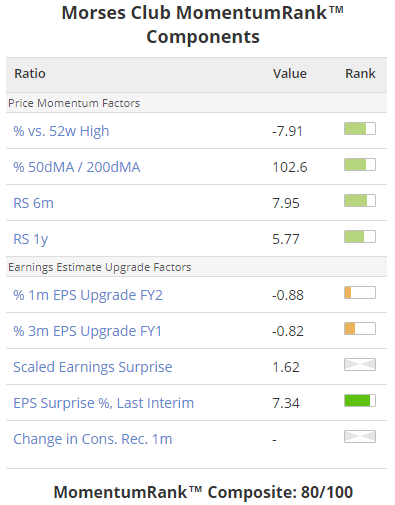
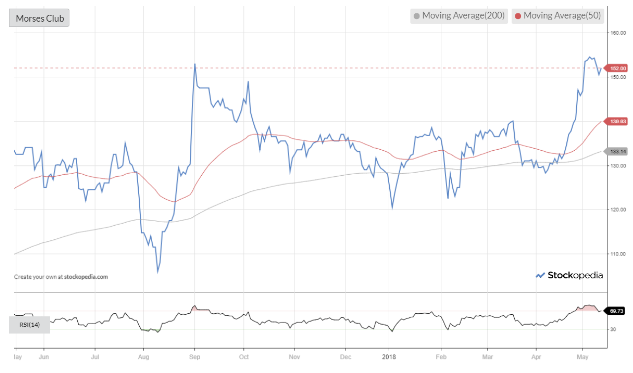
Chart-led technical traders tend to use price momentum factors such as those listed here to help guide their trades. Morses price action has certainly been positive recently, although I would argue that the stock looks a little overbought at the moment:
However, price momentum only accounts for half of the momentum score. The other half is driven by the outlook for earnings. As we can see above, broker consensus forecasts have actually edged lower recently, probably since the group’s results were published in April.
On the other hand, these recent results were ahead of consensus forecasts, as shown by the EPS surprise of 7.3%.
Earnings per share are expected to rise by about 12% this year and by 16% next year. This puts the stock on a rolling forecast P/E of 11, with a 5.1% prospective yield. That seems fairly attractive to me.
My decision
Having taken a fresh look at Morses Club, I still like this stock. But I’m not convinced it provides any useful diversification beyond the market covered by H&T Group. So I won’t be adding Morses to the portfolio this week.
Disclosure: Roland owns shares of H&T Group.
Disclaimer
This is not financial advice. Our content is intended to be used and must be used for information and education purposes only. Please read our disclaimer and terms and conditions to understand our obligations.

6 comments
H & T (LON:HAT) are seeing rapid growth in loans. Their £200 loan over 20 weeks comes to £350.70, fifty quid more than the loan from Morses.
I don't think Morses Club (LON:MCL) are hiding anything or deceptive about the cost of their loans. Maybe I'm missing something?
From the website: " Lenders are required by law to display their APR to allow people to effectively compare loan products. Our APRs at Morses Club are as follows:
20 week loan: representative 756.5% APR"
Required by law. Not disguised by b/s.
750% APR? That's exploitation in my book.
I totally disagree. In real terms the pay-back will be 82% at most. Here's a link to the numbers. As was pointed out to the select committee this is about the same figure that the Church of England came up with a couple of years back as the minimum likely 'break-even' rate when they were looking at encouraging community-based lending themselves. Despite the government patting itself on the back after the last round of rule changes there's evidence of strong growth in dodgy un-regulated back street lending to the least creditworthy and most vulnerable, with all the consequences that entails.
Great, detailed analysis. A month or so ago Morses Club (LON:MCL) CEO Paul Smith was one of several lenders hauled before the select committee working on the new regulations. He put in an impressive performance and coped well when the questioning turned nasty (over how some borrowers who are signing contracts may in fact be illiterate). They seemed to want blood, though. Follow-on loans could be in their sights, in particular.