SIF Portfolio: Post-Brexit review and lessons learned

The stock market is showing signs of stability and a return to normal after a brutal two day battering. Like most of you, I suspect, both my personal portfolio and the SIF portfolio are showing considerable losses.
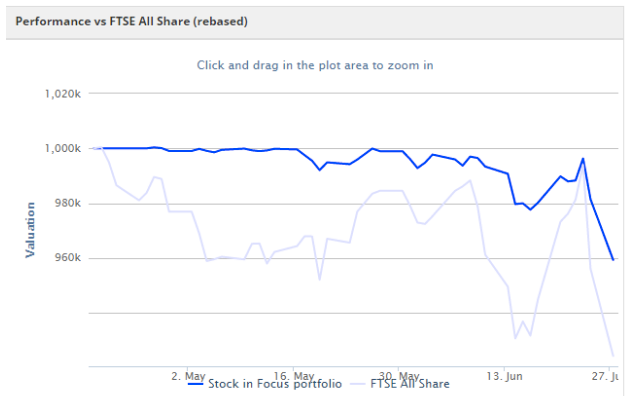
It’s early days yet, but I’m pleased that the SIF portfolio has so far managed to stay ahead of its benchmark, the FTSE All Share:
In my view it’s too soon to say how the UK’s Brexit vote will affect either the domestic economy or the stock market. I certainly don’t want to get into a debate about the pros and cons here. As an investor my main interest is in taking a level-headed view at the companies in the portfolio. Has the outlook changed materially since last week?
For the majority of the companies in the portfolio, I’d say the answer is no. For the most part, they’ve performed how I would have expected them to in a sudden sell off.
GlaxoSmithKline & BAE Systems
These two defensive heavyweights were always intended to offset the cyclical risks posed by some of the other stocks in the SIF portfolio. BAE and Glaxo have both performed well following the referendum. In classic defensive style, Glaxo has actually climbed 9% over the last week. Profits from non-UK sales should be boosted by the weaker pound. Over the same period, BAE has fallen by just 2.5%.
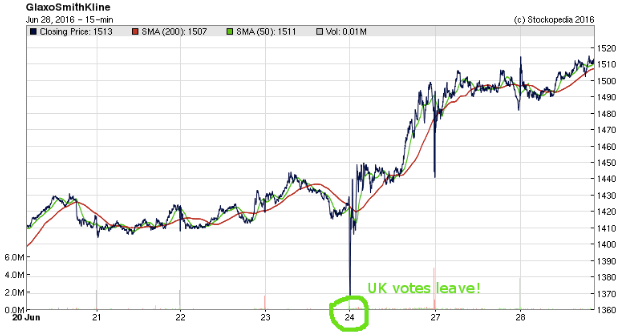
GlaxoSmithKline since the referendum
Go-Ahead Group
I had hoped that Go-Ahead would serve as a pseudo-defensive stock, thanks to its focus on public transport. So far, this experiment has failed. However, Go-Ahead has only fallen by 5% since the referendum. The majority of the 28% decline we’ve seen since Go-Ahead joined the SIF portfolio is the result of a downgrade to profit forecasts for the firm’s rail business.
Yet despite this reaction, Go-Ahead hasn’t issued a profit warning. Earnings growth is expected to continue next year, albeit at a lower rate:
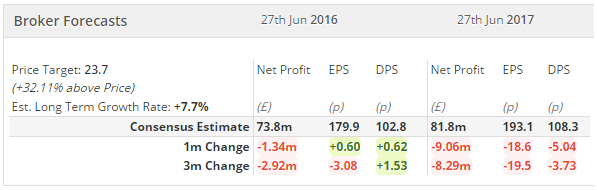
I’ve discussed this previously, but in essence I’m less worried than the market. Most of Go-Ahead’s profit comes from bus operations, not rail. With the shares now trading on about 9.5 times forecast earnings, I think the downside is priced in. The resulting 5%+ yield could now attract buyers.
Pan African Resources
The price of gold has risen by 4% since the referendum, but a mixture of panic and operational gearing means that gold miners have done much better. My Pan African shares are worth 8% more than they were five days ago, and 17% more than when I added them to the portfolio in May.
Stockopedia remains keen on this company, which has a StockRank of 93 and trades on a 2016 forecast P/E of just 10.
Somero Enterprises & Norcros
Somero emerged virtually unscathed from the Brexit correction. This is logical, as the business operates mainly in the USA. It isn’t heavily exposed to the UK, or indeed Europe.
In contrast, Norcros has fallen 14% over the last week. I suspect the outlook going forwards will depend on the housing market.
My view, which may be wrong, is that the housing market is treading a fine balance between strong demand and frothy pricing. If prices slip, the danger is that buyers will withdraw from the market, making a crash a self-fulfilling prophecy.
It’s too soon to say what will happen, but Norcros has a strong balance sheet and now trades on just 6.5 times 2016/17 forecast earnings. Even if earnings per share fall by 25% this year, the shares would still only trade on 9 times earnings. That seems enough downside protection for the time being.
Persimmon
Talk of the housing market brings me naturally to Persimmon. The carnage among housing stocks on Friday and Monday was spectacular. Persimmon is now up from its sub-1,200p low on Monday, but is still down by 32% since I added it to the portfolio in April:
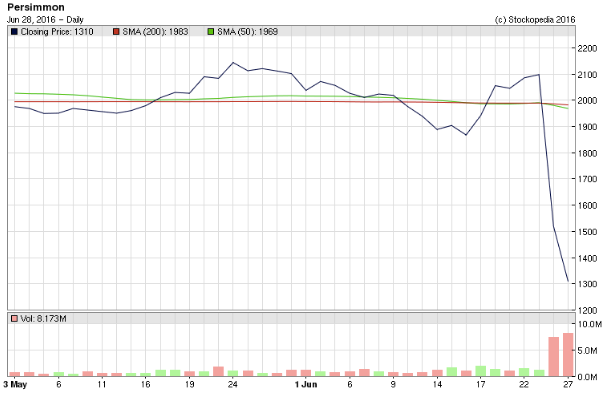
My view is that the shares have probably bottomed out and may recover somewhat. I expect earnings and dividend guidance to support the share price. A forecast P/E of 7 and a cash-backed yield of 8.5% should attract buyers.
However, Persimmon is still trading at around 1.8 times tangible book value. If earnings forecasts start falling, then the shares could easily fall much further.
Macfarlane
For me personally, packaging firm Macfarlane has been the biggest disappointment so far. I was impressed by this stock when I added it to the portfolio, but the shares started tumbling almost as soon as I hit the buy button.
The market seems to have been pricing in a cyclical downturn, even before the referendum. Macfarlane has only fallen by 5% since last Thursday, but the portfolio’s holding is now down by 20%.
I do accept that Macfarlane could be heavily exposed if the UK economy really does slow down. I imagine fixed costs are quite high in a business that manufactures and distributes packaging. If so, a relatively small drop in sales could hit profits hard, due to the operational gearing effect.
In such a scenario, Macfarlane’s £12.8m net debt and £11m pension deficit could also become problematic.
However, some of this risk is now priced in. Macfarlane shares now trade on a forecast P/E of 9.5 and offer a prospective yield of 3.8%. The group’s interim results should be published in August. Until we hear more from the company, this position remains on hold.
Lessons learned?
One thing that has been made clear over the last week is the value of maintaining a balance between defensive and cyclical stocks in a portfolio. Big cap defensive stocks such as Compass Group, Diageo, Glaxo and British American Tobacco have all risen since last Thursday. These companies earn the majority of their profits overseas and will benefit from the weaker pound. Smaller defensives like Finsbury Foods and Total Produce have also been fairly stable.
These performances compare very favourably with the 20%+ falls in financial stocks, housebuilders and airlines. These cyclical sectors were seen as having the potential to outperform. As we’ve now seen, this also implies the possibility of a major collapse.
The market now seems to be stabilising. A modest recovery may be on the cards. Barring company-specific profit warnings, I intend to continue holding each stock until its six-month review date. The first of these is in October.
What’s next?
I hope to add a new stock to the portfolio next week. My choice has been limited recently by a shortage of defensive picks, and a massive reduction in the number of stocks qualifying for my screen.
I’m hoping that things improve over the next week so that the screen provides me with some reasonable choices. Until then, I’d be interested to hear your post-referendum thoughts on my stocks, and those which you own.
Roland owns shares of Compass Group, Diageo, BAE Systems, GlaxoSmithKline and Persimmon.
Disclaimer
This is not financial advice. Our content is intended to be used and must be used for information and education purposes only. Please read our disclaimer and terms and conditions to understand our obligations.

11 comments
There has been a lot of director buying of shares in most of the listed housebuilders over the past 3 days, following the crash. These have been of various sizes but purchases by the chairmen, most noticeably at BKG (£800k's worth), GLE (£100k's worth) and GFRD (£600k's worth) have been substantial. Tony Pidgley at BKG is a world class operator, check his record out. I do not know whether the share prices of housebuilders have further to drop but I believe these people have a far better idea of the long term future of their businesses than me or anybody else, so have followed their money, leaving some still on the sidelines should they drop further.
I am not convinced that Brexit has scuppered the house market for several reasons. House builders hold land and we still have a housing shortage. I see no reason to believe we will now see people swarming out of the country because, even with food prices up 10%, this is a far better place to live than many of them left behind. One of the sad outcomes of the vote is a rise in antisocial, anti-foreigner behaviour emanating from those with limited grasp on life. These are the people who will be hardest hit by a rising cost of living and, for their pains, they'll see little change to their community. The government is now obliged to address many of the problems that led to the Brexit support and boosting house building addresses both overcrowding, the economy and unemployment and within months, not decades. I have increased my holding of Persimmon (LON:PSN) and Bellway (LON:BWY) today.
What I meant was the share prices in housebuilders, of course this is to do with recession fears and falling prices, London is key, whether foreign investors will come in now prices have been cut because of the fall in the £ we will have to see. Nothing will happen for months, the new leader will not be in place until October before then they will all be on holiday.
Roland I enjoy these reports on the SIF portfolio - lots of lessons for portfolio management and you've started at an interesting time.
One thing you seem to have benefited from very significantly is a systematic staggering of your buying decisions over time rather than buying lots of shares quickly. As a result you now have lots of cash and excellent opportunities to buy cheaply over the coming months. I think this may be a good aspect of disciplined portfolio management worth highlighting. In the long term do you intend to become fully invested or keep a balance of cash? Also have you thought about your strategy of when to sell? It would be interesting to hear about your thoughts on this at some point.
Also I'm not sure that you have explicitly considered geographic diversification of earnings which is another big issue Brexit seems to have brought to the fore.
Trigger14,
Thanks for your comment. I'm glad you find these articles useful.
My plan is to gradually expand the portfolio until it reaches 20 holdings, at which point I'd be fully invested. But doing this will depend on the availability of suitable stocks that have qualified for my screen, so it could take a while.
As regards selling, as this is a semi-mechanical strategy, I do have a plan. All stocks will stay in the portfolio for a minimum of six months, after which they'll be reviewed. Stocks that have fallen out of the screen will be sold. Stocks that still qualify will be held and top-sliced if necessary.
You can find out a bit more about the detail of the strategy for the SIF portfolio in my introductory article from April:
http://www.stockopedia.com/content/introducing-the-stock-in-focus-portfolio-128456/
Diversification is proving more of a challenge than I expected. Sector, geography and cyclical/defensive diversification are all desirable, but not necessarily easy to achieve using a single set of screening criteria.
Brexit has certainly highlighted the need for diversification. The solution is still work in progress! More on this next week, I hope.
Regards, Roland
I did think that you bought Go-Ahead (LON:GOG) at too high a price when looking at the charts, felt £26 was maybe a peak. Yes, I thought it was a good defensive stock. One negative as its many buses, fuel prices will be shooting up now, oil price has gone up and the £ has fallen. Anyway, I picked a few up this morning, think below £19 its now good value and the dividend is nearly 6%.
Macfarlane (LON:MACF) I did say I did not think it was very recession proof, ok we are not yet in a recession but I think thats why it has fallen, fears of a recession. Also thought you bought too high.
Persimmon (LON:PSN) thought you bought at right price but Brexit has scuppered the housing market. Got caught out on that as well.
Actually re food defensives I think you are slightly wrong there, some have fallen about 10%, I do hold Finsbury Food (LON:FIF) and I did hold Hilton Food (LON:HFG), maybe its concerns over pricing, as both supply supermarkets? Also J Sainsbury (LON:SBRY). is down quite a bit. Some of better defensives have been companies like: National Grid (LON:NG.) Reckitt Benckiser (LON:RB.) Relx (LON:REL), GlaxoSmithKline (LON:GSK), BP (LON:BP.) Think all these have gone up in the last week.
Herbie,
Thanks for your comment. What you say re. pricing/timing is probably true with hindsight, but if we hadn't voted to leave the EU, the situation might now be quite different.
The SIF portfolio is being built in a semi-mechanical way -- i.e. I select shares that have been pre-qualified by a screen. To some extent timing and pricing are out of my hands -- I'm relying on the screen and the StockRanks to point out the most suitable shares.
Obviously the risk is that my screening criteria will prove wanting... only time will tell!
Regards, Roland
Go-Ahead (LON:GOG) and Macfarlane (LON:MACF) did fall quite a bit before the vote. Certainly as I said Persimmon (LON:PSN) was because of the vote out, I got caught out there as I expected a remain vote otherwise I would have sold them.
Is this portfolio is a fantasy one or are you investing real money into it?
Do screens work after something like Brexit? Will it take some time for things to adjust?
herbie,
The portfolio is a virtual portfolio, although its holdings may overlap with some of my own personal holdings. This is indicated in the disclosure at the bottom of the article as usual on Stockopedia.
My perception is that the screens are still working fine, but the stocks which qualify for each screen are changing more often than usual. This should soon settle down. Other factors, such as oddly-timed year ends (e.g. £GOG), can also affect screen results, as they cause the Stockopedia rolling forecast data to update.
Hope this makes sense,
Roland
Roland,
Thanks for reply, yes it makes sense, I just thought with a sudden change in share prices and even whole sectors being marked down it may take some time to work its way through the Stockopedia system, especially as some is based on momentum. Yes year ends in particular when the year is extended can throw out the figures, I noticed this with Inland Homes (LON:INL), where they delayed the year end in order to include a large sale.
The problem is that no one knows what Brexit means right now. As a result, many of the forecast figures in Stockopedia will inevitably be wrong. Since many metrics and the ranks etc rely on these forecasts I cannot see how the system can be as effective today as it was before the Brexit vote. In time it will correct of course but I'm avoiding buying right now based on things like forward p/e and dividend etc.