Sky's battle for the living room

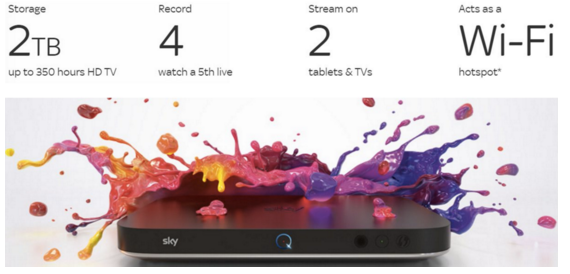
Sky’s new set-top box, Sky Q, launched in early February and includes a new interface, a new controller and “fluid viewing”. This should help to offset competition from new entrants like Netflix and Amazon Prime. Sky is seeing strong momentum in the UK & Ireland on the back of its content leadership.
Weak equity markets pushed the share price of Sky to its lowest level for a year last week at £9.76. With this well down on the high of £11.41 seen in July 2015 it is worth reviewing the investment case for the group.
Sky is no longer just a play on the UK pay TV market with the group having bought Sky Italia and Sky Deutschland in November 2014. However, the UK & Ireland generated nearly all of the profits in the six months to December 2015.
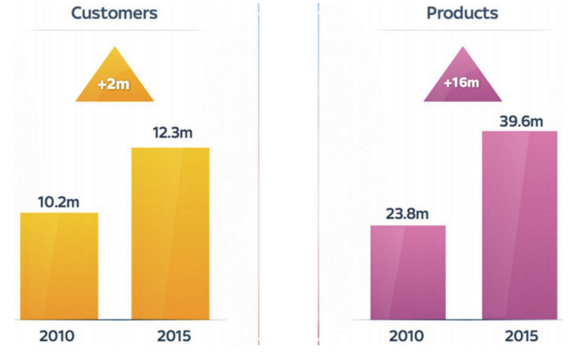
Sky has the dominant position in pay TV in the UK & Ireland with 12.3m customers at the end of 2015. This compares to 1.4m TV customers for BT Group and around 3.7m UK TV customers for Virgin Media.
Sky UK & Ireland subscriber numbers: pulling in the punters
Source: Sky investor presentation
Sky is also seeing good momentum with 205,000 new customers added in the UK & Ireland in Q2 – a 10-year high for the quarter. Customer churn hit a four-year low at 10.2% in Q2 and the TV customers in the quarter came in at 146,000.
Sky’s popularity clearly remains robust in its core market despite new competition from BT Group, Netflix and Amazon Prime. The launch of Sky Q should help the group to maintain its lead over the competition.
The new Sky Q set-top box
Source: Sky website
The takeover of Sky Italia and Sky Deutschland has hit profits in the short-term but as cost savings come through profit growth will return. Looking to the year to June 2018 and the forecast P/E is only 13.9X with a 3.9% forecast yield.
This falls to 10.9X for the year to June 2020 with the forecast yield increasing to 5.1%. The dividend yield is forecast 1.8X covered by profits in both while the ratios are based on Friday’s closing share price of £9.78.
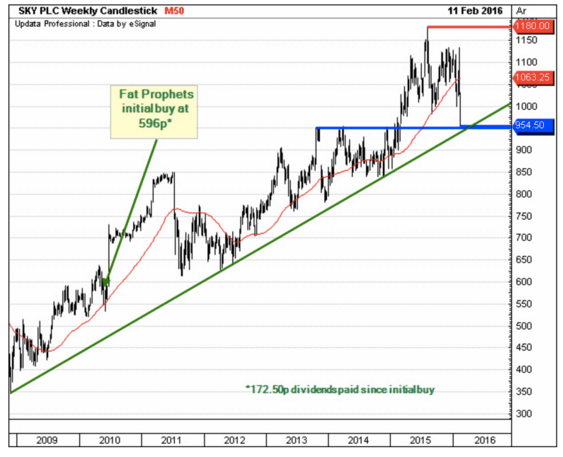
Sky’s investment case and the competition
Sky is in the media sector but generates 86% of its revenue from customer subscriptions. This is a high quality revenue stream and means that the company isn’t reliant on cyclical advertising income.
In our view, the £50-£100 monthly Sky subscription rate offers good entertainment value versus other leisure activities. This is in the same ballpark as a single family trip to a restaurant or the cinema.
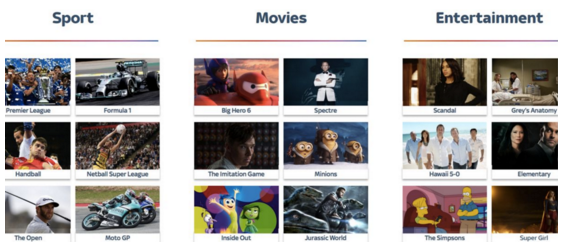
Sky Go also enables customers to watch Sky’s content on a smartphone, a tablet or a computer. The content line-up is the key draw with Sky Sports and Sky Movies having the market leading positions in the UK.
It is in Entertainment that Sky is also starting to stand out with Sky Atlantic including the Game of Thrones series. The group’s partnership with HBO is set to deliver other hits and Sky is also producing its own content.
The Sky Atlantic is described by Sky as a key reason that customers turn to the pay TV group. With no degree of humility the group describes Sky Atlantic as “The World’s best channel for quality drama.”
Sky aims to be the content leader and “content is king”
Source: Sky investor presentation
Content leadership has allowed Sky to attract new customers and retain its existing customer base. There generates a virtuous cycle whereby content attracts new subscribers allowing further investment in content.
Potential challenges include BT Group’s entry into pay TV and its aggressive purchase of a number of sports rights. However, in the December quarter BT attracted 97,000 net TV additions versus the 146,000 seen at Sky.
The two companies both appear to be successful at the expense of players like Virgin Media and Talk Talk. However, BT’s entry has increased the cost of sports content in the UK leading to higher content costs for Sky.
Netflix and Amazon Prime also offer new competition to Sky with their price points below £10 a month. However, while there are a number of hits on both services they do not offer a full suite of prime TV content.
At the end of 2015 Netflix had 74.76m subscribers and added 5.59m in the December quarter. The group is estimated to have around 5m subscribers in the UK at the end of 2015.
Netflix is spending heavily on its own productions

Source – Netflix website
The long-term threat is that Sky’s content leadership will erode but the recent evidence shows a pickup in momentum. The 12.3m subscriber base in the UK & Ireland also allows Sky to outbid rivals for content.
Sky into Europe
Sky’s purchase of its European businesses adds growth potential to the mix if the success seen in the UK can be replicated. However, Germany and Italy may be much more difficult markets for Sky to crack.
At the end of 2015 the group had 4.5m subscribers in Germany & Austria and added 120,000 in the December quarter. Italy had 4.7m customers at the end of 2015 and only saw 12,000 new customers in the December quarter.
Both figures are well below the 205,000 new customers added in the UK & Ireland in the quarter. However, Germany is described by Sky as “one of Europe’s fastest growing pay TV markets.”
We will have to see if Sky can generate momentum in the continent but the subscriber base will still have other benefits. The group has increased its purchasing power for new content and ability to fund its own content.
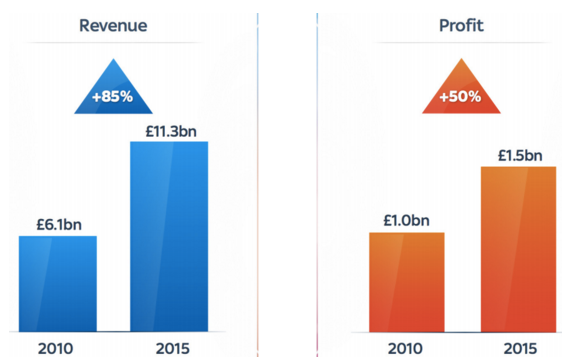
Sky has seen solid five-year growth
Source – Sky investor presentation
First half financial results (six months to December 2015)
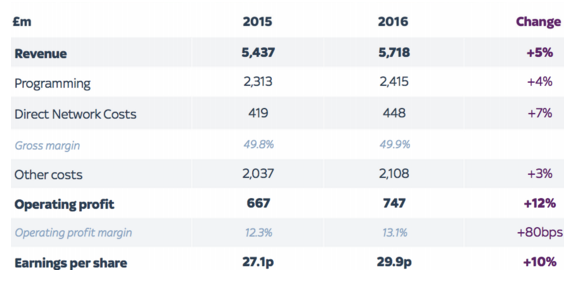
Turning to the financial results for the second half of 2015 and revenue improved by 5% to £5.7bn. Earnings per share improved by 10% to 29.9p and the interim dividend was increased by 2% to 12.6p.
Sky has a robust dividend record with it having been increased in each of the eleven years to June 2015. This was supported by subscriber momentum during the financial crisis with consumers willing to pay for TV content in difficult times.
Sky’s interim results (six months to Dec 2015)
Source: Sky investor presentation
The takeover of the continental European businesses has weakened Sky’s balance sheet. However, net debt fell to £5.7bn at the end of 2015, versus £6.3bn at the start of the year, and the net debt to EBITDA ratio fell to 2.6X.
Summary and valuation
An additional part of the investment case for Sky is the prospect of a takeover offer from 21st Century Fox. The group owns 39% of Sky and James Murdoch recently returned to the chairman role at Sky.
The fundamental case for Sky remains sound given the strong subscriber momentum in the UK & Ireland. The December quarter saw new customer wins in the UK & Ireland hit the highest level in the period for 10 years.
The company’s leading market position will be further reinforced by the recent introduction of Sky Q. The bottom line is that Sky remains the content leader in the UK despite ongoing competition from BT Group and Netflix.
Continental Europe will be a tougher nut to crack but it will help Sky obtain greater economies of scale. There should also be a longer-term growth opportunity in both Germany and Italy.
In our view, Sky’s strong market position, and high quality subscription revenue, makes the investment case sound. The forecast P/E for the year to June 2019 at 11.8X, with a 4.5% yield, supports the medium-term investment case.
This report was produced by Fat Prophets Senior Research Analyst, Andrew Latto
Disclaimer
This is not financial advice. Our content is intended to be used and must be used for information and education purposes only. Please read our disclaimer and terms and conditions to understand our obligations.
No comments yet
No one has commented here yet! Why not be the first one?